Sharks — 500 Species, 400 Million Years, One Apex Lineage
Sharks are cartilaginous fish in the class Chondrichthyes — over 500 species across 9 living orders, from the 18-cm dwarf lanternshark to the 12-m whale shark. They have existed for at least 400 million years, predating trees and dinosaurs and surviving five mass extinctions. This section is the complete TheSea.Org guide to the world’s sharks: 19 species pages, 27 general questions answered in plain language, and dedicated sub-clusters for the four sharks people search for most — great white, tiger, bull, and whale shark. Every page is built on the same field-tested template — a short answer, quick facts, body sections with named numbers and locations, and questions answered without the hedging filler you find elsewhere.
People search “sharks” for many reasons — some want to know if it’s safe to swim, some are choosing a destination to dive, some are trying to identify a fin they saw, some want to settle a megalodon argument, and some are reading after a documentary. This hub is built to answer every one of those questions in the right level of depth, with each question on its own page, all linked from here.
The structure is straightforward: each species gets a parent page with the biology, distribution, behaviour, conservation status, and a range map. Each common question gets its own page, drilled down from the relevant species or sitting in the general Q&A pool when it applies to sharks broadly. If you came here to find one specific answer, scroll down to the Q&A cluster and pick a card. If you came here to read about sharks generally, the body sections below cover the lineage, the families, the danger statistics in honest context, and how to navigate the rest.
The lineage — older than trees, older than dinosaurs
Sharks were swimming in shallow seas while the first land plants were figuring out how to grow more than a few centimetres tall. The body plan we recognise today was already in place by the late Devonian, around 380 million years ago.
The earliest unambiguous shark fossils — teeth, scales, and partial skeletons from species like Cladoselache — are found in rocks roughly 380 million years old. By comparison, dinosaurs appeared 240 million years ago, and the first flowering plants only 130 million years ago. Sharks survived the end-Devonian, end-Permian, end-Triassic, end-Cretaceous, and Pleistocene extinction events. The same basic anatomy — cartilaginous skeleton, multiple gill slits, oil-rich liver instead of a swim bladder, dermal denticles in place of scales, replaceable teeth on a conveyor — has been refined for hundreds of millions of years longer than any mammal lineage has existed.
One trade-off of cartilage skeleton: bone fossilises far better than cartilage, so the shark fossil record is dominated by teeth and scales. We have far more megalodon teeth than skeletons. Estimating the size and behaviour of extinct sharks is mostly a matter of scaling tooth dimensions against living relatives.

The headline four — the sharks people actually search for
Out of 500+ species, four account for the overwhelming majority of public attention, scientific publication, and search traffic. They are also the four species with their own dedicated Q&A sub-clusters on this site.
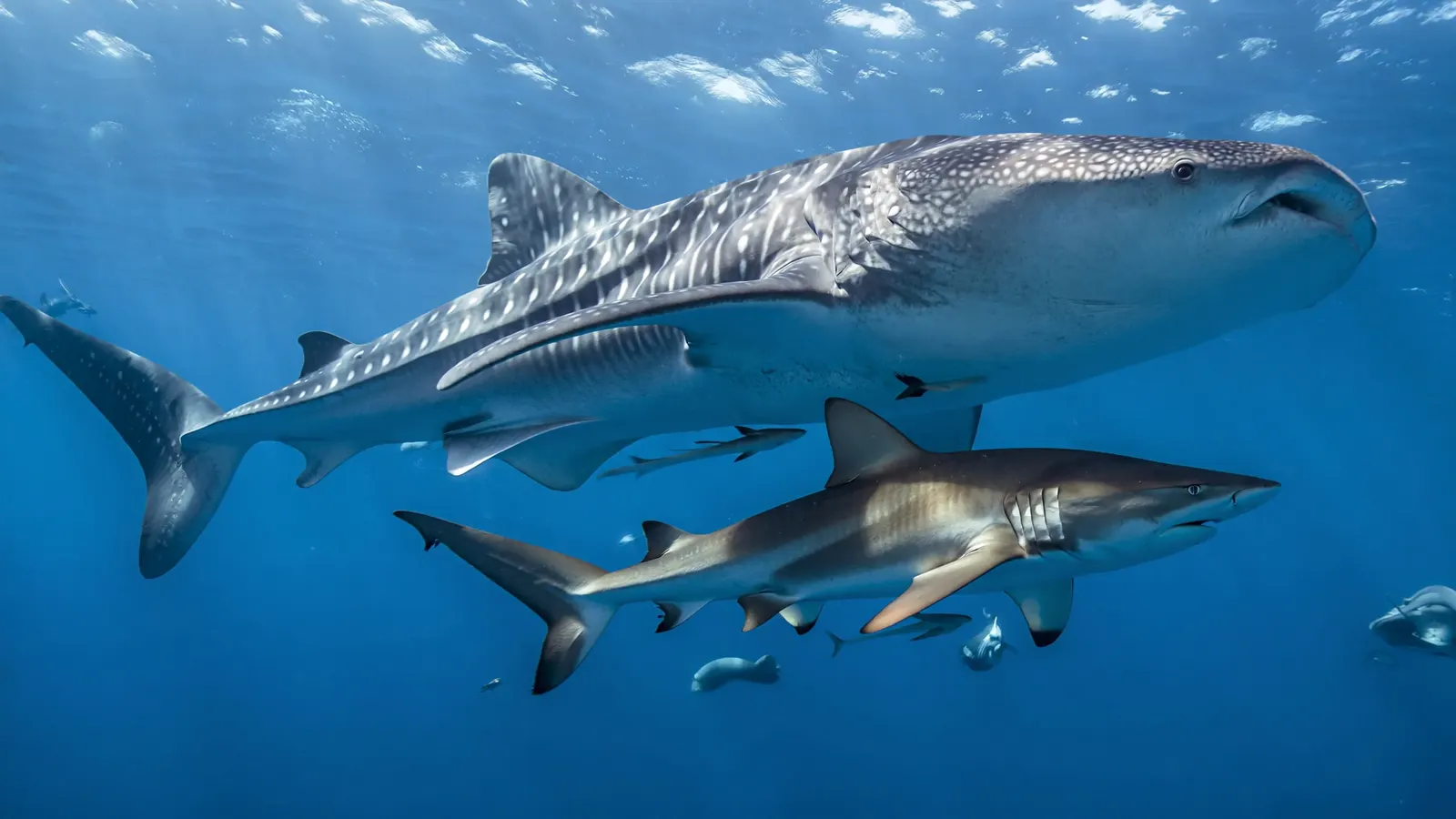
The great white shark (Carcharodon carcharias) is the largest predatory fish on Earth, recorded to 6 m and 2,300 kg, found in cold and temperate coastal waters worldwide. The tiger shark (Galeocerdo cuvier) is the most indiscriminate eater in the ocean, with a stomach contents list that includes licence plates, dog tags, and fully-grown sea turtles. The bull shark (Carcharhinus leucas) is the only large shark that tolerates fresh water indefinitely — documented populations in the Amazon, Lake Nicaragua, and as far as 4,000 km up the Mississippi. The whale shark (Rhincodon typus) is the largest fish alive, a filter feeder that eats plankton and small fish and presents no danger to swimmers.
These four species are responsible for the majority of recorded unprovoked attacks (great white, tiger, bull) or the majority of “swim with sharks” tourism (whale shark). Each has its own sub-cluster of dedicated Q&A pages further down this page.
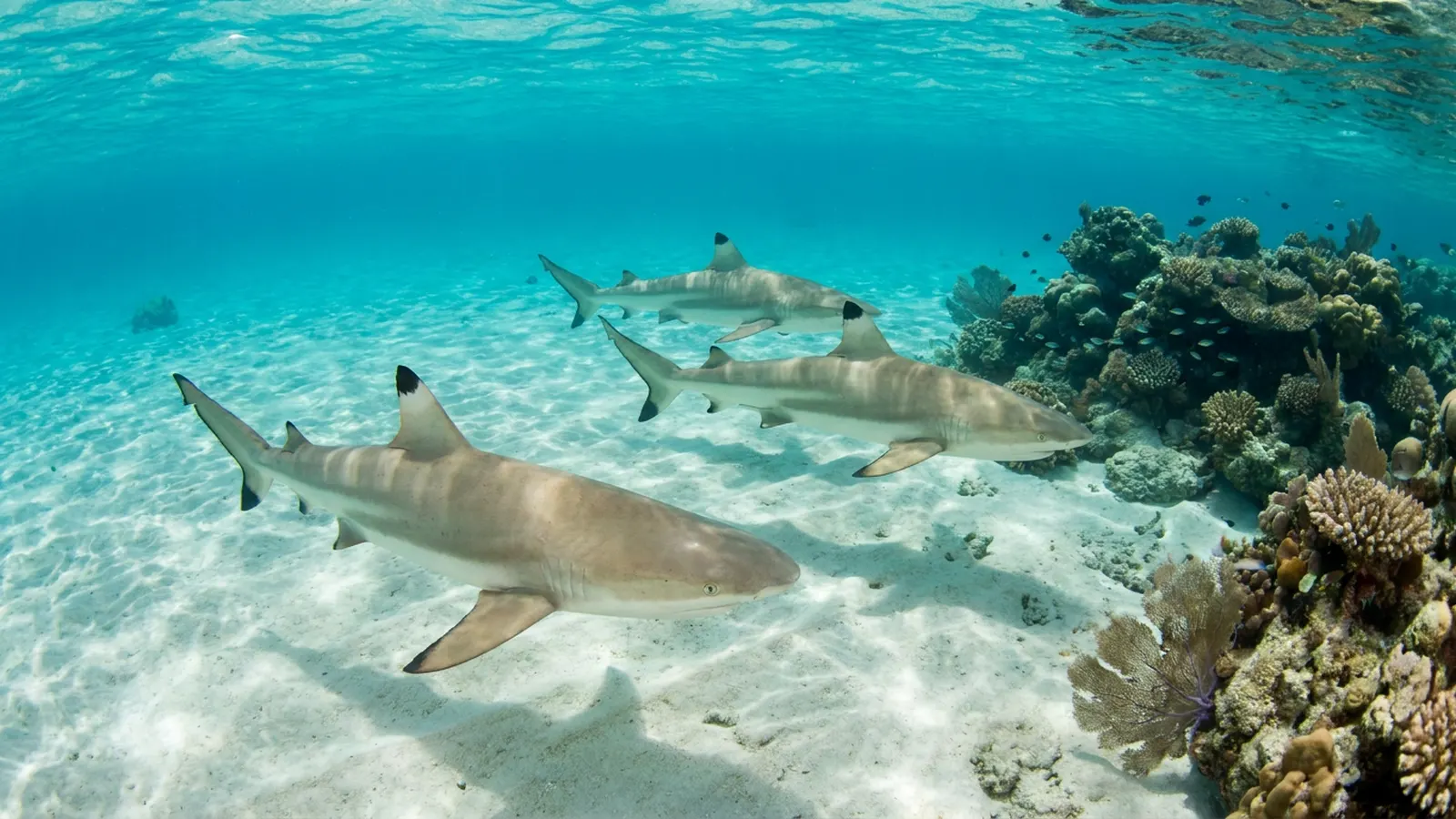
Beyond the headline four
The other 15 species pages on this site cover sharks that are equally interesting but get less air time — some because they live too deep to encounter, some because they don’t fit the man-eater narrative, and some because their evolutionary place is too strange to summarise in a tweet.
The great hammerhead uses its bizarre cephalofoil to detect electrical fields buried under sand. The basking shark is the second-largest fish alive, a 10-m filter feeder that ranges as far north as Iceland. The megamouth was unknown to science until 1976 and has been seen fewer than 300 times since. The oceanic whitetip was once the most abundant large pelagic shark on Earth and has now lost over 95% of its population.
The blue shark migrates across entire ocean basins. The shortfin mako is the fastest shark in the ocean, recorded at over 70 km/h. The sand tiger looks ferocious but is largely harmless, and is the species you’ve probably stood next to in an aquarium tunnel. The Caribbean reef shark is the one most divers will actually encounter on a tropical reef.
Three sharks that genuinely belong here also belong with the deep-sea oddities — the frilled shark, the goblin shark, and the tasselled wobbegong — and they’re cross-linked from the Bizarre Sea Creatures section as well. Pick the framing that suits what you came looking for.
How to use this hub
The Q&A cluster below is the actual table of contents for everything in this section. Three uses cover almost everyone who lands here.
If you have a specific question — “do bull sharks really live in Lake Nicaragua”, “are there great whites in Florida”, “how fast can a tiger shark swim” — scan the Shark Q&A and species sub-cluster groups and click the matching card. Each one is a single-question page that opens with the answer in the first paragraph.
If you want to read about a species — size, range, diet, conservation, the bite force compared to other predators, where to actually see one in the wild — click the species card under “All shark species”. Every species page is built on the same template, so you can compare across pages without learning a new layout.
If you want the lineage and the big picture — the difference between cartilaginous and bony fish, where the megalodon fits, why some sharks need to swim continuously and others don’t — the general Q&A pool answers each of those one at a time. Read the ones that interest you; skip the ones that don’t.
Related on TheSea
- Longfin Mako Shark
- Dogfish Shark
- Bronze Whaler Shark
- Do Sharks Eat Jellyfish? What Diet Studies Actually Show
- Are Whale Sharks Friendly to Humans? Safe, Docile Giants
- Bull Sharks in NJ
- Aquariums With Tiger Sharks
- Whale Sharks in the Philippines
- Diving With Great White Sharks
- Bull Sharks in Lake Erie
- Are There Great White Sharks In Florida
- Do Whale Sharks Lay Eggs? How Whale Sharks Give Birth
How many species of sharks are there?
There are over 500 living species of sharks, distributed across 9 living orders. New species are described regularly — on average several per year — especially among deep-water and small-bodied groups that haven’t been studied in detail. The total count has gone up by roughly 100 species since the year 2000.
How dangerous are sharks really?
Worldwide, sharks bite roughly 70 people per year unprovoked, with about 5 fatalities. In contrast, humans kill an estimated 100 million sharks each year. Of the 500+ shark species, only about 12 have ever been documented in unprovoked attacks on humans, and three species — great white, tiger, and bull — account for the majority of those.
What’s the largest shark in the world?
The whale shark is the largest, reaching up to 12 m (40 ft) and 19 tonnes. It’s also the largest fish of any kind. The whale shark is a filter feeder that eats plankton and small fish — not a predator of larger animals — and is generally docile around swimmers.
Are sharks fish or mammals?
Sharks are fish, not mammals. They breathe through gills, are cold-blooded (with a few partial exceptions like the great white and mako, which can warm parts of their body), reproduce via internal fertilisation, and do not nurse their young with milk. Their distinguishing feature among fish is a skeleton made of cartilage rather than bone — placing them in the class Chondrichthyes alongside rays and chimaeras.
How long have sharks existed?
At least 400 million years, based on the oldest unambiguous shark fossils. The shark body plan predates trees, dinosaurs, and most modern fish lineages. Sharks survived all five major mass extinction events — making them one of the most evolutionarily successful vertebrate groups in Earth’s history.
The largest predatory fish on Earth — biology, range, attacks, and how it actually hunts.
The largest fish alive: 12 m, plankton-eating, gentle — and the shark you can actually swim with.
Stomach contents include licence plates and dog tags — the ocean’s most indiscriminate eater.
Types of Sharks, All 9 Orders Explained.
Where Sharks Live, From Cape Cod to Hawaii.
The Species Off Both Coasts and When They Show Up.
Nurseries, Giants and a Lost Baseline.
White Shark Nurseries, Leopards and the Red Triangle.
The Species Around the Islands and the Law That Protects Them.
How Seals Brought the Great Whites Back.
Why All Five Lakes Are Shark-Free.
The Facts Behind the Rumours.
How Far Up They Really Go.
Numbers, Species and Hotspots.
Why Maui Has the Most Bites.
From Dogfish to the 400-Year Greenland Shark.
Rows, Replacement and Records.
Average vs Record Size.
Deep Blue, Nukumi and the record measurements.
The Latest Global Numbers.
Ranked by real attack records.
The Liver-Eating Orcas of South Africa.
70 Years and Counting.
Myth vs Fact.
Stingrays, Crabs and Seagrass.
Status by Region.
Blane Perun has been exploring Earth’s oceans and marine life for over 25 years. Founder of TheSea.Org in 1999, underwater photographer, coral aquaculture pioneer, and explorer of 80+ countries.
About Blane Perun → More on Sharks →