Coastal Wonders — Blue Holes, Rare-Sand Beaches and Sea Caves
Coastal wonders are the landforms where the sea’s work is easiest to see. Blue holes are limestone sinkholes and caves that formed on dry land when ice-age sea levels were about 100 to 120 metres lower, then flooded as the ice melted. Coloured sand beaches take their hue from what the waves grind up: basalt for black sand, the mineral olivine for green, and the red shells of a reef foraminifer for pink. Sea caves, arches and stacks are stages in one erosion sequence, in which waves exploit a weak zone in a cliff, hollow it into a cave, punch through a headland as an arch, and leave a free-standing pillar when the arch falls. Every one of them is temporary on a geological timescale.
Each guide explains how a landform is made, then visits the best examples, with the figures checked against current sources. Where sources disagree on a depth or a date, both figures are given.
Most coastlines change too slowly for anyone to notice. The places in this section are the exceptions, where a lava flow builds a beach in a day, a stack loses its arch in a single storm, or a hole in a reef flat drops into darkness three hundred metres deep.
Coastal wonders — at a glance
- Deepest blue hole: Taam Ja’, Chetumal Bay, Mexico: at least 420 m (2023 survey)
- Widest blue hole: Great Blue Hole, Belize: about 300–318 m across
- Black sand: Basalt fragments from lava meeting the sea
- Green sand: Olivine crystals winnowed from volcanic ash
- Pink sand: Red tests of the foraminifer Homotrema rubrum
- Longest sea cave: Matainaka Cave, New Zealand: about 1.5 km
- Tallest sea stack: Ball’s Pyramid, off Lord Howe Island: 572 m
What makes a coastal wonder
The coast is the most energetic boundary on the planet. Waves deliver the energy of distant storms, tides scour channels, and over longer periods the sea itself has risen and fallen by more than a hundred metres as ice sheets grew and melted. Most of the time this energy works invisibly, shifting sand a few grains at a time. The landforms gathered in this section are the places where its results are dramatic enough to stop people in their tracks.
They fall into three families. The first is drowned karst: blue holes, the circular, steep-walled sinkholes that pock carbonate banks such as the Bahamas and the Belize reef. The second is coloured sand, where the ordinary white or golden beach gives way to black, green or pink because of what the local rocks and reefs supply. The third is the erosion sequence of rocky coasts, the caves, arches and sea stacks that waves cut from cliffs. Each family has a different clock. A blue hole records tens of thousands of years of sea-level change; a black sand beach can appear in hours and vanish within decades; a sea stack may stand for a few centuries before it falls.
Blue holes: caves the sea took back
A blue hole is a large marine cavern or sinkhole, open to the surface, that has developed in a bank or island made of carbonate rock such as limestone or coral reef. They are named for the contrast between their dark blue centres and the pale turquoise shallows around them. The key to their origin is time spent above water. During the ice ages, sea level stood about 100 to 120 metres lower than today, and the carbonate platforms that are now shallow seas were dry land. Rain and groundwater dissolved the limestone, hollowing caves and shafts just as they do in karst country inland. When the ice melted and the sea rose, those caves flooded.
Inside, many blue holes are layered like a lake, with fresher water over salt water and an oxygen-free bottom layer where hydrogen sulfide builds up. That anoxic water preserves what falls into it, which is why blue holes in the Bahamas have yielded fossil tortoises, crocodiles and birds, and why their sediments hold climate records stretching back to the last glacial maximum. They are also some of the most dangerous dive sites in the world, because depth, darkness and overhead rock combine to disorient divers.
The record for the deepest blue hole changed hands in 2024. For years it belonged to Dragon Hole, also called the Sansha Yongle Blue Hole, in the Paracel Islands of the South China Sea, at 300.89 metres. Then researchers from Mexico, publishing in Frontiers in Marine Science, reported that the Taam Ja’ Blue Hole in Chetumal Bay off the Yucatan Peninsula reaches at least 420 metres, without the bottom having been found. Guinness World Records now lists Taam Ja’ as the deepest. The blue holes guide covers how they form and the record holders, Dean’s Blue Hole in the Bahamas has its own page as the world’s great freediving arena, and the Great Blue Hole of Belize is covered in our guides to Lighthouse Reef Atoll and Jacques Cousteau’s 1971 expedition there.
Beaches in black, green and pink
A beach is made of whatever the local rocks and reefs supply. On reef coasts that is mostly the crushed white skeletons of marine organisms; on many other shores it is pale mineral grains. Colour changes when the supply changes, and the three famous exceptions each tell a different story.
Black sand usually forms where lava meets the sea. Molten rock cools so fast on contact with water that it shatters into glassy fragments, and a large lava flow entering the ocean can build a new black sand beach almost overnight. Because one eruption supplies the sand and nothing replenishes it, such beaches can be short-lived, and Hawaii has made it illegal to remove black sand from its beaches. Other black sands are heavy-mineral placers rich in magnetite. See black sand beaches.
Green sand is much rarer. It forms where the mineral olivine, a magnesium iron silicate that is among the first crystals to grow in cooling magma, is freed from soft volcanic ash and concentrated by the waves, which carry the lighter grains away. Papakolea Beach near the southern tip of Hawaii Island is the best-known example. See green sand beaches.
Pink sand is biological. In Bermuda, the Bahamas and other reef coasts, a small red foraminifer, Homotrema rubrum, grows on the undersides of coral ledges and rubble. When it dies, waves break its bright red shell into sand-sized pieces that mix with the white grains of other reef skeletons. On Komodo’s Pink Beach, red fragments of organ pipe coral add to the colour. See pink sand beaches.
Caves, arches and stacks
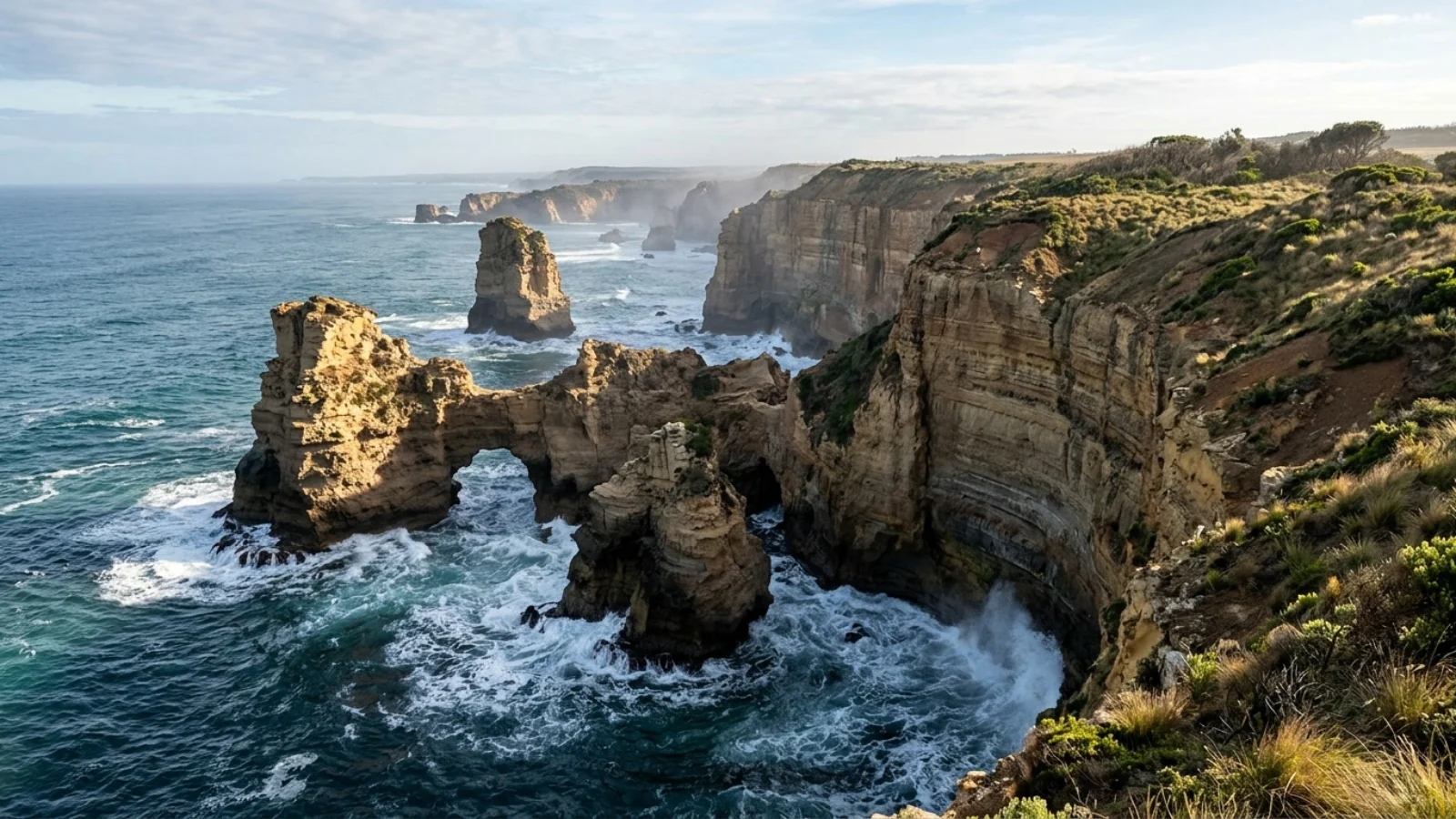
On rocky coasts, waves attack wherever the rock is weakest: a fault, a joint, a dike, a bedding plane or a boundary between hard and soft layers. Water forced into cracks compresses the air inside, sand and pebbles carried by the surf grind like sandpaper, and the weak zone deepens into a sea cave. The longest known, Matainaka Cave on the Otago coast of New Zealand’s South Island, has about 1.5 kilometres of passage. See sea caves.
Where a headland is attacked from both sides, caves can meet and break through, leaving an arch. When the arch roof collapses, the seaward pillar is left standing alone as a sea stack, and in time the stack is cut down to a stump that the tide covers. The sequence can run fast. The Old Man of Hoy in Orkney does not appear on a map of 1750 but was standing by 1819; London Bridge on Australia’s Great Ocean Road lost its landward span on 15 January 1990; and Malta’s Azure Window collapsed in a storm on 8 March 2017. See sea stacks.
Underwater volcanoes and the hidden coast
Not every coastal wonder is visible from the beach. Most of the planet’s volcanic activity happens beneath the sea, and submarine eruptions build seamounts, raft the sea with pumice and occasionally raise new islands. That story is told in our guide to whether most volcanic activity happens underwater, and it connects to this section in a practical way: the basalt and olivine that colour Hawaii’s black and green beaches were delivered by the same kind of volcano.
Visiting coastal wonders responsibly
These places are fragile in proportion to their beauty. Black and green sand is not replaced once it leaves the beach, and pink sand depends on healthy reefs to keep producing the foraminifera that colour it. Do not take sand home: removing it is illegal on Hawaii’s beaches, and parks such as Komodo ask visitors to leave sand and coral where they lie. Respect closures on cliff paths and stacks, which can fail without warning, and treat dramatic beaches with care; on Iceland’s Reynisfjara, sudden large waves have drowned visitors standing near the basalt columns. In blue holes, dive within your training. Overhead environments and deep anoxic water have claimed many experienced divers.
- Deepest blue hole: Taam Ja’, Mexico: at least 420 m
- Black sand: Punalu’u, Hawaii; Reynisfjara, Iceland
- Green sand: Papakolea, Hawaii Island
- Pink sand: Bermuda; Harbour Island, Bahamas; Komodo
How they form and the deepest on Earth.
The Bahamas’ freediving arena.
Belize’s atoll and its sinkhole.
The 1971 Calypso expedition.
How lava makes them, and the best.
Olivine and Papakolea.
Foraminifera and where to find them.
How waves carve them.
From headland to arch to stack.
Most volcanism is under the sea.
Taller than Everest from the seafloor.
Ireland’s Atlantic sea cliffs.
A beach of crushed shells.
Where the waves polish glass.
When the waves glow.
The Blue Hole and three atolls.
The snorkeling section hub.
What is the deepest blue hole in the world?
The Taam Ja’ Blue Hole in Chetumal Bay, Mexico, measured in 2023 to at least 420 metres; the previous record holder, Dragon Hole in the South China Sea, is 300.89 metres.
How do blue holes form?
They are limestone caves and sinkholes that formed on dry land when ice-age sea levels were 100 to 120 metres lower, then flooded as the sea rose.
Why is some beach sand black?
Most black sand is basalt shattered when lava hits the sea; some is heavy-mineral sand rich in magnetite.
What makes green sand beaches green?
Crystals of the mineral olivine, freed from volcanic ash and concentrated by the waves.
Why are some beaches pink?
Red shells of the foraminifer Homotrema rubrum, broken into sand and mixed with white reef sand.
How does a sea stack form?
Waves carve caves in a headland, the caves break through as an arch, and the arch collapses to leave a free-standing stack.
- Sources for each landform are listed in the individual guides linked above.
- Guinness World Records, “Deepest blue hole” (Taam Ja’, accessed November 2026); Phys.org, report on Alcerreca-Huerta et al., Frontiers in Marine Science (2024), doi:10.3389/fmars.2024.1387235.
- Wikipedia contributors, “Blue hole”, “Black sand”, “Papakolea Beach”, “Sea cave”, “Stack (geology)”, “Old Man of Hoy”, “London Arch”, “Azure Window” (2023 snapshot via Kiwix mirror, accessed November 2026).
- Bermuda Institute of Ocean Sciences, “Our unique pink sand” (27 April 2012); Iceland Monitor (mbl.is), report on Reynisfjara accidents (August 2025).
Blane Perun has been exploring Earth’s oceans and marine life for over 25 years. Founder of TheSea.Org in 1999, underwater photographer, coral aquaculture pioneer, and explorer of 80+ countries.
About Blane Perun →