RMS Republic — The Wreck Was Found in 1981; the Rumoured Gold Never Has
The RMS Republic is an odd kind of lost treasure: the ship is found but the gold is not. The White Star liner sank off Nantucket on 24 January 1909, a day after a collision with the Italian liner Florida. Within years, newspapers reported that $3 million in American gold coins lay in her hold. The wreck was located in 1981 in about 82 m of water, and expeditions have searched it since, but no gold has ever been recovered, and it is still not proven that any was aboard.
The Republic is also famous for something else: the first CQD wireless distress call, sent by operator Jack Binns, which brought rescuers and saved about 1,500 people. For the full story of the sinking and the rescue, read our companion post Treasure of the RMS Republic; this post looks at the gold that is still missing. See also the shipwreck treasure hub.
What gold was the Republic supposed to be carrying?
Two different stories circulate:
| Claim | Amount (1909 dollars) | Source type |
|---|---|---|
| US Navy payroll for the Great White Fleet | About $250,000 in gold coins | Later reports and books |
| Gold double eagles ($20 coins) | About $3,000,000 | Newspaper reports from the 1910s onward, including The Washington Post and The New York Times |
| Gold for a loan to Imperial Russia | Up to several million | A theory promoted by salvors; unproven |
In 1909 dollars, $3 million is equivalent to roughly $100 million today after inflation. At modern gold and rare-coin prices, believers suggest values far higher, but those numbers depend on a cargo nobody has documented.
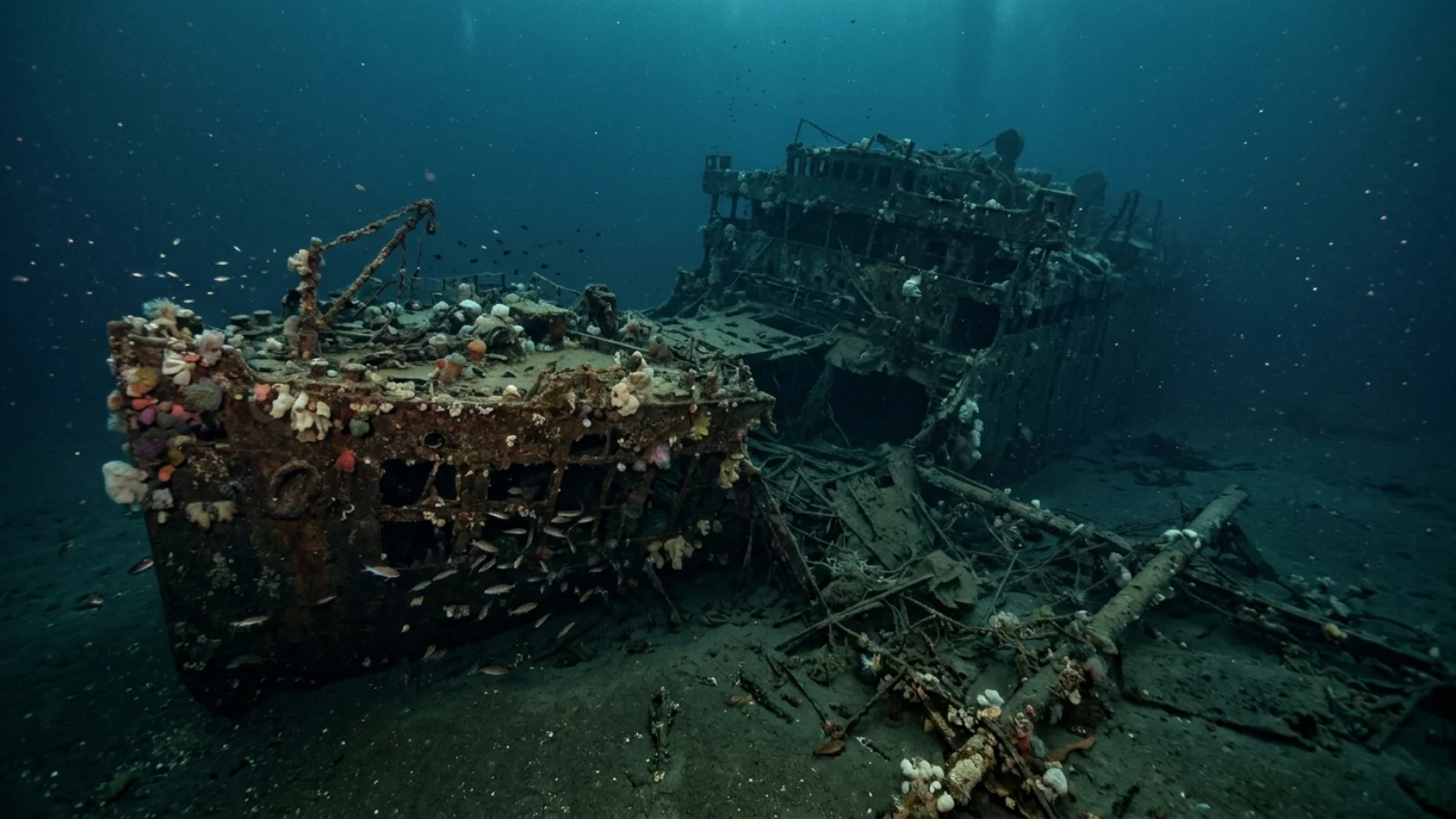
Why has the Republic’s gold never been found?
- It may not exist. No surviving cargo manifest confirms a large gold shipment, and White Star and the US government did not publicly report one. The navy payroll story, if true, involves a much smaller sum.
- It may have gone elsewhere. Some researchers suggest gold could have been carried on another ship or never loaded.
- Depth and conditions. At about 82 m, the wreck is a deep technical dive in cold, dark water with strong currents and frequent fog.
- A collapsed liner. More than a century on, the 15,400-ton hull has collapsed and been fished over; a specie room deep in the wreck would be buried under tonnes of steel.
- Fishing nets and debris. The wreck is draped in lost nets and gear, a serious hazard to divers.
Who has searched for the Republic’s gold?
A salvage attempt in 1919, reported in the press, failed. Captain Martin Bayerle located the wreck in 1981, lying upright about 50 miles south of Nantucket, and led salvage expeditions in the 1980s that found no gold. His company, MVSHQ, Inc., later secured recognition of its exclusive salvage rights from a US court. Over the years Bayerle has argued that the ship carried gold intended for the Russian government; critics point to the lack of documentary proof.
Is the Republic gold real?
The honest answer is that it is unproven. The case for gold rests on later newspaper articles and the ship’s reputation as the “Millionaires’ Ship”, which carried wealthy passengers on the Boston and Mediterranean services. The case against is the silence of the official record and the failure of every search to find a single coin. Neither side has settled it, and only finding, or definitively not finding, a specie room will.
Who would own the Republic’s gold if it were found?
Under US admiralty law, a salvor with recognised rights to a wreck can claim a salvage award or title to abandoned property, and courts have backed Bayerle’s company. But any gold shipped by a government could attract claims from that government’s successors, as happened when Spain won back the treasure of the Mercedes. Insurers who paid out in 1909 could also have claims.
How did the Republic sink?
Slowly, which is why almost everyone survived. After the Florida struck her side in thick fog, the Republic flooded but stayed afloat for about a day, giving time for a large rescue.
The collision happened in the early hours of 23 January 1909 off Nantucket. The Republic’s engine room flooded and she lost power, but her wireless still worked, and the distress calls brought several ships to the scene. Passengers were first moved to the damaged Florida, then the passengers of both ships were transferred to the White Star liner Baltic in a long, cold operation at sea. Attempts were made to tow the Republic toward shallower water, but she sank on 24 January with her captain and a small party staying aboard until near the end. That slow sinking is part of why the gold story persists: there was time, in theory, to remove valuables, yet no record says anything significant was taken off.
How would a gold shipment have been recorded in 1909?
Normally with paperwork at every step: bank or government shipping orders, bills of lading, a ship’s cargo manifest, insurance policies and, after a loss, insurance claims and press reports.
Large shipments of coin or bullion were usually carried in a secure strongroom, often called a specie room, and were insured. When a ship carrying significant specie sank, the loss typically showed up in insurers’ records, company correspondence or court cases. The absence of such evidence is the strongest argument against a multi-million-dollar cargo on the Republic. Supporters of the gold theory argue that a secret government shipment might deliberately leave fewer traces, but that is an argument from silence, and it cannot be tested without finding the coins.
| Evidence type | What it would show | Republic status |
|---|---|---|
| Cargo manifest | Specie listed as cargo | No published manifest confirming gold |
| Insurance claims | Payouts for lost bullion or coin | None widely documented |
| Government records | Payroll or loan shipments | Disputed and unconfirmed |
| Physical recovery | Coins from the wreck | None recovered |
Which shipwreck gold stories turned out to be true?
Several, and they show what proof looks like. In each case documents first established that gold was aboard, and recovery then confirmed it.
- SS Central America – lost off the Carolinas in 1857 carrying California gold; the wreck was located in the late 1980s and large quantities of gold coins and bars were recovered.
- RMS Laurentic – sunk by mines off Ireland in 1917 while carrying gold bars; Royal Navy divers recovered nearly all of it in the following years.
- HMS Edinburgh – sunk in the Arctic in 1942 carrying Soviet gold; most of the bars were salvaged in 1981.
The Republic differs from all three because the documentary trail never clearly established a gold cargo in the first place. For more cases, see our shipwreck treasure hub and shipwrecks that have been raised.
What would it take to settle the mystery?
A systematic, well-funded survey of the area of the hull where a strongroom would have been, followed by careful excavation through the collapsed decks.
Modern salvage could use remotely operated vehicles, sonar mapping and, where necessary, saturation divers able to work at depth for long periods. The work would be slow and expensive, and the wreck’s legal status means any serious operation would need the rights holder’s involvement and court oversight. A thorough search that found an empty strongroom would be almost as valuable to historians as a hoard of coins, because it would finally close the story. Until then, the Republic sits in the same category as many legendary wrecks: the ship is real, the history is dramatic, and the treasure is a question mark. For background on the wreck itself, see treasure of the RMS Republic.
How should you judge a lost treasure claim?
- Look for contemporary documents from the time of the sinking, not just later newspaper stories.
- Check whether insurers, banks or governments reported a loss.
- Be cautious of modern dollar values multiplied by gold or collector prices; they assume the cargo existed.
- Ask who benefits from the story, such as salvors seeking investors.
- Treat physical recovery as the only final proof.
Has the RMS Republic gold been found?
No. The wreck was located in 1981, but no gold has ever been recovered.
How much gold was on the RMS Republic?
Rumours range from a $250,000 navy payroll to $3 million in gold coins, in 1909 dollars; none is confirmed.
Where is the RMS Republic wreck?
About 50 miles south of Nantucket, Massachusetts, in about 82 m (270 ft) of water.
Who found the RMS Republic wreck?
Captain Martin Bayerle, in 1981.
How many people died when the Republic sank?
Six, all killed in the collision with the Florida; about 1,500 people were rescued.
Why is the Republic famous?
Its operator Jack Binns sent the first CQD wireless distress call, leading to a major rescue.
Can you dive the RMS Republic?
Only as an advanced technical (trimix) dive; it is deep, cold and covered in nets.
What would $3 million in 1909 be worth today?
Roughly $100 million after inflation, more at modern gold and coin prices.
- Wikipedia: RMS Republic (1903).
- The Washington Post and The New York Times archive reports on the Republic’s gold, 1910s–1930s.
- Bayerle, M. Public statements and court filings on the RMS Republic salvage (MVSHQ, Inc.).
Blane Perun has been exploring Earth’s oceans and marine life for over 25 years. Founder of TheSea.Org in 1999, underwater photographer, coral aquaculture pioneer, and explorer of 80+ countries.
About Blane Perun →