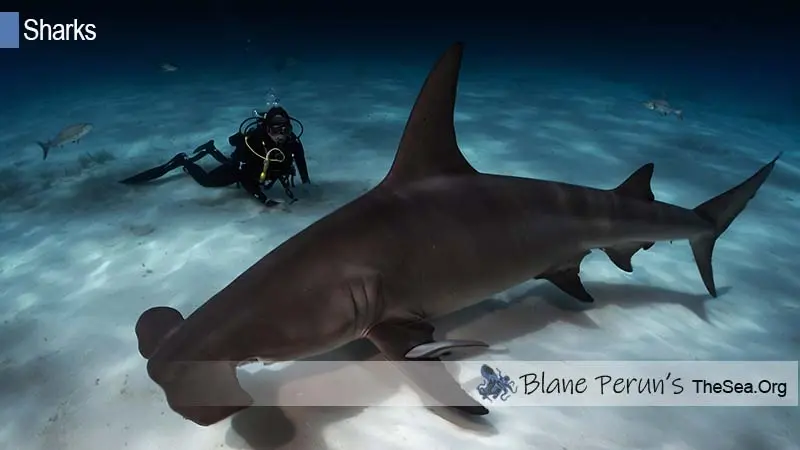
The great hammerhead shark (Sphyrna mokarran) is the largest of the nine hammerhead species, reaching up to 6 meters in length and weighing over 580 kg. It’s immediately recognizable by its nearly straight, wide cephalofoil — the distinctive hammer-shaped head that sets hammerheads apart from every other shark on Earth. Found in warm coastal waters worldwide, the great hammerhead is a powerful apex predator and one of the ocean’s most specialized hunters.
How Big Does the Great Hammerhead Get?
Most adult great hammerheads measure between 3.5 and 4.5 meters. Females grow significantly larger than males. The largest confirmed specimen on record measured 6.1 meters and was caught off Florida — making the great hammerhead one of the largest shark species alive. Despite their size, great hammerheads are slender and fast, built more for agility than bulk.
Their most distinctive feature is the cephalofoil — a flattened, hammer-shaped head that can span nearly 30% of total body length in adults. This is not decorative. It’s one of evolution’s most sophisticated hunting tools.
What Is the Hammerhead’s Head Actually For?
The cephalofoil serves three critical functions that give the great hammerhead a major predatory advantage:
- Electroreception: The underside of the hammerhead is densely packed with ampullae of Lorenzini — sensory organs that detect the faint electrical fields produced by all living animals. The wide head dramatically increases the sensor surface area, allowing great hammerheads to detect prey buried in sand with extraordinary precision.
- Hydrodynamic lift: The cephalofoil acts like a wing, generating lift as the shark swims. This gives hammerheads exceptional maneuverability — they can pivot and change direction faster than most sharks their size.
- Prey pinning: Great hammerheads are famous for using their head to pin stingrays to the seafloor before biting. Researchers have filmed this behavior repeatedly — the head functions as a weapon as well as a sensor.
Where Do Great Hammerhead Sharks Live?
Great hammerheads are found in tropical and warm temperate waters worldwide, typically in coastal zones and along continental shelves. Key locations include:
- Bimini, Bahamas — One of the most reliable dive sites in the world for great hammerhead encounters, particularly January through March
- Florida, USA — Jupiter and Palm Beach are well-known aggregation points in winter
- Red Sea — Ras Mohammed and the Brothers Islands
- Maldives and Cocos Island — Seasonal aggregations reported
- Australia — Northern Queensland and Western Australia
Great hammerheads are highly migratory, moving toward cooler water in summer and returning to tropical shallows in winter. They are generally solitary and do not form the large schools sometimes seen in scalloped hammerheads.
What Do Great Hammerhead Sharks Eat?
Stingrays are the great hammerhead’s signature prey — they are exceptionally well adapted to hunting them. Using electroreception, they locate rays buried under sand, then pin them with the cephalofoil and bite off the wings. Researchers examining great hammerhead stomachs have found stingray barbs embedded in the mouth and throat with no apparent ill effect.
Beyond rays, great hammerheads eat a wide range of prey:
- Bony fish — grouper, tarpon, jacks, and other reef species
- Cephalopods — squid and octopus
- Other sharks and rays — including smaller hammerheads
- Crustaceans
They are opportunistic and have been documented cannibalizing smaller hammerheads. Their immune system appears resistant to stingray venom, making them uniquely suited for ray-heavy diets.
Are Great Hammerhead Sharks Dangerous to Humans?
Great hammerheads are listed by the International Shark Attack File as responsible for a small number of unprovoked attacks on humans — far fewer than bull or tiger sharks. They are large, powerful animals and deserve respect, but they are not the aggressive man-hunters their appearance suggests.
Dive operators in the Bahamas and Florida run regular cage-free dives with great hammerheads. With proper protocols — staying low, moving slowly, not blocking escape routes — experienced divers routinely get within meters of these sharks without incident.
Conservation Status: Critically Endangered
The great hammerhead is listed as Critically Endangered on the IUCN Red List. Their populations have declined by an estimated 80% over the past 25 years, driven by:
- Shark fin trade: Great hammerhead fins are among the most valuable in the fin trade due to their large size and high ceratotrichia content. A single set of fins can fetch thousands of dollars.
- Bycatch: Frequently caught in longlines targeting tuna and swordfish
- Slow reproduction: Great hammerheads are viviparous, giving birth to 6–42 pups after a gestation period of 11 months. Low reproductive rates mean populations recover very slowly from fishing pressure.
Several countries have banned hammerhead fishing, and international fin trade regulations have improved. But enforcement remains inconsistent across much of their range.
Great Hammerhead Shark Facts
- Scientific name: Sphyrna mokarran
- Family: Sphyrnidae
- Maximum length: ~6.1 meters
- Maximum weight: ~580 kg
- Lifespan: Estimated 20–30 years
- Reproduction: Viviparous — live birth, 6–42 pups per litter
- Diet: Stingrays, fish, cephalopods, other sharks
- Conservation status: Critically Endangered (IUCN)
Frequently Asked Questions
Why do hammerhead sharks have hammer-shaped heads?
The cephalofoil dramatically increases the surface area for electroreception, letting the shark detect prey buried in sand. It also provides hydrodynamic lift for faster turning and is used to pin stingrays to the seafloor before biting.
How many hammerhead shark species are there?
There are nine recognized species in the family Sphyrnidae. The great hammerhead is the largest. Others include the scalloped hammerhead, smooth hammerhead, bonnethead, and winghead shark.
Can great hammerhead sharks be kept in aquariums?
Rarely and briefly. Great hammerheads stress severely in captivity — they require enormous open spaces and have a tendency to swim into tank walls. Most aquariums avoid keeping them. The few attempts have resulted in deaths within days or weeks.
Do great hammerhead sharks travel in schools?
No. Unlike scalloped hammerheads, great hammerheads are almost exclusively solitary. Aggregations at dive sites like Bimini are loose gatherings attracted by food — not social groups.
What is the great hammerhead’s bite force?
Not precisely measured for great hammerheads specifically, but hammerhead jaw biomechanics are studied for their efficiency — their jaws are designed for quick sideways slashing cuts, ideal for disabling rays and large fish rather than crushing.
Are great hammerhead sharks endangered?
Yes — Critically Endangered on the IUCN Red List, with population declines exceeding 80% in recent decades. The fin trade and bycatch are the primary threats.