Jordan Coral Reef Maps — Aqaba’s Shore Reefs on the Gulf of Aqaba
Jordan’s coral reefs line its only coastline, a stretch of roughly 27 kilometres around Aqaba at the northern end of the Gulf of Aqaba, the north-eastern arm of the Red Sea. Almost the whole coast south of the city, down to the Saudi border, is fringed by narrow fringing reefs that begin right at the beach and drop steeply into deep water. Much of this coast is protected in the Aqaba Marine Park. Jordan’s reefs are known for easy shore diving, rich coral cover, several deliberately sunk wrecks and corals that are unusually tolerant of warm water.
Jordan is a desert country with a single window onto the sea. That window, the coast around Aqaba, is short but remarkably rich. Step off the beach south of the city and within a few metres the sand gives way to coral, with gardens of hard and soft corals sloping down into the blue. For a nation with so little coastline, Jordan has built a reputation as one of the most accessible reef destinations in the Red Sea. This map shows where its reefs are and how they fit into the wider Gulf of Aqaba.
Jordan coral reef map
Almost every kilometre of Jordan’s coast south of Aqaba city is lined with fringing reef.
On the map, Jordan’s coastline appears as a short stretch on the eastern side of the head of the Gulf of Aqaba, between Israel to the west and Saudi Arabia to the south. The northern part of this coast is taken up by the city of Aqaba and its port. South of the port, coral shading follows the shore almost continuously to the Saudi border, a near-unbroken band of fringing reef.
The outlines come from the UNEP-WCMC global coral reef dataset. At regional scale, Jordan’s reef looks like a thin line, because fringing reefs here are narrow: a shallow reef flat close to the shore, followed by a slope that falls away quickly into the deep gulf. The map’s value lies in showing how the Aqaba reefs connect with those of Eilat across the bay and with the long reef coasts of Egypt and Saudi Arabia further south.
The Gulf of Aqaba setting
A deep, narrow, rift-valley sea gives Jordan clear water and reefs that lie very close to shore.
The Gulf of Aqaba follows the same great rift that holds the Dead Sea and the Jordan Valley. It is narrow, very deep and almost enclosed, with little rainfall and no permanent rivers flowing into it. The result is clear, warm, low-nutrient water ideal for reef corals. Despite being one of the northernmost reef areas on Earth, the gulf stays warm enough for coral throughout the year.
Because the sea floor drops away steeply, Jordan’s reefs are narrow. Most are a reef flat in the shallows followed by a slope that descends past coral heads, sandy channels and seagrass patches into deeper water. This gives divers and snorkellers access to a wide range of habitats within a short swim of the beach.
Diving, wrecks and protection
Shore diving, artificial reefs and a long-established marine park define Aqaba’s underwater experience.
Aqaba’s dive sites are strung along the southern coast, with names such as the Japanese Garden, Rainbow Reef, the Seven Sisters and Gorgonian I and II. Many can be dived directly from the shore. The Japanese Garden is known for dense coral cover on a gently sloping reef, while other sites offer pinnacles, sea fans and seagrass where turtles and seahorses can sometimes be seen.
Jordan has also created artificial reefs by sinking vessels and other structures. The best known is the Cedar Pride, a cargo ship deliberately sunk in 1985 that now lies on its side, covered in soft corals. More recent additions include a decommissioned military transport aircraft and, in 2019, an underwater military museum of retired tanks and vehicles. These sites help spread diving pressure away from natural reefs while creating new habitat.
Much of the southern coast lies within the Aqaba Marine Park, which manages diving, fishing and coastal use along the reef. Zoning separates swimming beaches, dive sites and protected areas, and rules forbid collecting or damaging coral.
Conditions in Aqaba are favourable for most of the year. The gulf is sheltered from large ocean swells, visibility is usually good thanks to the lack of river runoff, and the water stays warm enough for comfortable diving in every season, although it is noticeably cooler in winter than in summer. Because the reefs begin so close to shore, Aqaba is popular with beginners and for training dives, while the deeper slopes and wrecks give experienced divers plenty to explore. Glass-bottom boats and guided snorkel trips also let non-divers see the reef. That accessibility is a large part of why such a short coast supports a busy diving and snorkelling industry.
Reef life and heat-tolerant corals
Aqaba’s reefs host a rich Red Sea fauna and corals that may cope with warming better than most.
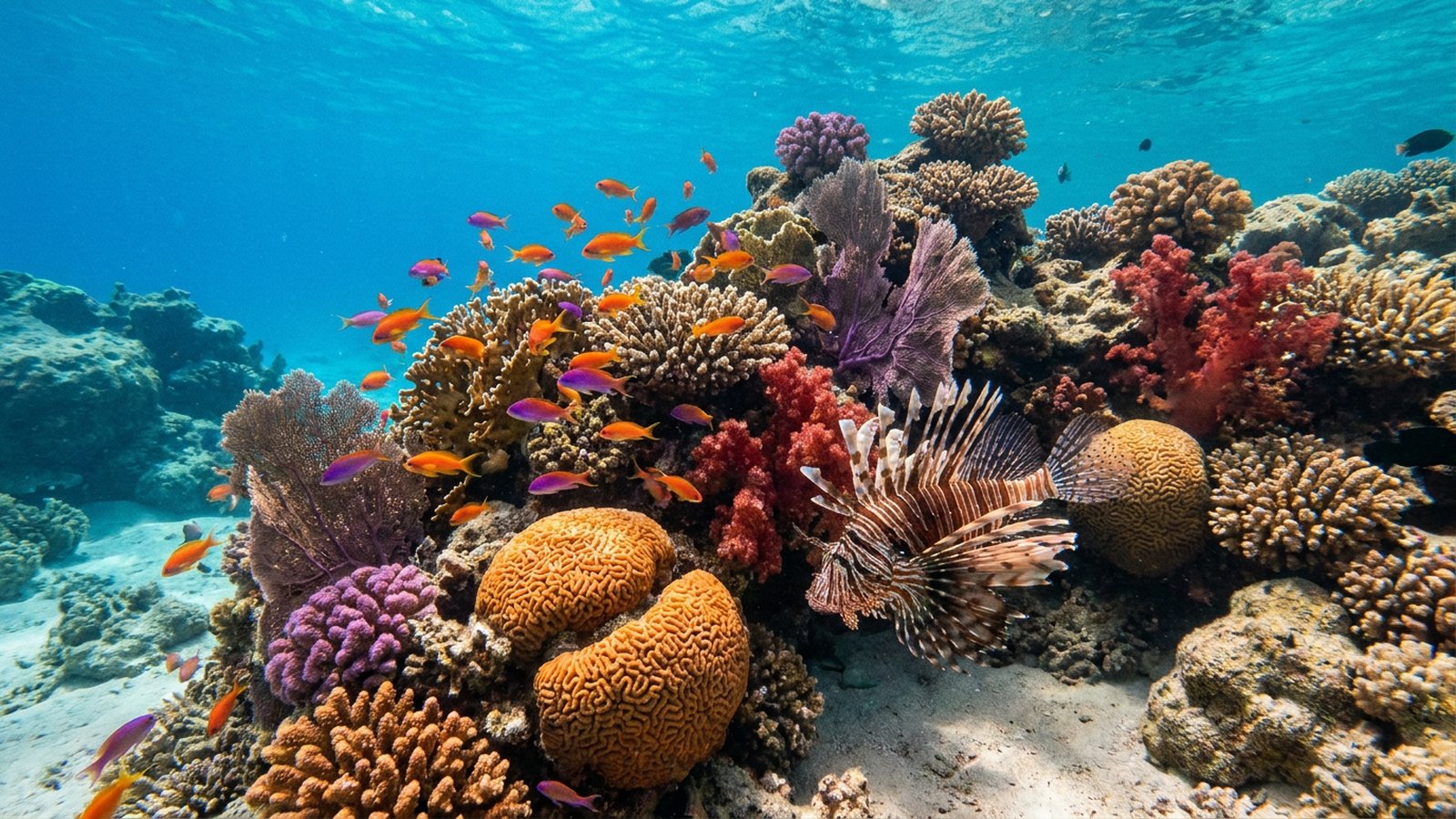
Jordan’s reefs support a wide range of stony and soft corals, and the fish life includes many Red Sea species, from anemonefish and butterflyfish to lionfish, groupers and moray eels. Sea turtles feed in the seagrass beds, and the reefs are home to a great variety of invertebrates, including nudibranchs, sea stars and giant clams.
Like the rest of the northern Red Sea, the Gulf of Aqaba has attracted scientific attention for its heat-tolerant corals. Experiments have shown that corals here can survive temperatures well above those they normally experience. This has led researchers to suggest the gulf could be a refuge for corals as oceans warm. That makes Aqaba’s reefs important not only to Jordan, but to the future of coral reefs in general. See our guide to coral reef bleaching for more on how heat affects coral.
Pressures on Jordan’s reefs
A port, a growing city and tourism all share a very short coast with the reef.
Aqaba is Jordan’s only seaport, and port operations, shipping, industry and the handling of bulk cargoes all take place close to the reef. Expansion of the port and the city, along with tourism development, puts pressure on the limited coastline. Sediment, runoff and pollution can reduce water quality, and heavy use of popular dive and snorkel sites causes physical damage.
Coastal planning has aimed to separate industrial areas from the most valuable reef sections, and the marine park provides a framework for managing use. Ocean warming remains a long-term concern, though Aqaba’s corals may be better placed than many to cope. Wider approaches to protecting reefs are covered in our coral reef conservation pages.
Does Jordan have coral reefs?
Yes. Jordan’s short coastline at Aqaba, on the Gulf of Aqaba in the northern Red Sea, is lined almost end to end with fringing coral reefs, much of them protected in the Aqaba Marine Park.
How long is Jordan’s coastline?
About 27 kilometres, all on the Gulf of Aqaba. It runs from the city of Aqaba south to the border with Saudi Arabia.
Can you snorkel from the beach in Aqaba?
Yes. Aqaba’s reefs begin right at the shoreline, so you can snorkel or dive straight from the beach at many sites along the southern coast, including within the marine park.
What are the best dive sites in Aqaba?
Popular sites include the Japanese Garden, Rainbow Reef, the Seven Sisters and the Gorgonian reefs, as well as wrecks such as the Cedar Pride, sunk in 1985, and newer artificial reefs including the underwater military museum.
Why are Aqaba’s corals important for the future?
Research shows corals in the Gulf of Aqaba tolerate unusually high temperatures, so the gulf may serve as a refuge for coral as oceans warm.
What threatens Jordan’s coral reefs?
Port and city expansion, shipping and industry, tourism pressure, runoff and pollution on a very short coast, plus long-term ocean warming.
- UNEP-WCMC, WorldFish Centre, WRI and TNC (2021), Global distribution of warm-water coral reefs, v4.1
- Aqaba Special Economic Zone Authority: Aqaba Marine Park
- Marine Science Station, Aqaba (University of Jordan and Yarmouk University)
- Fine, Gildor & Genin (2013), a coral reef refuge in the Red Sea, Global Change Biology
Blane Perun has been exploring Earth’s oceans and marine life for over 25 years. Founder of TheSea.Org in 1999, underwater photographer, coral aquaculture pioneer, and explorer of 80+ countries.
About Blane Perun → More Middle East Coral Reef Maps →