The Aqua-Lung — How Cousteau and Gagnan Gave Divers Their Freedom
The Aqua-Lung was the first open-circuit scuba set to win worldwide popularity and commercial success. It was worked out in occupied France in the winter of 1942–43 by naval officer Jacques-Yves Cousteau and Air Liquide engineer Émile Gagnan, tested along the Mediterranean coast in the summer of 1943, and put on sale in 1946. Its central idea was simple: give the diver air from a tank only when he breathes in, at exactly the pressure of the surrounding water.
Before the Aqua-Lung, most diving meant a heavy helmet and a hose to the surface, or a closed-circuit oxygen set that limited how deep a diver could safely go. After it, a swimmer with cylinders on the back could move freely through the water for an hour or more. Almost every scuba regulator in use today descends from that design.
What came before the Aqua-Lung?
People had been breathing underwater with machines for more than a century. Surface-supplied “standard diving dress”, with a copper helmet and air pumped down a hose, was developed in Britain in the early 19th century and became the working tool of salvage and naval divers. It was reliable but heavy and slow, and it tied the diver to a boat.
The idea of a demand valve was also older than Cousteau. In 1860 the French mining engineer Benoît Rouquayrol invented a regulator, first conceived to help people escape from flooded mines. In 1864 he teamed up with a naval officer, Auguste Denayrouze, to adapt it for diving, and the French Navy ordered the first units in 1865. The Rouquayrol-Denayrouze apparatus was a genuine demand system, but the cylinders of the day could hold air at only about 30 atmospheres, which limited dives to around 30 minutes at no more than about ten metres, and most of the time the equipment was used with a surface air supply.
Other inventors went in different directions. In 1878 Henry Fleuss, working for the London firm Siebe Gorman, built the first practical oxygen rebreather, which recycled the diver’s breath through a chemical that absorbed carbon dioxide. Rebreathers were adopted for submarine escape and later for wartime frogmen, including Christian Lambertsen’s American unit of 1939, but pure oxygen becomes toxic under pressure, which ruled them out for deeper work. In France, Commander Yves Le Prieur combined Maurice Fernez’s mouthpiece and goggles with a compressed-air cylinder in 1925 and demonstrated the result in a Paris swimming pool in 1926. Le Prieur’s set was open circuit and self-contained, but the diver had to open and close a valve by hand, so air flowed continuously and ran out quickly. Another French design, by René and Georges Commeinhes, was used by the French Navy early in the Second World War.
| System | How air is supplied | Limitation |
|---|---|---|
| Standard diving dress (19th century) | Pumped from the surface through a hose | Diver tethered, heavy and slow |
| Rouquayrol-Denayrouze (1860s) | Demand valve, low-pressure tank or surface supply | Tanks of about 30 atm; short, shallow dives |
| Oxygen rebreathers (1878 onward) | Recycles oxygen through a CO2 absorbent | Oxygen toxicity limits depth |
| Le Prieur set (1925–26) | Manually adjusted free flow from a cylinder | Wastes air, short endurance |
| Aqua-Lung (1943) | Automatic demand valve, high-pressure cylinders | Air supply, nitrogen narcosis, decompression |

How did Cousteau and Gagnan meet?
Through family and a fuel shortage. By the early 1940s Cousteau, a French Navy lieutenant based at Toulon, had been diving for several years. His friend Philippe Tailliez had lent him a pair of Fernez goggles in 1936, and in 1939 Cousteau had used Le Prieur’s apparatus. He found its endurance far too short and was looking for an automatic regulator that would release air only as it was needed.
Meanwhile, in German-occupied France, petrol was scarce because of German requisitioning, and many vehicles were converted to run on gas from wood or coal. Émile Gagnan, an engineer at the industrial gas company Air Liquide who specialised in high-pressure pneumatic design, had been working on regulators for these gas generators. He had miniaturised and adapted a device derived from the old Rouquayrol-Denayrouze patent, which at that time was held by the firm Établissements Bernard Piel. Gagnan’s boss at Air Liquide, Henri Melchior, was Cousteau’s father-in-law, and knowing what Cousteau was looking for he introduced the two men in December 1942. On Cousteau’s initiative, Gagnan’s regulator was modified for breathing underwater, and the pair received a patent a few weeks later in 1943.
How was the first Aqua-Lung tested?
Early prototypes were made at Air Liquide’s works in Boulogne-Billancourt, near Paris. In The Silent World, Cousteau describes the first trial in a river, in which the device behaved well with the diver horizontal but gave too much air when he stood upright and too little when he was head-down. The cause was the difference in water pressure between the regulator’s diaphragm and the exhaust valve. The fix, putting the exhaust at the same level as the diaphragm in the same housing, became a defining feature of the twin-hose design.
The serious sea trials took place in the summer and autumn of 1943 on the Mediterranean coast. Cousteau, Tailliez and the spearfisherman Frédéric Dumas, who became known as the three mousquemers, or “musketeers of the sea”, made around 500 dives, going gradually deeper as they learned what the equipment and their bodies could tolerate. They took a movie camera with them. The resulting film, Épaves (“Shipwrecks”), shot on two of the first prototypes, was the first film made with the Cousteau-Gagnan Aqua-Lung. Film stock was so scarce in wartime that Cousteau bought up hundreds of short reels meant for children’s cameras and spliced them together. Épaves won a prize at the 1946 Cannes Film Festival.
How does the Aqua-Lung work?
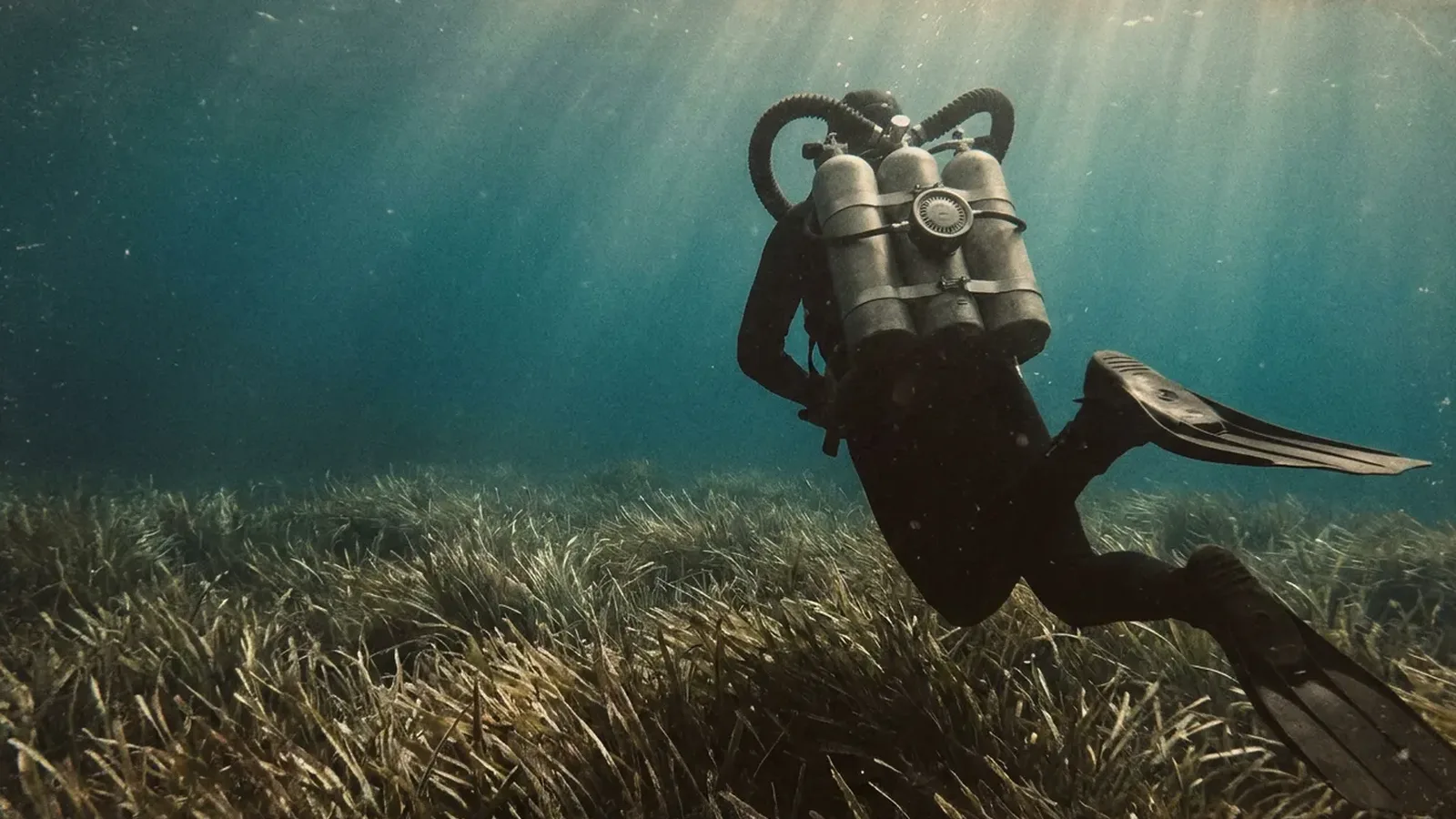
The original Aqua-Lung regulator was a single-stage unit in a round brass housing mounted on the cylinder valve, behind the diver’s neck. Two wide, corrugated rubber hoses ran over the shoulders to a mouthpiece: one carried fresh air to the diver and the other carried exhaled air back to the housing. Inside the housing, a flexible diaphragm separated a low-pressure chamber from the surrounding water. When the diver inhaled, the pressure in the chamber dropped slightly, the water pushed the diaphragm inwards, and the diaphragm pressed a lever that opened a valve on the high-pressure air. Air flowed in until the pressure inside matched the water outside, and the valve closed again when the diver stopped inhaling. Exhaled air left through a one-way valve in the same housing.
The genius of the arrangement is that the regulator automatically follows depth. Water pressure increases by about one atmosphere for every ten metres, so the air a diver needs at 30 metres must be delivered at roughly four times surface pressure. Because the diaphragm senses the surrounding water, the Aqua-Lung always supplied air at the right pressure without the diver touching a valve. Non-return valves at the mouthpiece kept water out of the inhalation hose and made it easier to clear any water that got in.
The single-stage design had quirks. The effort needed to breathe changed as the tank emptied and with the diver’s position: because the regulator sat behind the shoulders, air came too freely when the diver rolled onto his back and was harder to draw when he lay face down. Experienced divers learned to block the mouthpiece with the tongue or roll to one side when the tank was low. Later Aqua-Lung models added a first stage that dropped the cylinder pressure to an intermediate pressure before the demand stage, making breathing smoother. The other key ingredient was the cylinder. Steel tanks of the 1940s could hold air at up to about 200 atmospheres, far more than the 30 atmospheres of the 1860s, which allowed dives of more than an hour, including decompression stops. For years Cousteau and his team dived with a regulator mounted on three cylinders, one of them a reserve.
What did early divers learn about its limits?
The Aqua-Lung opened the sea faster than the physiology of diving was understood, and its pioneers paid for that. In 1945 Admiral André Lemonnier, after seeing Épaves, put Tailliez in charge of a new French Navy unit in Toulon, the Groupement de Recherches Sous-marines (GRS), with Cousteau as his deputy and Dumas as civilian chief diver. The group cleared mines, explored wrecks and ran physiological tests that helped develop diving tables.
Some lessons were hard. In August 1946 Cousteau and Dumas dived into the Fontaine de Vaucluse, a deep karst spring in southern France, and were poisoned by carbon monoxide that had contaminated their air when the cylinders were filled. Their surface tender, Petty Officer Maurice Fargues, saved them by hauling them up on the guide rope. A year later, on 17 September 1947, Fargues himself became the first diver to die using an Aqua-Lung, during a deep-diving attempt off Toulon. He descended an anchor line with signing slates at ten-metre intervals, and his signature was found on the slate at 120 metres, but he lost consciousness at depth and could not be revived, probably overcome by nitrogen narcosis. The GRS concluded that about 90 metres was the practical limit for a diver breathing compressed air, and that is one reason recreational scuba on air is limited far shallower today.

How did the Aqua-Lung go on sale?
After the war, in 1946, Air Liquide created a division called La Spirotechnique to manufacture and sell the equipment under a new 1945 patent. The production regulator was called the CG45, for Cousteau, Gagnan and the year of the patent, and it was the first to be marketed as the Aqua-Lung. It stayed in production for more than ten years. In French it was usually called the scaphandre autonome or the scaphandre Cousteau-Gagnan. Gagnan left for Canada in 1947 to work for Canadian Liquid Air in Montreal, where he set up a laboratory and continued to design diving equipment.
Exports followed. In 1948 the patent was licensed to Siebe Gorman in Britain, which was allowed to sell in Commonwealth countries but struggled to meet demand. In the United States, the Los Angeles sporting goods dealer René Bussoz won a contract with Air Liquide to import the equipment for the Pacific coast, renamed his business U.S. Divers and registered the name Aqua-Lung. When the French company later decided not to renew his contract, it found that American buyers knew the product by Bussoz’s names, not by its French ones. Bussoz eventually sold the company and its trade names, and U.S. Divers became part of the Air Liquide group, later taking the Aqua Lung name.
How did the Aqua-Lung become famous?
Mostly through Cousteau’s storytelling. The word “aqualung” first appeared in print, as far as is known, on page three of The Silent World, the book Cousteau wrote in English with Dumas and published in 1953. The same year, a National Geographic article about Cousteau’s excavation of an ancient wreck at Grand Congloué, near Marseille, introduced the equipment to a huge English-speaking audience. The 1956 film The Silent World, co-directed by Cousteau and Louis Malle, won the Palme d’Or at Cannes, the only documentary to do so until 2004.
Scientists adopted it quickly. At the Scripps Institution of Oceanography in California, Conrad Limbaugh and Andreas Rechnitzer bought Aqua-Lungs as soon as they became available, taught themselves to use them and introduced them to Scripps researchers in 1950. Limbaugh went on to run the first civilian scientific diving course in the United States. On television, the 1958 series Sea Hunt spread the word further. The name became so common that it turned into a generic term in English, used even in the British Sub-Aqua Club’s manuals, and it passed into Russian as akvalang.
Who invented the single-hose regulator?
The twin-hose Aqua-Lung ruled for about two decades, but its patents encouraged rivals to find a way round them. The answer was to separate the regulator into two parts joined by a hose: a first stage on the tank that reduces cylinder pressure, and a second stage, the demand valve, at the diver’s mouth, which breathes out directly into the water. Because the second stage sits at the mouth, it is always at the same depth as the lungs, so the position problems of the twin-hose design disappear.
It is not clear who built the first single-hose regulator. An advertisement in Popular Mechanics in October 1950 offered one, the Sport Diver, from Divers Supply of Wilmington, California. At about the same time, the Australian engineer Ted Eldred, who had been developing a rebreather called the Porpoise, designed a two-stage single-hose open-circuit regulator and sold it in Australia under the same name. The first school to teach single-hose scuba opened in Melbourne in 1953. Today virtually all open-circuit regulators use the single-hose, two-stage layout, although the principle inside the second stage is still the Cousteau-Gagnan demand valve.
Where does the word “scuba” come from?
Not from the Aqua-Lung. SCUBA, short for Self-Contained Underwater Breathing Apparatus, was coined by Christian Lambertsen for his oxygen rebreather, which he developed for the US Office of Strategic Services during the Second World War and patented in a modified form in 1952. The acronym became the general term for all self-contained diving equipment, including open-circuit sets like the Aqua-Lung, and is now usually written in lower case as an ordinary word.
Did Cousteau invent scuba?
Not by himself. Gagnan engineered the regulator, adapting a device whose ancestry went back to Rouquayrol and Denayrouze in the 1860s, while Cousteau supplied the purpose, pushed for the modifications and did the testing with Dumas and Tailliez. Self-contained breathing sets already existed in the form of rebreathers and Le Prieur’s free-flow unit. What the Cousteau-Gagnan team achieved was the first reliable, safe, mass-produced open-circuit system, and that is why the Aqua-Lung is usually treated as the start of modern scuba.
Cousteau’s larger contribution may have been persuading millions of people that the sea was worth seeing for themselves. Combined with the neoprene wetsuit, invented by Hugh Bradner at the University of California in 1952, and the first civilian training agencies, such as NAUI in 1959 and PADI in 1966, the Aqua-Lung turned diving from a military and commercial trade into a sport. For the rest of his career see Cousteau’s accomplishments, and for modern depth limits see how deep you can dive with scuba. Cousteau told the story of the first Aqua-Lung dives himself in The Silent World, and the years that led up to them are in young Jacques Cousteau.
Who invented the Aqua-Lung?
Jacques-Yves Cousteau and Air Liquide engineer Émile Gagnan, who adapted a gas-generator regulator for diving in the winter of 1942–43.
When was the Aqua-Lung invented?
The regulator was adapted for diving in 1942–43, the first sea trials took place in 1943, and it went on sale in France in 1946.
How does the Aqua-Lung work?
A diaphragm-operated demand valve releases air from a high-pressure tank only when the diver inhales, at the pressure of the surrounding water.
Did Jacques Cousteau invent scuba?
He co-invented the Aqua-Lung, the first widely successful open-circuit scuba. Earlier self-contained systems existed, but none was as practical.
What does SCUBA stand for?
Self-Contained Underwater Breathing Apparatus, a term coined by Christian Lambertsen for his oxygen rebreather.
Who was Émile Gagnan?
A French engineer born in 1900 who specialised in high-pressure gas systems at Air Liquide and moved to Montreal in 1947.
What was the first Aqua-Lung film?
Épaves (Shipwrecks), shot in 1943 by Cousteau, Dumas and Tailliez with two of the first prototypes.
Who was the first person to die using an Aqua-Lung?
Maurice Fargues, a French Navy diver, during a deep-diving attempt off Toulon on 17 September 1947.
- Cousteau, J.-Y. & Dumas, F. (1953). The Silent World. New York: Harper & Brothers.
- Wikipedia: Aqua-Lung; History of scuba diving; Émile Gagnan; Yves Le Prieur; Maurice Fargues; Philippe Tailliez; Frédéric Dumas (dates, patents, licensing, trademark history).
- Lemelson-MIT Program: Jacques-Yves Cousteau and Émile Gagnan, the Aqua-Lung.
- Tailliez, P. (1954). To Hidden Depths. New York: E.P. Dutton.
Blane Perun has been exploring Earth’s oceans and marine life for over 25 years. Founder of TheSea.Org in 1999, underwater photographer, coral aquaculture pioneer, and explorer of 80+ countries.
About Blane Perun →