#10 Andros Coral Reefs — The Bahamas Barrier Reef & Tongue of the Ocean
The Andros Barrier Reef is the largest coral reef in the Bahamas and one of the longest barrier reefs in the world. It runs about 225 km (140 miles) along the east coast of Andros, the largest Bahamian island, typically 2–3 km offshore. Just beyond it the seabed plunges into the Tongue of the Ocean, a deep-water trench up to about 2,000 m deep that comes within a couple of kilometres of shore. Andros also has the world’s best-known collection of blue holes, flooded caves on land and in the sea. The reef is often called the world’s third-largest barrier reef; measured by length it ranks closer to sixth. It completes TheSea’s Top Ten at #10.
Few places put a long barrier reef, a sheltered lagoon, a vertical wall dropping into a deep ocean trench and tidal blue holes within a few kilometres of each other. Andros does, and it is lightly developed and sparsely populated, so its reef sees far fewer divers than better-known Caribbean islands. It ranks tenth because, like most Caribbean reefs, it has lost much of its branching coral, and because it is less accessible than the islands above it. It follows #9 Raja Ampat on our Top Ten Coral Reefs list.
Where is Andros, Bahamas?
Andros lies just west of New Providence and Nassau, between the shallow Great Bahama Bank and the deep Tongue of the Ocean.
Andros is really an archipelago: North Andros, Mangrove Cay and South Andros, divided by shallow channels called bights, plus hundreds of cays and islets laced together by mangrove creeks and tidal swamps. Its total land area is larger than all the other Bahamian islands combined, yet only a few thousand people live there, most along the east coast road. Bahamians call it “the Sleeping Giant” or “the Big Yard”.
The island has two very different coasts. The west faces the vast, shallow flats of the Great Bahama Bank, famous for bonefishing. The east faces the barrier reef and the deep water beyond it. That contrast is the key to the island’s marine life. For an overview of the country’s reefs, see Bahamas coral reef.
Is the Andros reef the third-largest barrier reef in the world?
It is often described that way, but it depends on how you measure.
The Andros Barrier Reef is commonly listed as the world’s third-largest barrier reef, after the Great Barrier Reef and the Mesoamerican Barrier Reef. Measured by length alone, it is usually ranked around sixth. Some scientists describe it as a hybrid between a true barrier reef and a fringing reef, because the lagoon behind it is fairly narrow. Either way, it is the largest reef in the Bahamas. For background, see barrier reefs and barrier reefs vs atolls.
From shore to deep water, the reef has distinct zones:
- Lagoon – seagrass, patch reefs and calm, shallow water, ideal for snorkellers.
- Back reef – coral heads and sheltered fish nurseries.
- Reef crest – the elkhorn coral zone where swell breaks at or near the surface.
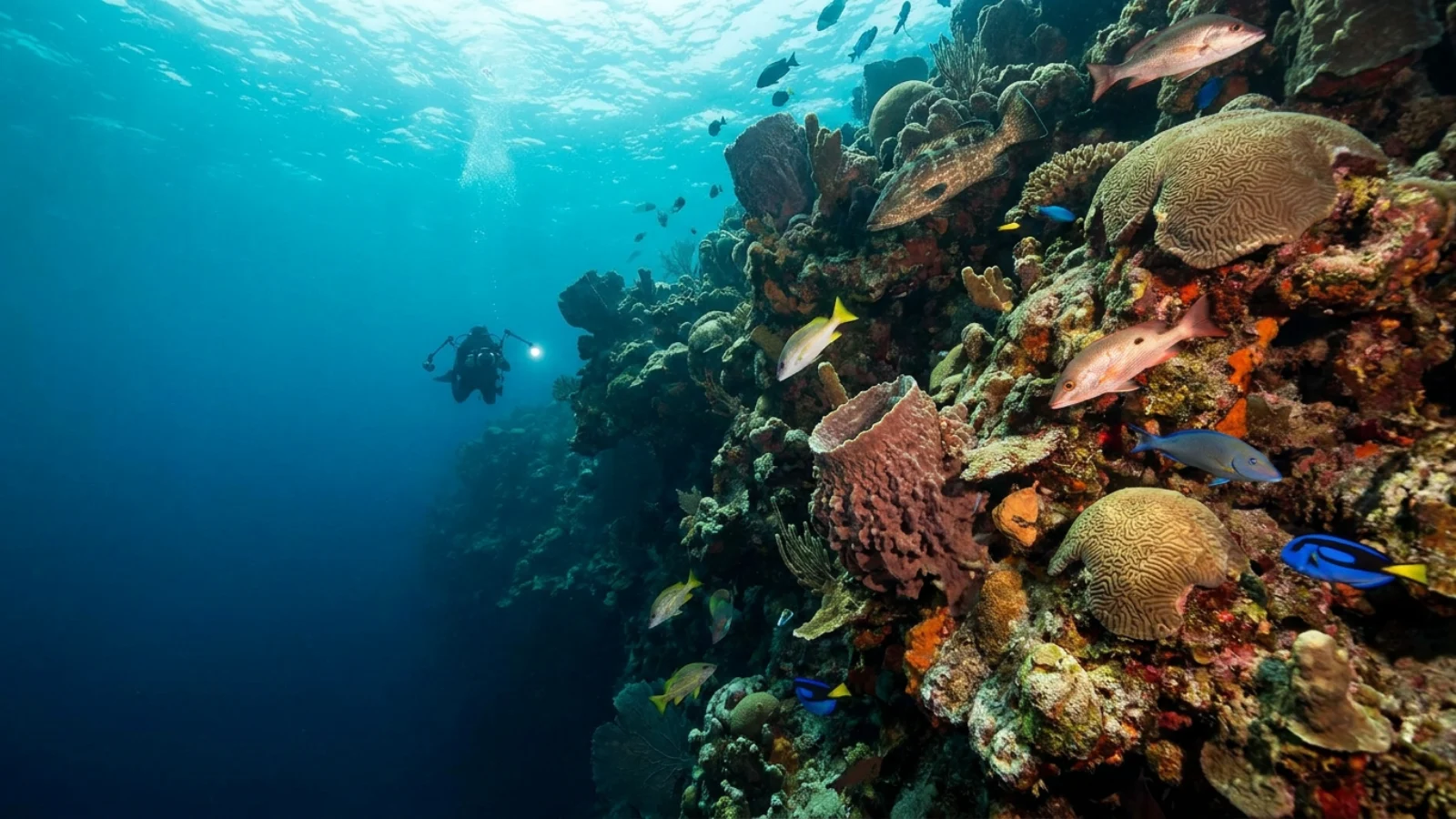
- Fore reef – spur-and-groove formations, staghorn coral and sea fans from about 3 m to 20 m.
- The Wall – the lip of the drop into the Tongue of the Ocean, at roughly 21–37 m.
On a single morning you can snorkel shallow reef in the lagoon and then make a boat dive along the top of a wall with open blue water below. Recreational divers stay near the lip; the wall itself continues far beyond any safe sport-diving depth.
What is the Tongue of the Ocean?
A deep, almost enclosed basin that cuts into the Great Bahama Bank between Andros and New Providence; its steep western edge forms the Andros wall.
The Tongue of the Ocean is a long, U-shaped basin with a fairly flat floor, roughly 30 km wide and well over 200 km long, deepening from about 1,100 m in the south to about 2,000 m in the north. It opens to the Atlantic only at its northern end. Geologists see it as one branch of the Great Bahama Canyon. As the Bahamas platform slowly subsided over millions of years, the banks kept building upward with reef and sediment and stayed near sea level, while the basins between them did not keep pace, leaving deep troughs between flat-topped banks. Upwelling from the deep water is thought to help feed the reef.
Because it is so sheltered and quiet, the Tongue has long been used by the US Navy. The Atlantic Undersea Test and Evaluation Center (AUTEC) has operated there since the 1960s, with its main base on Andros, testing sonar and underwater systems. In 1970 Jacques-Yves Cousteau brought Calypso to explore the Tongue of the Ocean and the island’s blue holes; read more in Cousteau and the Blue Hole.
The blue holes of Andros
Andros has the world’s best-known collection of blue holes, the openings of flooded caves that run through the limestone beneath the island and the sea floor.
Estimates put the number at about 175 on land and more than 50 in the sea, most of the marine ones along the inside of the barrier reef. The caves formed during ice ages when sea level was far lower and rainwater dissolved passages through exposed rock; when the sea rose they flooded. Some passages run sideways for kilometres, and shafts range from a few metres to well over 100 m deep.
Ocean blue holes breathe with the tide. On the flood, seawater pours in, sometimes strongly enough to pull in anything nearby; on the ebb it flows back out, sometimes carrying water from deep in the caves with its own unusual microbial life. Inland blue holes are layered: rain-fed fresh water floats on salt water, and below the boundary many holes are oxygen-free and rich in hydrogen sulphide, preserving fossils and Lucayan remains remarkably well. Andros folklore blames the whirlpools over ocean holes on the Lusca, a legendary creature said to be half shark and half octopus. Penetrating the caves is technical cave diving; recreational divers should only look into the openings with a guide, and only at slack tide.
What marine life lives on the Andros reef?
Classic Caribbean reef life, fed by mangrove nurseries on one side and deep ocean water on the other.
The reef has brain corals, sea rods, sea fans, giant tube and barrel sponges, and remnants of the elkhorn and staghorn coral that once dominated it. Reef fish include queen triggerfish, blue tang, hamlets, hogfish, parrotfish, groupers and snappers, and divers regularly see green, loggerhead and hawksbill turtles. Reef sharks and eagle rays patrol the wall, and open-ocean fish such as tuna, wahoo and dolphinfish pass by in the deep water.
Mangrove creeks, tidal estuaries and the shallow flats act as nurseries for young fish and invertebrates, which later move out to the reef. On land, Andros has the endangered Andros iguana and the Bahama oriole, found only on Andros, and the greatest plant diversity in the country, including dozens of wild orchids.
How healthy is the Andros Barrier Reef?
Like reefs across the Caribbean, it has lost much of its branching coral since the 1980s, but its remoteness gives it real advantages.
Elkhorn and staghorn coral declined sharply across the region from the 1980s through disease, bleaching and storms. More recently, stony coral tissue loss disease, first reported in Florida in 2014, has spread through much of the Caribbean, killing large numbers of brain, pillar and star corals. Hurricanes are a recurring hazard; Hurricane Matthew in 2016 caused widespread damage on North Andros.
On the positive side, the island’s small population and limited development mean less runoff, fishing pressure and diver traffic than on busier islands. In 2002 the Bahamas created its first national parks and marine protected areas on Andros, including Central Andros National Park, supported by the Bahamas National Trust and local conservation groups. Protecting the mangroves, the flats and the island’s freshwater aquifers protects the reef too.
Diving Andros: history, access and the best time to go
Andros was a pioneer of dive tourism, and it remains a quiet, uncrowded place to dive.
In 1960 Small Hope Bay Lodge opened near Fresh Creek, the first dive resort in the Bahamas and one of the first dive-dedicated resorts anywhere. Another early dive lodge at Blanket Sound later became the Forfar Field Station, which brings school and university groups to study the reef, mangroves and island ecology. Long before that, sponge fishing on the bank west of the island was a major Bahamian industry until a die-off in the late 1930s wiped out the sponge beds.
Most visitors fly from Nassau, a short hop to one of the island’s small airports, or take the ferry. There is little public transport, so plan on taxis or a hire car and stay close to your dive operator. Winter, roughly December to April, is drier and cooler; summer is hotter and more humid and overlaps with the June to November hurricane season. Calm days are best for the wall and the ocean blue holes, while the lagoon is often diveable when the outer reef is too rough.
How long is the Andros Barrier Reef?
About 225 km (140 miles), running roughly 2–3 km off the east coast of Andros. It is the largest reef in the Bahamas.
Is the Andros reef the third-largest barrier reef in the world?
It is often called that, after the Great Barrier Reef and the Mesoamerican Reef. Measured by length alone, it ranks around sixth.
How deep is the Tongue of the Ocean?
It deepens from about 1,100 m in the south to about 2,000 m (6,600 ft) in the north, and its western edge forms the Andros wall.
How many blue holes does Andros have?
Roughly 175 inland and more than 50 in the sea, the world’s best-known collection of blue holes.
Can you snorkel the Andros Barrier Reef?
Yes. The lagoon side is calm and shallow with patch reefs and seagrass. The outer reef and the wall are for divers, ideally with a local guide.
How do you get to Andros?
By a short flight from Nassau to one of the island’s small airports, by charter from Florida, or by ferry from Nassau.
Is Andros good for beginner divers?
Yes, inside the reef. The lagoon and shallow fore reef suit beginners, while the wall and ocean blue holes are for experienced divers in calm conditions.
- Iwanowicz, D.D. et al. (2021). Novel microbiome dominated by Arcobacter during anoxic excurrent flow from an ocean blue hole in Andros Island, The Bahamas. PLoS ONE 16.
- Bahamas National Trust: Andros national parks.
- Tongue of the Ocean and the Great Bahama Canyon: published geological summaries.
- Atlantic Undersea Test and Evaluation Center (AUTEC): history and ranges.
Blane Perun has been exploring Earth’s oceans and marine life for over 25 years. Founder of TheSea.Org in 1999, underwater photographer, coral aquaculture pioneer, and explorer of 80+ countries.
About Blane Perun → More Top Ten Coral Reefs →