Mariana Snailfish — Pseudoliparis swirei
The Mariana snailfish is the deepest-living fish ever recorded, found at depths exceeding 8,100 metres in the Mariana Trench. A pale, gelatinous member of the family Liparidae, it thrives where pressure exceeds 800 atmospheres and no other vertebrate has been confirmed to survive — making it one of the most extreme deep-sea fish ever discovered.
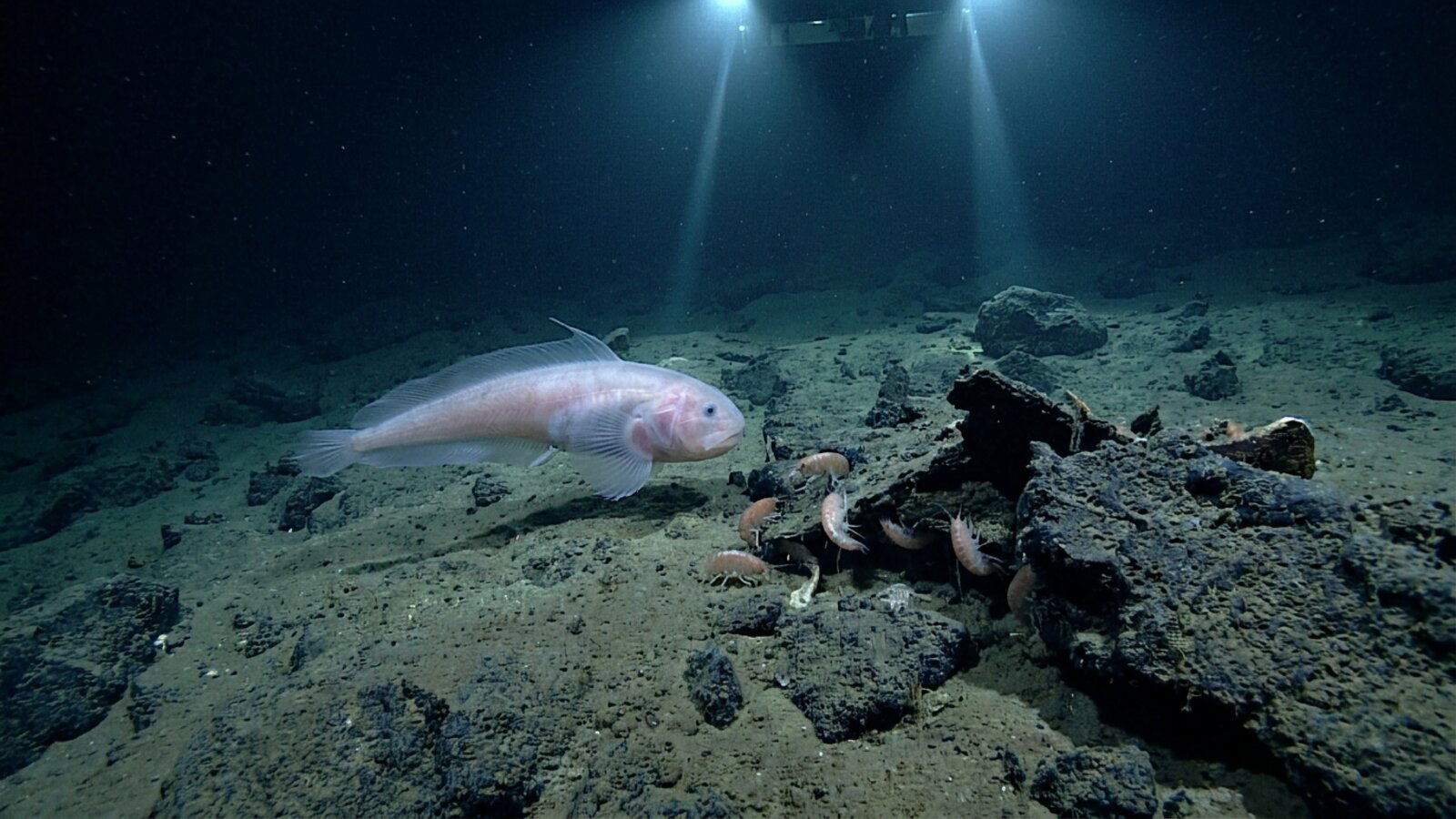
At 8,100 metres below the Pacific Ocean surface, in total darkness and under pressure that would crush most living things, a pale, tadpole-shaped fish glides through the water hunting amphipods. The Mariana snailfish is not the alien-looking, fang-toothed monster that most people imagine when they think of deep-sea fish. It is small, translucent, and rather delicate-looking — and yet it is the most extreme vertebrate on Earth.
The Deepest Vertebrate on Earth
Formally described in 2017 by Gerringer et al., Pseudoliparis swirei is named after Herbert Swire, an officer on HMS Challenger during the 1872–1876 expedition that first sounded the Mariana Trench. The species was discovered using baited camera traps and lander systems deployed to the hadal zone of the trench.
The current depth record for a living fish is held by an unidentified snailfish filmed at 8,336 metres in the Mariana Trench in 2023. The deepest confirmed specimen of Pseudoliparis swirei was collected from 8,022 metres. Both records surpass the theoretical maximum depth for fish life based on biochemical constraints — a limit that had to be revised upward in light of these discoveries.
How It Survives the Pressure
The crushing hydrostatic pressure of the deep ocean is the central challenge for any organism living at hadal depths. Proteins and cellular membranes are vulnerable to pressure-induced deformation that disrupts their function. Most organisms cannot adapt to pressures above 400–500 atmospheres.
The Mariana snailfish has evolved several key adaptations. Its tissues contain high concentrations of trimethylamine oxide (TMAO), a pressure-stabilizing compound that counteracts the destabilizing effects of pressure on proteins. The concentration of TMAO in snailfish tissues increases with depth — deeper-living populations have more TMAO. This same compound is responsible for the fishy smell associated with seafood; in deep-sea fish it is present in far higher concentrations than in shallow-water species.
Feeding and Behavior
The Mariana snailfish feeds primarily on small crustaceans, particularly amphipods of the genus Hirondellea, which are themselves among the dominant animals in the hadal zone. Snailfishes have been filmed actively hunting and capturing these amphipods in baited trap footage. They are apparently highly active and competitive feeders — surprising given their extreme environment.
Snailfishes are among the apex predators of the hadal zone. Because few other vertebrates can survive at these depths, and because amphipods aggregate in enormous numbers around organic falls on the trench floor, snailfish have abundant food and few competitors. This may explain why snailfish — not the larger, more dramatic deep-sea species — have pushed further into the hadal zone than any other fish.
Snailfish Family: Liparidae
The family Liparidae contains over 400 species of snailfishes, distributed from shallow coastal waters down to the hadal zone. Multiple snailfish species have evolved independently in different ocean trenches — the Japan Trench, the Kermadec Trench, the Atacama Trench — suggesting that the hadal zone presents ecological opportunities that snailfishes are uniquely positioned to exploit.
The body plan is consistent across the family: elongated, tadpole-shaped, scaleless, with large pectoral fins and a continuous dorsal-caudal-anal fin running around the rear of the body. The gelatinous texture of the flesh reflects the water-rich, low-density tissue structure that allows the fish to survive without a swim bladder at extreme depths.
Related on TheSea
What is the deepest fish ever recorded?
The deepest fish ever filmed was an unidentified snailfish captured on camera at 8,336 metres in the Mariana Trench in 2023. The deepest confirmed specimen ever physically collected is Pseudoliparis swirei, the Mariana snailfish, taken from 8,022 metres. Both records are held by members of the family Liparidae.
How does the Mariana snailfish survive such extreme pressure?
The Mariana snailfish accumulates high concentrations of trimethylamine oxide (TMAO) in its tissues — a compound that stabilizes proteins and cellular membranes against pressure-induced deformation. TMAO concentrations increase with depth in snailfish populations. The fish also lacks a swim bladder and achieves neutral buoyancy through water-rich, gelatinous tissue rather than gas.
What does the Mariana snailfish eat?
The Mariana snailfish feeds primarily on amphipods — small crustaceans that are abundant in the hadal zone, especially around organic material that sinks to the trench floor. Snailfishes have been filmed actively pursuing and catching amphipods in baited trap footage deployed to the Mariana Trench.
Is there a depth limit for fish?
There is a theoretical biochemical depth limit for fish based on TMAO concentration — as TMAO levels needed to counteract pressure increase, they eventually reach concentrations that disrupt cellular function through osmotic effects. Earlier estimates placed this limit at around 8,200 metres, but the 2023 filming at 8,336 metres has pushed that estimate higher. The true maximum depth for fish life is still uncertain.
Why are snailfish so successful in the deep ocean?
Snailfish are small, flexible, and require less energy than larger fish. They have no swim bladder to maintain, reducing the energetic cost of pressure management. Their gelatinous bodies cope better with pressure than rigid structures. In the hadal zone, they face minimal competition from other vertebrates and exploit abundant amphipod prey, making them the dominant vertebrate predators of the deepest ocean.
Blane Perun has been exploring Earth’s oceans, coral reefs, and marine life for over 25 years. Founder of TheSea.Org in 1999, underwater photographer, coral aquaculture pioneer, and explorer of 80+ countries.
About Blane Perun → More on Bizarre Sea Creatures →