Is There a Real Sunken Pirate City? — Port Royal, and the Legends That Grew Around It
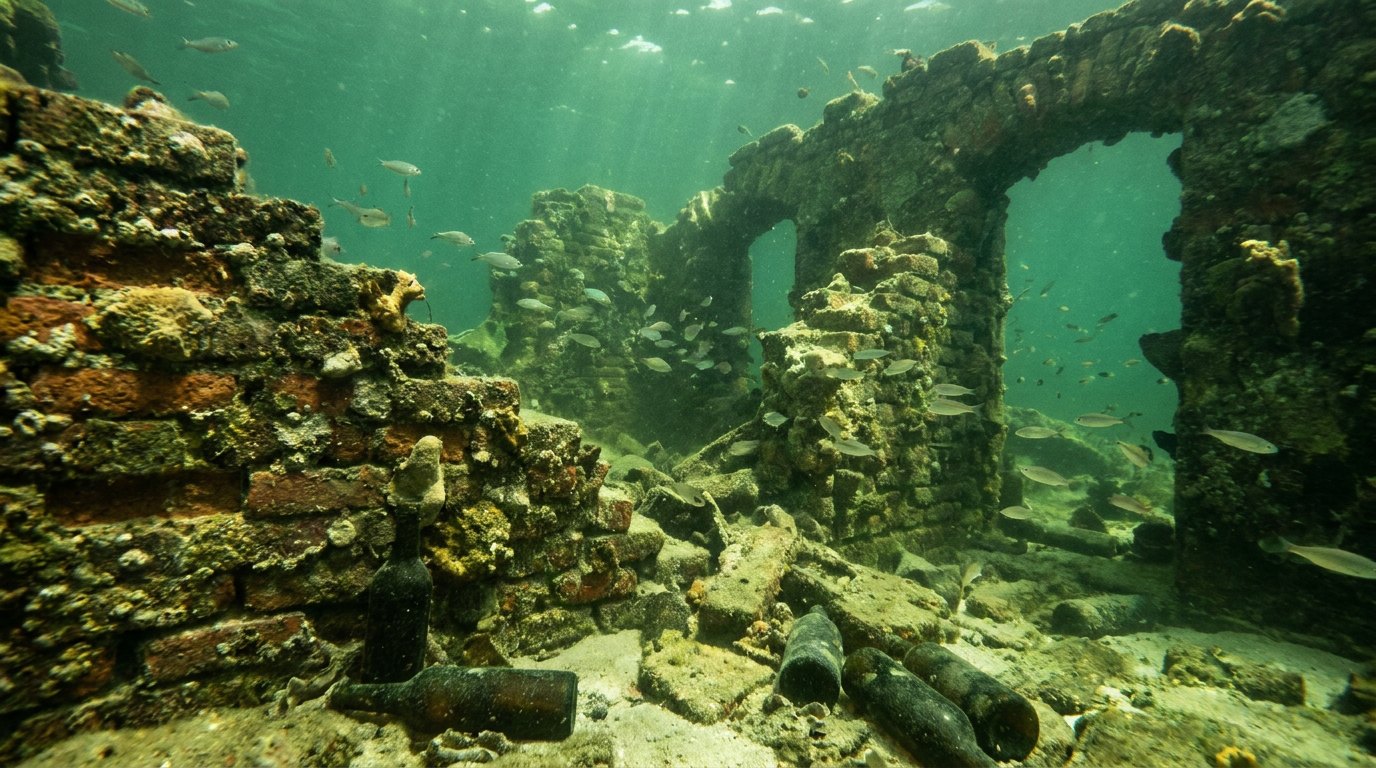
Yes. The real sunken pirate city is Port Royal, Jamaica, base of buccaneers such as Henry Morgan and once called the wickedest city on Earth. On 7 June 1692 an earthquake liquefied its sandy ground and about two-thirds of the town slid into Kingston Harbour, where it still lies 1–12 m down. It is not a cursed hoard of gold, though: archaeologists found taverns, houses, pewter, bottles and a pocket watch stopped at 11:43, and in 2025 the site became a UNESCO World Heritage Site.
Why do people talk about a “sunken pirate city”?
Because the legend has a real core. In the 1660s to 1680s Port Royal was the main English base for buccaneers raiding Spanish shipping, and plunder made it one of the richest towns in the Americas, with taverns, gambling dens and a reputation to match. When the sea swallowed most of it in a single morning, preachers called it divine judgement, and the story of a wicked pirate city drowned with its gold has been retold ever since in novels, films and games. This page looks at the legend; for the full history of the town see our Port Royal profile.
Was Port Royal still a pirate city when it sank?
Not really. Its buccaneering heyday had largely ended by the 1680s, when England made peace with Spain and the colonial government turned on the raiders. Henry Morgan himself became lieutenant governor and hunted pirates before he died in 1688. By 1692 Port Royal was mainly a booming merchant port, trading sugar, goods and, grimly, enslaved Africans. The pirate label stuck because the money that built it came from the sea raids of the previous generation.
| Year | Event |
|---|---|
| 1655 | England captures Jamaica |
| 1660s–1680s | Port Royal is the main buccaneer base |
| 1671 | Henry Morgan sacks Panama City |
| 1688 | Morgan dies at Port Royal |
| 7 June 1692 | Earthquake; two-thirds of the town sinks |
| 1981–1990 | Texas A&M / INA underwater excavations |
| 2025 | Inscribed as a UNESCO World Heritage Site |
Was pirate treasure found in sunken Port Royal?
Not the chests of doubloons of legend. Because buildings sank fast with their contents, archaeologists found something more useful: whole rooms frozen on one day in 1692, with pewter plates, ceramics, glass bottles, clay pipes, tools, food remains and some coins. The pocket watch stopped at 11:43 is the most famous single find. The wealth that made Port Royal rich was mostly spent, banked or shipped home long before the earthquake. For real gold from the deep, see shipwreck treasure.
Are there real sunken pirate ships?
Yes, a handful. The Whydah Gally, Samuel Bellamy’s ship, wrecked off Cape Cod on 26 April 1717. Barry Clifford found it in 1984, and its bell, inscribed “THE WHYDAH GALLY 1716”, came up in 1985, making it the first fully authenticated Golden Age pirate wreck. Blackbeard’s Queen Anne’s Revenge was found off Beaufort Inlet, North Carolina, in 1996 and confirmed by the state in 2011. Neither is a city, but together with Port Royal they are where pirate legend meets hard evidence.
How exactly did Port Royal sink?
Through liquefaction. Port Royal was built on a sand spit, and when the earthquake shook the waterlogged sand it briefly behaved like a liquid, so buildings, streets and people slid or sank into the harbour.
The town sat at the tip of the Palisadoes, a long, narrow ridge of sand and gravel that shelters Kingston Harbour. Much of the waterfront had been extended with fill, and heavy brick buildings stood on loose, saturated sediment only a short distance above sea level. When the earthquake struck shortly before noon, the shaking raised water pressure in the sand, the ground lost its strength, and whole blocks along the harbour edge slumped into deeper water. Eyewitness accounts describe streets collapsing and the sea rushing in within minutes. Some buildings sank almost upright, which is why archaeologists later found walls still standing and rooms with their contents in place.
Disease and looting followed in the days and weeks after the disaster, and many more people died. Survivors moved across the harbour, and the settlement they built there grew into Kingston, today Jamaica’s capital. Port Royal itself was rebuilt on a smaller scale, then hit again by a fire in 1703, by hurricanes and by another major earthquake in 1907.
Who has explored the sunken city?
Divers and archaeologists have worked on the site since the mid-20th century, moving from early salvage-style digs to careful scientific excavation.
Early dives in the late 1950s and 1960s, including work by the underwater explorer Edwin Link and later the diver and author Robert Marx, brought up large numbers of artefacts and drew attention to the site, but methods at the time recorded less context than modern archaeology requires. From 1981 to 1990, the Institute of Nautical Archaeology and Texas A&M University ran a long-term project that excavated buildings street by street, mapping walls, floors and finds in detail. That work turned Port Royal into one of the best-documented underwater urban sites in the world, and it is the main reason the site is so valuable to historians of the 17th-century Caribbean.
Because objects were sealed quickly in silt and sand, the site preserves organic materials and everyday items that rarely survive on land. That is why Port Royal is sometimes described as a “Pompeii of the New World”: a snapshot of ordinary urban life on a single day, rather than a treasure vault.
What was life like in pirate-era Port Royal?
Crowded, wealthy and rough. In its prime it was one of the largest and busiest English towns in the Americas.
Port Royal’s growth came from its harbour and its position close to Spanish trade routes. English authorities encouraged buccaneers and privateers, often with official commissions, because their raids weakened Spain and helped defend the young colony. Captains such as Henry Morgan sailed from the town, and returning crews poured money into taverns, shops, goldsmiths and lodging houses. Brick and timber buildings stood close together on the narrow spit, and fresh water had to be brought in because the sand held none.
The town’s wealth also came from trade in sugar and from the transatlantic slave trade, which became increasingly important as buccaneering declined. Any honest picture of Port Royal includes that side of its story as well as the romance of piracy that later writers built around it.
Are there other sunken cities people confuse with a pirate city?
Yes. Several genuine underwater cities exist around the world, but none of them are linked to pirates.
| Site | Where | Why it is underwater |
|---|---|---|
| Port Royal | Jamaica | 1692 earthquake and liquefaction |
| Heracleion (Thonis) | Abu Qir Bay, Egypt | Ground subsidence, floods and earthquakes over centuries |
| Pavlopetri | Southern Greece | Gradual sea-level rise and ground movement |
| Baiae | Bay of Naples, Italy | Slow volcanic ground sinking (bradyseism) |
Tortuga and Nassau, the other famous pirate havens, never sank. Port Royal is the only one where the legend of a drowned pirate city and the archaeology line up. See Heracleion artifacts for a very different kind of sunken city.
Can you dive the sunken pirate city?
Only with permission. The submerged town is protected and managed by the Jamaica National Heritage Trust, and the water in the harbour is usually murky. Visitors can walk the surviving part of Port Royal, see Fort Charles and the tilted Giddy House, and dive reefs elsewhere on the island; see Jamaica coral reef maps.
Is there a real sunken pirate city?
Yes. Port Royal, Jamaica, a famous buccaneer haven, largely sank in an earthquake on 7 June 1692.
Where is the sunken pirate city?
In Kingston Harbour, Jamaica, at the end of the Palisadoes spit.
How did the pirate city sink?
An earthquake liquefied the sandy ground and about two-thirds of the town slid into the harbour within minutes.
Was pirate treasure found at Port Royal?
No legendary treasure, but thousands of everyday objects, some coins and a famous pocket watch stopped at 11:43.
Can you visit sunken Port Royal?
You can visit the surviving town; diving the submerged ruins requires permission from the Jamaica National Heritage Trust.
Is Port Royal a World Heritage Site?
Yes. “The Archaeological Ensemble of 17th Century Port Royal” was inscribed by UNESCO in July 2025.
What is the most famous pirate shipwreck?
The Whydah Gally, sunk off Cape Cod in 1717 and found in 1984, the first authenticated Golden Age pirate wreck.
Is the sunken pirate city in Pirates of the Caribbean real?
The films are fiction, but Port Royal is a real town that appears in them and really did sink in 1692.
- Jamaica Information Service (July 2025): Port Royal now a World Heritage Site.
- Texas A&M University / Institute of Nautical Archaeology: Port Royal Project (1981–1990).
- Whydah Gally: Barry Clifford discovery (1984) and bell recovery (1985).
- North Carolina Department of Natural and Cultural Resources: Queen Anne’s Revenge project.
Blane Perun has been exploring Earth’s oceans and marine life for over 25 years. Founder of TheSea.Org in 1999, underwater photographer, coral aquaculture pioneer, and explorer of 80+ countries.
About Blane Perun →