Mission 31 — Fabien Cousteau’s Month Living Under the Sea
Mission 31 was a 2014 undersea expedition in which Fabien Cousteau, grandson of Jacques Cousteau, lived for 31 days in the Aquarius Reef Base, an underwater laboratory 63 ft (19 m) deep, about 9 miles off Key Largo by most mission accounts (Wikipedia’s Aquarius article gives 5.4 miles), in the Florida Keys. Running from June 1 to July 2, 2014, it honored, and by one day outlasted, Jacques Cousteau’s 30-day Conshelf II undersea village in the Red Sea in 1963.
It was more than a stunt. The crew of aquanauts, joined by researchers from Florida International University, Northeastern University and MIT, ran experiments on coral reef health, ocean acidification and predator behavior, while broadcasting live to classrooms around the world.
What is the Aquarius habitat?
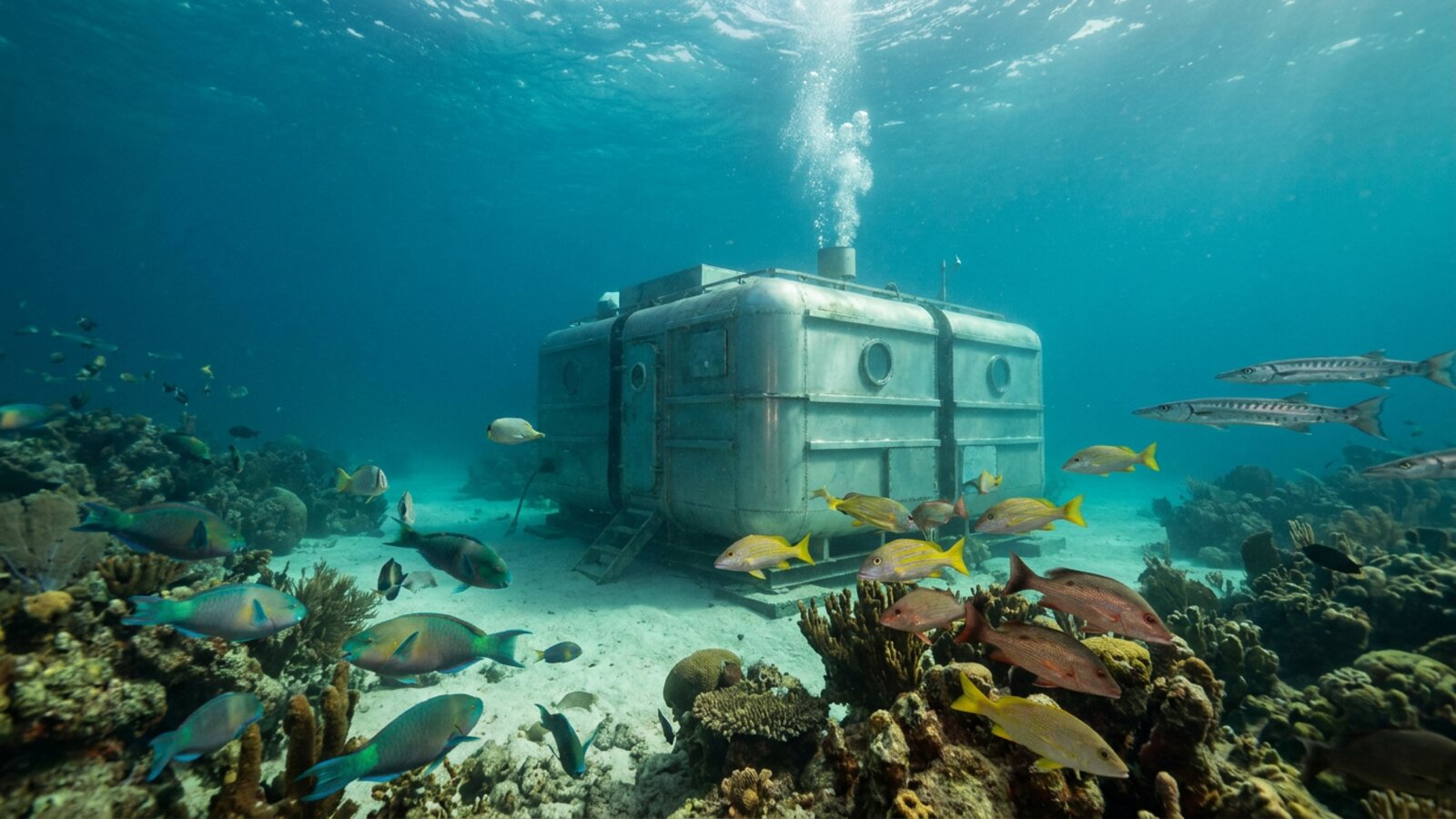
Aquarius is an undersea laboratory, owned by NOAA at the time of the mission and operated by Florida International University, sitting on the seafloor in the Florida Keys National Marine Sanctuary near Key Largo. It measures about 43 × 20 × 16.5 ft (13 × 6 × 5 m), weighs about 81 tons, and holds up to six people in bunks, with a small kitchen, hot water, computers and internet. Because aquanauts live at the pressure of the surrounding water, they become fully saturated after about 24 hours and can dive for up to nine hours a day, then need a long decompression, roughly 16 to 18.5 hours depending on the source, at the end of the mission.
How does saturation diving work?
Every breath a diver takes at depth pushes extra nitrogen into the blood and tissues, and the deeper and longer the dive, the more gas dissolves. On a normal dive from a boat, that gas has to come out slowly on the way back up, which is why surface dives at Aquarius’s depth are usually limited to an hour or two. After about 24 hours at the same pressure, however, the body’s tissues hold as much gas as they can: they are saturated. From then on, the decompression needed at the end no longer depends on how long the diver stays. One long decompression at the end of a mission can cover a day, a week or a month underwater.
That is the principle behind Aquarius. Its wet porch is open to the sea through a moon pool, a hole in the floor kept dry by air at the same pressure as the surrounding water, about 2.6 atmospheres. The main living compartment is built strongly enough to hold surface pressure but is normally kept somewhere in between, and a small entry lock between the two works as an airlock. Aquanauts can swim out through the moon pool for dives of up to nine hours, refilling their tanks at way stations on the reef, then return to the habitat without any decompression stops.
At the end of a mission the whole main compartment becomes a decompression chamber. The pressure is lowered slowly while the crew stays inside, so they can climb to the surface when the hatch opens without needing a separate chamber. Sources differ on how long this took for Mission 31: National Geographic gave about 18.5 hours, Wikipedia’s account of the mission says the crew underwent 16 hours of decompression, and Wikipedia’s article on Aquarius gives a standard figure of 17 hours. The crew spent part of that time watching World Without Sun, the film of Jacques Cousteau’s own undersea experiment.
Why was Aquarius under threat in 2014?
Aquarius had been owned by NOAA and run for many years by the University of North Carolina Wilmington. Budget cuts ended NOAA’s funding after September 2012, and the last mission scheduled under that arrangement, in July 2012, included Sylvia Earle among its crew. Supporters set up a foundation to try to keep the laboratory alive, and in January 2013 a proposal for Florida International University to run it was accepted. FIU took over operations in 2013 and took ownership of the habitat in October 2014, a few months after Mission 31 ended.
Fabien Cousteau got the idea for Mission 31 while visiting Aquarius during a fundraiser held to keep it running. The mission was first planned for November 2013, 50 years after Conshelf II, but was postponed when the US federal government shut down in October 2013. It cost an estimated US$1.8 million, paid for through corporate sponsors, private donations and a crowdfunding campaign. Running Aquarius itself cost about $15,000 a day. One of its two stated goals was to raise money and attention for the laboratory; the other was to gather scientific data.
Who took part in Mission 31?
Fabien Cousteau, Mark “Otter” Hulsbeck and Ryan LaPete stayed for the full 31 days. The first-half science team, including filmmaker Kip Evans and FIU students Andy Shantz and Adam Zenone, was replaced midway by Matt Ferraro, Northeastern research diver Liz Magee and MIT ocean engineer Grace C. Young. About 36 scientists and support staff worked at the surface, and visitors included ocean explorer Sylvia Earle and retired NASA astronaut Clay Anderson.
What did Mission 31 study?
| Research area | What the team did |
|---|---|
| Climate change and acidification | Installed sensors to monitor ocean chemistry |
| Sponge physiology | Placed oxygen and temperature sensors inside giant sponges |
| Predator–prey behavior | Used helmet-mounted sonar and high-speed cameras |
| Fish sound | Filmed groupers producing sound pulses |
| Reef invertebrates | Filmed feeding by Christmas tree worms and others |
Fabien Cousteau estimated the team gathered the equivalent of two years of surface-based diving data, enough for about ten scientific papers.
What was daily life like inside Aquarius?
The habitat has six bunks, a small galley and laboratory space, and is tethered to a large buoy on the surface that supplies power, air and communications. A topside team, led by Roger Garcia and Tom Potts according to Divers Alert Network’s Alert Diver magazine, watched over the crew around the clock, and US Navy divers brought supplies down each day. For most of the crew, Fabien Cousteau included, Mission 31 was their first saturation dive. Wake-up calls came as early as 4:30 a.m. for experiments that had to start at first light.
Space was tight, so the crew ate mainly astronaut-style packaged food. Early in the mission the air conditioning failed, and temperatures inside reached about 35 °C (95 °F) at 95 percent humidity until it was repaired. The crew took part in physiological and psychological tests on the effects of long confinement without sunlight, and wore bands that tracked their light exposure, activity and sleep. Cameras streamed the mission online 24 hours a day, though they were switched off at times for privacy. Besides Sylvia Earle and Clay Anderson, day visitors included Fabien’s father, Jean-Michel Cousteau, his sister Céline and actor Ian Somerhalder.
What did the aquanauts see on the reef?
Long bottom times and night dives let the team watch reef life that surface divers rarely see for long. Wikipedia’s account lists eels, mantis shrimp, octopus, porkfish, snook, sponges, spotted eagle rays, starfish, tarpon and reef sharks among the animals encountered. Night dives revealed clouds of plankton, Caribbean reef squid, barracuda and a loggerhead turtle. One of the most striking sights was an Atlantic goliath grouper attacking a barracuda, which one of the scientists said was something he had never imagined happening. To avoid disturbing animals with bright lights, some filming used sonar cameras.
How did Mission 31 compare with Conshelf II?
In 1963 Jacques Cousteau’s team lived for 30 days in Conshelf II, a cluster of underwater structures on a reef in the Red Sea off Sudan, an experiment that proved long-term saturation living was possible and became the Oscar-winning film World Without Sun. Mission 31 was one day longer and about 30 ft deeper than Conshelf II’s main habitat. Fabien Cousteau framed it as a tribute: the grandson finishing a conversation his grandfather had started fifty years earlier.
A short history of living under the sea
The idea that people could live for long periods at sea-floor pressure was tested first in the laboratory. In 1957 US Navy physician George F. Bond began the Genesis project at the Naval Submarine Medical Research Laboratory, showing that humans and animals could tolerate long exposure to raised pressure and different breathing gases. Bond is often called the father of saturation diving.
Jacques Cousteau’s Precontinent, or Conshelf, programme took the idea into the sea. Precontinent I was set up off Marseille in 1962. Conshelf II followed in 1963 in the Red Sea off Sudan, where a team lived for 30 days in a star-shaped house at about 10 m while two men spent a week in a deeper cabin at about 30 m. A third station came a few years later, after which Cousteau turned away from the idea of exploiting the seabed and towards conservation.
The US Navy ran its own SEALAB series at the same time. SEALAB I was lowered off Bermuda on 20 July 1964 to 59 m. SEALAB II went down in 1965 in the La Jolla Canyon off California at 62 m, where teams stayed 15 days each and former astronaut Scott Carpenter stayed 30; a Navy bottlenose dolphin named Tuffy was trained, with mixed success, to carry supplies and messages between the surface and the habitat. In 1969 the Tektite habitat in Great Lameshur Bay, St John, US Virgin Islands, kept four aquanauts down for more than 58 days. The following year, during Tektite II, a team led by Sylvia Earle became the first all-female saturation diving crew.
Aquarius came later. Designed by Perry Submarine Builders and built in Victoria, Texas, in 1986, it was originally named the George F. Bond in honour of the saturation pioneer. It was first deployed in the US Virgin Islands, damaged by Hurricane Hugo in 1989, refurbished in Wilmington, North Carolina, and placed on Conch Reef in the Florida Keys in 1993. Several other habitats were built around the world, but by the time of Mission 31 Aquarius was widely described as the only undersea research laboratory still operating. A typical Aquarius mission lasted about ten days, and before Mission 31 the longest had lasted 18, so a 31-day stay was a real test of the habitat, its life-support systems and its crew.
Was Mission 31 the longest time anyone has lived underwater?
No. Mission 31 beat Jacques Cousteau’s 30 days, but not the overall record. At the time, Guinness World Records listed the longest stay in a fixed underwater environment as 73 days, 2 hours and 34 minutes. Since then the record has moved further. In 2023 American diver Joseph Dituri spent 100 days in an underwater lodge in a shallow lagoon in Key Largo, Florida. On 24 January 2025 German engineer Rüdiger Koch emerged after 120 days in a capsule about 11 m below the surface off the coast of northern Panama, a record recognised by Guinness for living underwater without depressurisation. Both of those habitats were far shallower than Aquarius, and neither was a saturation science mission.
How dangerous is Aquarius?
Living on the seabed in hurricane country carries real risks. In 1994, during Hurricane Gordon, a crew had to evacuate and climb a rescue line to the surface in seas of about 4.6 m after one of the habitat’s generators caught fire. In 1998 Hurricane Georges broke a joint in one of the habitat’s legs and shifted two 3,600 kg weights nearly off the structure. Hurricane Rita in 2005 broke two seabed anchors and moved one end of the habitat by about 3.7 m, and in 2017 Hurricane Irma tore the 43,000 kg life-support buoy from its moorings and carried it about 23 km away. In May 2009 a diver, Dewey Smith, died during a dive from Aquarius; an investigation found that several factors contributed, including the failure of his closed-circuit rebreather’s electronics.
Why does NASA train astronauts at Aquarius?
Since 2001, NASA has used Aquarius for its NEEMO (NASA Extreme Environment Mission Operations) missions, usually lasting 7 to 14 days. A small crew in a cramped, isolated habitat, dependent on life support and unable to leave quickly, faces many of the same problems as a spacecraft crew. Outside, aquanauts can practise spacewalk techniques, and by adjusting their weights divers can simulate the lower gravity of the Moon, Mars or an asteroid. Clay Anderson, who had trained in Aquarius in 2003, made a short visit during Mission 31, limited to about 45 minutes, the length of an ordinary dive to that depth, was a reminder of the difference between visiting the habitat and living in it.
Why did Mission 31 matter?
It showed how much fieldwork saturation living allows, and it brought reef science to a huge audience at a time when Aquarius itself was under threat of losing federal funding. The mission was streamed live around the clock and included more than 50 classroom video sessions by late June across the US, Canada, Australia, Kenya and the Czech Republic. For Jacques Cousteau’s own legacy, see his accomplishments and discoveries.
What happened after Mission 31?
The mission’s organisers said around 330 million people heard about it while it was under way, and the team made 31 videos. National Geographic reported more than 50 educational video sessions by late June, and Alert Diver later put the total at 70 sessions with schools, universities, camps and media. In 2016 Fabien Cousteau founded the Fabien Cousteau Ocean Learning Center, a nonprofit focused on ocean education and restoration. He has also proposed Proteus, a planned underwater research station off Curaçao at a depth of about 20 m in a marine protected area. Aquarius, meanwhile, remains in use under FIU for research, training and NASA missions. For Fabien’s place in three generations of ocean explorers, see Jacques Cousteau’s family; for how the founder’s own story ended, how Jacques Cousteau died.
What was Mission 31?
A 31-day undersea expedition led by Fabien Cousteau in the Aquarius habitat off Key Largo, Florida, from June 1 to July 2, 2014.
How deep was Mission 31?
The Aquarius habitat sits at about 63 ft (19 m).
Who is Fabien Cousteau?
An ocean explorer and filmmaker, grandson of Jacques Cousteau and son of Jean-Michel Cousteau.
Why was it called Mission 31?
It lasted 31 days, one day longer than Jacques Cousteau’s 30-day Conshelf II experiment in 1963.
What is Aquarius?
An underwater research laboratory owned by NOAA and operated by Florida International University in the Florida Keys National Marine Sanctuary.
What did Mission 31 research?
Climate change, ocean acidification, pollution, sponge physiology and predator–prey behavior on coral reefs.
Was Mission 31 a world record?
It set a Cousteau family record. It was not the longest time anyone has lived underwater.
How long did decompression take after Mission 31?
Roughly 16 to 18.5 hours; National Geographic gave about 18.5 hours, other accounts 16 to 17.
- Wikipedia: Mission 31 (dates, crew, Aquarius, records).
- National Geographic (2014): Fabien Cousteau and the Mission 31 aquanauts.
- NPR (2014): Jacques Cousteau’s grandson plans to spend a month underwater.
- National Geographic (24 June 2014): Fabien Cousteau and the Mission 31 aquanauts (sponge sensors, grouper sound, 36 surface staff, 18.5-hour decompression, habitat size and weight).
- Divers Alert Network, Alert Diver: Mission 31 — An Aquanaut’s Journey (topside team, Navy resupply, 70 Skype sessions, 31 videos).
- Wikipedia: Aquarius Reef Base (history, NOAA funding cut 2012, FIU ownership 2014, hurricanes, NEEMO, 17-hour decompression).
- Wikipedia: SEALAB; Tektite habitat; Conshelf; Saturation diving (George F. Bond, Genesis project).
- RNZ / AFP (25 January 2025): Rüdiger Koch spends 120 days underwater off Panama, surpassing Joseph Dituri’s 100 days.
Blane Perun has been exploring Earth’s oceans and marine life for over 25 years. Founder of TheSea.Org in 1999, underwater photographer, coral aquaculture pioneer, and explorer of 80+ countries.
About Blane Perun →