Blue Shark — Prionace glauca, the Most Widely Distributed Shark in the Ocean
The blue shark (Prionace glauca) is the most widely distributed shark in the ocean, found in every temperate and tropical sea. Slim, fast, and unmistakably indigo-blue along the back, adults reach 3–3.8 m in length and routinely cross entire ocean basins. Blue sharks are pelagic specialists — rarely encountered close to shore — and produce the largest litters of any shark, with documented litters of over 130 pups. They are heavily caught as bycatch in pelagic longline fisheries, with current global catches estimated at 20 million animals per year.
Blue Shark
Identification — the slim, indigo-backed pelagic specialist
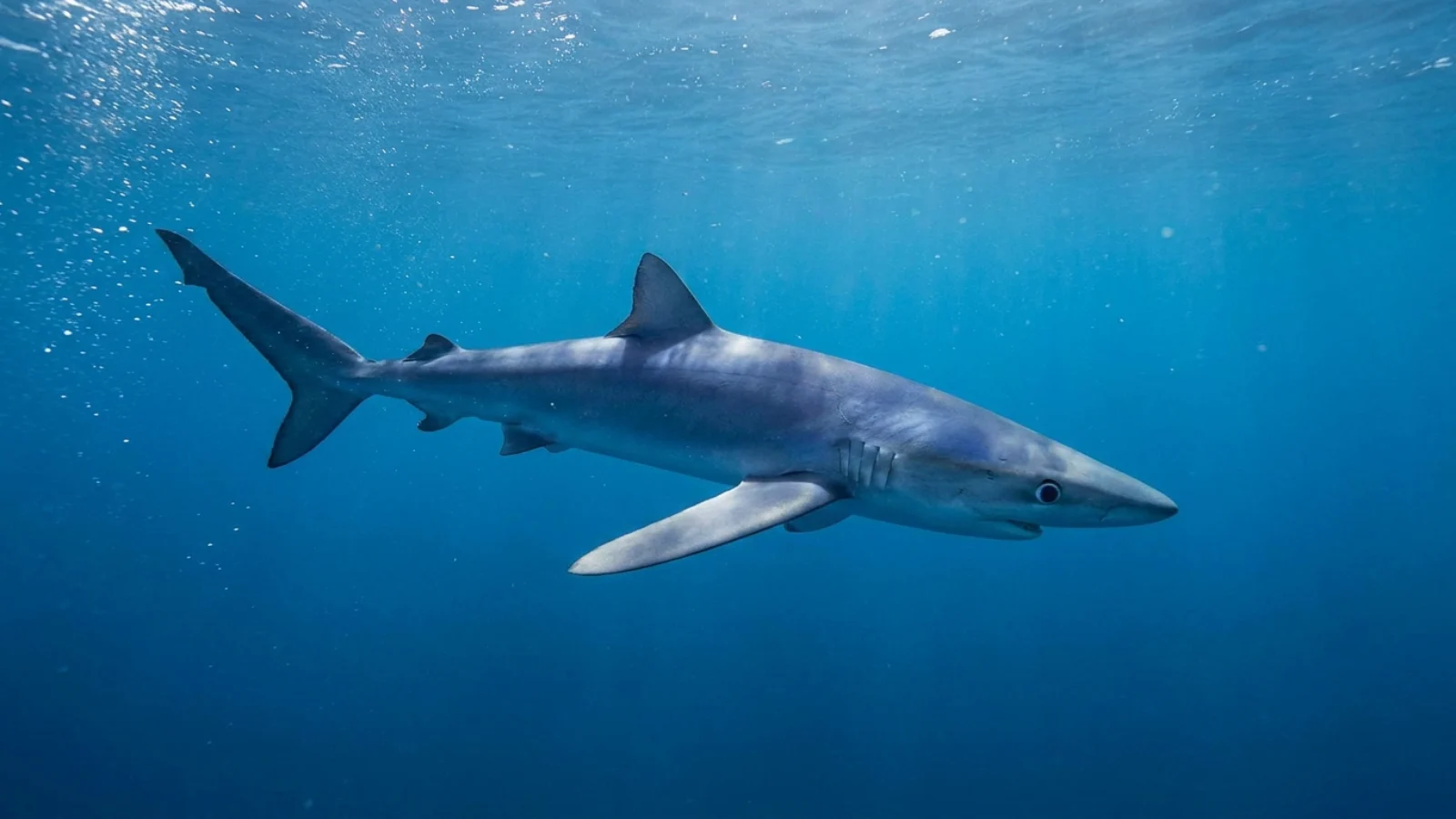
Blue sharks are the slimmest of the large carcharhinids, with disproportionately long pectoral fins, a pointed snout, and a brilliant indigo-blue dorsal coloration that fades dramatically after death.
The blue shark's body plan is built for sustained pelagic cruising rather than ambush. The pectoral fins are extremely long (proportionally the longest of any large shark), the body is slim and laterally compressed, and the snout is long and conical. The dorsal coloration is a vivid indigo-blue in life that fades to a muted slate-grey within hours of death. The flanks are lighter blue and the belly is white, with a sharp transition between the three colours that produces effective countershading at the depths where blue sharks hunt.
Adult blue sharks reach 3–3.8 m, with mature females typically larger than males. The largest reliably measured individual was 3.8 m at approximately 240 kg.
Range — the most cosmopolitan shark in the ocean
Blue sharks occur in every temperate and tropical sea between 50°N and 50°S, and undertake the longest documented seasonal migrations of any shark.
Blue sharks were the first shark species shown to undertake genuine trans-oceanic migrations. A blue shark tagged off New York in 1965 was recaptured off Brazil 5,980 km away, an 8-month journey. More recent tagging shows individuals routinely crossing the entire Atlantic basin, and Pacific tagging documents migrations from California to Hawaii and back.
The species is most reliably encountered offshore in waters of 10–20°C, generally avoiding both very cold polar waters and very warm tropical surface waters. In tropical regions, blue sharks live below the thermocline at depths where temperatures match their preferred range, surfacing only at night to hunt.
Diet — squid specialist and opportunist
Blue sharks eat almost any pelagic prey they can catch, but squid dominate the diet in most regions. The species' long fins and slim body suit it for sustained pursuit of fast, agile prey.
Stomach analyses across multiple oceans consistently show that 50–75% of blue shark prey by mass is squid, particularly the abundant pelagic squids of the genera Loligo, Illex, and Ommastrephes. The remainder is dominated by schooling pelagic fish (mackerel, herring, hake), smaller sharks, and on documented occasions, seabirds, dolphin carcasses, and carrion. Blue sharks are also notable scavengers around fishing operations, frequently taking offal and discards from longliners and trawlers.
Reproduction — the largest litters of any shark
Blue sharks are viviparous and produce the largest litters of any shark species. A single female has been documented carrying 135 pups, an order of magnitude more than most other large sharks.
Females reach maturity at 5 years and produce litters of ~25–50 pups on average, with the largest documented litter at 135 pups. Gestation is 9–12 months, with pups born at 35–44 cm in offshore nursery areas. The combination of high fecundity and rapid maturity makes blue sharks more resilient to fishing pressure than most other large sharks — but the absolute scale of the bycatch (estimated 20 million blue sharks per year globally in pelagic longline fisheries) has caused declines even in this productive species.
Attack record — rare and almost always boat-related
Blue sharks live offshore where humans rarely encounter them. The few attacks on record are concentrated around shipwrecks, fishing vessels, and post-mortem scavenging.
ISAF records 13 unprovoked blue shark attacks with 4 fatalities. The fatalities cluster around major sinking-ship events: blue sharks were among the species implicated in the post-sinking attacks on survivors of the USS Indianapolis (1945) and the SS Nova Scotia (1942). In normal recreational and diving conditions, the species is rarely encountered and almost never aggressive. Cage-diving operations off the Azores, Cape Cod, and the Cornish coast routinely host divers in the water with blue sharks at close quarters with no incidents.
Where the blue shark sits among the major shark species
Comparing blue sharks against the major species at a glance.
The blue shark is the most numerous large shark and the most cosmopolitan, but it lives offshore where most humans never encounter it. Per individual it produces an order of magnitude more pups than the comparison species — the only reason the population persists despite the scale of the fin trade.
| Species | Max length | Max weight | Bite force | Attacks (unprov.) | Lifespan |
|---|---|---|---|---|---|
| Great white shark | 6.0 m | 2,300 kg | ~4,000 PSI | 354 | 70 yrs |
| Tiger shark | 5.5 m | 900 kg | ~6,000 PSI | 142 | 27–50 yrs |
| Bull shark | 3.5 m | 320 kg | 1,250 PSI | 121 | 16 yrs |
| Oceanic whitetip | 4.0 m | 170 kg | n/a | 15 | 22 yrs |
| Shortfin mako | 4.0 m | 570 kg | n/a | 10 | 30 yrs |
| Great hammerhead | 6.1 m | 580 kg | n/a | 17 | 44 yrs |
| Whale shark | 12.0 m | 19,000 kg | n/a (filter) | 0 | 80–130 yrs |
Related on TheSea
How big does a blue shark get?
Adult blue sharks typically reach 2.5–3.5 m (8–11 ft), with the largest documented individuals at 3.8 m. They are slim for their length — weighing far less than a great white or tiger of the same size.
Are blue sharks dangerous?
Rarely. ISAF records 13 unprovoked attacks and 4 fatalities, with the fatalities clustered around historical sinking-ship events. Recreational encounters are uncommon because the species lives offshore. Cage-diving operations handle blue sharks safely with experienced operators.
Why are blue shark numbers declining?
Blue sharks are caught as bycatch in pelagic longline fisheries at a scale no other shark approaches: an estimated 20 million blue sharks are killed annually. Their high fecundity (largest litters of any shark) has prevented a collapse, but population declines are documented in the North Atlantic and elsewhere. The IUCN lists the species as Near Threatened.
Where can I dive with blue sharks?
The most established sites are the Azores (June–September), Cornwall in the UK (July–September), Cape Cod and Rhode Island in the US (June–August), and San Diego (July–October). All operate as offshore baited dives.
Why are blue sharks so blue?
The bright indigo coloration is structural — it comes from the way the skin pigment cells (chromatophores) interact with light, not from a stable pigment. The colour fades dramatically within hours of death because the cells stop functioning, which is why dead blue sharks look grey-brown in photos and museum specimens.
Blane Perun has been exploring Earth’s oceans and marine life for over 25 years. Founder of TheSea.Org in 1999, underwater photographer, coral aquaculture pioneer, and explorer of 80+ countries.
About Blane Perun → More on Sharks →