Shark Attacks in Australia — Numbers, Species and Hotspots
Australia has about 13 unprovoked shark bites in a typical recent year, but 2025 was much worse, with 21 unprovoked bites and five deaths. The national database, kept by Taronga Conservation Society, holds about 1,200 recorded bites since 1791. Three species account for most serious bites: white sharks cause the most bites overall, while a higher share of tiger and bull shark bites prove fatal. Surfers and other board riders now make up the largest group of victims, but the chance of dying from a shark bite has fallen over the past century thanks to faster medical care and first aid on the beach.
Shark bites in Australia are rare, mostly involve white, tiger and bull sharks, and kill a smaller share of victims than they did a century ago.
How many shark attacks happen in Australia each year?
Australia is one of the world’s main shark-bite hotspots. The International Shark Attack File (ISAF) at the Florida Museum of Natural History, which compiles bites worldwide, counted 21 unprovoked bites in Australia in 2025, five of them fatal. That was, in the ISAF’s words, notably higher than the most recent five-year annual average of 13 incidents for the region. Worldwide in 2025 there were 65 unprovoked bites and nine deaths, so Australia accounted for roughly a third of the world’s bites and more than half of its shark-bite deaths that year.
Those numbers sound alarming, and every one represents a person and a family. But they need context. Australia has a long coastline, a warm climate and a beach-going culture, and millions of people swim, surf and dive every year. Spread across all that time in the water, the risk to any individual remains extremely low. Drowning, rip currents and road accidents on the way to the beach kill far more Australians every year than sharks do.
What does Australia’s shark-bite database show?
The country’s long-term record is the Australian Shark-Incident Database, formerly called the Australian Shark-Attack File. It is maintained by Taronga Conservation Society Australia, with input from state fisheries departments, questionnaires completed by victims and witnesses, and media reports. In 2022 a team led by Madeline Riley published a detailed description of the dataset in the journal Scientific Data. At that point it contained 1,196 shark bites recorded over 231 years, from 1791 to 2022, in fresh, brackish and marine waters, involving 22 suspected shark species. It includes both provoked bites, such as those on fishers handling a hooked shark, and unprovoked bites.
The database lets researchers look beyond headlines. It shows where bites happen, which species are involved, what people were doing, what time of day it was and how badly victims were hurt. Its maps show bites spread around the whole continent, but concentrated where people and sharks overlap most: the populous coasts of New South Wales and Queensland, the southwest of Western Australia and the gulfs and coasts of South Australia.
Which sharks bite people in Australia?
Three species dominate the serious incidents. According to the 2022 analysis, white sharks (Carcharodon carcharias) were responsible for the largest number of bites on humans, 361 in total, followed by tiger sharks (Galeocerdo cuvier) with 229 and bull sharks (Carcharhinus leucas) with 197. At the time of publication, white sharks had caused 91 deaths in Australia and tiger sharks 86.
The proportion of bites that prove fatal differs between them. Over the whole record since 1791, 38 percent of tiger shark bites resulted in death, compared with 32 percent of bull shark bites and 25 percent of white shark bites. The authors stress that these figures span more than two centuries and do not account for changes over time, such as improvements in medical care. They also depend on where each species tends to bite: bull sharks often bite in murky estuaries and rivers, tiger sharks in warm northern waters, and white sharks in the cooler south, where surfers wear wetsuits and are often far from help.
Many other species are involved in minor bites, from wobbegongs that nip waders and divers to whaler sharks that bite spearfishers. These rarely make international news, but they are a large part of the record. Our ranking of the most aggressive sharks compares the same three species using worldwide data.
Where do most shark attacks happen in Australia?
Bites happen in every mainland state and the Northern Territory, but their character varies by region. On the east coast, from northern New South Wales into Queensland, bull and tiger sharks are involved in many incidents, often in warm water near river mouths, canals and harbours. Sydney Harbour and the canals of the Gold Coast, for example, are bull shark habitat. Further south and west, in Victoria, South Australia, southern Western Australia and Tasmania, white sharks account for most serious bites, typically on surfers and divers in cool, open water.
Western Australia has had a run of fatal white shark bites in recent decades, as has South Australia, while New South Wales has the most bites overall because it has the most people in the water. In northern Australia, crocodiles are a greater hazard than sharks in many estuaries, and fewer people swim in the open sea.
Who gets bitten by sharks in Australia?
The activities of victims have changed with beach culture. In the early twentieth century most victims were swimmers. Today, board riders, a category that includes surfers, bodyboarders, kitesurfers, windsurfers, wakeboarders and stand-up paddleboarders, make up the largest group. Swimmers, snorkellers, spearfishers, freedivers and scuba divers make up much of the rest, and a smaller share are people fishing or cleaning fish.
Surfers face a particular risk from white sharks because they spend long periods at the surface in exactly the places where white sharks hunt seals and fish, often at dawn or dusk. The database shows that most bites happen during the day, which reflects when most people are in the water, but bull sharks show a slightly higher proportion of bites at dusk than tiger or white sharks.
Why was 2025 such a bad year?
Several fatal bites in quick succession made 2025 one of Australia’s worst recent years. Early in the year a 28-year-old surfer was killed in South Australia, and in February a 17-year-old girl was fatally bitten while swimming off an island on the east coast. In March a surfer died after a bite in shallow water at a remote Western Australian beach. On 6 September 2025 an experienced surfer in his fifties was killed at Long Reef Beach in northern Sydney, about 100 metres from shore and away from patrolled flags, and beaches from Manly to Narrabeen were closed for at least a day. It was only Sydney’s second fatal shark bite in decades: in February 2022 a 35-year-old British diving instructor had been killed in what was reported as the city’s first fatal attack since 1963.
The ISAF suggests the jump in white shark fatalities may simply reflect random year-to-year variation, which is common with rare events. But it also raises a second possibility: that it might be a consequence of the increasing number of white sharks seen at aggregation sites near beaches popular with surfers, particularly in Australia. White sharks are protected in Australia and are thought to be stable after historic declines, a story told in our article on whether great white sharks are endangered.
Are shark attacks in Australia becoming more deadly?
No, the opposite. The number of bites has risen over the past century, roughly in line with the growth in population and in the number of people using the ocean, but the proportion that end in death has fallen. The 2022 database analysis found that since 1900 the share of fatal bites has decreased, and that the trend holds for all three of the main species. Among 973 bites with known outcomes and injury locations, 250 were fatal and 723 were non-fatal.
The authors attribute the improvement mainly to better medical response and to surfers’ growing awareness of how to use tourniquets to stop bleeding, helped by first-aid training required in many workplaces. Where a person is bitten matters too: fatalities were most common after bites to the torso, where damage to organs and major blood vessels causes severe blood loss. Blood loss is a leading cause of shark-bite deaths, which is why rapid first aid on the beach often decides the outcome.
Do shark nets and drumlines work?
This is one of the most heated debates in Australian coastal management. New South Wales began netting popular beaches in 1937, and Queensland began its Shark Control Program, using nets and baited drumlines, in 1962. Supporters point to the record. In Queensland, only one fatal bite has been recorded at a controlled beach since the programme began, compared with 27 fatal attacks between 1919 and 1961. In New South Wales, 13 people were killed off surf beaches between 1900 and 1937, and over the next 72 years the number fell to eight, only one of them at a meshed beach.
Critics argue that these figures do not prove cause and effect, since surfing culture, beach patrols and medical care also changed, and that the cost to wildlife is high. Shark nets do not form a complete barrier; they are relatively short nets that catch sharks swimming past, and they also catch dolphins, turtles, rays and harmless sharks, including threatened hammerheads. In Queensland, more than 84,000 marine animals have been caught by nets and drumlines since 1962, according to figures compiled by conservation groups, including loggerhead turtles and manta rays.
Western Australia took a different path. In 2014 the state ran a drumline cull that killed dozens of sharks, mostly tiger sharks, until it was abandoned after public protests and a ruling by the state’s Environmental Protection Authority. Later trials used so-called SMART drumlines, designed to alert crews when a shark takes the bait so that it can be tagged and released alive rather than killed. In New South Wales, nets and SMART drumlines were added at five extra north coast beaches in a six-month trial from December 2016, after 11 bites, two of them fatal, on that coast between 2014 and 2016.
How can you reduce the risk of a shark bite in Australia?
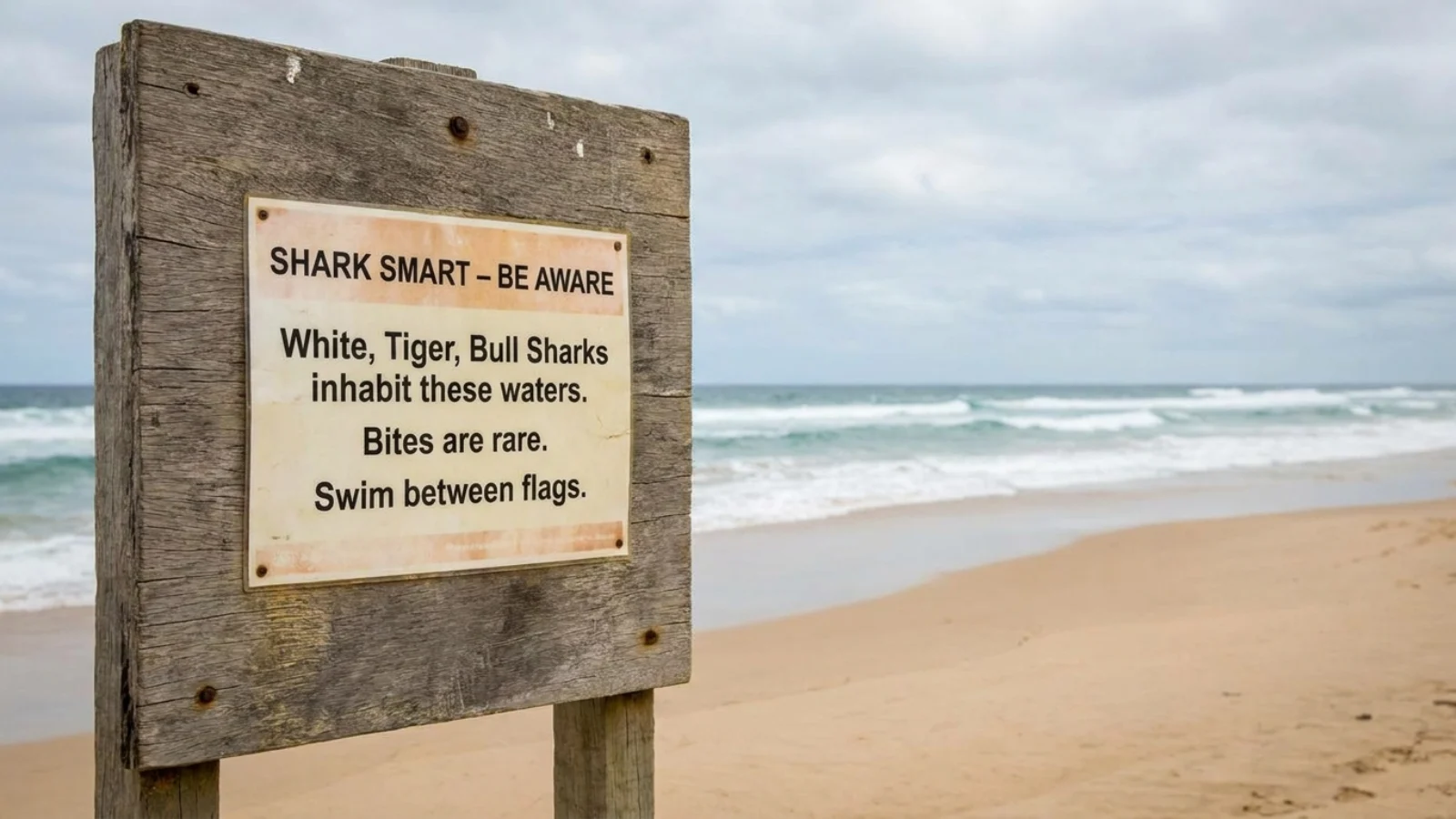
Australian authorities give consistent advice. Swim at patrolled beaches between the flags, and do not swim far from shore, alone, at dawn, dusk or night, in murky water, near river mouths or near drop-offs to deep water. Avoid swimming near people fishing or near schools of baitfish, seals or dolphins feeding, and leave the water if a shark is sighted. Avoid swimming with pets, and do not swim with bleeding cuts. Many beaches now use drones, helicopters and tagged-shark listening stations, so check local alerts before entering the water.
Surfers in white shark country increasingly use personal electric deterrents, which emit an electric field around the board or leg, and bite-resistant wetsuit fabrics are under development. Studies of these products give mixed results, and none offers complete protection, but the combination of good information, sensible behaviour and quick first aid has made shark bites in Australia less deadly than they were a century ago.
What counts as a shark “attack”?
Researchers increasingly prefer the word “bite”, because many incidents are brief investigative or defensive bites rather than predatory attacks. The ISAF separates unprovoked bites, which happen in the shark’s natural habitat without any human provocation, from provoked bites, such as a fisher bitten while unhooking a shark or a diver bitten after grabbing one. Only unprovoked bites are used in its yearly comparisons between countries, because provoked bites say more about human behaviour than about shark behaviour. The Australian database records both kinds, along with incidents in which a shark bit a board or kayak but left the person uninjured.
That distinction matters when reading headlines. A year with many provoked bites on fishers or spearfishers does not mean sharks have become more dangerous to swimmers, and a single bite on a surfboard may appear in the record even though nobody was hurt. Counting methods also differ slightly between organisations, which is why figures from Taronga, the ISAF and state governments do not always match exactly.
What should you do if someone is bitten?
The most important lesson from Australia’s record is that fast first aid saves lives. Because severe bleeding is the leading cause of death after a shark bite, bystanders should get the person out of the water, call emergency services and apply firm pressure or a tourniquet above a limb wound as quickly as possible. The 2022 database analysis credited growing tourniquet awareness among surfers, helped by workplace first-aid training, with part of the long fall in the proportion of fatal bites. Lying the victim down, keeping them warm and continuing pressure until paramedics arrive all improve the chances of survival.
How does Australia compare with Florida?
The United States usually records the most unprovoked bites in the world, and Florida has the most of any US state. In 2025 the ISAF counted 25 unprovoked bites in the US and one death, with 11 bites in Florida and no deaths. Volusia County on the Atlantic coast had six, and Lee County on Florida’s Gulf coast, home to Fort Myers and Sanibel, had two. The difference is in severity. Most Florida bites are quick, defensive or mistaken-identity bites by small blacktip and spinner sharks on hands and feet in the surf. Australia sees fewer bites overall in some years but many more involving large white, tiger and bull sharks, so a much larger share are serious or fatal. Our guide to shark attacks in Florida looks at the Sunshine State in detail, and our overview of how many shark attacks happen each year puts both in a global context.
So, how dangerous are sharks in Australia?
Australia has more serious shark bites than almost anywhere else, and 2025 was a bad year, with five deaths. Yet the national record shows that bites remain rare, that a handful of species are responsible for nearly all serious incidents, and that the chance of surviving a bite has improved steadily for a century. Understanding where and when white, tiger and bull sharks hunt, and following local advice, keeps the risk very small.
How many shark attacks are there in Australia per year?
About 13 unprovoked bites in a typical recent year; 2025 had 21, including five deaths.
Which shark kills the most people in Australia?
White and tiger sharks, with 91 and 86 recorded deaths respectively by 2022; tiger shark bites are fatal most often.
Which Australian state has the most shark attacks?
New South Wales has the most bites overall; Western Australia and South Australia have had many fatal white shark bites.
Are shark attacks increasing in Australia?
Bites have risen with population and ocean use, but the share that are fatal has fallen since 1900.
When did Australia start using shark nets?
New South Wales in 1937 and Queensland in 1962, when it began its Shark Control Program.
Do shark nets stop sharks?
No. They are short nets that catch passing sharks; they reduce numbers locally but also catch dolphins, turtles and rays.
When was the last fatal shark attack in Sydney?
On 6 September 2025 a surfer was killed at Long Reef Beach in northern Sydney.
Is it safe to swim in Australia?
Yes, for most people. Swim between the flags at patrolled beaches and avoid murky water, river mouths, dawn and dusk.
- Riley, M., Meagher, P., Huveneers, C. et al. (2022), “The Australian Shark-Incident Database for quantifying temporal and spatial patterns of shark-human conflict”, Scientific Data 9.
- International Shark Attack File, Florida Museum of Natural History, Yearly Worldwide Shark Attack Summary (2025).
- Al Jazeera (6 September 2025), “Shark attack kills surfer off Sydney beach in Australia”.
- Shark control programme statistics as summarised from Queensland and New South Wales government sources (Wikipedia, “Shark culling” and “Shark attacks in Australia”).
Blane Perun has been exploring Earth’s oceans and marine life for over 25 years. Founder of TheSea.Org in 1999, underwater photographer, coral aquaculture pioneer, and explorer of 80+ countries.
About Blane Perun →