How Long Do Sharks Live? — From Dogfish to the 400-Year Greenland Shark
Most sharks live roughly 20 to 40 years, but some live far longer. Radiocarbon dating has shown that great white sharks can live to at least 70 years, whale sharks to 50 or more, and spiny dogfish have been reported to nearly 70. The record holder is the Greenland shark: in 2016, eye-lens dating put the oldest sampled individual at 392 ± 120 years, making it the longest-lived vertebrate known, with sexual maturity at about 150. Many older estimates were too low, because the growth bands used to age sharks stop recording years in old animals.
Most sharks live decades rather than years, the biggest and coldest-water species live longest, and nearly every new validation study makes sharks older than we thought.
How long do sharks live?
There is no single answer, because there are more than 500 species of shark, from finger-sized lanternsharks to the whale shark, and they live very different lives. As a rough guide, most sharks that have been studied live somewhere between 20 and 40 years. The lemon shark, for example, has an unknown maximum lifespan, but the average individual is thought to be 25 to 30 years old. The great hammerhead typically lives 20 to 30 years, and a record female caught off Boca Grande, Florida, was estimated at 40 to 50 years old.
At the long end, the numbers become astonishing. Great white sharks can live to at least 70 years, whale sharks to at least 50 and probably much longer, and the Greenland shark of the Arctic and North Atlantic may live for several centuries. That makes sharks, as a group, some of the longest-lived animals with backbones.
The general pattern is that large sharks of cold or deep water live longest, and small sharks of warm, shallow water live fastest and die youngest. But almost every rule has exceptions, and our knowledge of shark lifespans has changed dramatically in the last two decades as new dating methods have been applied.
How do scientists tell how old a shark is?
Ageing a shark is surprisingly hard. Bony fish can be aged from their otoliths, small ear stones that lay down rings like a tree. Sharks have no bones and no otoliths, so scientists use the next best thing: their vertebrae. As a shark grows, its cartilaginous vertebrae, which are partly calcified, lay down alternating light and dark bands. Counting these band pairs, rather like counting tree rings, gives an estimate of age, provided each pair represents one year.
For some species, other structures are used. Spiny dogfish, for example, are aged from bands on the spines in front of their dorsal fins. A 2022 study of New Zealand spiny dogfish counted bands on the second dorsal fin spine and found that 93.3 percent of 112 spines had readable patterns.
The problem is the assumption that each band equals one year. That has to be tested, or validated, and validation is difficult for animals that live for decades in the open ocean. Scientists use two main methods: chemical marking, in which a shark is injected with a fluorescent compound that leaves a mark in the vertebrae, then recaptured years later; and bomb radiocarbon dating, which is explained below.
What is bomb radiocarbon dating?
Atmospheric nuclear weapons tests in the 1950s and early 1960s sharply increased the amount of carbon-14 in the atmosphere and, soon after, in the surface ocean. This pulse, sometimes called the bomb spike, was absorbed into the tissues of animals growing at the time. Because the timing of the spike is well known, it acts as a time stamp.
If a shark’s vertebrae show the bomb spike in a particular band, scientists can check whether the number of bands laid down since then matches the number of years that have passed. If it does, the band count is valid. If there are fewer bands than years, the shark has been laying down bands less than once a year, and band counts underestimate its age.
In a 2017 review in Fish and Fisheries, the shark biologist Harry looked at 15 bomb carbon and 44 chemical marking studies of sharks and rays. He found that age was probably underestimated in 30 percent of the 53 populations studied, and in 50 percent of those validated with bomb carbon dating. The underestimation was greatest in larger, older animals, ranging up to 34 years and averaging 18 years. Bands appeared reliable only up to about 41 percent of the maximum age. In other words, many published shark lifespans are probably too short.
How long do great white sharks live?
Great whites are a textbook example. Older studies based on band counts suggested lifespans of around 20 to 30 years. Then in 2014 Hamady, Natanson, Skomal and Thorrold measured radiocarbon in the vertebrae of four female and four male great whites from the northwestern Atlantic. Their age estimates reached 40 years for the largest female, with a fork length of 526 cm, and 73 years for the largest male, at 493 cm.
That made the great white one of the longest-lived cartilaginous fishes known. The same work suggested that males take about 26 years to reach sexual maturity and females about 33. The authors warned that such slow growth and late maturity make white shark populations considerably more sensitive to human-caused deaths than had been thought. For a full profile, see the great white shark.
How long do whale sharks live?
The whale shark, the largest fish in the world, is also long-lived. A study that compared carbon-14 in whale shark vertebrae with the bomb spike found that growth bands are laid down annually, and it estimated an age of 50 years for a 10 m female and 35 years for a 9.9 m male. Other studies based on vertebral bands and on measuring free-swimming whale sharks over many years have estimated lifespans of about 80 to 130 years.
Whale sharks grow slowly, and evidence suggests that males grow faster than females early in life but reach a smaller maximum size. Because the largest whale sharks are much bigger than the dated individuals, it is likely that the oldest whale sharks alive today are well over 50. Read more in our whale shark profile.
How long does the Greenland shark live?
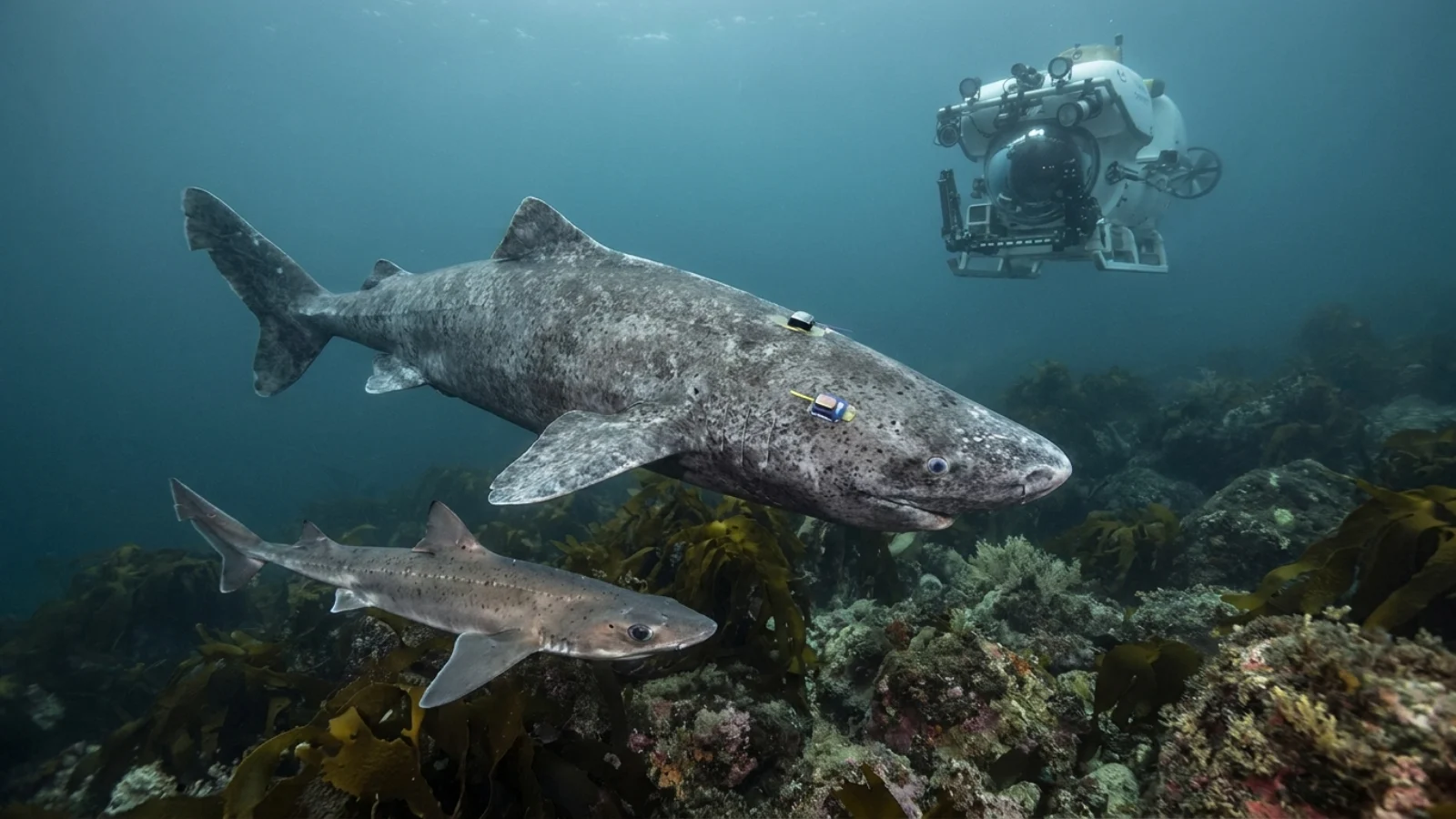
The Greenland shark, Somniosus microcephalus, is the longest-lived vertebrate known. It lives in the cold, dark waters of the North Atlantic and Arctic, grows to around 5 m and moves extremely slowly. As early as the mid-twentieth century there were hints of great age: one Greenland shark tagged off Greenland in 1936 and recaptured in 1952 had grown so little that its growth rate was estimated at just 0.5 to 1 cm per year.
Greenland sharks have soft vertebrae that do not form readable bands, so a different method was needed. In 2016 Nielsen and colleagues published a study in Science that used radiocarbon in the lens of the eye. The core of the lens forms during development, so the carbon-14 locked into it reflects the time around the shark’s birth, including any trace of the bomb spike. Using 28 sharks from 81 to 502 cm long, they found that the oldest and largest had lived for 392 ± 120 years, meaning it was born somewhere between 1504 and 1744. They also concluded that Greenland sharks reach sexual maturity at about 150 years of age.
Even the lower end of that range, 272 years, would make it the longest-lived vertebrate known. Our profile of the Greenland shark covers its biology in more detail.
Why do Greenland sharks live so long?
Cold water and a slow metabolism are central to most explanations. Greenland sharks live in water near freezing, grow at a fraction of a centimetre a year and swim very slowly. In general, animals with slow metabolisms in cold environments age more slowly, and the Greenland shark sits at the extreme of that pattern.
Genetics may also play a part. In 2025 Yang and colleagues reported the first chromosome-level assembly of the Greenland shark genome, 5.9 billion base pairs long with 37,125 predicted genes. They found expanded copy numbers of gene families involved in the NF-κB signalling pathway, which is linked to immunity and inflammation and has been associated with ageing. A separate study published in Nature Communications found that, despite the sharks being more than a century old, their retinas showed no obvious degeneration and expressed DNA repair-related genes strongly, which may help maintain tissues over an extreme lifespan.
These are early findings, and they describe correlations rather than proven causes. But they suggest that the Greenland shark may be useful for understanding how vertebrate bodies can resist ageing.
How long do small sharks live?
Small sharks generally live shorter lives, but not always. The spiny dogfish, a small shark of temperate waters, matures surprisingly late: most males around 10 years and females around 16 years. Its average lifespan is around 30 to 40 years, and some individuals have been reported to live nearly 70. It also has one of the longest pregnancies of any animal, about 18 to 24 months.
Ageing studies of dogfish are also a window on fishing pressure. The spiny dogfish is one of six shark species managed under New Zealand’s Quota Management System, and it is a major bycatch species in some deep-water fisheries. Because its age and growth had not been studied there since the 1980s, a 2022 study collected 119 adults and juveniles and 15 pups from the Chatham Rise, ranging from 54.1 to 85.8 cm for males and 52.1 to 92.8 cm for females, to check whether growth and maturity had changed under decades of fishing. Studies like this matter because heavy fishing can remove the oldest, largest animals and shift a population towards younger fish.
At the other extreme of size is the dwarf lanternshark, Etmopterus perryi, a deep-sea species only about 17 cm long and one of the smallest sharks known. Like many deep-water sharks, little is known about how long it lives, a reminder of how much remains to be learned.
The lesson of the validation studies is that small sharks, too, may be older than their band counts suggest. Studies of species such as the tiger shark and the oceanic whitetip have used bomb radiocarbon to test and refine age estimates for the same reason.
Do sharks die of old age?
Wild sharks rarely reach their maximum possible age. Most die from predation when young, from disease, starvation or injury, or, increasingly, from fishing. Juvenile sharks face the highest risk: newborn sharks are small enough to be eaten by larger sharks, including adults of their own species, which is one reason many species give birth in sheltered nursery areas.
Old age in sharks probably looks much like old age in other fish: slower growth, reduced reproduction and gradual decline. In very long-lived species such as the Greenland shark, individuals may simply continue living slowly for centuries until something kills them. The 2026 study of Greenland shark eyes found no obvious signs of retinal degeneration even in sharks more than a hundred years old.
Why does shark lifespan matter for conservation?
Long life sounds like an advantage, but for sharks it comes with slow growth, late maturity and few young. A Greenland shark that only begins to reproduce at about 150 years, or a great white female that matures at about 33, cannot replace losses quickly. If fishing kills large numbers of adults or near-adults, a population may take decades or centuries to recover.
That is why accurate ages matter. Harry’s review pointed out that underestimating age leads to overestimating how fast populations grow and how much fishing they can withstand. Fisheries scientists use age data to set catch limits, and if a species is really twice as old as assumed, those limits may be far too generous. The ageing revolution in shark science is therefore not just a curiosity: it changes how sharks should be managed. For the broader picture, see how many sharks are in the ocean?
Which sharks live the longest?
Based on current evidence, the Greenland shark is far ahead of all others, followed by large, slow-growing species such as the whale shark, the great white and the spiny dogfish. The basking shark, the second-largest fish, has been the subject of growth and longevity studies too, one of which suggested that individuals larger than about 10 m are unlikely.
Many species have never been aged at all, especially deep-sea sharks, which may turn out to be long-lived too. A broad 2026 analysis of 757 marine fish species found that maximum depth was positively associated with maximum lifespan after accounting for body size. As more species are dated with radiocarbon, the list of long-lived sharks is likely to grow. For the giants of the shark world, see our guide to the biggest sharks.
How long do most sharks live?
Most studied species live roughly 20 to 40 years, though many large species live much longer.
What shark lives the longest?
The Greenland shark. A 2016 study dated one individual at 392 ± 120 years, the longest-lived vertebrate known.
How long do great white sharks live?
At least 70 years. A 2014 radiocarbon study aged one male at 73 years.
How long do whale sharks live?
At least 50 years based on radiocarbon; other studies estimate 80 to 130 years.
How do scientists age sharks?
By counting growth bands in vertebrae or fin spines, validated with bomb radiocarbon or chemical marking.
When do Greenland sharks become adults?
At about 150 years of age, according to the 2016 eye-lens study.
Can sharks die of old age?
Probably, but in the wild most die earlier from predation, disease, injury or fishing.
Why are shark ages often underestimated?
Growth bands stop recording years reliably in older sharks, so band counts miss decades in large animals.
- Nielsen, J. et al. (2016), “Eye lens radiocarbon reveals centuries of longevity in the Greenland shark (Somniosus microcephalus)”, Science.
- Hamady, L.L., Natanson, L.J., Skomal, G.B. & Thorrold, S.R. (2014), “Vertebral bomb radiocarbon suggests extreme longevity in white sharks”, PLoS ONE.
- Harry, A.V. (2017), “Evidence for systemic age underestimation in shark and ray ageing studies”, Fish and Fisheries.
- Yang, K. et al. (2025), “The Greenland shark genome: insights into deep-sea ecology and lifespan extremes”, bioRxiv; Fogg, L.G. et al. (2026), “The visual system of the longest-living vertebrate, the Greenland shark”, Nature Communications.
- Li, L. & Xu, Z. (2026), “Body size, functional form and environmental correlates of maximum longevity in marine-occurring fishes”, Journal of Fish Biology.
Blane Perun has been exploring Earth’s oceans and marine life for over 25 years. Founder of TheSea.Org in 1999, underwater photographer, coral aquaculture pioneer, and explorer of 80+ countries.
About Blane Perun →