Sharks by Region — Where Sharks Live, From Cape Cod to Hawaii
Which sharks you meet depends on where you swim. Florida and the Gulf of Mexico have the greatest variety of coastal sharks in the United States, led by blacktips, bonnetheads and young bull sharks. Cape Cod and central California have seal-hunting white sharks, Southern California has young white sharks close to its beaches, and Hawaii has reef sharks and wide-ranging tiger sharks but no confirmed bull sharks. Inland, bull sharks reach brackish Louisiana and, very rarely, the middle Mississippi, but there are no sharks in the Great Lakes. This hub links every regional guide on TheSea.Org.
Start with the region you care about. Each guide covers which species live there, when they are closest to shore, what the latest research shows, and how often bites really happen.
Why do sharks differ so much from region to region?
There are more than 500 species of sharks, but no coastline has more than a fraction of them, and the mix changes sharply from place to place. Three things set the local cast. The first is temperature: warm-water sharks such as bull sharks, blacktips and nurse sharks dominate the Gulf of Mexico and Florida, while cold-tolerant species such as spiny dogfish and Greenland sharks live in New England and Canadian waters. The second is food. White sharks gather where seals haul out, at Cape Cod and on the islands and headlands of central California, and tiger sharks follow seasonal feasts such as fledgling albatrosses in the Northwestern Hawaiian Islands. The third is habitat: broad, shallow shelves and river-fed bays make nurseries for young sharks, while steep volcanic islands such as Hawaii favour reef sharks and ocean wanderers.
That is why the honest answer to “are there sharks here?” is almost always “yes, but which ones, where and when?” The guides in this section answer that question for the regions people ask about most.
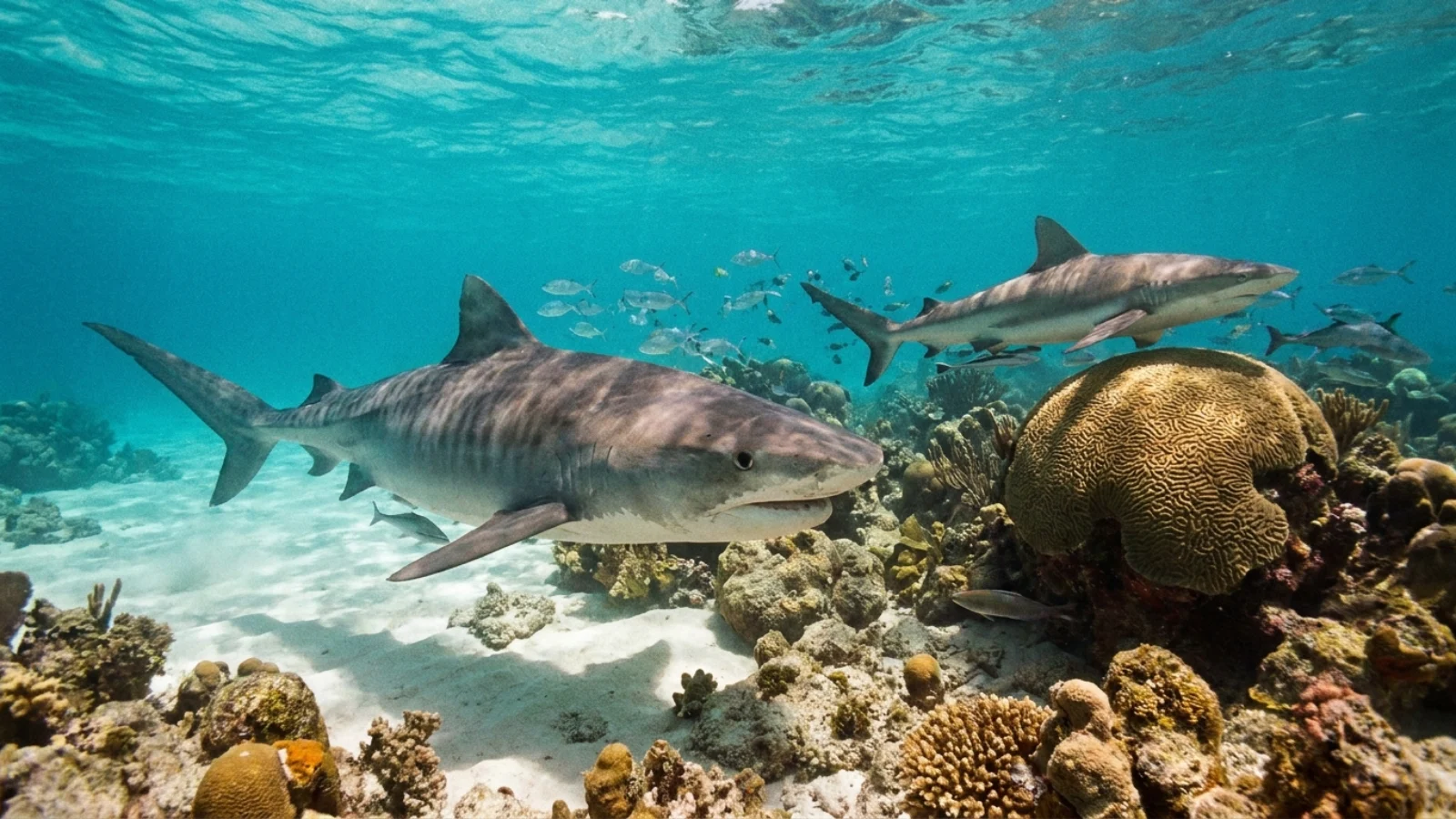
Which US regions have the most sharks close to shore?
Florida has the richest coastal shark fauna in the United States. Its Atlantic coast hosts a winter migration of blacktip sharks that peaked at 12,128 sharks counted in a single aerial survey off Palm Beach County in 2011, and its Gulf coast estuaries are nurseries for bull sharks, blacktips and bonnetheads. Florida also records more unprovoked shark bites than any other state, 11 of the 25 in the United States in 2025, almost all of them minor. Our guide to sharks in Florida covers both coasts and the state’s strict fishing rules.
The wider Gulf of Mexico shares many of Florida’s species but adds its own stories: the largest whale shark gatherings ever recorded, up to 420 sharks in one aerial survey off the Yucatan Peninsula; bull shark nurseries in the brackish bays of Alabama and Louisiana; and a sobering record of decline for oceanic whitetip sharks, estimated to have fallen by more than 99 percent between the 1950s and 1990s. Those are covered in sharks in the Gulf of Mexico.
Where are the white shark hotspots?
Two US regions have become famous for white sharks, and both owe it to recovering seals. Off Cape Cod, gray seals hunted for bounties until 1962 have rebounded to tens of thousands, and a 2023 study estimated that about 800 white sharks used the Outer Cape between 2015 and 2018. On the Pacific coast, the Red Triangle between Bodega Bay, the Farallon Islands and Big Sur is the autumn hunting ground of the northeastern Pacific white shark population, while Southern California beaches are a nursery where young white sharks swim within a few hundred metres of surfers and paddleboarders, mostly without incident. See sharks in Cape Cod and sharks in California.
The two populations are connected by behaviour, not geography. Atlantic white sharks summer off New England and winter off Florida and in the Gulf, while Pacific white sharks spend winter and spring far offshore, roughly halfway to Hawaii, before returning to the California coast.
What about Hawaii and Australia?
Hawaii’s sharks are a Pacific island community: whitetip reef sharks sleeping in lava tubes, grey reef sharks guarding their patch of reef, scalloped hammerhead pups in Kāneʻohe Bay, and tiger sharks that travel thousands of kilometres between feeding grounds. There are no confirmed bull sharks, and since 2022 it has been illegal to knowingly catch or kill any shark in state waters. Our guides cover the species in sharks in Hawaii and the bite record, including why Maui has more bites than Oahu, in shark attacks in Hawaii.
Australia is the other country with a long, well-documented shark record. In 2025 it recorded 21 unprovoked bites, 5 of them fatal, and its national database lists white, tiger and bull sharks as the species involved in most serious incidents. Shark attacks in Australia explains where and why, and what decades of shark nets and culling have and have not achieved.
Can sharks really live in rivers and lakes?
One shark can: the bull shark, which can switch between salt and fresh water and whose young grow up in brackish rivers and bays. That ability has taken bull sharks thousands of kilometres up the Amazon and into Lake Nicaragua. In North America, bull sharks are common in coastal Louisiana, and the farthest inland record is a young shark netted at Alton, Illinois, in 1937, about 1,100 kilometres from the sea. Only two bull sharks were reported from the upper Mississippi in the whole twentieth century, and researchers now think one of those was probably a hoax. The full story is in bull sharks in the Mississippi River.
Further north, the story becomes myth. There has never been a confirmed shark in any of the five Great Lakes, which are fresh, cold and cut off from the sea by rivers, locks and Niagara Falls; the nearest living sharks are Greenland sharks in the salty St. Lawrence estuary. Our guides to sharks in the Great Lakes and sharks in Lake Michigan explain why, and the bull shark rumours from Lake Erie, Iowa and New Jersey each have their own article in the grid below.
How should you compare shark risk between regions?
Bite numbers are useful, but they mostly reflect how many people are in the water, not just how many sharks. Florida tops the US list every year because of its huge beach population and busy surf breaks, but most Florida bites are minor nips from small blacktips and spinners. California and Cape Cod record far fewer bites, but because the sharks involved are adult white sharks, a higher share of them are serious. Hawaii’s bites are mostly by tiger sharks and cluster around Maui. Across the world, the International Shark Attack File counted 65 unprovoked bites in 2025, 9 of them fatal.
Whatever the region, the same habits lower the risk: swim near lifeguards, avoid murky water, river mouths and the low light of dawn and dusk, stay away from seal colonies and people fishing, and follow local warnings. In every region in this section, sharks have far more to fear from people than people do from sharks.
Both coasts, the blacktip migration and the fishing rules.
Nurseries, whale sharks and a lost baseline.
How seals brought the great whites back.
White shark nurseries and the Red Triangle.
Reef sharks, tiger sharks and the 2022 law.
Why Maui has the most bites.
Why none are confirmed.
Where, which species, and shark nets.
How far up they really go.
Why all five lakes are shark-free.
The Chicago canal question.
The rumours, checked.
An inland claim examined.
Bull sharks on the Jersey Shore.
A real freshwater shark lake.
Bites by county, species and year.
The winter visitors.
Europe’s shark sea.
Where do the most sharks live in the United States?
Florida and the Gulf of Mexico have the greatest variety and numbers of coastal sharks.
Where are great white sharks most common in the US?
Off Cape Cod in summer and autumn, and in central California’s Red Triangle in autumn.
Which state has the most shark bites?
Florida, with 11 of the 25 unprovoked US bites in 2025.
Are there sharks in fresh water?
Only the bull shark regularly enters fresh water, mainly as a juvenile in rivers and estuaries.
Are there sharks in the Great Lakes?
No. No shark has ever been confirmed in any of the five Great Lakes.
Are there bull sharks in Hawaii?
No confirmed bull sharks have been recorded in Hawaii.
- International Shark Attack File, Florida Museum of Natural History: 2025 worldwide shark bite summary.
- Regional sources are listed in each guide in this section.
Blane Perun has been exploring Earth’s oceans and marine life for over 25 years. Founder of TheSea.Org in 1999, underwater photographer, coral aquaculture pioneer, and explorer of 80+ countries.
About Blane Perun →