Olivier Levasseur — La Buse, the Cryptogram, and the Unsolved Treasure
Olivier Levasseur, nicknamed La Buse (“the Buzzard”), was a French privateer turned pirate who raided in the Caribbean, off West Africa and finally in the Indian Ocean between about 1716 and the early 1720s. In April 1721 he shared in one of the richest captures in pirate history, the Portuguese ship Nossa Senhora do Cabo, seized at Réunion with the outgoing viceroy of Portuguese India aboard. He was hanged at Saint-Denis on Réunion on 7 July 1730. The famous story that he threw a coded message into the crowd, and the 17-line cryptogram linked to it, cannot be traced earlier than the 20th century.
Levasseur’s life is a mix of well-documented episodes and later legend. The capture of the Nossa Senhora do Cabo, his partnership with John Taylor and his execution are recorded in contemporary sources. His education, his exact birth year and above all the treasure cryptogram rest on much weaker evidence. This page separates the two, starting with his career and ending with the treasure hunters who have spent decades digging on the Seychelles.
From privateer to pirate
Like many Golden Age pirates, Levasseur learned his trade as a licensed privateer in wartime.
Levasseur was born in Calais, in northern France, around 1688 to 1690; sources disagree on the exact year. Later accounts describe him as coming from a well-off family and receiving a good education, but there is little firm evidence for his early life. What is clearer is that he went to sea during the War of the Spanish Succession (1701–1714), sailing as a privateer with a commission from the French crown that allowed him to attack enemy shipping. Privateering was legal, profitable and widely practised, and it trained thousands of sailors in the tactics of boarding and plunder.
When the war ended in 1714, the commissions lapsed and many privateers found themselves without work. Some went home; a large number drifted to the Bahamas, where Nassau on New Providence had become a lawless base for raiders. By 1716 Levasseur had joined the company of Benjamin Hornigold, the most influential captain in Nassau, whose circle also included Samuel Bellamy and Edward Teach, later known as Blackbeard. After the Hornigold group split up, Levasseur sailed briefly with Bellamy before striking out on his own.
His first independent venture took him to Brazil. According to accounts drawn from Portuguese and Brazilian records, he commanded a 22-gun ship and plundered vessels along the southern Brazilian coast in early 1718, before his ship was lost in a storm near the bay of Paranaguá in March of that year, with heavy loss of life. Levasseur escaped in a smaller consort and made his way back north to the Caribbean, where he was nearly caught by the Royal Navy and fled with what he could carry.
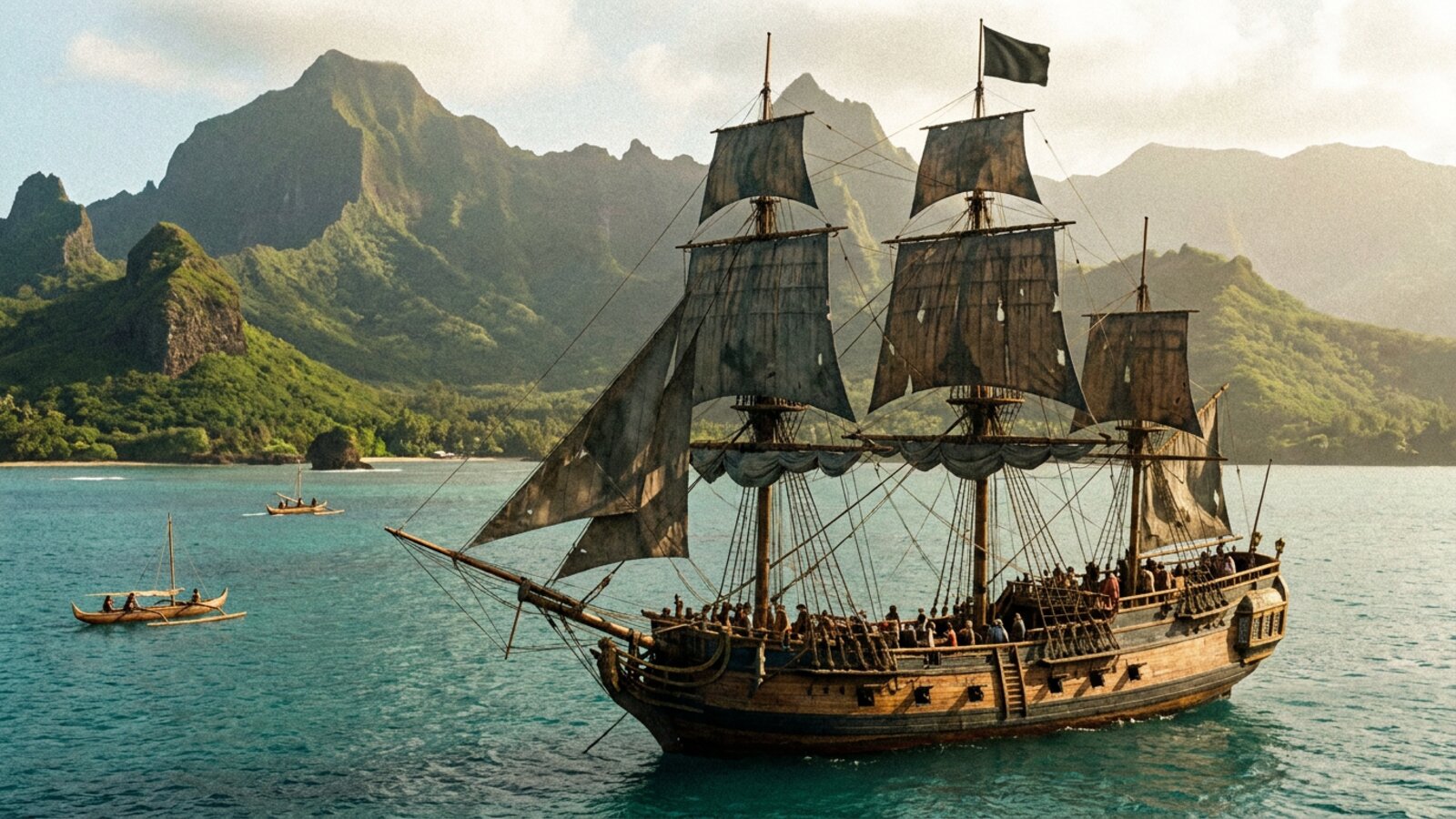
West Africa and the move to the Indian Ocean
As the Caribbean became dangerous, Levasseur followed other pirates east.
The years 1717 and 1718 changed piracy in the Atlantic. The British crown offered a pardon to pirates who surrendered, and in 1718 Woodes Rogers arrived in Nassau as governor to enforce it. Many pirates accepted the pardon, Hornigold among them, while others moved their operations to the coast of West Africa, where slave ships and trading posts offered rich and lightly defended targets. Levasseur was among them. After the crew of William Moody voted their captain out in late 1718, they chose Levasseur to replace him, and in 1719 he cruised alongside Howell Davis and Thomas Cocklyn. In 1720 the pirates attacked shipping at Ouidah, the great slave-trading port in what is now Benin.
From West Africa he went on to the Indian Ocean, a region that had attracted pirates since the 1690s, when Henry Every and Thomas Tew had raided the shipping of the Mughal Empire. In 1720 Levasseur’s ship was wrecked and he was stranded on the island of Anjouan (then called Johanna) in the Comoros, until he was picked up by Edward England. From then on he worked with the group of pirates who used the islands off north-eastern Madagascar, and especially Île Sainte-Marie (today Nosy Boraha), as a base for refitting, trading and dividing plunder. By this time he is said to have lost the sight of one eye.
In July 1720 England’s ship Fancy and its consort Victory, commanded by John Taylor, fought a long and bloody battle with the East India Company ship Cassandra off Anjouan. The pirates won, but England spared the life of the Cassandra’s captain, James Macrae, and gave him the battered Fancy. Taylor and many of the crew were furious at this mercy. England was voted out of command and marooned on Mauritius, and the pirates, now including Levasseur, Taylor and Jasper Seagar, sailed on in Victory and Cassandra. Sources differ on who commanded which ship. They raided along the west coast of India and traded with Dutch merchants at Cochin before returning to Madagascar at the end of 1720.
The capture of the Nossa Senhora do Cabo
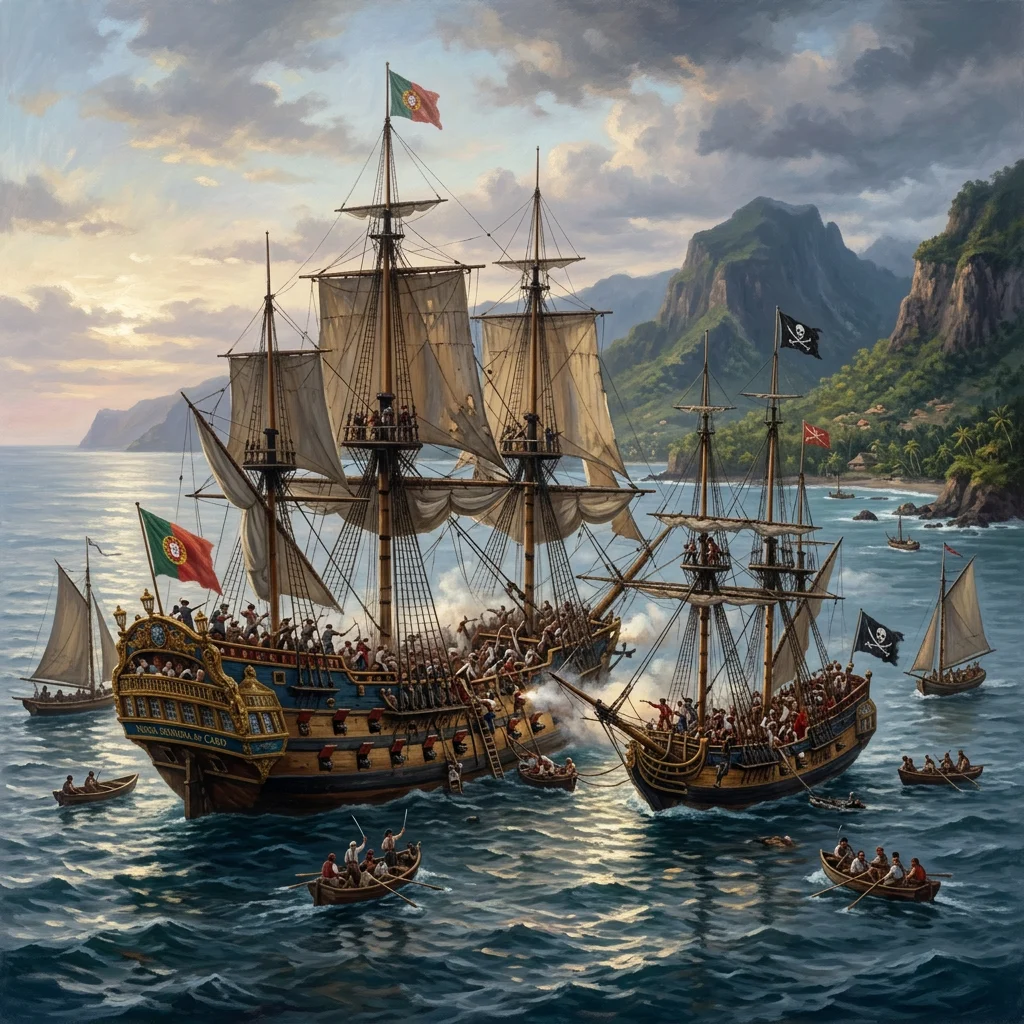
On 8 April 1721 the pirates took a crippled Portuguese ship at Réunion without a fight.
The Nossa Senhora do Cabo had left Goa, the capital of Portuguese India, in early 1721, bound for Lisbon. Aboard were the outgoing viceroy, a large number of passengers and crew, valuable cargo and, according to the archaeologists who have studied the ship, about 200 enslaved people from Mozambique held below decks. On the way the ship was badly damaged in a storm. She lost her masts and, to avoid capsizing, her crew threw most of her guns overboard. She then put in at the French island of Bourbon, now Réunion, for repairs.
It was there, on 8 April 1721, that Levasseur, Taylor and Seagar found her. With few guns left and her rigging wrecked, the Portuguese ship could not resist, and she was taken after a brief boarding action. The viceroy was later released for a ransom. Christopher Condent, a former pirate who had accepted a French pardon and settled on Bourbon, is reported to have helped negotiate between the pirates and the island’s governor. What happened to the enslaved people aboard is not recorded.
The value of the haul has grown with every retelling. Contemporary and later accounts speak of gold and silver, diamonds, pearls, silks and church treasures from Goa, and one well-known version claims that each pirate received thousands of pounds in coin and dozens of diamonds. Modern estimates of the cargo’s worth in today’s money range from tens of millions of dollars to the “over a billion” quoted in popular articles. None of these figures can be checked against a full cargo list. What is certain is that the capture was enormously profitable and that it made the reputations of everyone involved.
The most famous item in the legend is the “Fiery Cross of Goa”, a golden processional cross set with gems that supposedly took three men to carry. It is often described as the centrepiece of Levasseur’s share. However, there is no solid contemporary evidence that such an object was aboard, and the researchers who published on the wreck in 2025 noted that the cross may be a myth.
What happened after the great capture?
The pirates split up, and one by one they found ways out of the trade.
After returning to Madagascar to divide the plunder, the company began to break up. Seagar died. The pirates learned that a Royal Navy squadron had been sent to the Indian Ocean to hunt them, and they reorganised their ships: Levasseur took the Nossa Senhora do Cabo and Taylor the Cassandra, while the worn-out Victory was burned. In 1722, after attacking the Dutch post at Delagoa Bay in southern Mozambique, the two men parted. Taylor sailed for the Caribbean and in 1723 surrendered to the Spanish at Portobello, handing over the Cassandra in exchange for a pardon. He later served the Spanish crown.
In 2025 a team from the Center for Historic Shipwreck Preservation, led by Brandon Clifford with archaeologist Mark Agostini, announced that a wreck in the harbour of Nosy Boraha was the Nossa Senhora do Cabo, which pirates are thought to have abandoned or scuttled there. The identification rests on the hull structure, historical records and more than 3,300 recovered artefacts, including devotional figures in wood and ivory, an ivory plaque inscribed “INRI”, fragments of a crucifix, gold coins with Arabic inscriptions and fine porcelain. No hoard of treasure was found, but the religious objects match the Goa cargo described in the old accounts.
Levasseur stayed in the region. In the mid-1720s the French authorities on Bourbon offered an amnesty to pirates in the Indian Ocean who gave up their trade, and Levasseur is said to have opened negotiations. According to the usual account, the price was the return of a large part of his loot, and he refused. For several years afterwards he appears to have lived quietly around Madagascar, and some sources say he worked as a pilot, guiding ships through the coastal waters he knew so well.
Capture and execution
Levasseur was taken in Madagascar and hanged on Réunion in July 1730.
Around 1729 or 1730 Levasseur was recognised and arrested in Madagascar, reportedly while acting as a pilot for a French ship, and taken to Bourbon to stand trial for piracy. The capture of the Portuguese viceroy’s ship in a French harbour had not been forgotten. He was convicted and hanged at Saint-Denis on 7 July 1730, some nine years after the raid that made him famous. By then most of the other great pirates of his generation, from Blackbeard to Bartholomew Roberts, were dead, and organised piracy in the Indian Ocean had largely faded.
A grave in the old marine cemetery at Saint-Paul, on the west coast of Réunion, is traditionally pointed out as that of La Buse. It is decorated with a skull and crossbones and has become one of the island’s most visited monuments. Whether it really holds Levasseur’s remains is uncertain; the attribution is a matter of tradition rather than documentary proof, and hanged criminals were not normally given marked graves.
Where does the cryptogram come from?
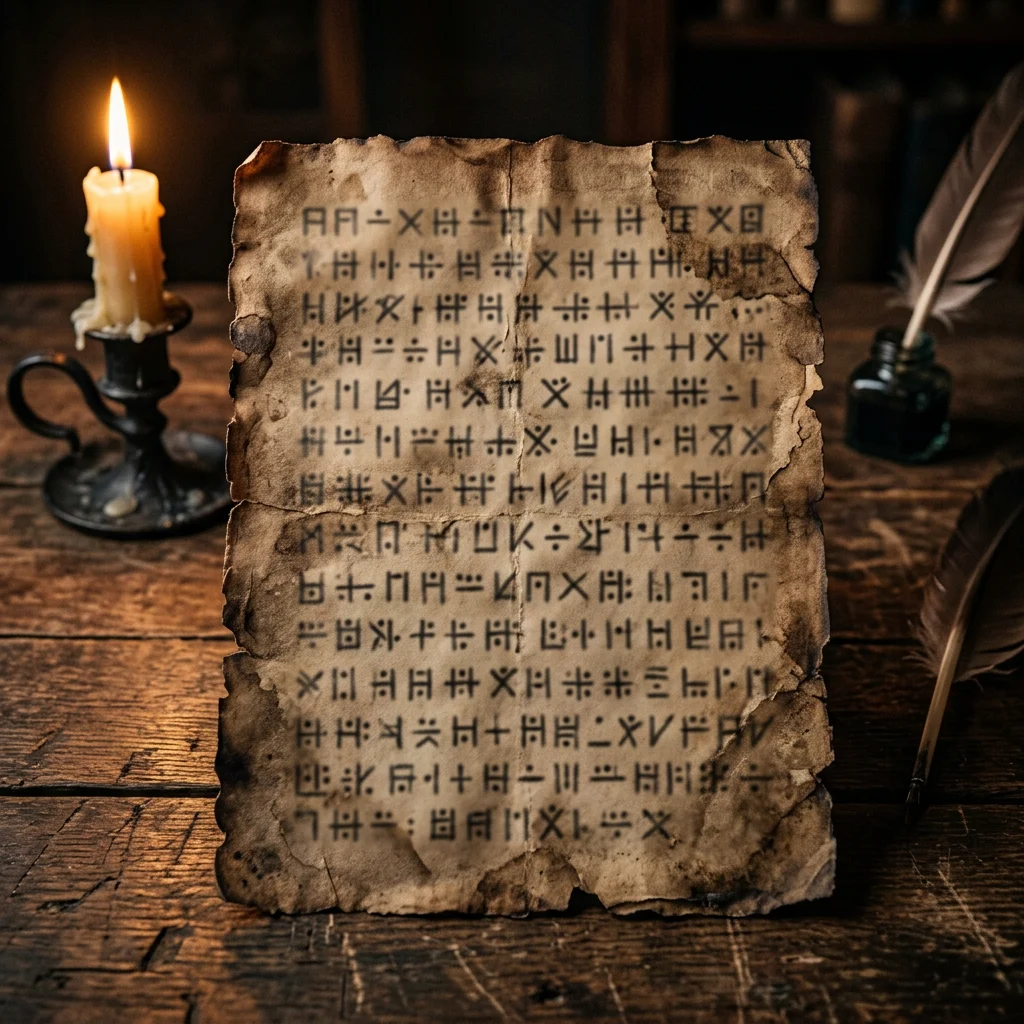
The story of the coded message at the gallows first appears in print in 1934.
According to the legend, Levasseur stood on the scaffold with a necklace or a document bearing a cryptogram and threw it into the crowd, crying out something like “Find my treasure, he who can understand it!” It is a vivid scene, but there is no known contemporary record of it. No account from 1730 mentions a coded message, and researchers who have looked for an earlier version of the story have not found one.
The cryptogram itself was published in 1934 by Charles de La Roncière, a French historian and curator at the Bibliothèque nationale, in a book titled Le Flibustier mystérieux, histoire d’un trésor caché (“The mysterious buccaneer: the story of a hidden treasure”). La Roncière linked it to documents that had come to light in the 1920s through Rose Savy, a woman from the Seychelles who had found strange rock carvings on the beach at Bel Ombre on Mahé. Accounts differ on whether her papers came from the archives on Réunion or were private documents. La Roncière himself cited only oral tradition for the scene at the gallows.
The text is written in a pigpen cipher, a simple substitution in which each letter is replaced by a symbol based on its position in a grid. It runs to 17 lines. When the symbols are replaced with letters, the result is a garbled passage of French that reads in places like a recipe or a set of riddling instructions, with phrases about pigeons, honey and a woman. Cipher historians have noted that the decoded text does not make straightforward sense and may contain copying errors, and some doubt that it has anything to do with Levasseur at all. Its connection to the pirate remains unproven.
The search on the Seychelles
For more than seventy years one family has dug at Bel Ombre on Mahé.
The most famous treasure hunter is Reginald Cruise-Wilkins, a former British Army officer who arrived in the Seychelles in the late 1940s while recovering from illness and became fascinated by the Savy papers and the carvings at Bel Ombre. He raised money from backers in Kenya and from about 1950 spent the rest of his life excavating the beach and the cliffs behind it. He came to believe that the treasure’s hiding place had been designed as a series of puzzles based on Greek mythology, especially the labours of Hercules, and that the final chamber was protected by the tides.
Cruise-Wilkins dug tunnels, diverted streams and built a sea wall around his excavation. He reported finding old guns, coins and graves, but no treasure. He died in 1977. His son, John Cruise-Wilkins, a history teacher in the Seychelles, took up the search and has continued it for decades, also turning his attention to other parts of Mahé. The Seychelles Heritage Foundation lists the Bel Ombre treasure site among the islands’ heritage sites, and visitors can still see the carvings and the remains of the excavations.
Other hunters have searched on Réunion, Mauritius, Rodrigues and Madagascar, each convinced that the cryptogram or other papers point to their island. A second “La Buse” document that surfaced later has been dismissed as a forgery. There is also a competing tradition that treasures on Mahé were hidden by a different man, the corsair Bernardin Nageon de l’Estang, who operated in the region later in the 18th century. In nearly a century of digging, no object that can be shown to come from Levasseur’s share of the Nossa Senhora do Cabo has been found on the Seychelles.
How much of the La Buse story is true?
The pirate was real and so was the capture; the coded treasure map is far less certain.
The solid core of the story is well supported. Levasseur was a French pirate who sailed with Hornigold and Bellamy, raided off West Africa, joined the Madagascar pirates, took part in the capture of the Nossa Senhora do Cabo in April 1721 and was hanged on Réunion in July 1730. The 2025 identification of the wreck at Nosy Boraha has added physical evidence for the Goa cargo and the ship’s final days.
Much of the rest is uncertain. His early life is sketchy, the value of his share is unknown and the Fiery Cross may never have existed. The cryptogram first appears two centuries after his death, with no earlier record of the scene at the gallows, and its text has resisted every attempt to turn it into clear directions. It is quite possible that Levasseur spent or lost most of his plunder long before he was arrested, as most pirates did.
The legend has also left a mark on literature. In Robert Louis Stevenson’s Treasure Island (1883), Long John Silver says that his parrot was at the boarding of the “Viceroy of the Indies” out of Goa, a clear echo of the 1721 capture, and Silver claims to have sailed with Edward England, the captain who rescued Levasseur in the Comoros. Three centuries on, the combination of a real treasure ship, a hanged pirate and an unsolved code continues to draw visitors to Réunion and the Seychelles.
Related on TheSea
Why was Olivier Levasseur called La Buse?
La Buse means “the buzzard” in French. The nickname is usually explained by the speed and ferocity of his attacks. Some English sources also call him La Bouche.
What did Levasseur capture in 1721?
The Portuguese ship Nossa Senhora do Cabo, taken at Réunion on 8 April 1721 with John Taylor and Jasper Seagar. Storm-damaged and stripped of most guns, she carried the outgoing viceroy of Portuguese India and a rich cargo from Goa.
When and where was Levasseur executed?
He was hanged at Saint-Denis on Réunion (then Île Bourbon) on 7 July 1730, after being arrested in Madagascar.
Is the La Buse cryptogram genuine?
Its link to Levasseur is unproven. It was first published in 1934 by Charles de La Roncière, and no 1730 record mentions a message thrown from the scaffold.
Has the treasure of La Buse been found?
No. Decades of digging at Bel Ombre on Mahé and searches on Réunion, Mauritius and Rodrigues have found no authenticated part of his plunder.
Was the wreck of the Nossa Senhora do Cabo found?
In 2025 researchers identified a wreck in the harbour of Nosy Boraha (Île Sainte-Marie), Madagascar, as the ship, based on its hull and more than 3,300 artefacts, mostly religious objects from Goa.
Did the Fiery Cross of Goa exist?
There is no solid contemporary evidence for it, and the researchers who studied the wreck say the gem-studded cross may be a myth.
Where is La Buse buried?
A grave in the marine cemetery at Saint-Paul, Réunion, is traditionally attributed to him, but there is no documentary proof that it holds his remains.
- La Roncière, C. de (1934). Le Flibustier mystérieux, histoire d’un trésor caché. Paris: Éditions du Masque.
- Live Science (3 July 2025). 300-year-old pirate-plundered shipwreck that once held ‘eyewatering treasure’ discovered off Madagascar (Clifford & Agostini, Wreckwatch).
- Cipher Mysteries (N. Pelling). La Buse’s cryptogram: provenance and the 1934 publication.
- Seychelles Heritage Foundation. Treasure Site, Bel Ombre, Mahé.
- Johnson, C. (1724–28). A General History of the Pyrates (accounts of England, Taylor and the Cassandra).
- Explorersweb (25 January 2023). Exploration mysteries: the treasure of Olivier Levasseur.
- Stevenson, R. L. (1883). Treasure Island, chapter 10.
Blane Perun has been exploring Earth’s oceans and marine life for over 25 years. Founder of TheSea.Org in 1999, underwater photographer, coral aquaculture pioneer, and explorer of 80+ countries.
About Blane Perun →More on Pirates →