Gulper Eel — The Deep-Sea Fish With a Mouth Bigger Than Its Body
The gulper eel (Eurypharynx pelecanoides) is a deep-sea fish famous for its enormous, loosely hinged mouth that can open wide enough to engulf prey larger than its own body. Also called the pelican eel or umbrella-mouth gulper, it lives at depths of 500 to 3,000 metres in all tropical and temperate oceans. Despite its dramatic appearance, it is a small, fragile animal — the body is whip-thin and the giant jaws are lightweight and poorly muscled.
The gulper eel is one of the deep ocean’s most recognisable animals — but almost everything people assume about it is wrong. The enormous mouth is not for eating giant prey. The eel-like body is not strong. The jaws are not powerful. The gulper eel is a fragile, slow-moving animal that spends its life in near-total darkness, using a bioluminescent tail lure and an expandable stomach-bag to catch whatever small animals blunder close enough to swallow.
How big is the gulper eel’s mouth?
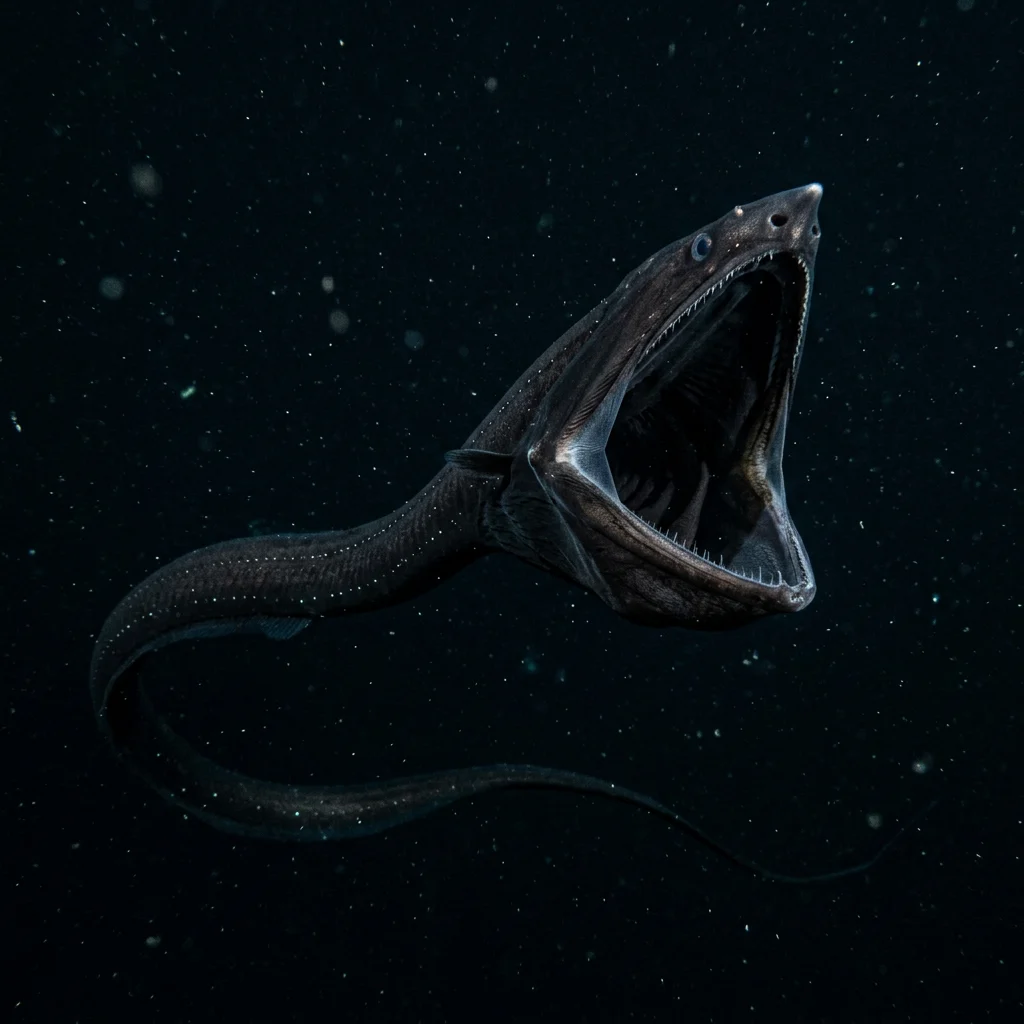
The gulper eel’s mouth is its most extreme feature — a loosely hinged structure that can open to an angle far beyond 90 degrees and expand to engulf prey larger than the eel’s own body.
The lower jaw is several times the length of the skull. It is hinged so loosely that it can swing down and forward to form a massive pouch. The stomach is also highly expandable — it can distend to accommodate prey items that exceed the eel’s normal body diameter. Together, mouth and stomach allow the gulper eel to exploit rare feeding opportunities in the deep sea where food may be scarce for extended periods. Despite this capacity, the jaws are weakly muscled — the gulper eel cannot bite hard and primarily targets soft-bodied prey.
How does the gulper eel use bioluminescence?
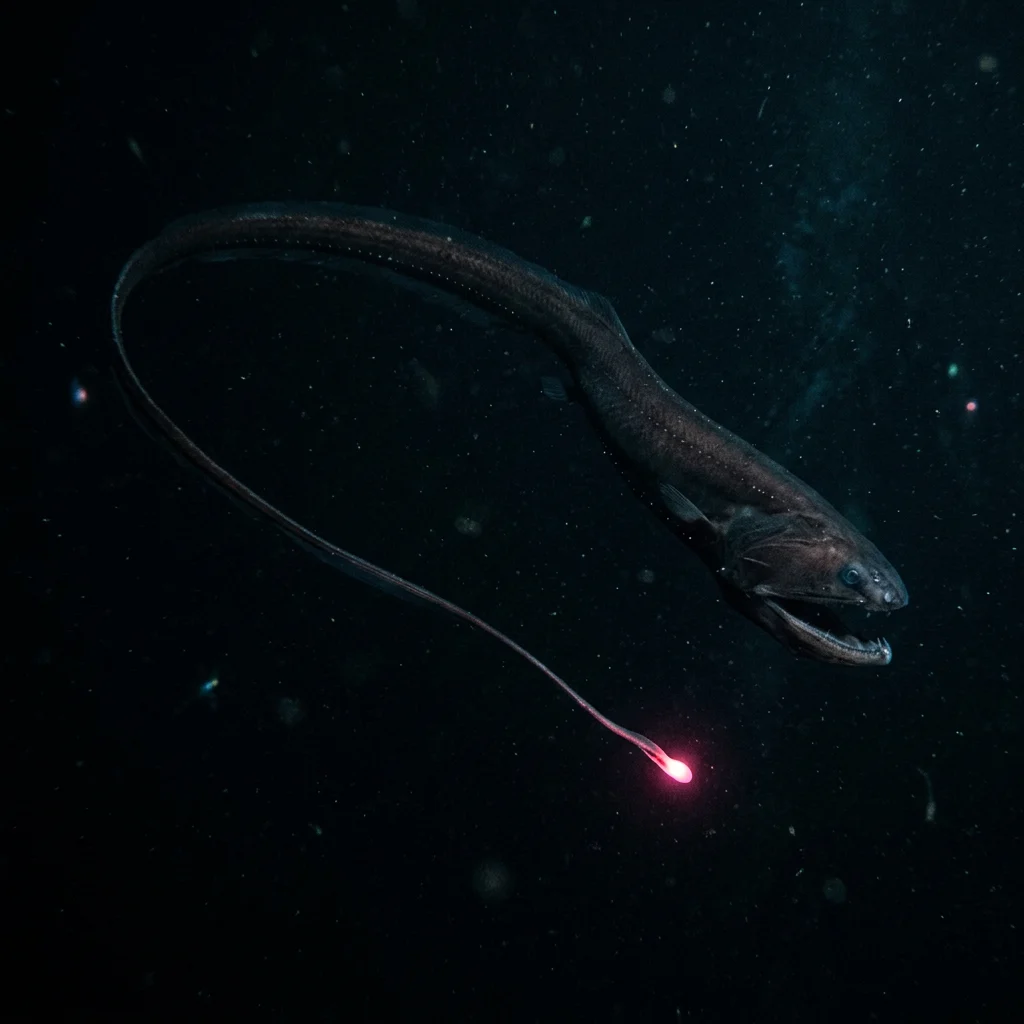
The gulper eel has a bioluminescent organ at the tip of its tail that produces pink and red light — used as a lure to attract prey in the total darkness of the deep ocean.
The tail tip is slender, whip-like, and tipped with a small bulbous organ that can produce flashes of pink or red bioluminescent light. The eel dangles or waves this tail lure to attract curious or photosensitive prey toward its open mouth. When prey approaches, the enormous jaws engulf it. This luring strategy is seen in several deep-sea predators — the anglerfish being the most famous example — and represents an energy-efficient way to hunt in an environment where active pursuit is costly.
What does the gulper eel eat?
Stomach content analysis of trawled specimens shows primarily small crustaceans, small fish, and cephalopods. Despite the enormous mouth, the eel does not typically consume prey near its own size — the jaws are too weakly muscled to restrain and process large struggling prey. The expandable capacity is an insurance policy for opportunistic large meals, not the primary feeding strategy.
How do you identify a gulper eel?
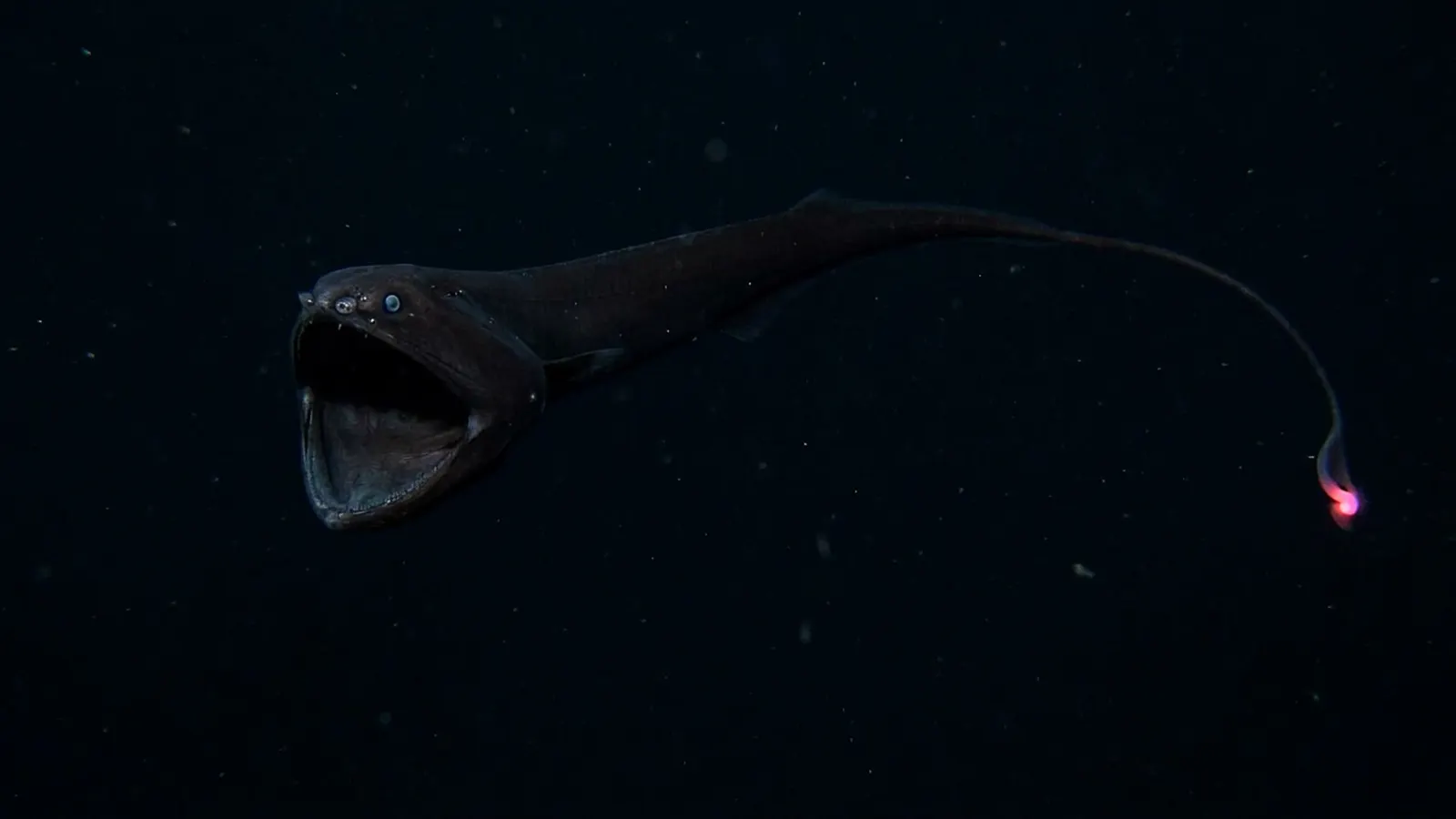
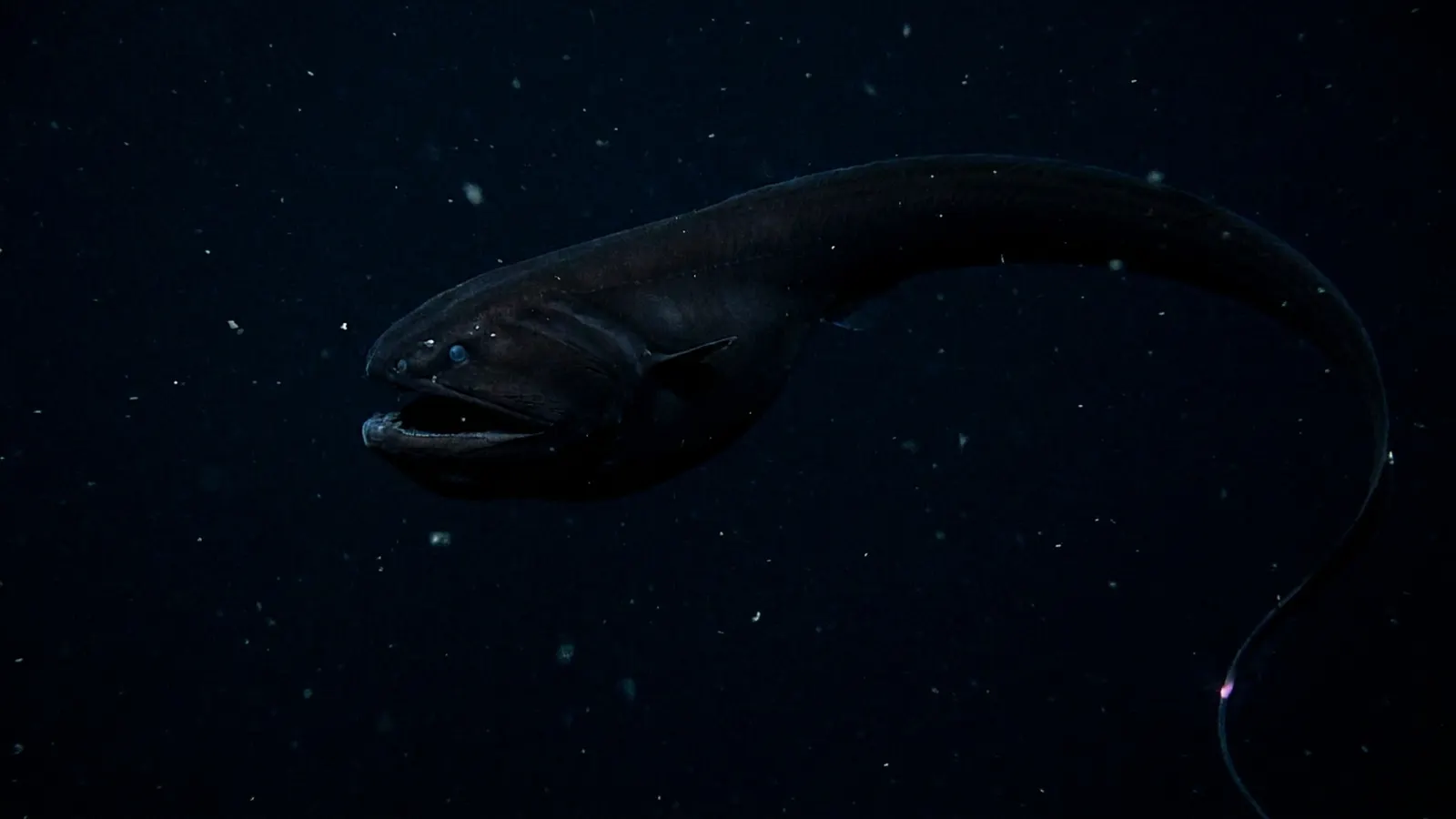
A huge, pouch-like mouth on a tiny head, a thin black body, and a long tail ending in a glowing organ.
The pelican eel, Eurypharynx pelecanoides, is the only species in its genus and family (Eurypharyngidae). Its jaws make up roughly a quarter of its total length, and the lower jaw is hinged at the very back of the head with almost no body mass behind it, so the head looks out of proportion to everything else. At rest the mouth is folded. When the eel hunts, the jaws unfold sideways and the stretchy skin of the throat inflates into a balloon-like scoop. The teeth are tiny. The eyes are minute too: one male specimen had an eye only 2.6 mm across, which suggests they detect faint light rather than form images.
Like most eels it has no pelvic fins and no scales, and it has no swim bladder. Instead, gelatinous “lymphatic spaces” around the backbone may help with buoyancy. The lateral-line sense organs stick out from the body instead of sitting in a groove, which may make it more sensitive to water movement. The skin is black or dark olive. It is one of the “ultra-black” deep-sea fishes described in 2020, with skin that reflects less than 0.5 percent of the light that hits it, so it is almost invisible even in the glow of a bioluminescent flash.
The name “gulper eel” causes some confusion, because it is also used for the related genus Saccopharynx, whose species are longer and have proportionally smaller mouths. The French zoologist Léon Vaillant named Eurypharynx in 1882. The species name pelecanoides means “pelican-like”, after the throat pouch. It has been described under several other names, including Gastrostomus bairdii, but nobody has shown that more than one species of pelican eel exists.
How does a gulper eel hunt?
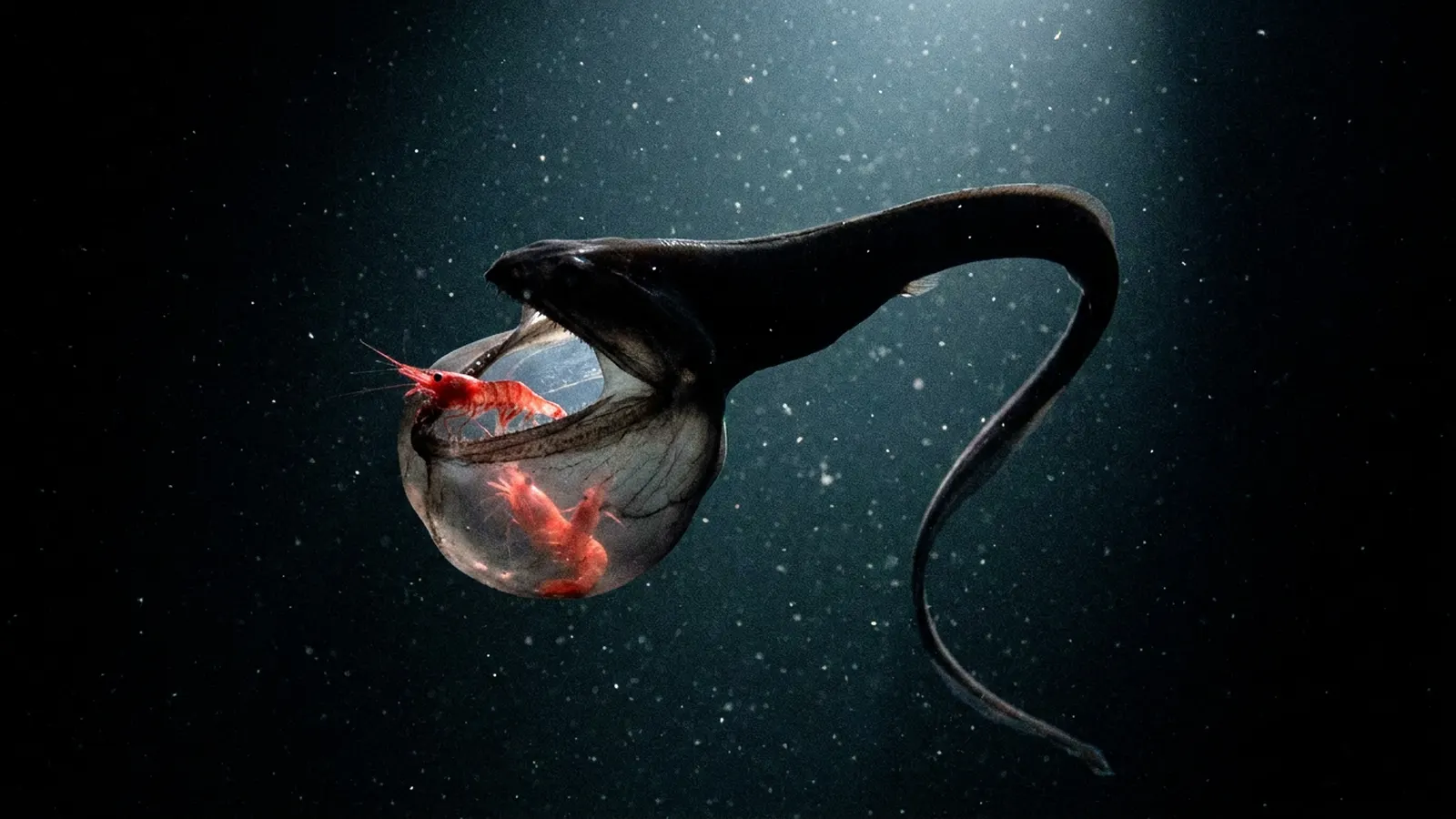
It chases small prey and lunges with its mouth inflated, scooping up water and prey together and then pushing the water out through the gills.
For most of the 20th century the gulper eel was known only from damaged specimens in trawl nets, often with their long tails tied in knots. That changed in 2018, when two teams filmed live animals. Researchers off the Azores watched one actively moving through the water column looking for prey. The E/V Nautilus team in Papahānaumokuākea Marine National Monument, off the northwestern Hawaiian Islands, filmed a juvenile inflating its mouth into a huge black balloon before deflating it and swimming off. Together with a study of how the jaws unfold and then stretch, this footage supports the idea that gulper eels are active lunge feeders, not passive drifters waiting for food to fall in.
Gut contents tell the same story. Despite the enormous mouth, the stomachs of pelican eels mostly contain small crustaceans such as shrimp and copepods, along with some small fish and squid. The tiny teeth couldn’t grip large struggling fish. The best explanation is that the mouth works like a net: it lets the eel swim into a cluster of small animals and take many at once, and it gives it the option of a larger meal when one turns up. The pink glow at the tip of the tail, with occasional bright red flashes, is thought to attract prey, but because it sits at the far end of the body, nobody yet knows what posture the eel uses to make the lure useful.
Where do gulper eels live, and how deep?
In tropical and temperate oceans worldwide, usually between about 500 and 3,000 m, with FishBase giving records to about 7,600 m.
In the North Atlantic, where it has been sampled most, the pelican eel is found mostly from 500 to 3,000 m. FishBase lists a total depth range of 500 to 7,625 m and a usual depth of 1,200 to 1,400 m. It has been caught as far north as the Davis Strait between Canada and Greenland, at about 1,140 m, and in the eastern Pacific from northern California to Peru. Since 1970, hundreds of specimens have turned up in fishing nets, mostly in the Atlantic. Unlike many midwater fishes, it is not known to migrate up toward the surface at night.
Adults are usually around 75 cm long, and FishBase records a maximum of about 1 m. Most of that length is tail. The species is listed as Least Concern by the IUCN (assessed 2012), because its range is vast and it isn’t targeted by any fishery. Its known predators include lancetfish and other large deep-sea fishes.
How do gulper eels reproduce?
Probably only once, at the end of life, after a transparent larval stage drifting in the plankton.
Like all true eels, the pelican eel starts life as a leptocephalus, a flat, glass-clear larva. Its larval teeth are fewer, larger and point inward, and gut contents show the larvae feed on marine snow, the drifting flakes of organic debris that sink from above. Leptocephali have very small organs and no red blood cells until they transform into juveniles.
The adults change dramatically as they mature, especially the males. A mature male’s olfactory organ (the nasal rosette) swells into a large bulb, while its teeth and jaws degenerate and its testes fill most of the body cavity, squeezing the stomach. Females change much less. The giant nose suggests males find females by following scent in the dark. Many researchers think pelican eels die soon after spawning, like their relatives the freshwater eels, although nobody has watched them breed.
Related on TheSea
What is the gulper eel?
The gulper eel (Eurypharynx pelecanoides) is a deep-sea fish with an enormous loosely hinged mouth that can open wide enough to engulf prey larger than its own body. It lives at 500 to 3,000 metres depth in all tropical and temperate oceans. Also called the pelican eel or umbrella-mouth gulper.
How big can a gulper eel get?
Usually about 75 cm, with a recorded maximum of about 1 m, but most of this is the long whip-like tail. The body is thin and fragile. The mouth, when fully open, can exceed the length of the body itself.
Does the gulper eel use bioluminescence?
Yes. The tip of its tail produces pink and red bioluminescent light used as a lure to attract prey in complete darkness. The eel dangles or waves its tail to draw curious prey toward its open mouth.
What does the gulper eel eat?
Primarily small crustaceans, small fish, and cephalopods. Despite its enormous mouth, its jaws are weakly muscled and it primarily targets soft-bodied, smaller prey. The expandable stomach allows it to exploit occasional larger opportunistic meals.
Where does the gulper eel live?
The mesopelagic and bathypelagic zones of all tropical and temperate oceans, at depths between 500 and 3,000 metres. It is a pelagic animal — it lives in the open water column, not on the seafloor.
Is the gulper eel dangerous to humans?
Not at all. Gulper eels are small, fragile, deep-sea animals that live far beyond recreational dive depths. They have weakly muscled jaws and pose zero threat to humans. They are only encountered in deep-sea trawls or ROV footage.
Is the gulper eel endangered?
No. The IUCN lists it as Least Concern (assessed 2012). It is found worldwide in tropical and temperate deep water and is not targeted by fisheries.
Why is the gulper eel so black?
Its skin is ultra-black, reflecting less than 0.5% of light. That hides it from both predators and prey in the glow of bioluminescence.
- FishBase: Eurypharynx pelecanoides (depth, size, larvae, IUCN status)
- Pelican eel species account (Wikipedia), for morphology, feeding, life cycle and distribution
- Davis et al. (2020), ultra-black camouflage in deep-sea fishes, Current Biology
- Ocean Exploration Trust, E/V Nautilus gulper eel video, Papahānaumokuākea (2018)
Blane Perun has been exploring Earth’s oceans and marine life for over 25 years. Founder of TheSea.Org in 1999, underwater photographer, coral aquaculture pioneer, and explorer of 80+ countries.
About Blane Perun → More on Bizarre Sea Creatures →