Sharks in Florida — The Species Off Both Coasts and When They Show Up
Florida’s coastal waters hold dozens of shark species, and the ones you are most likely to meet are blacktips, spinners, bonnetheads, nurse sharks, lemon sharks, bull sharks and Atlantic sharpnose sharks. The Atlantic coast gets a huge winter migration of blacktips, counted at more than 12,000 sharks in a single aerial survey off Palm Beach County. The Gulf coast has calmer, shallower water with bull shark and blacktip nurseries in its bays. Tiger sharks, great and scalloped hammerheads, lemon sharks, sand tigers and white sharks are all protected from harvest in state waters, and anglers fishing for sharks from shore need a free permit. Florida led the United States with 11 unprovoked bites in 2025, almost all of them minor.
Florida has more sharks close to its beaches than any other US state, but most of them are small, fish-eating species that pay swimmers no attention.
What sharks live in Florida?
Florida sits where tropical and temperate seas meet, with the Gulf Stream brushing its Atlantic coast and the broad, shallow West Florida Shelf running under its Gulf coast. That mix gives the state an unusually long list of sharks. The state fishing regulations alone name more than thirty shark species, split between those anglers may keep, those they may keep only above a minimum size, and a long list that is fully protected. Add the deep-water species that live off the shelf edge and never come near a beach, and the total runs to several dozen.
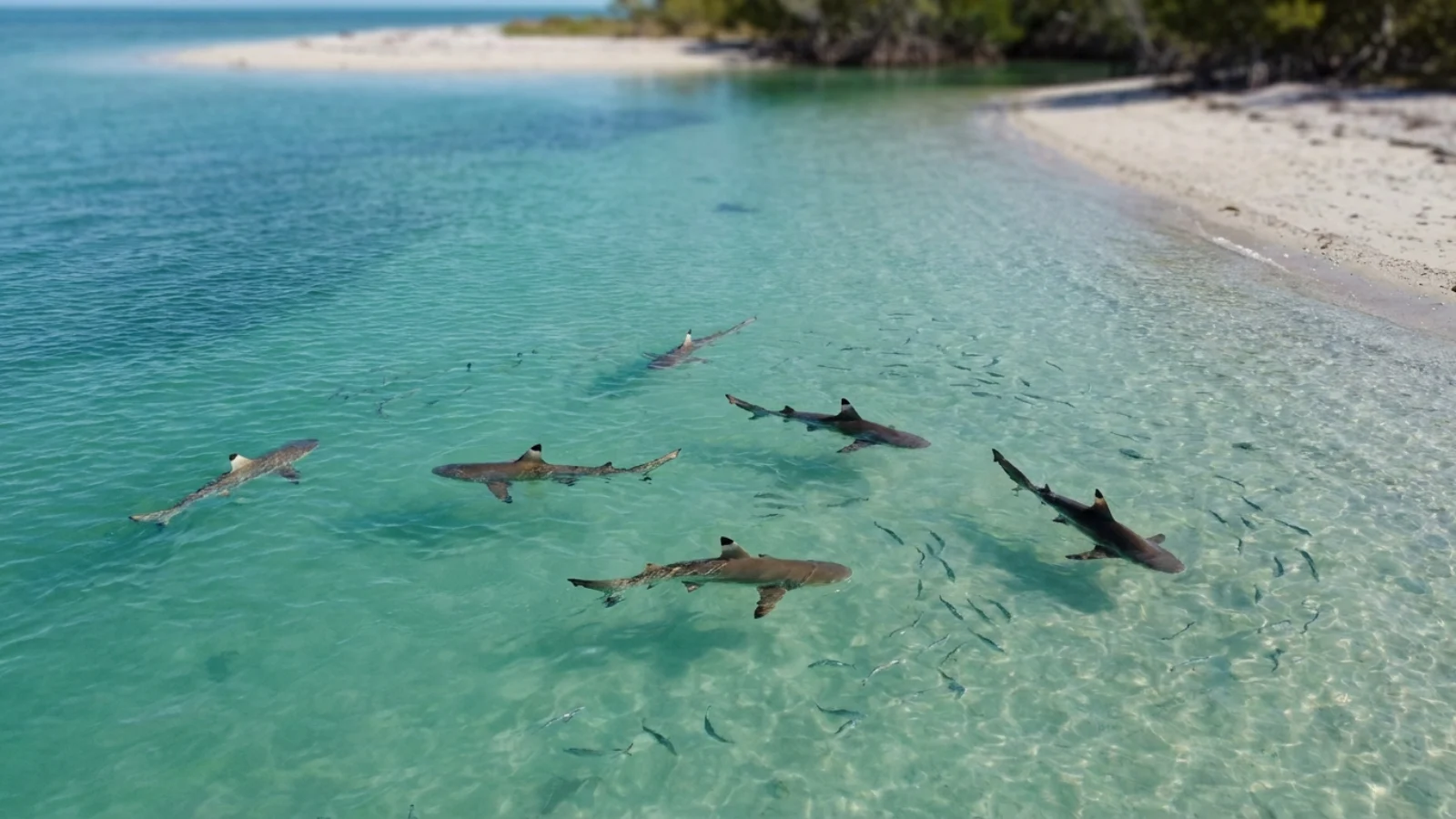
Most of those species are rarely seen. The sharks that make up the bulk of what swimmers, anglers and divers actually meet in Florida belong to a much shorter list. In the surf and around inlets, the commonest are the blacktip shark and its look-alike the spinner shark, along with the small Atlantic sharpnose shark. In the seagrass flats of Florida Bay, Tampa Bay and the Big Bend coast, the little bonnethead, a hammerhead relative with a shovel-shaped head, is everywhere. On reefs and wrecks, divers find nurse sharks resting under ledges, and in the clear water around the Keys and the southeast coast they see lemon sharks, Caribbean reef sharks and, offshore, bull sharks and tiger sharks.
Large sharks also pass through. Great hammerheads, which eat tarpon among many other fish, are migratory off Florida, moving toward the poles in summer; one caught off Boca Grande in 2006 was about 4.4 metres (14 feet) long and weighed 580 kilograms (1,280 pounds). Sandbar sharks gather on offshore wrecks, and white sharks visit the Atlantic coast in winter. Whale sharks, the largest fish in the sea, are seen occasionally in Florida’s offshore waters, usually far enough out that only boaters meet them. Our shark species guide covers the wider family tree; this article focuses on what happens in Florida’s waters.
Which sharks are most common off Florida’s Atlantic coast?
The Atlantic side is defined by the Gulf Stream. Off Palm Beach County the continental shelf is very narrow, and the warm current runs within a few kilometres of the beach. Further north, past Cape Canaveral, the shelf widens and the water cools in winter. That geography creates a natural funnel for sharks migrating along the East Coast, and it produces one of the largest shark gatherings anywhere in the world.
Every winter, blacktip sharks that spend the summer off the Carolinas and Georgia move south as the water cools and pack into the shallow coastal strip between Jupiter Inlet and Boca Raton Inlet. Stephen Kajiura and Shari Tellman of Florida Atlantic University flew an aerial survey along that coast roughly every two weeks from 2011 to 2014, filming a strip 200 metres wide from the shoreline out to sea. Their 2016 study in PLOS ONE reported a peak count of 12,128 sharks inside the survey strip in 2011, a density of about 803 sharks per square kilometre. The sharks were abundant from January to March and only when the water was cooler than about 25 °C; by April and May, numbers had fallen to about 1 percent of the peak, and the sharks left around the spring equinox.
Those numbers explain the dramatic drone videos of black-tipped fins lined up just beyond the breakers that circulate every February. They also explain why bites on the Atlantic coast cluster around inlets and surf breaks where people and feeding sharks overlap. The blacktips are chasing baitfish, especially the mullet and menhaden that move along the coast, and a surfer’s foot in murky surf can be mistaken for a fish. Because the sharks only crowd in when the water is cool, the size of each winter’s run depends on the weather, and a warm winter can mean far fewer sharks off the beaches.
The Atlantic coast is also a migration corridor for lemon sharks. A study led by Eric Reyier, published in PLOS ONE in 2014, tracked 54 juvenile lemon sharks tagged at Cape Canaveral using a network of acoustic receivers along 300 kilometres of coastline. Most stayed near the cape from December through February, but during unusually cold spells they shifted as much as 190 kilometres south. From late February to April they headed north at up to 64 kilometres a day, some reaching estuaries in Georgia and South Carolina up to 472 kilometres away, and 19 sharks returned to the cape for a second or third winter. Off Jupiter, larger adult lemon sharks gather on wrecks and reefs each winter, a well-known draw for divers. Our lemon shark profile covers the species in detail.
Which sharks live off Florida’s Gulf coast?
The Gulf coast is a different world. The West Florida Shelf slopes gently for well over 100 kilometres offshore, the water is usually calmer and murkier near shore, and the coast is broken by large, sheltered estuaries such as Tampa Bay, Charlotte Harbor, the Caloosahatchee and Estero Bay, and the maze of mangrove islands around Ten Thousand Islands. Those estuaries work as nurseries, places where female sharks give birth and the young grow up in warm, shallow water with fewer large predators.
Bull sharks are the Gulf coast’s signature large shark. They are one of the few sharks that can live in fresh water, and young bull sharks spend their early years in the brackish upper reaches of rivers and bays, moving with the salinity as rain and drought change the estuary. Blacktips, spinners, bonnetheads, Atlantic sharpnose sharks and finetooth sharks are also abundant inshore, and around piers and passes from Naples to Sanibel anglers catch them regularly. Nurse sharks are common around rock piles and artificial reefs.
Further offshore, the Gulf coast’s artificial and natural reefs hold sandbar sharks, larger bull sharks, tiger sharks, great hammerheads and the occasional dusky shark. Because the shelf is so wide, the sharks of the open Gulf are rarely seen from the beach, and the wider Gulf’s shark fauna has its own article on sharks in the Gulf of Mexico. Florida’s Gulf coast has far fewer recorded bites than the Atlantic coast, largely because it has less surf, fewer surfers and clearer, calmer water through much of the year.
What about the Florida Keys and the sawfish?
The Keys add a third, tropical community. Nurse sharks, lemon sharks, Caribbean reef sharks and blacktips are common around the reefs and channels, and great hammerheads hunt the flats and channels for rays; one hammerhead caught off Florida had 96 stingray spines lodged in and around its mouth. The Keys and Florida Bay are also the last stronghold in the United States of a remarkable relative of sharks, the smalltooth sawfish.
Sawfish are rays, not sharks, but their long, flattened bodies and toothed rostrum make them look like a shark with a hedge trimmer attached. In the western Atlantic the smalltooth sawfish once ranged from the United States to Uruguay; today it is listed as Critically Endangered by the IUCN, survives in only a fraction of its historical range, and in US waters is found mainly in southwest Florida and the Keys. Its saw tangles easily in nets, which is a large part of why it declined. Researchers working in a Florida estuary have even found that about 3 percent of the sawfish living there were produced by parthenogenesis, virgin birth, probably because females in such a small population sometimes fail to find a mate.
In early 2024, fishermen and residents in the lower Keys began reporting sawfish spinning in circles, swimming erratically and stranding on beaches. Local reports put the count of dead sawfish at about 40 by mid-April that year, prompting an emergency rescue effort by federal and state agencies in which sick animals were taken into care. Other fish species showed the same strange spinning behaviour. For a species already reduced to a remnant of its former range, losses on that scale matter. The episode is a reminder that Florida’s rarest sharks and rays face risks far more serious than anything they pose to people.
When are sharks closest to Florida beaches?
Shark activity near Florida’s beaches follows the water temperature and the bait. On the southeast coast the biggest concentration is in winter, when the blacktip migration peaks from January to March. Along much of the rest of the state, sharks are most active close to shore from late spring to early autumn, when the water is warm, the baitfish schools are thick and coastal sharks give birth in the bays. Bites, however, track people as much as sharks: most happen in summer and on holiday weekends simply because far more people are in the water.
Time of day and conditions matter too. Sharks feed most actively around dawn and dusk, near inlets and passes where tides carry baitfish, and in murky water after heavy rain or rough surf. Splashing near a feeding school of mullet or near people fishing from the beach increases the chance of a mistaken-identity bite. None of this makes Florida’s beaches dangerous, but it explains the patterns behind the headlines.
How many shark bites does Florida have?
Florida records more unprovoked shark bites than any other US state, year after year. The International Shark Attack File (ISAF) at the Florida Museum of Natural History counted 11 unprovoked bites in Florida in 2025, out of 25 in the United States and 65 worldwide, and none was fatal. Volusia County, home of New Smyrna Beach, accounted for 6 of them, Broward and Lee counties for 2 each and Miami-Dade for 1. New Smyrna Beach is often described as the location with the most recorded shark bites in the world, the result of busy surf breaks, an inlet full of fish and a huge number of surfers.
Florida’s fatal bites are rare. Historical records stretch back to the 1840s, when bathers and fishermen were killed near Pensacola, but in modern decades deaths have been very uncommon relative to the millions of people who swim off Florida’s beaches every year. Most Florida bites are a single quick nip to a hand or foot by a small blacktip or spinner shark. The full breakdown by county, species and year is in our article on shark attacks in Florida, and the global picture is in how many shark attacks happen each year.
Are there great white sharks in Florida?
Yes, seasonally. White sharks tagged in the northwest Atlantic spend summer off New England and the mid-Atlantic and move south in winter, some as far as the Florida coast and into the eastern Gulf of Mexico. A 2014 study in PLOS ONE led by Tobey Curtis compiled 649 white shark records from the northwest Atlantic between 1800 and 2010 and found that sightings clustered off Massachusetts to New Jersey in summer and off Florida in winter. Most Florida white sharks stay well offshore and are known from satellite tags rather than sightings. We cover them in detail in are there great white sharks in Florida, and the summer half of the story in sharks in Cape Cod.
What are Florida’s rules on catching sharks?
Florida’s shark rules are strict by US standards. Only hook-and-line gear may be used, and an angler may keep only one shark per person per day, with a maximum of two per vessel. Some species, including blacktip, bonnethead, Atlantic sharpnose, blacknose and finetooth sharks, have no minimum size. Others, including bull, nurse, spinner, blue, porbeagle and common thresher sharks, must be at least 54 inches (137 centimetres) to the fork of the tail.
A long list of species is fully protected in state waters and cannot be harvested, possessed or sold. It includes the tiger shark, the great, scalloped, smooth and Carolina hammerheads, the lemon shark, the sand tiger, the white shark, the shortfin and longfin makos, the oceanic whitetip, the dusky, silky, sandbar, Caribbean reef, Galapagos and night sharks, the basking and whale sharks, both sixgill sharks and sevengill sharks, and all sawfish.
Since 1 July 2019, anyone aged 16 or over who fishes for sharks from a beach, pier, bridge or jetty must hold a free shore-based shark fishing permit, which requires passing a short online course and is renewed every year. Shore anglers must use non-stainless-steel circle hooks, may not chum from the beach, and must keep a protected shark’s gills in the water and release it immediately. In 2020 Florida also passed the Kristin Jacobs Ocean Conservation Act, banning the shark fin trade in the state; a national ban, the Shark Fin Sales Elimination Act, followed in 2022.
Where can you see sharks in Florida?
For divers, the classic Florida shark experiences are winter lemon sharks on the wrecks off Jupiter, nurse sharks on almost any reef, and the occasional great hammerhead around the Keys. Snorkellers in the Keys and Biscayne Bay often see nurse sharks and small blacktips. Anglers find sharks around nearly every pass and pier on both coasts, and the winter blacktip run off Palm Beach can be seen from the beach and piers on calm days.
On Florida’s Gulf coast, beachcombers often meet sharks in a different form: fossil teeth. The beaches around Venice are famous for shark teeth washed out of ancient sediments, including those of megalodon, and our article on megalodon teeth in Florida explains where they come from.
How do you stay safe around sharks in Florida?
The advice is simple and mostly about avoiding mistaken identity. Swim near lifeguards, stay out of the water at dawn, dusk and night, and avoid murky water, inlets and areas where people are fishing or where baitfish are jumping. Leave shiny jewellery on the beach, avoid heavy splashing, and stay close to shore in groups. If you see sharks feeding in a baitfish school, get out and wait for them to move on. Rip currents and lightning injure far more beachgoers in Florida every year than sharks do.
So, what should you know about sharks in Florida?
Florida’s coastal waters are full of sharks, more so than any other US state, and that is a sign of a healthy, productive sea rather than a danger. The species you are most likely to meet are small and medium-sized fish-eaters: blacktips and spinners in the surf, bonnetheads on the grass flats, nurse sharks on the reefs and lemon sharks around the southeast coast. The winter blacktip migration off Palm Beach is one of the world’s great natural spectacles, the Gulf coast’s estuaries are nurseries for bull sharks and blacktips, and the Keys protect the country’s last smalltooth sawfish. Respect the seasons, follow the fishing rules, and Florida’s sharks are a wildlife highlight rather than a reason to stay on the sand.
What is the most common shark in Florida?
Near beaches, the blacktip and spinner sharks are the most common, along with bonnetheads and Atlantic sharpnose sharks.
When do blacktip sharks migrate to Florida?
They arrive off southeast Florida in winter, peak from January to March, and leave around the spring equinox.
Which Florida beach has the most shark bites?
New Smyrna Beach in Volusia County, which had 6 of Florida’s 11 unprovoked bites in 2025.
Are bull sharks common in Florida?
Yes. Bull sharks live along both coasts, and young bull sharks use brackish rivers and bays as nurseries.
Do you need a permit to shark fish in Florida?
Yes, from shore. Anglers aged 16 and over need a free annual shore-based shark fishing permit.
Can you keep a hammerhead in Florida?
No. Great, scalloped, smooth and Carolina hammerheads are all protected in Florida state waters.
Are there great white sharks in Florida?
Yes, in winter, mostly offshore. White sharks migrate south from New England as the water cools.
Is shark finning legal in Florida?
No. Florida banned the shark fin trade in 2020, and the US banned fin sales nationwide in 2022.
- Kajiura SM, Tellman SL (2016). Quantification of massive seasonal aggregations of blacktip sharks in southeast Florida. PLOS ONE 11: e0150911.
- Reyier EA et al. (2014). Regional-scale migrations and habitat use of juvenile lemon sharks in the US South Atlantic. PLOS ONE 9: e88470.
- Florida Fish and Wildlife Conservation Commission saltwater regulations: sharks and prohibited species (via eRegulations); shore-based shark fishing permit rules, effective 1 July 2019 (Spectrum News 13).
- International Shark Attack File, Florida Museum of Natural History: 2025 worldwide shark bite summary.
- Curtis TH et al. (2014). Seasonal distribution and historic trends in abundance of white sharks in the western North Atlantic. PLOS ONE 9: e99240.
- Smalltooth sawfish status and parthenogenesis (Wikipedia, “Smalltooth sawfish”); 2024 lower Keys sawfish deaths (WPLG Local 10, April 2024); state and national fin bans (Wikipedia, “Shark finning”).
Blane Perun has been exploring Earth’s oceans and marine life for over 25 years. Founder of TheSea.Org in 1999, underwater photographer, coral aquaculture pioneer, and explorer of 80+ countries.
About Blane Perun →