Kemp’s Ridley Sea Turtle — The Smallest, Rarest Sea Turtle and Its Daylight Arribadas
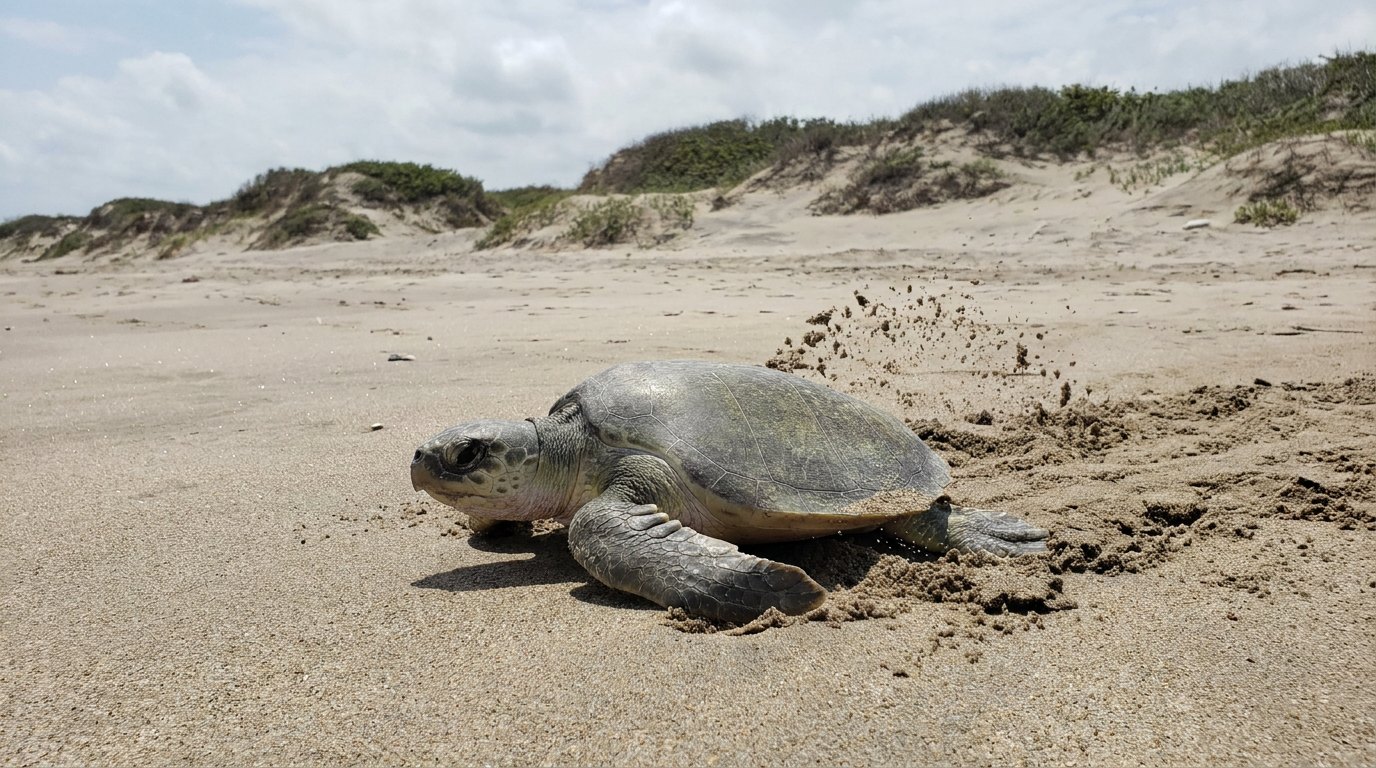
The Kemp’s ridley (Lepidochelys kempii) is the smallest sea turtle, about 2 ft long and 70–100 lb, with a nearly round grey-olive shell. It lives mainly in the Gulf of Mexico and along the US Atlantic coast, and about 95% of all nesting happens on a short stretch of coast in Tamaulipas, Mexico. It is listed as Critically Endangered and is widely considered the most endangered sea turtle.
No sea turtle has come closer to vanishing than the Kemp’s ridley. In 1947 a film shot near Rancho Nuevo, Mexico, showed tens of thousands of females crawling ashore on a single day. By 1985 the entire species laid just 702 nests. Its partial recovery since then is one of the great cooperative conservation efforts between Mexico and the United States.
How big is a Kemp’s ridley?
About 2 ft in shell length and 70–100 lb, the smallest of the seven sea turtles.
Adults have a nearly circular, grey-olive carapace and a pale yellow plastron, with a triangular head and hooked beak. Hatchlings are almost black. The name honors Richard Kemp, a Key West fisherman who sent specimens to Harvard in the 1800s.
| Species | Adult size | Diet | IUCN (global) |
|---|---|---|---|
| Leatherback | 5–6 ft; 750–1,000 lb | Jellyfish, salps | Vulnerable |
| Green | 3–4 ft; 250–400 lb | Seagrass, algae | Least Concern |
| Loggerhead | 2.5–3.5 ft; 200–350 lb | Crabs, conch, whelks | Vulnerable |
| Flatback | 80–95 cm; up to 100 kg | Benthic invertebrates | Data Deficient |
| Hawksbill | 2–3.5 ft; 100–150 lb | Sponges | Critically Endangered |
| Olive ridley | 2–2.5 ft; up to 100 lb | Crustaceans, algae, tunicates | Vulnerable |
| Kemp’s ridley | ~2 ft; 70–100 lb | Crabs | Critically Endangered |
What do Kemp’s ridleys eat?
Crabs, above all. Juveniles living in floating Sargassum eat small animals and plants; once they move into shallow coastal waters they switch to crabs.
Blue crabs and other swimming crabs are favorites, which brings the turtles into shallow bays and sounds from Texas to New England, and into conflict with shrimp trawls and recreational anglers. See blue claw crabs and crabs.
Where do Kemp’s ridleys nest?
About 95% of nesting occurs in Tamaulipas, Mexico, on three main beaches: Rancho Nuevo, Tepehuajes and Barra del Tordo. Smaller numbers nest in Texas, especially on Padre Island.
Kemp’s ridleys are the only sea turtle that routinely nests in daylight, and like the olive ridley they nest in synchronized mass arrivals called arribadas, usually on windy days between April and July. Females lay two to three clutches a season of about 100 eggs, incubating for 50–60 days, and return to nest every one to three years. See ridley sea turtles for how arribadas work.
How did the Kemp’s ridley nearly go extinct?
Decades of egg collection and drowning in shrimp trawls. The 1947 arribada filmed at Rancho Nuevo involved tens of thousands of turtles; by 1985 there were just 702 nests, fewer than 250 nesting females.
| Year | Event |
|---|---|
| 1947 | Amateur film shows tens of thousands nesting near Rancho Nuevo in a day |
| 1966 | Mexico begins protecting the nesting beach |
| 1970 | Listed as Endangered in the US (Dec 2, 1970) |
| 1978 | US–Mexico binational recovery program begins, including egg transfers to Padre Island, Texas |
| 1985 | Record low: 702 nests |
| 1990s–2009 | Nests increase about 15% a year as TEDs and beach protection take effect |
| 2010 onward | Growth stops abruptly; nest numbers fluctuate |
The reasons for the post-2010 stall are still debated; candidates include the Deepwater Horizon oil spill, fishing bycatch, food availability and changes in the Gulf. See sea turtle rescue.
Why do Kemp’s ridleys strand on Cape Cod?
Juveniles that feed in New England waters in summer can be trapped by falling temperatures in Cape Cod Bay in late autumn and become “cold-stunned.”
Cold-stunned turtles float helplessly and wash ashore. Volunteers patrol the beaches each November and December, and rehabilitation centers warm them up slowly before releasing them in warmer water. Kemp’s ridleys make up most of these strandings.
Naming: Richard Kemp, Samuel Garman and the “bastard turtle”
The species was described scientifically in 1880 by Samuel Garman of Harvard, who called it Thalassochelys kempii. The name honours Richard Moore Kemp (1825–1908), a Key West fisherman and naturalist who was the first to send Garman a specimen. NOAA’s species page gives a different date, saying Kemp submitted the species for identification in 1906; since Garman’s description is dated 1880, the earlier date is the one that fits the published record. The turtle was later moved through several genera, including Colpochelys and Caretta, and was at one point treated as a subspecies of the olive ridley, before settling as Lepidochelys kempii.
Nobody knows where the word “ridley” comes from. Before it caught on for both species in the genus, Gulf fishermen often called this turtle the “bastard turtle”, partly because they believed it was a hybrid. One writer, Pamela Philips, also recorded the name “heartbreak turtle”, which she said fishermen coined after watching turtles die when flipped on their backs. Today the species is also known as the Atlantic ridley, to separate it from the olive ridley of the Pacific and Indian Oceans.
Identifying a Kemp’s ridley
Kemp’s ridleys are small and compact. Adults reach maturity at about 58 to 70 cm (23 to 28 in) in carapace length and 36 to 45 kg (79 to 99 lb), and the largest recorded animals reach about 75 cm (30 in) and 50 kg (110 lb). The carapace is the key feature: it is almost as wide as it is long, giving the turtle a nearly circular outline found in no other sea turtle. In adults it is usually olive-grey above, with a pale yellowish plastron. Hatchlings are dark charcoal grey on both sides.
Close up, a few scale details confirm the identification. The carapace has five pairs of costal scutes. On each side of the shell, where the carapace joins the plastron, there are four inframarginal scutes, each pierced by a small pore. The head is triangular, with two pairs of prefrontal scales and a slightly hooked beak with broad crushing surfaces suited to cracking crab shells. Each front flipper has one claw, and the back flippers may have one or two.
The species most easily confused with it is the olive ridley, which is similar in shape but has a variable number of costal scutes, from five to nine on each side and most often six to eight, and lives mainly in the Pacific and Indian Oceans. In the Gulf of Mexico and along the US Atlantic coast, a small, round, grey turtle is almost always a Kemp’s ridley; a young loggerhead has a longer, reddish-brown shell and a much bigger head.
Where Kemp’s ridleys live at each life stage
The species’ distribution changes with age and sex. After hatching, the young turtles swim offshore. Some stay in currents within the Gulf; others are carried around Florida and up the Atlantic coast by the Gulf Stream. Juveniles shelter in floating Sargassum, feeding on small animals and plants, for roughly one to two years or until they reach a shell length of about 20 cm (8 in). Then they move into shallow coastal waters of the Gulf or the northwest Atlantic.
Adults are mostly a Gulf animal. They forage over the continental shelf, usually in water 50 m deep or less, though they have been recorded much deeper. Adult females range widely between nesting seasons, from the Yucatán Peninsula to southern Florida and the north-central Gulf, and some return to the same foraging grounds year after year. Many males stay closer to the nesting beaches off Texas, Tamaulipas and Veracruz; some migrate each year between feeding and breeding areas, while others may not migrate at all. Adults are rarely found in the Atlantic: one analysis found that only about 2 to 4% of Kemp’s ridleys recorded there were adults.
Juveniles travel much further. They are found along the US Atlantic coast to New England and as far north as Nova Scotia, and a few have turned up in European waters, near the Azores and off Morocco. In November 2021 a live male stranded on Talacre beach in North Wales and was taken to the Anglesey Sea Zoo for care, with the aim of returning it to the Gulf.
Feeding: a crab specialist
Crabs dominate the adult diet, and the turtle’s broad crushing jaws are built for them. Kemp’s ridleys also take molluscs, jellyfish, fish, sea urchins and some algae, and adults are opportunistic bottom feeders over muddy and sandy seabeds where their prey is common. Research has found that their dives, including feeding dives, may be longer at night.
Diet varies with region and prey availability, and comparisons of head-started turtles (raised in captivity before release) with wild turtles found little difference in what they ate. Some scientists now think the amount of food available on the Gulf’s foraging grounds may help explain the species’ uneven recovery since 2010, which is discussed below.
The arribada and daytime nesting in detail
Mass nesting, or the arribada (Spanish for “arrival”), is found only in the genus Lepidochelys. Females gather offshore and then, when conditions are right, come ashore together. Scientists have proposed several triggers, including strong onshore winds, the lunar cycle and pheromones released by the females, but none has been proven. The likely benefit is safety in numbers: predators cannot eat all the eggs laid in a short window, and the many hatchlings that emerge around the same time overwhelm crabs, birds and fish waiting for them.
Daytime nesting is the Kemp’s ridley’s other oddity. The National Park Service at Padre Island suggests it may make it harder for nocturnal predators such as raccoons to follow a turtle’s tracks or scent to her eggs.
Sources differ slightly on the details of reproduction, so both versions are given here. NOAA describes a nesting season from April to July, an average of two to three clutches per season, about 100 eggs per clutch and incubation of 50 to 60 days. Padre Island National Seashore gives a season from mid-March through August, one to four clutches per season, and incubation of six to eight weeks. Both agree that females return to nest every one to three years.
As in other sea turtles, nest temperature sets the sex of the hatchlings. Cooler eggs, below roughly 29.5 °C, produce mainly males, and warmer eggs mainly females. Even within one nest the result is mixed: eggs in the centre of a clutch are warmed by the metabolic heat of their neighbours and tend to produce females, while eggs at the edges are more likely to produce males. Once a male hatchling enters the sea, he never comes ashore again unless he is sick or injured.
How many were there? Estimates of the 1947 arribada
The 1947 film is the baseline for everything written about this species. According to the National Park Service, a pilot who had heard rumours of mass nesting flew over Rancho Nuevo with a camera, landed and filmed the turtles. When scientists found the footage in the 1960s and analysed it, they estimated that about 40,000 females came ashore on that one day.
Later reconstructions put the numbers in other terms. One estimate puts nesting in 1947 at about 121,517 nests, which fell to 702 nests in 1985, a decline of 99.4%. At the low point, NOAA puts the nesting population at fewer than 250 females, while the Padre Island National Seashore profile says fewer than 300 females nested in Mexico in 1985. The difference reflects how many nests each female is assumed to lay in a season.
The recovery effort: Mexico, Texas and the turtle excluder device
Protection began in 1966, when Mexico’s national fisheries research institute sent biologists to the coast of southern Tamaulipas to survey the nesting beach and start conservation work. In the United States the Kemp’s ridley was listed on December 2, 1970, under the Endangered Species Conservation Act, and then under the Endangered Species Act of 1973. An informal binational group, the Kemp’s Ridley Working Group, first met in 1977, and a formal binational recovery plan followed in 1984, revised in 1992 and again in a draft published in 2010.
Padre Island National Seashore has been part of the binational recovery programme since the mid-1970s. Its goal was to build a secondary nesting colony in Texas as insurance against a disaster at the Mexican beaches. Texas sits at the northern end of the species’ historic nesting range, and nesting there was documented as early as the 1940s; Texas is the only US state where the species is native as a nester, and the state legislature has designated it the Texas State Turtle. More Kemp’s ridley nests are found at Padre Island than anywhere else in the United States.
The single most important change at sea was the turtle excluder device, a grid fitted in shrimp trawls that lets turtles escape. TEDs are required in the US shrimp otter trawl fishery, and since early 2021 they have also been required on larger vessels in the skimmer trawl fishery. Since 1989 the United States has banned imports of shrimp caught in ways that harm sea turtles, unless the exporting country has comparable protections.
The 2010 setback and the debate over why
Before 2010, nesting was climbing fast. Estimates of the rate differ with the period and the beaches counted: NOAA gives growth of about 15% a year through 2009, the Padre Island profile gives 12 to 19% a year in Texas and Mexico from 1997 to 2009, and a 2018 paper in Chelonian Conservation and Biology says the index of nests on the main Tamaulipas beach was rising at about 19% a year in 2009.
Then, in 2010, nest numbers dropped by more than a third, and they have fluctuated ever since. The timing matched the Deepwater Horizon oil spill, which NOAA describes as the largest offshore oil spill in US history, and unprecedented numbers of Kemp’s ridleys stranded on northern Gulf beaches that year. A 2016 stock assessment by B. J. Gallaway and colleagues noted that nests recovered to about 2009 levels in 2011, improved slightly in 2012 and then fell sharply again in 2013. Their best-fitting model was one in which the number of nests each female lays depends on the size of the population, consistent with a large population running short of food.
C. W. Caillouet and colleagues developed that idea in 2018, proposing that the Gulf’s carrying capacity for Kemp’s ridleys was already declining before 2010. Possible causes include broader degradation of the Gulf ecosystem, the rapidly growing turtle population, and less food per turtle, including less discarded bycatch from shrimp trawling for turtles to scavenge. The spill, ongoing bycatch and food limits are not mutually exclusive, and researchers still treat the question as open.
Recent nesting news from Texas
Texas nesting has recently reached new highs. In September 2007 officials reported a then-record 128 Kemp’s ridley nests on Texas beaches, 81 of them on North Padre Island. In July 2026 the US Fish and Wildlife Service reported that Texas had documented more than 650 Kemp’s ridley nests that season, well above the previous record of 449 nests set in 2025. The Padre Island profile estimates that about 5,500 females nest in Mexico each year and about 55 in Texas, so the Mexican beaches remain the heart of the population.
Cold-stunning and a warming Gulf of Maine
The Cape Cod strandings described above have grown dramatically since the 1970s. A 2019 study in PLOS ONE by L. P. Griffin and colleagues, examining oceanic, atmospheric and biological factors behind strandings in Cape Cod Bay, found that the biggest stranding years came when the Gulf of Maine was warmer than usual in late October and early November. Surprisingly, the number of hatchlings released in Mexico, used as a rough index of population size, was not an important predictor.
The authors suggest warmer water is drawing more young Kemp’s ridleys north into New England bays, where a sudden autumn chill then traps them. Using sea-temperature projections, they predicted that more than 2,300 Kemp’s ridleys a year might cold-stun by 2031. Cold-stunning probably accounts for only a small share of juvenile deaths, but for a critically endangered species the rescue and rehabilitation effort still matters.
Other threats on the nesting beach
On land, NOAA lists beach driving as a particular problem for Kemp’s ridleys: vehicles can crush nesting females, eggs and hatchlings, and ruts and compacted sand make it harder for hatchlings to reach the sea. Predators including feral pigs, coyotes, raccoons, birds and crabs take eggs and young, and coastal lighting can disorient hatchlings. Rising seas and storms threaten the low barrier beaches where most nesting takes place.
One recent curiosity shows how closely Gulf turtles share their habitat. A preprint (not yet peer reviewed) by B. M. Shamblin and colleagues describes a juvenile hawksbill × Kemp’s ridley hybrid that stranded near Port Aransas, Texas, on 30 July 2022, apparently the first such hybrid reported. The authors expect more to be found as both species use the southern and western Gulf.
What threatens Kemp’s ridleys today?
NOAA lists bycatch in fishing gear as the greatest threat, along with harvest, nesting habitat loss, egg and hatchling predation, vessel strikes, pollution and changing environmental conditions.
TEDs in shrimp trawls are the single most important fix. Kemp’s ridleys mature at about 13 years, younger than most sea turtles, which gives them some capacity to rebound if adult survival stays high. See olive ridley for its close relative and loggerhead for another Gulf turtle.
What is the rarest sea turtle?
The Kemp’s ridley is generally considered the rarest and most endangered sea turtle.
How big is a Kemp’s ridley sea turtle?
About 2 ft long and 70–100 lb, the smallest sea turtle.
Where do Kemp’s ridleys nest?
About 95% nest in Tamaulipas, Mexico; smaller numbers nest in Texas, especially Padre Island.
Do Kemp’s ridleys nest during the day?
Yes. They are the only sea turtle that routinely nests in daylight.
What is an arribada?
A synchronized mass nesting event, seen only in ridley sea turtles.
What do Kemp’s ridleys eat?
Mainly crabs, especially blue crabs, in shallow coastal waters.
How many Kemp’s ridley nests were there at the lowest point?
Just 702 nests in 1985, representing fewer than 250 nesting females.
Why are Kemp’s ridleys found on Cape Cod?
Juveniles feed in New England in summer and can be cold-stunned in Cape Cod Bay in late autumn.
- NOAA Fisheries — species pages for the green, hawksbill, loggerhead, leatherback, Kemp’s ridley and olive ridley turtles.
- IUCN Red List global assessments, as summarized by WWF-UK’s marine turtle species pages.
- NOAA Fisheries — Kemp’s ridley turtle species page (population status, reproduction, threats, TED rules).
- National Park Service, Padre Island National Seashore — Kemp’s ridley sea turtles species profile.
- US Fish and Wildlife Service (30 July 2026). Renewed hope for Kemp’s ridley sea turtles.
- Gallaway, B. J. et al. (2016). Evaluation of the status of the Kemp’s ridley sea turtle after the 2010 Deepwater Horizon oil spill. Gulf of Mexico Science 33(2). doi:10.18785/goms.3302.06
- Caillouet, C. W. et al. (2018). Did declining carrying capacity for the Kemp’s ridley sea turtle population within the Gulf of Mexico contribute to the nesting setback in 2010−2017? Chelonian Conservation and Biology 17(1). doi:10.2744/CCB-1283.1
- Griffin, L. P. et al. (2019). Warming seas increase cold-stunning events for Kemp’s ridley sea turtles in the northwest Atlantic. PLOS ONE 14(1): e0211503. doi:10.1371/journal.pone.0211503
- Shamblin, B. M. et al. (2024, preprint). Hawksbill × Kemp’s ridley sea turtle hybridization. Authorea. doi:10.22541/au.173532678.83513539/v1
Blane Perun has been exploring Earth’s oceans and marine life for over 25 years. Founder of TheSea.Org in 1999, underwater photographer, coral aquaculture pioneer, and explorer of 80+ countries.
About Blane Perun → More on Sea Turtles →