The Loudest Ocean Sound Was an Icequake — How the “Bloop” Mystery Was Solved
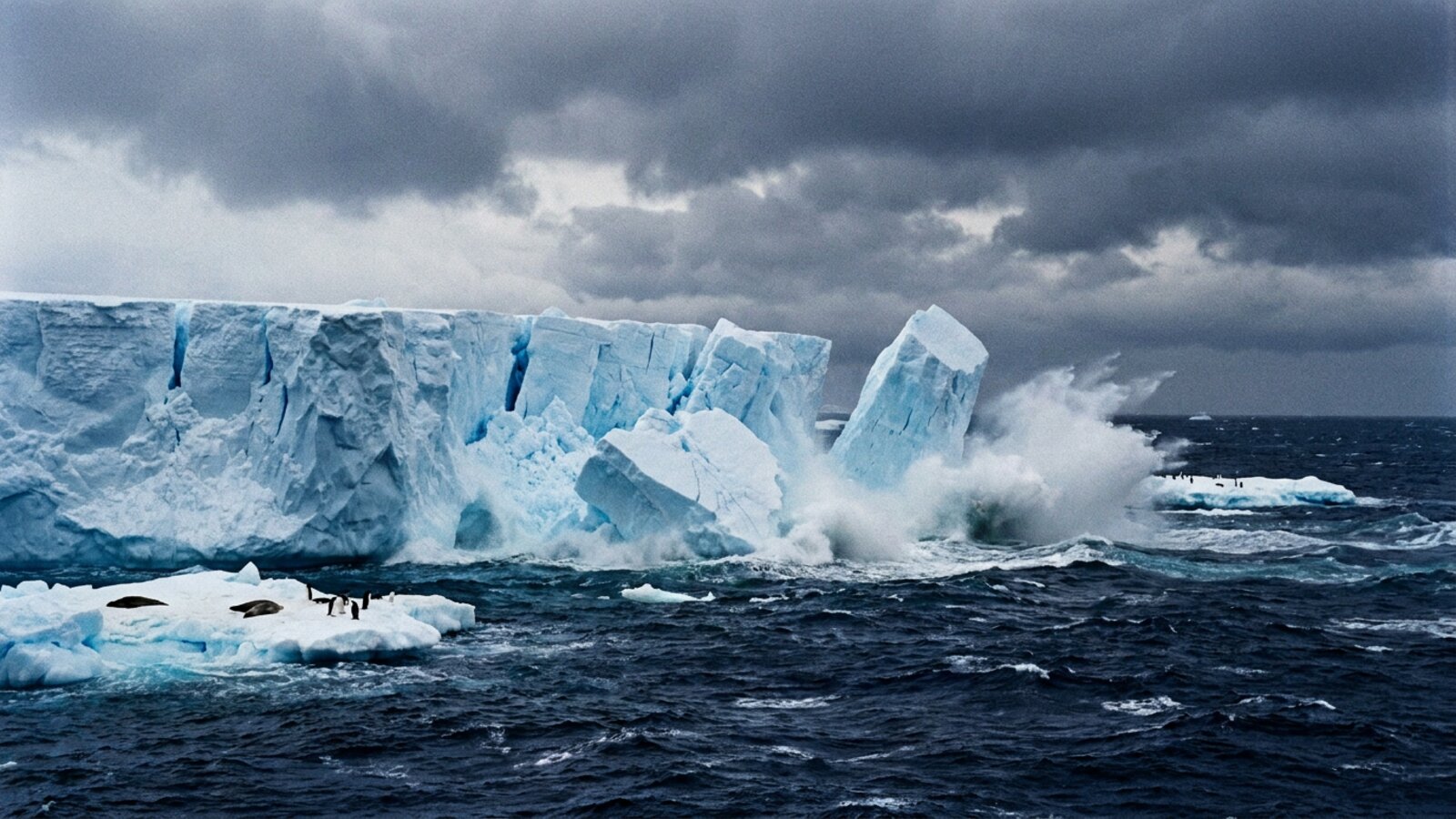
The “Bloop” was an extremely loud, ultra-low-frequency sound recorded by NOAA underwater microphones in 1997, and it was almost certainly made by an icequake: Antarctic ice cracking and breaking away from a glacier. It was picked up by hydrophone arrays at least 5,000 km (3,100 miles) apart and traced to the remote ocean off southern Chile toward Antarctica. For years it fuelled sea-monster speculation, until NOAA’s acoustic team matched it to the sounds of calving ice recorded between 2005 and 2010.
What was the Bloop?
It was a deep, rising sound captured in 1997 by NOAA’s network of hydrophones, underwater microphones originally set up to listen for submarines, earthquakes and volcanoes. The recording sweeps upward in frequency and, sped up 16 times so humans can hear it, sounds like a giant, wet “bloop.” What made it famous was its reach: arrays at least 5,000 km apart heard it, which is why it is often called one of the loudest ocean sounds ever recorded.
NOAA’s own description is short. The sound rose in frequency over about one minute and was strong enough to register on several sensors of its Equatorial Pacific Ocean autonomous hydrophone array, at ranges of more than 5,000 km. By triangulating the arrival times, the acoustics team placed the source roughly at 50°S, 100°W, a remote stretch of the South Pacific west of the southern tip of South America and well north of the Antarctic coast. Played at its true speed the recording is closer to a long, low rumble, like distant thunder, than to a bubble; the cartoonish “bloop” comes from compressing it into a few seconds.
The title of this page uses the popular shorthand. The Bloop was not measured as the loudest sound in the sea, and no single loudness figure was ever published for it. What can be said is that it travelled across a large part of an ocean basin and reached several distant instruments, which tells acousticians it carried a great deal of energy at very low frequencies.
Who was listening, and why?
The ears that caught the Bloop had a Cold War history. The US Navy’s Sound Surveillance System, SOSUS, grew out of anti-submarine research begun in 1949. A six-element test array was laid off Eleuthera in the Bahamas in 1951, and a full 40-hydrophone array followed in 1952, cabled to shore stations so that analysts could pick out the noise of Soviet submarines. The system was secret for decades; its mission was declassified in 1991.
That same year, scientists at NOAA’s Pacific Marine Environmental Laboratory began recording SOSUS data for civilian research. They soon added their own instruments: autonomous hydrophones moored in the eastern and equatorial Pacific, each a single sensor with an accurate clock and enough battery to record for a year or two before being recovered. Their main job was to monitor undersea earthquakes and volcanic activity, along with ice noise and the movements of whales. Along the way they picked up whales, ships, ice and a handful of sounds nobody could immediately explain. NOAA gave those sounds informal names, posted spectrograms and sped-up audio online, and the Bloop became the most famous of them.
Why does low-frequency sound travel so far?
Low-frequency sound travels astonishingly far in seawater, especially through the SOFAR channel, a layer about 1,000 m deep where sound waves are trapped and can carry across entire ocean basins. See why sound travels faster in the ocean.
Sound moves through seawater at about 1,500 m per second, more than four times faster than in air. Its speed depends mainly on temperature and pressure. Near the surface, warm water makes sound fast; deeper down, cooling water slows it; deeper still, rising pressure speeds it up again. The depth where those effects balance, at the bottom of the thermocline, is the axis of the deep sound channel. Sound that starts near that depth is bent back towards it every time it heads up or down, so it travels along the channel with very little loss, especially at frequencies below a few hundred hertz.
The channel was described independently in the 1940s by Maurice Ewing and J. Lamar Worzel at Columbia University and by Leonid Brekhovskikh in the Soviet Union. In a 1944 test, Ewing and Worzel hung a hydrophone from the research vessel Saluda while another ship set off explosive charges up to about 1,700 km away, and still heard them clearly. The depth of the axis varies. Data from north of Hawaii put it near 750 m; at both Perth and Bermuda it lies at around 1,200 m; and above about 60° of latitude it rises to the surface and gives way to a surface duct. In the 1991 Heard Island Feasibility Test, coded signals sent from a ship in the southern Indian Ocean were picked up in all five major ocean basins, including hydrophones off Ascension Island, about 9,200 km away, after a journey of 1 hour, 44 minutes and 17 seconds.
Why did people think it was a sea monster?
The sound’s profile resembled some animal calls, and early commentary noted it was far louder than any known animal could make. That opened the door to speculation about an unknown giant creature, helped along by fiction and internet lore. NOAA’s own scientists leaned towards ice. Oceanographer Christopher Fox told CNN in 2001 that he suspected ice calving in Antarctica, and in the following years NOAA’s team recorded many similar sounds from icebergs and ice shelves cracking, confirming the match.
The confusion came from a single remark taken out of context. In a 2002 New Scientist article, journalist David Wolman reported Fox’s hunch that, of the unexplained sounds, the Bloop was the one most like an animal, because its rapid change in frequency resembled known animal calls. Wolman then pointed out that sensors up to about 4,800 km apart had picked it up, so if it were an animal it would have to be far louder than any whale, and asked whether some creature bigger than a whale could be lurking in the depths. The cultural historian Philip Hayward later argued that this framing amplified Fox’s passing comment and opened the door to years of speculation.
Fiction did the rest. The approximate source of the Bloop lies around 2,000 km from the coordinates H. P. Lovecraft gave in his 1928 story The Call of Cthulhu for the sunken city of R’lyeh, home of his tentacled sea god, and fans were quick to notice. The sound then turned up in internet forums, video games and television. In 2012 the Animal Planet docufiction Mermaids: The Body Found used it as supposed evidence, prompting NOAA to state publicly that there was no evidence of aquatic humanoids. A sea creature that could be heard across an ocean is a good story, and it sits comfortably beside older legends such as the kraken and the other sea monsters of maritime folklore, but there is no animal known or plausible that could produce it.
How was the Bloop solved?
By listening closer to the ice. From late 2005, NOAA and partner scientists moored hydrophone arrays in the Bransfield Strait and Drake Passage off the Antarctic Peninsula, and from December 2007 to December 2008 five more hydrophones in the Scotia Sea. A paper by Robert Dziak and colleagues, published in 2015, summarised what they heard. Icequakes, the short, broadband cracks produced when large floating icebergs fracture, were a dominant feature of the soundscape. Their numbers peaked in the southern summer and fell in winter, apparently following the cycle of thawing and freezing, and the loudest reached source levels of 220 dB or more, comparable in acoustic energy to a magnitude-5 earthquake.
One iceberg made the link especially clear. Iceberg A53a, about 1,100 km² when it broke away in the Weddell Sea, drifted north, grounded in the Bransfield Strait and then fell apart in the Scotia Sea in early 2008, right inside the hydrophone array. As it scraped and split it produced swarms of icequakes and long, tonal “harmonic tremor” as the berg ground against the seabed and other ice. Those signals had the same kind of spectrogram as the Bloop, with comparable power. NOAA concluded that the Bloop was most likely an icequake from a large iceberg somewhere between the Bransfield Strait and the Ross Sea, possibly near Cape Adare, a well-known source of ice sounds. In a 2012 interview, Dziak said the hydrophones pick up tens of thousands of Bloop-like sounds every year.
NOAA’s summary was blunt: the Bloop was the sound of an icequake, an iceberg cracking and breaking away from an Antarctic glacier. Strictly, it cannot be pinned to a particular iceberg on a particular day in 1997, because no instrument was close enough to see the ice break. The explanation is a match of pattern and power rather than a direct observation, but it is the only one consistent with everything the hydrophones have recorded since.
Loud sounds in the ocean
| Source | What it is | Note |
|---|---|---|
| The Bloop (1997) | Icequake, Antarctic ice fracturing | Heard 5,000+ km away |
| Large icequakes | Fracturing icebergs | Source levels ≥220 dB re 1 µPa near Antarctica |
| Blue whale calls | Low-frequency song | About 188 dB re 1 µPa; see blue whale call |
| Sperm whale clicks | Echolocation | Among the loudest animal sounds |
| Undersea earthquakes and volcanoes | Seismic “T-waves” | Can cross ocean basins |
| Snapping shrimp | Collapsing cavitation bubble | Loud crackle on reefs; see pistol shrimp |
What is an icequake?
An icequake is a seismic event in ice rather than rock. When glaciers and ice shelves crack, slide, or shed icebergs, they release energy as vibrations that pass into the sea. Grounded icebergs scraping the seabed produce long, tonal “songs.” Because Antarctica is ringed by the Southern Ocean, those sounds can travel north into the Pacific, Atlantic and Indian Oceans with little loss.
- Calving: blocks of ice breaking off a glacier front.
- Fracturing: cracks spreading through ice shelves.
- Grinding: icebergs dragging on the seabed or colliding.
- Tremor: ice vibrating as water flows beneath it.
Scientists sometimes call these events cryoseisms. On glaciers they come from fractures inside the ice, from calving at the front, or from slipping at the base, and the largest calving events in Greenland and Antarctica have produced seismic signals of magnitude 5 or more. Very large icebergs can generate signals detectable thousands of kilometres away when they collide or grind across the sea floor. The scale of Antarctic ice explains how such sounds can be so powerful. Iceberg B-15, which broke from the Ross Ice Shelf in March 2000, measured about 295 by 37 km, roughly 11,000 km², the largest iceberg ever recorded by area. A-68, which calved from the Larsen C Ice Shelf in July 2017, covered about 5,800 km², was around 200 m thick and weighed an estimated one trillion tonnes; it took until April 2021 to break down completely.
Not every ice sound is a single crack. When two masses of ice are forced together, the edges shear and ride over each other in processes known as rubbing and ridging, and the resulting failure can sound like a collapsing air bubble. A grounded iceberg pushed by tides and currents can stick and slip repeatedly, ringing like a struck bell and producing the harmonic tremor recorded from A53a. Each of these mechanisms leaves a slightly different signature on a spectrogram, which is how analysts tell them apart from whales, ships and earthquakes.
What other mystery sounds did NOAA record?
The Bloop was one of a small set of named sounds from the same hydrophone arrays. “Slow Down”, recorded on 19 May 1997, falls slowly in frequency over about seven minutes and has been heard several times a year since; it is thought to come from an iceberg grounding or a large ice mass dragging over land. “Train”, recorded on 5 March 1997, rises to a steady frequency and was traced to a very large iceberg aground in the Ross Sea near Cape Adare. “Julia”, recorded on 1 March 1999, lasted about 2 minutes 43 seconds, was loud enough to be heard across the whole equatorial Pacific array, and was most likely a large iceberg running aground off Antarctica.
Two sounds are usually blamed on volcanoes rather than ice. The “Upsweep”, a long train of rising, narrow-band tones each lasting several seconds, was already present when NOAA began recording SOSUS in August 1991. It is roughly located at 54°S, 140°W between New Zealand and South America, peaks in spring and autumn, and has been getting quieter since 1991; NOAA scientists suspect volcanic activity. The “Whistle”, picked up on 7 July 1997 by a single hydrophone at 8°N, 110°W, resembles volcanic sounds recorded in the Mariana arc, but because only one instrument heard it, its source could not be located.
How loud is loud underwater?
Comparing ocean sounds is harder than it looks. Underwater sound levels are given in decibels relative to a pressure of 1 micropascal, while in air the reference is 20 micropascals, so the same physical sound produces a figure about 26 dB higher in water before anything else is considered. Water is also far denser than air and carries sound much faster, which changes how pressure relates to energy. That is why a blue whale call of about 188 dB re 1 µPa cannot be compared directly with a jet engine measured in air.
Within the ocean, though, the comparisons are meaningful. Near Antarctica the biggest icequakes reached at least 220 dB re 1 µPa at the source, well above the calls of blue whales, which are among the loudest sustained animal sounds. Sperm whale clicks, also among the loudest animal sounds, are brief pulses rather than long calls. For people, the lowest sound a diver with normal hearing can detect underwater is about 67 dB re 1 µPa, and exposure above about 154 dB is considered risky, which gives a sense of how far beyond human scale ice and whale sounds can be.
Why do scientists listen to the ocean?
Hydrophones let NOAA track undersea volcanic eruptions, earthquakes, whale migrations and ship noise. Listening to ice is increasingly important: the rate and character of icequakes can reveal how fast Antarctic ice shelves are breaking up as the climate warms. Ocean noise also affects marine life, since whales and dolphins rely on sound to find mates and food.
The Antarctic Peninsula records show how much is packed into the background. Ambient sound in the deep, open Scotia Sea was as much as 10–20 dB higher than in the shallower Bransfield Strait. It was quietest in the southern winter, when sea ice smothers wind and wave noise, and loudest in spring and summer, when surface noise, cracking ice and animal calls all rise together. Blue and fin whale calls dominated the long-term recordings in the 15–28 Hz and 89 Hz bands. Elsewhere in the world, human activity may have raised ocean noise by as much as 12 dB above 1960s levels, so icequakes are a reminder that the Southern Ocean still has a loud natural voice of its own.
The same arrays that once hunted submarines now serve climate science and conservation. The US Navy was tasked in 1992 with reporting whale detections from its surveillance system, and long hydrophone records are now used to count calling whales, track eruptions on the sea floor and follow the break-up of giant icebergs from thousands of kilometres away. The Bloop, the most famous recording among them, turned out to be a story about ice rather than monsters, and about how far a single crack can echo through the sea.
Unexplained sounds and sightings have fuelled sea legends for centuries, from the sea serpent and the Loch Ness monster to the Lusca of the Bahamas, Scylla and Charybdis, and the question of whether mermaids are real.
- The Bloop was recorded by NOAA in 1997 and located near 50°S, 100°W.
- It was heard more than 5,000 km away, carried by the SOFAR channel.
- It was an icequake, not an animal; Antarctic hydrophones in 2005–2010 confirmed the match.
- Hydrophones now help track Antarctic ice breakup, whales and undersea volcanoes.
What was the Bloop sound?
An extremely loud, ultra-low-frequency sound recorded by NOAA in 1997, now explained as an icequake from a large Antarctic iceberg cracking.
Was the Bloop a sea monster?
No. NOAA scientists matched it to the sounds of ice fracturing and calving recorded near Antarctica between 2005 and 2010.
Where did the Bloop come from?
Its source was triangulated to roughly 50°S, 100°W in the remote South Pacific, west of the tip of South America; the ice responsible was probably between the Bransfield Strait and the Ross Sea.
How far away was the Bloop heard?
On hydrophones more than 5,000 km (3,100 miles) from its source.
Why does the Bloop recording sound like a bubble?
The public recording is sped up 16 times. At its true speed it is a low rumble rising in frequency over about a minute.
Why does sound travel so far underwater?
Water carries sound efficiently, and the SOFAR channel traps low-frequency sound so it can cross ocean basins.
How loud are icequakes?
The largest recorded near the Antarctic Peninsula reached at least 220 dB re 1 µPa at the source, comparable in energy to a magnitude-5 earthquake.
- NOAA Pacific Marine Environmental Laboratory, Acoustics Program: Bloop, Upsweep, Julia, Slow Down, Train and Whistle descriptions (via Wikipedia summaries).
- Dziak, R.P. et al. (2015). Sources and levels of ambient ocean sound near the Antarctic Peninsula. PLoS ONE 10: e0123425.
- ScienceAlert (31 Dec 2023). Decades ago a huge noise roared in the ocean (NOAA explanation; Dziak in WIRED, 2012).
- CNN (2001), interview with Christopher Fox on ice calving; Wolman, D. (2002), New Scientist.
- Hayward, P. Commentary on the Bloop and its reception, as summarised in Wikipedia’s Bloop article.
- Wikipedia. SOFAR channel; Sound Surveillance System; Underwater acoustics; Cryoseism; Iceberg B-15; Iceberg A-68.
Blane Perun has been exploring Earth’s oceans and marine life for over 25 years. Founder of TheSea.Org in 1999, underwater photographer, coral aquaculture pioneer, and explorer of 80+ countries.
About Blane Perun →