Do Gray Whales Have Two Blowholes? — Yes — Like Every Baleen Whale on Earth
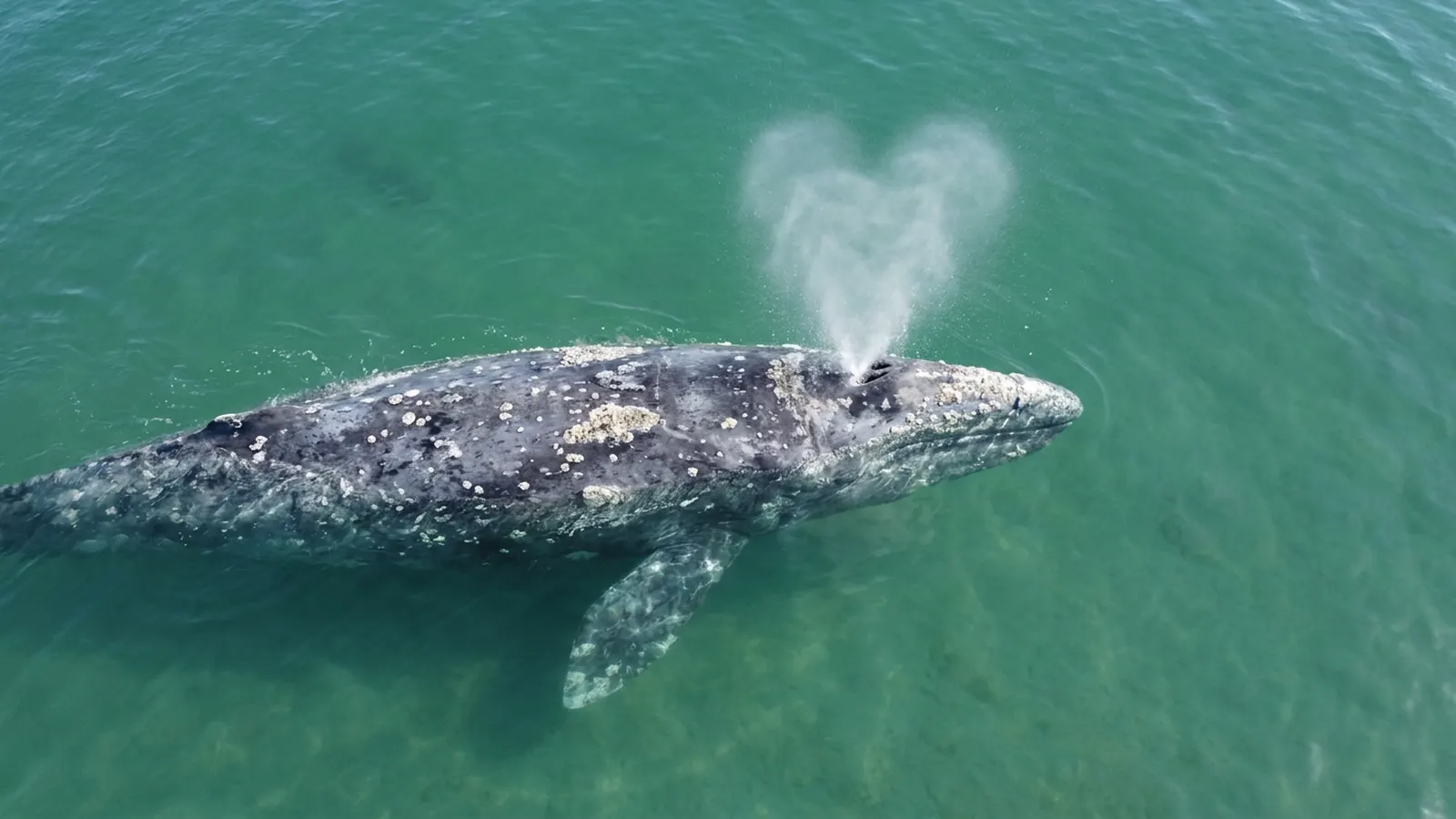
Yes. Gray whales have two blowholes side by side on top of the head, as do all baleen whales: blue, humpback, fin, right and minke. Toothed whales, including dolphins, porpoises, orcas and sperm whales, have only one. The two openings are a gray whale’s nostrils, which have migrated to the top of the head over millions of years of evolution. When it exhales, the pair produces a short, bushy blow that often looks V- or heart-shaped from behind.
Both groups started with two nostrils, like every mammal. In toothed whales, one nasal passage became part of the sound-producing system used for echolocation, and the external openings fused into a single blowhole. Baleen whales don’t echolocate in the same way, and they kept the paired openings.
How many blowholes do gray whales have?
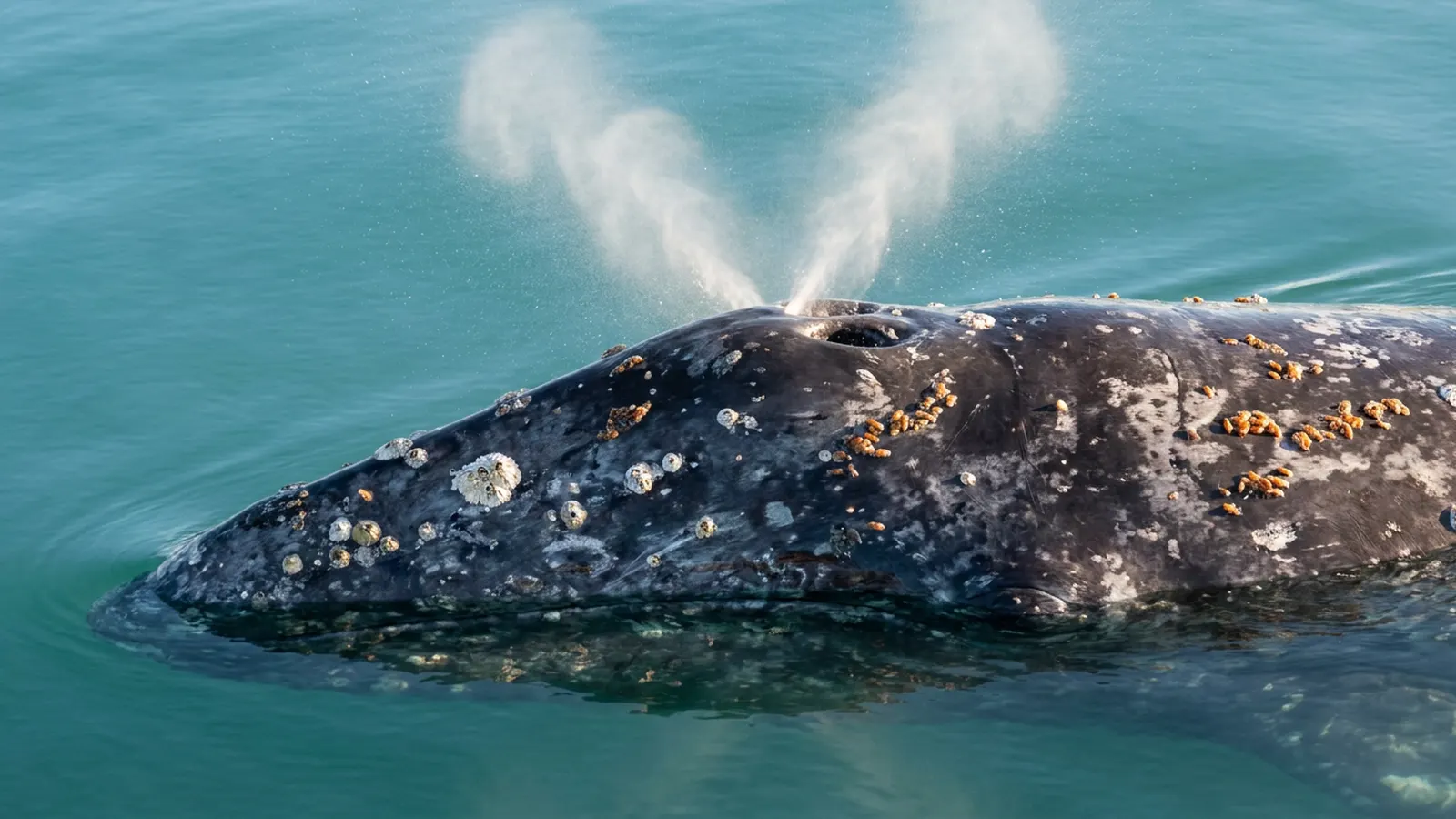
Two. They sit side by side in a shallow depression on top of the head, behind a raised fleshy ridge often called the splash guard.
A blowhole is simply a nostril. In a gray whale the two nostrils are long slits that lie close together at the front and spread apart toward the back, a little like a narrow V. A wall of tissue, the nasal septum, separates them, and muscular plugs attached to that wall close the openings tightly while the whale is underwater. Unlike our own nostrils, which are open by default, a whale’s blowholes are closed at rest. The whale has to open them deliberately when it reaches the surface, so it cannot accidentally breathe in water as it dives.
The blowholes are the only route to the lungs. Whales cannot breathe through the mouth, because the windpipe and the food passage are kept separate: the top of the larynx fits up into the nasal passage like a plug in a socket. That arrangement lets a gray whale open its mouth to gulp mud and water on the seabed without any risk of flooding its airway. It also means that the blowholes, and the breath that comes out of them, are among the best clues to what kind of whale you are looking at.
Do all whales have two blowholes?
No. All baleen whales have two; all toothed whales, including dolphins, have one.
The living whales split into two groups more than 30 million years ago. The baleen whales, or mysticetes, filter food with plates of baleen and include the blue, fin, sei, Bryde’s, minke, humpback, right, bowhead and gray whales. Every one of them has a pair of blowholes. The toothed whales, or odontocetes, include dolphins, porpoises, orcas, belugas, narwhals, beaked whales and sperm whales, and every one of them has a single blowhole.
The difference is tied to sound. Toothed whales find prey by echolocation, sending out clicks and listening for the echoes. Those clicks are made inside the head, in the nasal passages just below the blowhole, by pushing air past pairs of fatty structures called phonic lips. Over millions of years the two nasal passages of toothed whales were reshaped into this sound-making system, with air sacs and fatty organs packed around them, and the external openings merged into one blowhole. Baleen whales do not echolocate in the same way, so their nasal passages stayed simpler and their nostrils stayed paired.
The sperm whale is the oddest case. Its single blowhole sits at the front of the head and well over to the left. Its left nasal passage runs to the blowhole and is used for breathing; the right one runs through the huge spermaceti organ in the forehead and ends at the phonic lips that produce its powerful clicks. That lopsided plumbing is why a sperm whale’s blow angles forward and to the left, making it one of the easiest whales to identify from a distance.
| Whale | Blowholes | Typical blow |
|---|---|---|
| Gray whale | 2 | Short, bushy, often V- or heart-shaped from behind |
| Blue whale | 2 | Tall, slender column |
| Humpback whale | 2 | Bushy, rounded plume |
| Right and bowhead whales | 2 | Wide, clearly V-shaped |
| Sperm whale | 1 (left side of head) | Angled forward and to the left |
| Dolphins and porpoises | 1 | Usually a quick puff, rarely visible |
Why are a whale’s nostrils on top of its head?
Because over about 50 million years, whale nostrils moved back from the tip of the snout to the top of the head.
Whales descend from four-legged, land-living relatives of hippos and other even-toed hoofed mammals. The earliest whales, such as Pakicetus, which lived around 50 million years ago in what is now Pakistan, had nostrils near the end of the snout, like a dog or a cow. As whales became more and more aquatic, fossil skulls show the nostrils moving backward along the snout, toward the top of the head. In early baleen whales the blowholes sat partway along the top of the snout; in modern species they sit almost above the eyes.
The benefit is easy to see. A whale with nostrils on top can breathe by bringing only a small part of its head above the water, without lifting its whole body, stopping or turning. A gray whale swimming along the coast can surface, blow and inhale in a couple of seconds, then slip back under, which saves a great deal of energy on a migration of thousands of kilometres. The same reshaping of the skull, in which the bones of the snout and the top of the head slide over one another, is called telescoping, and it happened in different ways in baleen and toothed whales.
What does a gray whale’s blow look like?
A short, bushy cloud roughly 3 to 4.5 m high, which often forms a V or heart shape when seen from behind in calm weather.
The blow is not a fountain of water from the lungs. It is the whale’s exhaled breath, which is warm and moist and leaves the blowholes at high speed. As it rushes out and expands, it cools and its water vapour condenses into droplets, like your breath on a cold morning. Any seawater lying on top of the blowholes and mucus from the airways are blown up with it. Because the gray whale’s two blowholes diverge, the two jets spread apart and can produce a double or heart-shaped cloud when the wind is light and you are looking from directly behind or in front of the whale.
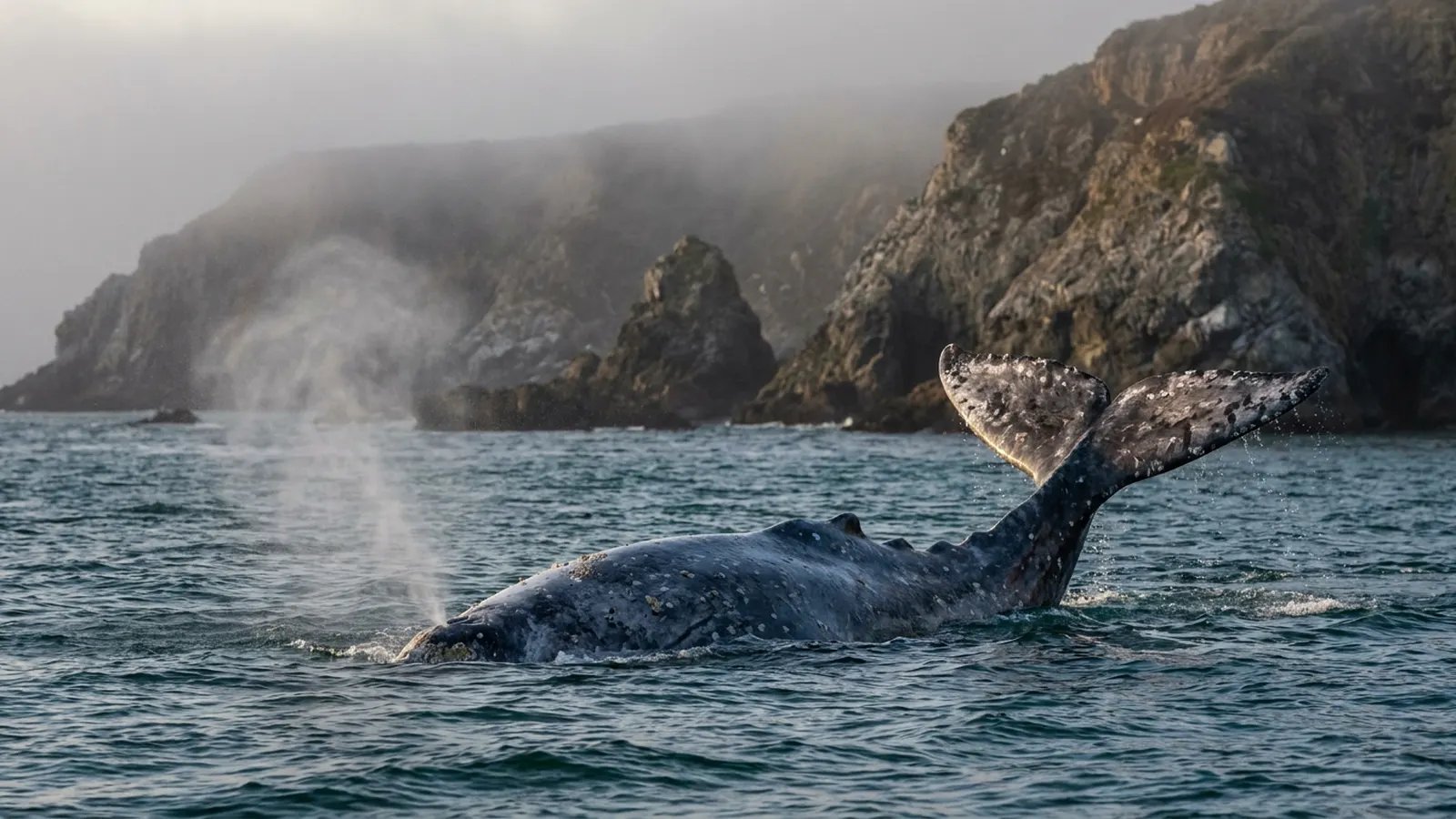
Whale watchers use blow shape to identify species before they see much of the body. Blue whales send up a tall, narrow column; right and bowhead whales produce a wide, clearly separated V; humpbacks make a bushy plume. A gray whale’s blow is lower and bushier than a blue’s, and often it is the first sign of a whale moving along the coast. Gray whales typically blow several times in a row, a few seconds to a minute apart, then raise their flukes and dive. The blow is also audible: on a quiet day you can hear the explosive exhalation and sharp intake of breath from a long way off.
That breath has become a research tool. Scientists collect it, sometimes by flying small drones through the blow, and analyse it for hormones, DNA and microbes. The samples can show whether a whale is pregnant or stressed and what bacteria are living in its airways, without the need for a biopsy.
Why does the blow look different from day to day?
Because a blow is mostly condensation, its size and shape depend as much on the weather as on the whale.
The same gray whale can produce a tall, sharply defined blow on a cold, still morning and an almost invisible puff on a warm, windy afternoon. In cold air the warm, moist breath condenses quickly into a dense cloud of droplets that hangs in the air; in warm air there is less condensation and the cloud evaporates faster. Wind tears the blow apart and bends it sideways, so the neat heart shape seen in photographs usually needs calm conditions and a viewer directly behind or in front of the whale. Seen from the side, the two jets overlap and the blow looks like a single bushy plume.
The whale itself also changes the blow. The first breath after a long dive is usually the strongest and tallest, because the whale exhales hard and empties its lungs quickly. The shorter breaths that follow, as it recovers and gets ready to dive again, are often smaller. Calves produce small, weak blows that can be hard to see next to their mothers’. Experienced observers therefore treat blow shape as one clue among several, alongside the shape of the back, the presence or absence of a dorsal fin and the way the whale raises its flukes before a dive.
How do gray whales breathe and dive?
In short, powerful breaths between dives, exchanging much more of their lung air with each breath than we do.
A whale breathes very differently from a person. It exhales almost all the air in its lungs in one explosive blow and refills them in a single quick inhalation, so each breath replaces a large share of the air in the lungs. Between breaths it holds its breath, sometimes for many minutes. Whales store much of their oxygen in their blood and in their muscles, which are rich in the oxygen-binding protein myoglobin, rather than in the lungs, and during a dive the lungs partly collapse under pressure. That helps them avoid decompression problems when they return to the surface.
Gray whales are not deep divers. They feed mostly on shallow continental shelves, often in water less than 100 m deep, and their dives are usually short. On migration they tend to swim steadily just below the surface, coming up to blow at fairly regular intervals, which is one reason they are so easy to watch and to count from shore.
How far do gray whales migrate?
One of the longest migrations of any mammal: roughly 16,000 to 19,000 km (10,000 to 12,000 miles) round trip.
Eastern North Pacific gray whales spend the summer feeding in the Bering, Chukchi and Beaufort Seas. In autumn they swim south along the coast of North America to lagoons on the Pacific side of Baja California, Mexico, including Laguna Ojo de Liebre (Scammon’s Lagoon) and Laguna San Ignacio, where females give birth and nurse their calves in warm, sheltered water. In spring they return north. Gestation lasts about 13 and a half months, females give birth every one to three years, and calves drink large quantities of milk that is about half fat.
The population has had a turbulent recent history. After commercial whaling ended, it recovered to a peak of about 27,000 whales in 2015–16. Strandings then rose sharply, and NOAA Fisheries declared an unusual mortality event in 2019 that lasted until 2023, linked to poor feeding conditions in the Arctic. NOAA’s estimate for 2025 was about 12,890 whales, one of the lowest since counting began in the late 1960s, and only 85 calves were counted that year, the lowest on record. The 2026 count rose to about 17,750, but NOAA cautioned that an increase that large probably exceeds what the population could produce through births and may partly reflect survey or analysis factors, such as changes in where the whales migrate.
A separate western population feeds off Sakhalin Island in the Russian Far East and numbers only a few hundred. Some of those whales have been tracked crossing the Pacific to join the eastern population’s migration. Gray whales once lived in the North Atlantic too, but disappeared there by the eighteenth century. In recent years single gray whales have turned up in the Mediterranean and the Atlantic, probably wanderers from the Pacific that crossed through the Arctic as sea ice retreated.
How do gray whales feed?
They are the only baleen whale that regularly feeds on the seabed, rolling onto one side and sucking up mouthfuls of sediment.
A feeding gray whale dives to the bottom, turns onto its side and draws in mud or sand by pulling back its tongue. It then pushes the mixture out through its short, coarse baleen plates, which trap the small crustaceans living in the sediment, especially amphipods. The process leaves pits and furrows in the seafloor that can be seen on sonar images. Most gray whales favour rolling onto their right side, and many have more worn baleen and fewer barnacles on that side of the head as a result. Gray whales also feed in other ways when bottom prey is scarce, skimming swarms of small shrimp-like animals from the water or picking up herring eggs and crab larvae.
Can you see gray whale blowholes up close?
Yes. In the Baja lagoons in winter, some gray whales approach small boats closely enough to show their blowholes clearly.
The calving lagoons of Baja California are among the few places in the world where wild whales regularly come right up to visitors in small boats, and Laguna San Ignacio in particular became known for these “friendly” encounters from the 1970s onward. Mexican law limits the number of boats and the hours they can operate, and visitors go out with licensed local guides. Along the US and Canadian Pacific coasts, the gray whale migration passes so close to shore that the blows can be seen from headlands and lighthouses in winter and spring, and many coastal parks run whale-watching events. Whichever way you see them, look for the double nostril opening as the whale surfaces, and the low, bushy, two-lobed blow that rises a moment later.
Do gray whales have two blowholes?
Yes. Gray whales, like all baleen whales, have two blowholes side by side. Toothed whales and dolphins have one.
Which whales have two blowholes?
All baleen whales: blue, fin, sei, Bryde’s, minke, humpback, gray, right and bowhead whales.
Why do dolphins have only one blowhole?
In toothed whales the nasal passages were reshaped into an echolocation sound system, and the external openings merged into a single blowhole.
What shape is a gray whale’s blow?
Short and bushy, roughly 3 to 4.5 m high, often V- or heart-shaped from behind in calm weather.
Can whales breathe through their mouths?
No. The airway is sealed off from the mouth, so whales breathe only through their blowholes.
How many gray whales are left?
NOAA estimated about 17,750 eastern North Pacific gray whales in 2026, up from about 12,890 in 2025. The western population numbers only a few hundred.
How far do gray whales migrate?
Roughly 16,000 to 19,000 km (10,000 to 12,000 miles) round trip, between Arctic feeding grounds and calving lagoons in Baja California.
What do gray whales eat?
Mainly amphipods and other small crustaceans, which they suck from seafloor sediment and strain through their baleen.
- NOAA Fisheries (July 2026). West Coast gray whale estimate shows increase; abundance of eastern North Pacific gray whales 2025/2026.
- NOAA Fisheries. 2019–2023 eastern North Pacific gray whale unusual mortality event.
- NOAA Fisheries. Gray whale (Eschrichtius robustus) species profile.
- Berta, A., Sumich, J. L. & Kovacs, K. M. (2015). Marine Mammals: Evolutionary Biology, 3rd ed. Academic Press.
- Cranford, T. W., Amundin, M. & Norris, K. S. (1996). Functional morphology and homology in the odontocete nasal complex. Journal of Morphology 228: 223–285.
- Gray whale, Baleen whale, Whale and Sperm whale overviews, Wikipedia (accessed 2026).
Blane Perun has been exploring Earth’s oceans and marine life for over 25 years. Founder of TheSea.Org in 1999, underwater photographer, coral aquaculture pioneer, and explorer of 80+ countries.
About Blane Perun →