Florida Beach Safety — Rip Currents, Flags, Storms and Water Hazards
Most days on a Florida beach are safe, but the hazards that do kill and injure people here are well documented. Rip currents drown more beachgoers than any other surf hazard, storm surge has been the deadliest part of recent hurricanes in Southwest Florida, and Florida has recorded more lightning deaths than any other state. Bacteria such as Vibrio vulnificus, stinging larvae known as sea lice, jellyfish, stingrays and red tide round out the list. This section explains each one with figures from the agencies that track them, and tells you what to do. In an emergency, call 911.
Each guide uses figures from official sources, mainly the National Weather Service (NWS), the National Hurricane Center (NHC), the Florida Department of Health (DOH) and the Florida Department of Environmental Protection, and gives the date of every statistic. First-aid advice follows the wording of those agencies. None of it replaces a lifeguard, a doctor or an evacuation order.
What are the biggest hazards on Florida beaches?
Florida has a long coastline, warm water for most of the year and millions of visitors who swim in the sea only on holiday. That mix is why the same few hazards turn up again and again in official statistics. The guides in this section cover them one by one, but the overview is simple: water movement kills the most people, weather comes next, and living things, from bacteria to jellyfish, cause the most day-to-day injuries.
Currents and waves
Rip currents are the hazard most beachgoers underestimate. They are narrow channels of water flowing away from the beach, and the National Weather Service says the strongest can move at up to 8 feet per second, faster than an Olympic swimmer. The NWS preliminary list of surf-zone fatalities for 2025 counted 99 deaths across the United States and its territories, 21 of them in Florida, and Florida again appears frequently in the 2026 list. Most of those deaths were on the Atlantic coast and in the Panhandle, but the 2025 list also includes deaths at Bean Point Beach, Turtle Beach and Siesta Key on the Gulf coast near Southwest Florida. Rip currents in Florida explains how they form, how to spot them and how to escape one.
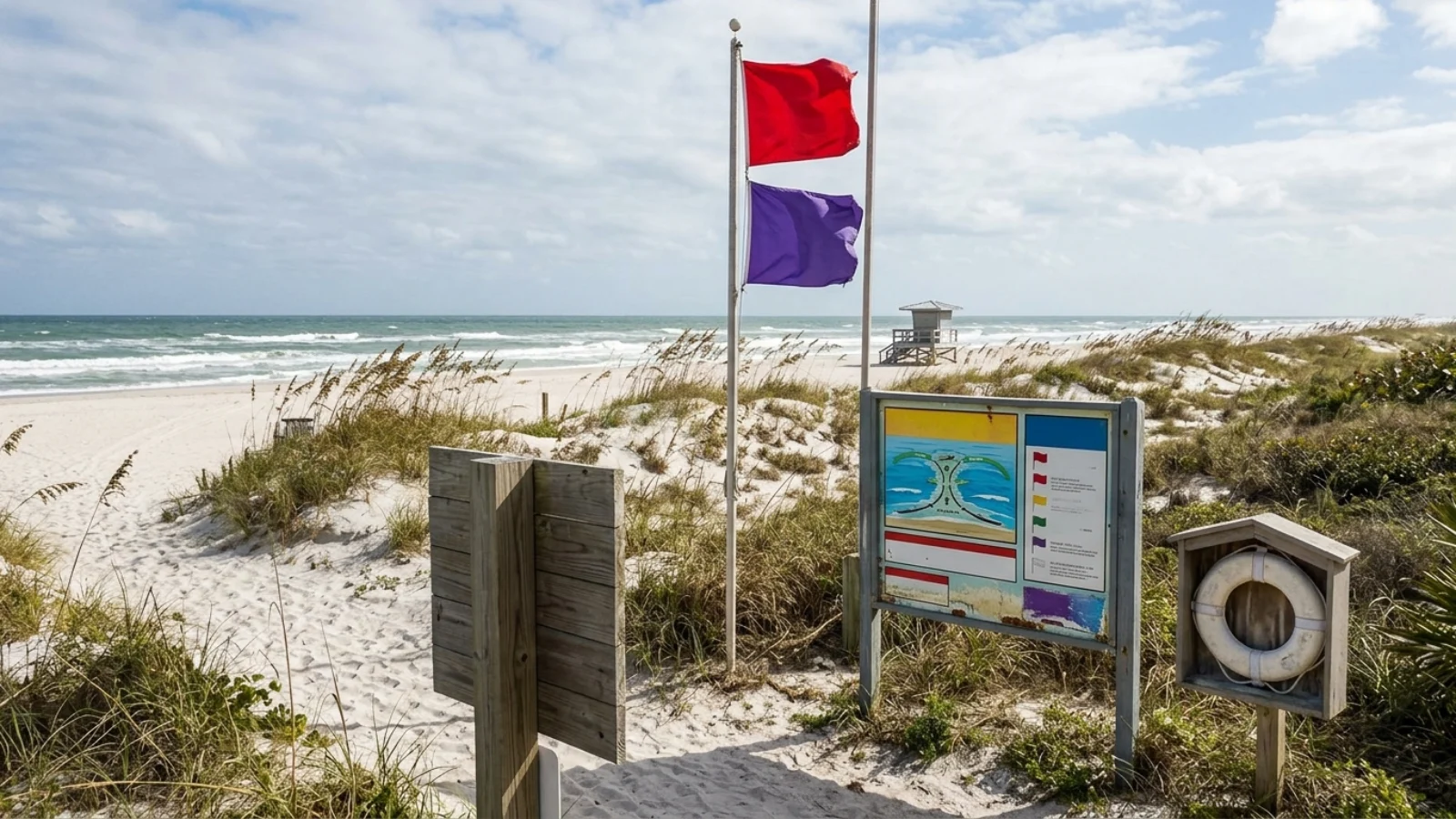
The state’s answer to changing surf is a uniform set of beach warning flags. Since a 2005 amendment to section 380.276 of the Florida Statutes, public beaches that fly warning flags must use the flags developed for the state program, which run from green for low hazard to double red for water closed to the public, plus purple for dangerous marine life. Florida beach warning flags explains each colour and how local rules, such as the fines in Panama City Beach, are enforced.
Storms
For residents of the Southwest Florida coast, Hurricane Ian in September 2022 is the reference point. The National Hurricane Center’s report on Ian found that storm surge was the deadliest hazard, claiming 41 lives, 36 of them in Lee County, with water 10 to 15 feet above ground level on Fort Myers Beach. Storm surge explains why the shallow shelf off this coast makes surge so dangerous and how surge warnings work, and hurricane season in Florida covers the season’s timing, the Saffir-Simpson scale and the coastal side of preparing for a storm.
Ordinary summer thunderstorms are a hazard too. Lightning has killed more people in Florida than in any other state: a Vaisala analysis published by the NWS counted 498 Florida lightning deaths from 1959 to 2017, more than twice the total in Texas, the second state. A national study by the National Lightning Safety Council found that beach activities were the second-largest cause of lightning deaths during leisure time, and in July 2026 a man was killed by lightning while in the water at Fort Myers Beach. Lightning on the beach explains why the beach is so exposed and what the NWS advises.
Things in the water
The warm, brackish water of Florida’s bays and estuaries is home to Vibrio vulnificus, a bacterium that can infect open wounds. The Florida Department of Health recorded 82 cases and 19 deaths in 2024, a year in which Hurricane Helene drove an unusual increase in several Gulf coast counties, and 74 cases in 2022, the year of Ian. Vibrio vulnificus in Florida explains who is most at risk and when to seek care urgently.
Sea lice are not lice at all: the itchy rash, known medically as seabather’s eruption, is caused by the larvae of the thimble jellyfish and similar animals trapped under swimsuits. It is most common on the southeast coast in spring and early summer; sea lice in Florida covers prevention and treatment. Jellyfish, including the Portuguese man o’ war, wash in on both coasts, and jellyfish in Florida explains which ones you are likely to meet. For stings, see jellyfish sting treatment.
Two other hazards already have their own guides on TheSea.org. Stingrays bury themselves in warm, shallow sand and sting in self-defence when stepped on; are stingrays dangerous? explains the stingray shuffle and the hot-water first aid, and stingray barb covers how the sting works. Florida red tide, a bloom of the microscopic alga Karenia brevis, can make the air on Gulf beaches irritating to breathe; red tide in Florida explains how to read the state’s bloom reports.
Water quality advisories
Florida also tests beach water for bacteria that indicate sewage or stormwater pollution. The Department of Health’s beach water sampling program measures enterococci, which the department says correlate better with swimming-related stomach illness than other indicator bacteria and survive longer in salt water. A result of 0 to 35 enterococci per 100 millilitres of seawater is rated good, 36 to 70 moderate and 71 or more poor. If a sample exceeds 70 and a resample also exceeds that value, the department issues an advisory for that site. The program began as a pilot in five coastal counties in 1998 and was extended to 30 coastal counties in August 2000; results and advisories are posted on each county’s health department pages.
The basics that prevent most problems
A handful of habits cover most of the risk. Swim at a beach with lifeguards whenever you can; the NWS, citing the United States Lifesaving Association, puts the chance of drowning at a lifeguarded beach at 1 in 18 million. Check the surf forecast and the flags before you go in, and ask the lifeguard about conditions. Leave the beach at the first sound of thunder. Keep cuts and fresh tattoos out of warm salt and brackish water. Shuffle your feet in shallow water where rays rest. During hurricane season, know whether you live or are staying in an evacuation zone before a storm forms. And if someone is in trouble in the water, call 911 first: the NWS estimates that about a quarter of rip current deaths are bystanders who tried to rescue someone without training or equipment.
How they form, how to spot one, how to escape.
What green, yellow, red, double red and purple mean.
Why surge is the deadliest part of a hurricane.
Dates, peak, categories and the coastal risk.
Why Florida leads the nation in lightning deaths.
The “flesh-eating” bacteria, cases and prevention.
Seabather’s eruption: causes, season, treatment.
Which jellies wash up on Florida beaches.
Karenia brevis and how to read bloom reports.
The stingray shuffle and first aid.
How a sting works and how to treat it.
Vinegar, hot water and when to get help.
Symptoms and first aid.
The numbers and the hotspots.
The risks after dark.
A naturalist’s guide to the coast.
What is the most dangerous thing on Florida beaches?
By deaths, rip currents and other surf-zone currents; the NWS counted 21 Florida surf-zone deaths in its preliminary 2025 list.
What do the beach flag colours mean in Florida?
Green is low hazard, yellow medium, red high hazard, double red means the water is closed, and purple means dangerous marine life.
When is hurricane season in Florida?
The Atlantic season runs from 1 June to 30 November, with the climatological peak around 10 September.
Is it safe to swim with a cut in Florida?
Health officials advise keeping open wounds out of warm salt and brackish water because of Vibrio vulnificus.
What should I do if someone is caught in a rip current?
Call 911 and alert a lifeguard. If you must go in, take a flotation device and keep it between you and the swimmer.
Who do I call for a sting or poisoning?
For emergencies call 911. Poison Help (1-800-222-1222) can advise on stings and marine toxins.
- National Weather Service, “Surf Zone Fatalities in the United States in 2025” and “… in 2026” (preliminary data, accessed 8 November 2026); “How to Avoid Getting Caught in a Rip Current”; “2021 Rip Current Basics and Safety Information” slide notes.
- NOAA National Ocean Service, “What is a rip current?” (last updated 23 September 2026).
- Bucci, L. et al., National Hurricane Center Tropical Cyclone Report: Hurricane Ian (AL092022), original 2 April 2023, revised 12 March 2026.
- Holle, R. L. (Vaisala), “Lightning Fatalities by State, 1959-2017” (May 2018), via weather.gov; NWS “Lightning Fatalities in 2026” (updated 22 September 2026); Jensenius, J. S., “A Detailed Analysis of Lightning Deaths in the United States from 2006 through 2024”, National Lightning Safety Council (January 2025).
- Florida Department of Health, Vibrio vulnificus cases by year (updated 5 November 2026) and Beach Water Quality program pages (accessed November 2026).
- Florida Department of Environmental Protection, “Beach Warning Flag Program” (last modified 17 July 2025); Section 380.276, Florida Statutes (2025).
Blane Perun has been exploring Earth’s oceans and marine life for over 25 years. Founder of TheSea.Org in 1999, underwater photographer, coral aquaculture pioneer, and explorer of 80+ countries.
About Blane Perun →