Rays, Skates & Sawfish — The Flattened Cousins of Sharks
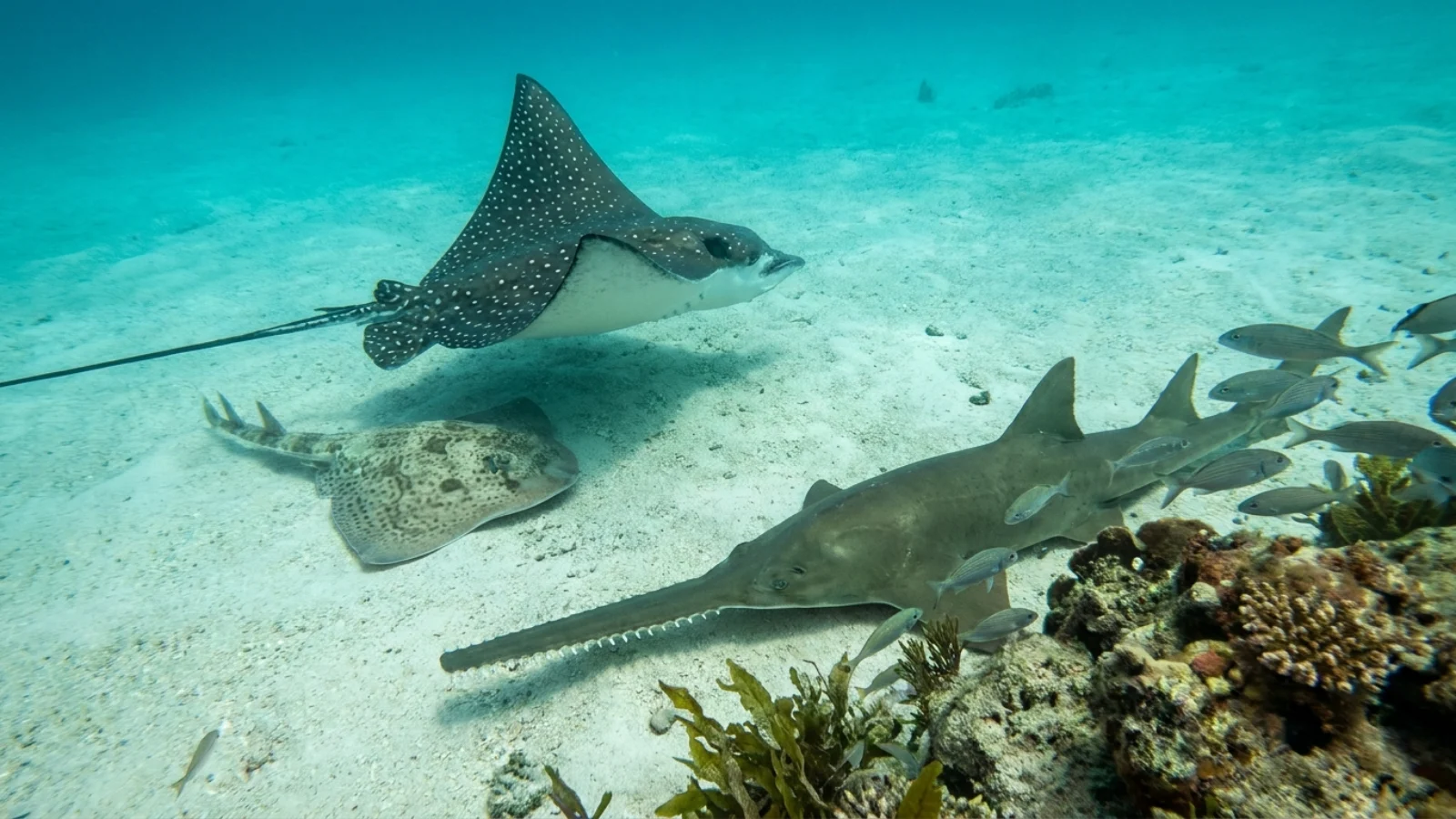
Rays, skates and sawfish are batoids: cartilaginous fish closely related to sharks whose pectoral fins are fused to the head, with the gill slits on the underside. There are about 600 described species, from palm-sized round stingrays to manta rays 7 m across and sawfish that reach about 7 m (23 ft) long. Stingrays and their relatives carry a venomous tail spine, skates lay egg cases called mermaid’s purses, electric rays stun prey with up to 220 volts, and all five sawfish species are Endangered or Critically Endangered.
Batoids
What is the difference between rays, skates and sawfish?
All three are flattened relatives of sharks, but they split into distinct groups: stingrays and eagle rays carry a tail sting and give live birth, skates have no sting and lay eggs, and sawfish are shark-shaped rays with a toothed saw.
The quickest way to sort them is by the tail and the reproduction. Stingrays (order Myliobatiformes, about 220 species in roughly 29 genera) have a thin whip-like tail armed with one or more serrated, venomous spines, and they bear live young. Skates (order Rajiformes, roughly 270 species) have a thick, fleshy tail with two small dorsal fins near the tip, no stinging spine, and they lay leathery egg cases. Electric rays (Torpediniformes, about 69 species) stun prey with organs in their pectoral discs. The rhino rays — sawfish, guitarfish and wedgefish (Rhinopristiformes) — look like a shark from the hips back and a ray from the head forward.
| Group | Order | Species (approx.) | Tail sting? | Reproduction | Guide |
|---|---|---|---|---|---|
| Stingrays, eagle rays, mantas | Myliobatiformes | ~220 | Most (not mantas) | Live birth | Types of stingrays |
| Skates | Rajiformes | ~270 | No | Egg cases | Skates |
| Electric rays | Torpediniformes | ~69 | No (electric) | Live birth | Electric ray |
| Sawfish, guitarfish, wedgefish | Rhinopristiformes | Dozens | No | Live birth | Sawfish |
Sawfish also get confused with the unrelated sawshark: a sawshark is a small deep-water shark with barbels on its saw and gill slits on the side of its head, while a sawfish is a giant ray with gill slits underneath. For a side-by-side of the two biggest groups, read skate vs stingray.
Which rays live in Southwest Florida?
Southwest Florida is one of the best batoid regions in the United States: Atlantic and southern stingrays on the beaches, cownose and spotted eagle rays over the flats, and the last stronghold of the smalltooth sawfish in the mangroves.
From Sanibel to Naples and down into the Ten Thousand Islands, the most common rays underfoot are the Atlantic stingray and the southern stingray — which is why every Gulf beach sign tells you to do the stingray shuffle. Offshore and over the grass flats you will see schools of cownose rays and the occasional spotted eagle ray leaping clear of the water. The real prize is the smalltooth sawfish: federal critical habitat for its young covers the Charlotte Harbor estuary and the Ten Thousand Islands/Everglades, the two nursery areas that kept the species alive in U.S. waters.
Are rays dangerous to people?
Most rays are harmless unless stepped on or grabbed. Stingray injuries are common but rarely serious, and deaths are extremely rare.
Stingrays sting defensively when a foot lands on them; Seal Beach in California alone logs around 400 stingray injuries a year. The first-aid rule is hot water: immerse the wound at about 45°C (113°F) to break down the heat-sensitive venom, then get the wound checked for barb fragments. Fatal stings, like the 2006 death of Steve Irwin, involve a large ray and a strike to the chest or abdomen. Read the full guide: Are stingrays dangerous? and how a stingray barb works. Manta rays have no sting at all — see are manta rays dangerous.
Why are so many rays endangered?
Batoids grow slowly, mature late and have few young, so fishing pressure hits them harder than most fish.
Sawfish once lived along the coasts of about 90 countries and are now presumed extinct in 55 of them. In 2019 the IUCN listed 15 of the 16 wedgefish and giant guitarfish species as Critically Endangered, driven by the fin trade. Even common-looking species can be in trouble: the cownose ray was listed as Vulnerable in 2019 and the whitespotted eagle ray as Endangered in 2020. The good news comes from Florida, where protected nurseries, a federal recovery plan and a public reporting line (1-844-4SAWFISH) are slowly bringing the smalltooth sawfish back.
How many species of rays are there?
About 600 species of batoids (rays, skates, sawfish, guitarfish and electric rays) have been described, more than the roughly 500 species of sharks. New species are still being named as genetic work splits old species complexes.
Are skates and rays the same thing?
No. Skates are a type of ray, but they belong to their own order (Rajiformes). Skates have a thick tail with small dorsal fins and no sting, and they lay egg cases. Stingrays have a whip-like tail with a venomous spine and give live birth.
Is a sawfish a shark or a ray?
A sawfish is a ray. Its gill slits are on the underside of the head and its pectoral fins join the head, both ray traits, even though its body looks like a shark’s.
Do all rays have stingers?
No. Most stingrays and eagle rays do, but manta and devil rays have no functional sting, and skates, electric rays, guitarfish and sawfish have none.
Where can you see sawfish in Florida?
Smalltooth sawfish live mainly between Charlotte Harbor and the Florida Keys, including Everglades National Park and the Ten Thousand Islands. If you see or catch one, keep it in the water and report it to 1-844-4SAWFISH.
What is the largest ray?
The giant manta ray, which reaches about 7 m across. The longest batoids are sawfish, which can approach 7 m in length including the saw.
What should you do if a stingray stings you?
Get out of the water, rinse the wound, and soak it in water as hot as you can tolerate (about 45°C / 113°F) for 30 to 90 minutes. See a doctor to check for barb fragments and infection, and call emergency services for any sting to the chest, neck or abdomen.
Blane Perun has been exploring Earth’s oceans and marine life for over 25 years. Founder of TheSea.Org in 1999, underwater photographer, coral aquaculture pioneer, and explorer of 80+ countries. Based in Southwest Florida, where stingrays work the grass flats and smalltooth sawfish still raise their young in the mangroves of Charlotte Harbor and the Ten Thousand Islands.
About Blane Perun → All Rays, Skates & Sawfish →