Sharks in Cape Cod — How Seals Brought the Great Whites Back
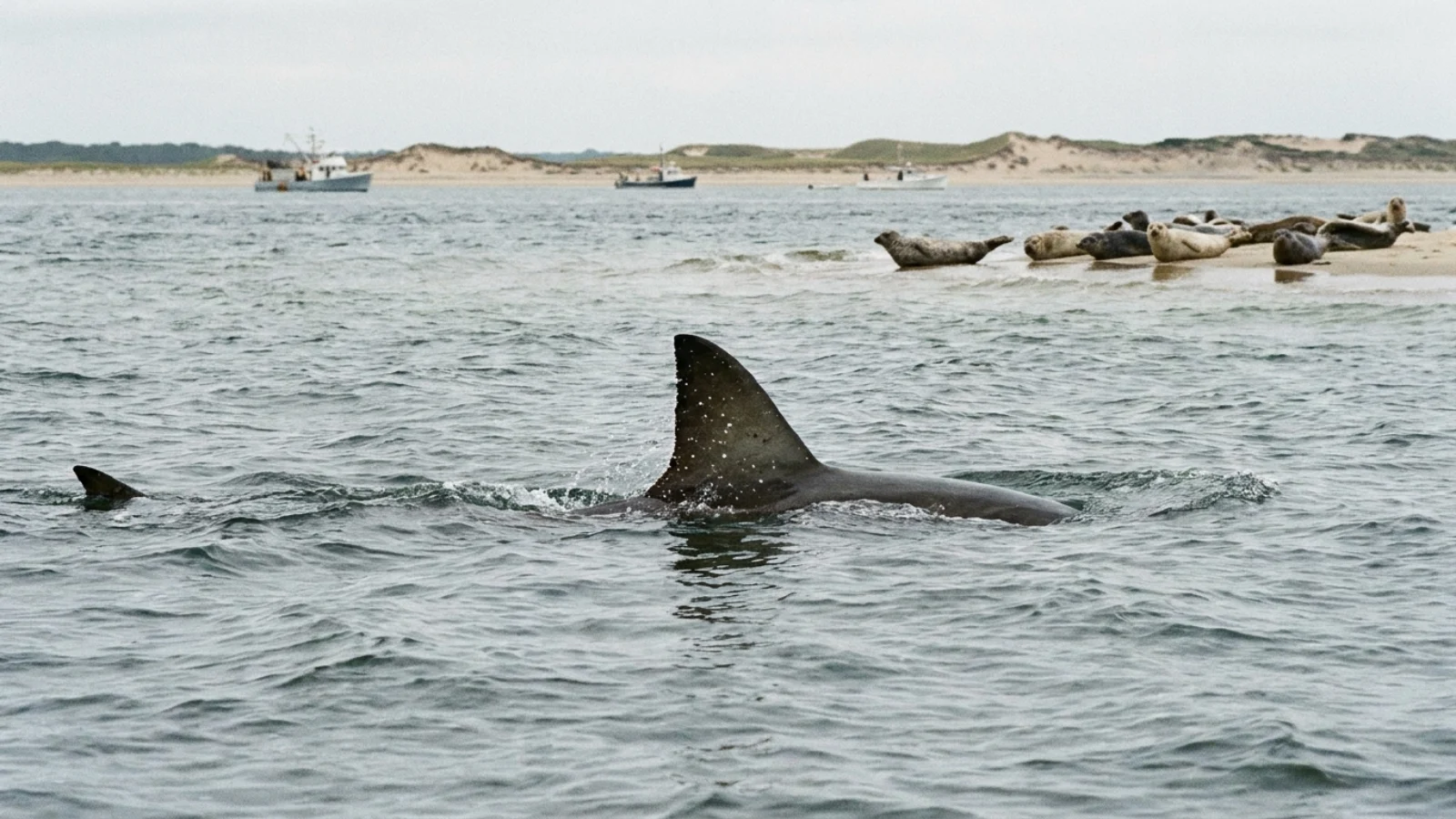
Yes. White sharks now gather off Cape Cod every summer and autumn, and a 2023 study estimated that about 800 individuals used the area between 2015 and 2018. They come for gray seals, which were hunted under bounties in Massachusetts until 1962, protected by the federal Marine Mammal Protection Act in 1972, and have grown from about 2,000 animals around Cape Cod and Nantucket in the late 1990s to tens of thousands; a 2017 study put gray and harbor seals on the Cape and Islands at 30,000 to 50,000. The sharks hunt close to the Outer Cape’s ocean beaches, from Chatham to Provincetown. Bites are rare, but in 2018 Arthur Medici was killed off Wellfleet, the first fatal shark attack in Massachusetts since 1936.
Cape Cod’s white sharks are a conservation success story with a hard edge: the same recovery that brought back the seals brought back their main predator.
Are there sharks in Cape Cod?
Yes. Several shark species live in the waters around Cape Cod, but the one that defines the region today is the white shark (Carcharodon carcharias). In barely two decades, the Outer Cape, the long arm of the peninsula from Chatham north to Provincetown, has become a seasonal aggregation site for white sharks, a place where they gather predictably close to shore. The sharks come to hunt gray seals, and they patrol the same sandbars, troughs and surf zones that swimmers and surfers use on the Cape’s ocean beaches.
This was not always so. A generation ago, white sharks were rare visitors to Massachusetts and gray seals were scarce. The story of how both returned is one of the clearest examples of a predator and its prey recovering together after people stopped killing them.
Why are there so many sharks off Cape Cod now?
The answer is seals. Gray seals (Halichoerus grypus) are large seals of the North Atlantic; the western Atlantic population, whose largest colony is on Sable Island off Nova Scotia, has been genetically distinct from the European population for at least a million years. In the United States they are found year-round off New England, especially in Maine and Massachusetts.
For about a century, fishermen in New England saw seals as competitors for cod and other valuable fish, and Maine and Massachusetts paid bounties for them. Massachusetts paid bounties from 1888 to 1962, and Maine in 1891-1905 and again in 1937-1945. One study estimated that 72,000 to 135,000 seals were killed, and a seal’s nose could still earn a $5 reward in the 1960s. After the last bounties ended in Massachusetts in 1962, and the Marine Mammal Protection Act of 1972 made it illegal to kill seals in US waters.
The recovery was slow at first and then dramatic. About twenty years before the 2017 count, there were only about 2,000 seals around Cape Cod and Nantucket. In a 2017 study in BioScience, Moxley, David Johnston of Duke University and colleagues estimated seal numbers in southeastern Massachusetts by counting animals on Google Earth satellite images and correcting the counts using data from tagged seals, an approach they nicknamed “Google Haul Out”. Their work put gray and harbor seals on Cape Cod and the Islands at between 30,000 and 50,000. NOAA estimated in 2018 that there were 22,000 to 33,000 gray seals in all US waters, alongside about 75,000 harbor seals, and the Canadian seal population is thought to be about 500,000.
Wherever large numbers of seals gather near deep water, white sharks follow. Scientists studying the region have linked the growth of white shark numbers off New England directly to the seals’ recovery since 1972.
How many great white sharks are there off Cape Cod?
Researchers have been counting them individually. The Massachusetts Division of Marine Fisheries began a population study in 2014, photographing white sharks and identifying individuals from their unique fins and markings. In a 2023 paper in Marine Ecology Progress Series, Winton, Fay and the state shark biologist Gregory Skomal reported that the team identified 393 individual white sharks off Cape Cod between 2015 and 2018.
Not every shark that visits is photographed, and sharks come and go through the season, so the team built a new statistical model that allowed for sharks moving in and out of the survey area. It estimated a “superpopulation” of about 800 white sharks, with a plausible range of 393 to 1,286, using the Cape Cod aggregation site over those four years. That was the first estimate of white shark abundance at any aggregation site in the western North Atlantic and a baseline for judging whether protection is working.
Has the Atlantic white shark population recovered?
The Cape Cod numbers are part of a wider recovery. A 2014 study led by Tobey Curtis and published in PLOS ONE compiled 649 confirmed white shark records from the northwest Atlantic between 1800 and 2010, the largest such dataset for the region. It found that white shark abundance fell significantly in the 1970s and 1980s, when shark fishing was intense, but has apparently increased since the 1990s as conservation measures took effect. Fishing for white sharks has been prohibited in US Atlantic federal waters since 1997.
The same study found that white sharks of all life stages use continental shelf waters year-round, but that their range shifts with the seasons: they are found mostly between Massachusetts and New Jersey in summer and off Florida in winter, spreading along the coast in spring and autumn. Cape Cod’s sharks, in other words, are part of a migratory population that spends the cold months far to the south, as our article on sharks in Florida describes.
How do white sharks hunt seals off Cape Cod?
Off South Africa and California, white sharks often ambush seals in deep water near island colonies, launching up from below. Cape Cod is different. The Outer Cape has no rocky offshore islands; its seals haul out on beaches and sandbars, so every trip to sea takes them through the troughs and surf zones just off the beach. That is where the sharks wait, which is why the Cape’s sharks are so visible from shore and so close to swimmers.
Seals have adjusted their behaviour to the danger. In a 2020 study in Marine Ecology Progress Series, Moxley, Skomal and colleagues analysed 412 trips to sea by 8 tagged gray seals alongside more than 25,000 acoustic detections of 23 tagged white sharks. In the months when sharks were most abundant, the seals foraged almost entirely at night, ranged less far offshore and spent less time at sea. Returning seals tended to avoid daybreak and crossed the danger zone when shark activity was lowest. Leaving the haul-outs was riskier: seals tended to depart at dusk, when shark presence peaked.
The sharks themselves are not a single uniform group. A study of five years of acoustic data from eastern Cape Cod, covering 185 tagged white sharks and 365,880 detections between 2017 and 2021, found that males and females tended to use the area separately and that sharks generally avoided each other rather than travelling together, with notable changes from year to year.
Should Cape Cod cull its seals?
The seal recovery has its critics. Some commercial fishermen on the Cape argue that seals have eaten down inshore fish stocks, foul the water and draw sharks to the beaches, and some local officials have worried that shark fears could hurt the tourism economy. Gray seals are big animals, 7 to 8 feet long and up to about 800 pounds, and a herd of thousands on a sandbar is hard to ignore. Calls to cull them surface every few summers, especially after a serious shark incident.
Scientists have generally pushed back. The seals are protected under the Marine Mammal Protection Act, and diet studies do not support the idea that they are the main reason cod are scarce. Marine biologist Kristen Ampela analysed more than 300 scat samples and 49 stomachs and found in 2009 that sand lance, a small eel-like fish, made up at least half of the seals’ diet by weight, with cod about 6 percent and herring about 4 percent. A 2013 analysis by the Woods Hole Oceanographic Institution found no correlation between beach closures and where seals congregate. Joe Roman of the University of Vermont has pointed out that seal droppings may add nitrogen that feeds plankton and fish. Animal-welfare scientists argue that killing a few thousand seals out of tens of thousands would make little difference to shark numbers, much like removing a few squirrels from a bird feeder. The Cape Cod Chamber of Commerce reported that it had found no data showing that visitors had changed their behaviour because of sharks; in a focus group, visitors said they would simply avoid water deeper than waist height.
When are white sharks off Cape Cod?
White sharks are seasonal visitors to Cape Cod. They are present mainly in summer and autumn, when the water is warm and seals are abundant along the Outer Cape, and they leave as the water cools, joining the rest of the northwest Atlantic population in its southward migration toward Florida and the Gulf of Mexico. The seal-tracking study above found that seals changed their behaviour during the months of greatest shark presence, a reminder that the risk is not constant through the year. The overlap with the summer beach season is what makes Cape Cod’s sharks a management issue as well as a wildlife spectacle. The winter end of the migration is covered in sharks in the Gulf of Mexico.
Have there been shark attacks on Cape Cod?
Shark bites in Massachusetts are rare, but the state has a long history of them. The earliest recorded deaths include a man named Alexander Sampson, reported killed in Boston Harbor around 1730 when a shark knocked him from his boat, and Joseph Blaney, a 52-year-old fisherman who disappeared from his dory five miles off Scituate in July 1830. On 25 July 1936, 16-year-old Joseph Troy was killed by a white shark while swimming off Mattapoisett in Buzzards Bay, after which beaches around the bay emptied.
For more than eighty years after that there were no fatal attacks in Massachusetts. Then, around noon on Saturday 15 September 2018, 26-year-old Arthur Medici was attacked near Newcomb Hollow Beach in Wellfleet, and died after being taken to Cape Cod Hospital. His death, the first fatal shark attack in the state since 1936, came at the end of a summer of intense shark activity and pushed Cape towns and state agencies to put far more effort into shark safety, public warnings and research on how people and sharks overlap. The global picture is in our article on how many shark attacks happen each year.
What are the rules about white sharks in Massachusetts?
Massachusetts has some of the strictest white shark protections in the United States. In 2015 the state banned catching, cage diving with, feeding, towing decoys for, baiting and chumming for white sharks without a research permit. That means there is no cage-diving industry on Cape Cod, unlike in South Africa or Mexico, and no attracting sharks to boats. Since 2019, the state’s research has focused increasingly on how people can avoid conflict with sharks, such as identifying the times and places where sharks are most active. The status of the species worldwide is covered in are great white sharks endangered.
What other sharks live around Cape Cod?
White sharks steal the headlines, but other sharks are common in Cape Cod waters. The spiny dogfish, a small, schooling shark, is so abundant that it is a regular bycatch of groundfish fisheries, and the Cape Cod Commercial Fishermen’s Alliance has promoted it as a sustainable local seafood. Basking sharks, the second-largest fish in the sea and harmless filter feeders, cruise the surface of Cape Cod Bay and the waters offshore in summer. A 2009 study that tagged 25 basking sharks off Cape Cod found that some migrated south in winter, spending weeks at depths of 200 to 1,000 metres and crossing the equator to reach Brazil.
Blue sharks are common offshore in summer and migrate long distances, as far as South America. Sand tigers, the ragged-toothed sharks often seen in aquariums, also spend summers here: juvenile sand tigers use Cape Cod’s coastal waters and leave when the water drops below about 16 °C and the days shorten to under 12 hours.
How do you stay safe from sharks on Cape Cod?
Local advice reflects the fact that the sharks are hunting seals in shallow water. Stay close to shore, in water where you can stand, and swim near lifeguards where they are present. Avoid swimming near seals or seal haul-outs, and leave the water if seals are nearby. Avoid murky water and the low-light hours of dawn and dusk, when sharks and seals are most active. Swim, paddle and surf in groups, and follow posted signs, beach closures and sighting alerts at Outer Cape beaches.
So, what should you know about sharks in Cape Cod?
Cape Cod’s white sharks are a predictable result of a successful conservation story. Gray seals, hunted for bounties for a century, have recovered to tens of thousands of animals since the Marine Mammal Protection Act of 1972, and white sharks, protected in federal waters since 1997 and by Massachusetts since 2015, have followed them. About 800 white sharks used the Outer Cape between 2015 and 2018, hunting close to shore in summer and autumn before migrating south. Bites remain very rare, but the sharks are real, so beachgoers on the Outer Cape should stay close to shore, keep away from seals and follow local warnings. Few places on Earth offer such a clear view of how an ocean ecosystem rebuilds itself.
Are there great white sharks in Cape Cod?
Yes. White sharks gather off the Outer Cape every summer and autumn to hunt gray seals.
How many great white sharks are off Cape Cod?
A 2023 study identified 393 individuals from 2015 to 2018 and estimated about 800 used the area.
Why are there so many sharks on Cape Cod?
Seals have recovered to tens of thousands since bounties ended in 1962 and the 1972 Marine Mammal Protection Act protected them.
When is shark season on Cape Cod?
Mainly summer and autumn; white sharks migrate south when the water cools.
Has anyone been killed by a shark on Cape Cod?
Yes. Arthur Medici was killed off Wellfleet in September 2018, the first fatal attack in Massachusetts since 1936.
Can you cage dive with sharks on Cape Cod?
No. Massachusetts banned cage diving, chumming and baiting for white sharks in 2015.
Which Cape Cod beaches have the most sharks?
The Outer Cape ocean beaches from Chatham to Provincetown, near seal haul-outs.
What other sharks live around Cape Cod?
Spiny dogfish, basking sharks, blue sharks and juvenile sand tigers, among others.
- Winton MV, Fay G, Skomal GB (2023). An open spatial capture-recapture framework for estimating the abundance and seasonal dynamics of white sharks at aggregation sites. Marine Ecology Progress Series, doi:10.3354/meps14371.
- WBUR (2 August 2019), the Cape Cod seal-culling debate: bounty history, 2018 NOAA seal estimates, Ampela diet study, WHOI 2013 beach-closure analysis.
- Moxley JH et al. (2017). Google Haul Out. BioScience, doi:10.1093/biosci/bix059; seal estimates, bounty history and MMPA as reported by AP (Spokesman-Review, 14 June 2017); Moxley JH, Skomal G, Chisholm J et al. (2020). Daily and seasonal movements of Cape Cod gray seals vary with predation risk. Marine Ecology Progress Series, doi:10.3354/meps13346.
- Curtis TH et al. (2014). Seasonal distribution and historic trends in abundance of white sharks in the western North Atlantic. PLOS ONE 9: e99240.
- Goncalves (thesis). Co-occurrence of white sharks along coastal Cape Cod, Massachusetts, doi:10.62791/20418.
- Massachusetts fatal shark attacks 1730-2018 (Wikipedia, “List of fatal shark attacks in the United States”); Massachusetts 2015 white shark rules and DMF study (Wikipedia, “Great white shark”); grey seal, basking, spiny dogfish, blue and sand tiger sharks (Wikipedia articles of those names).
Blane Perun has been exploring Earth’s oceans and marine life for over 25 years. Founder of TheSea.Org in 1999, underwater photographer, coral aquaculture pioneer, and explorer of 80+ countries.
About Blane Perun →