Longfin Mako Shark — Isurus paucus, the Slim Deep-Water Cousin of the Shortfin Mako
The longfin mako (Isurus paucus) is the slim, deep-water cousin of the much better-known shortfin mako. Adults are commonly 2–2.5 m long and reach a maximum of about 4.3 m, with disproportionately long pectoral fins that distinguish the species. It lives at greater depths than its shortfin relative, occurs in tropical and warm-temperate seas worldwide, and is rarely seen alive — most records come from offshore longline bycatch. The IUCN lists it as Endangered (assessed 2018, published 2019). No unprovoked attacks on humans are on record.
Longfin Mako Shark
How do you tell a longfin mako from a shortfin mako?
Look at the pectoral fins: in the longfin they are as long as the head or longer.
The two makos are so alike that for most of the 20th century they were lumped together, and many older records of “mako sharks” cannot be assigned to either species with confidence. Both are torpedo-shaped mackerel sharks with a pointed snout, a crescent-shaped tail, strong keels on either side of the tail base and long, smooth-edged, knife-like teeth, with the outermost lower teeth jutting from the mouth even when it is closed. Both are dark blue above and white below.
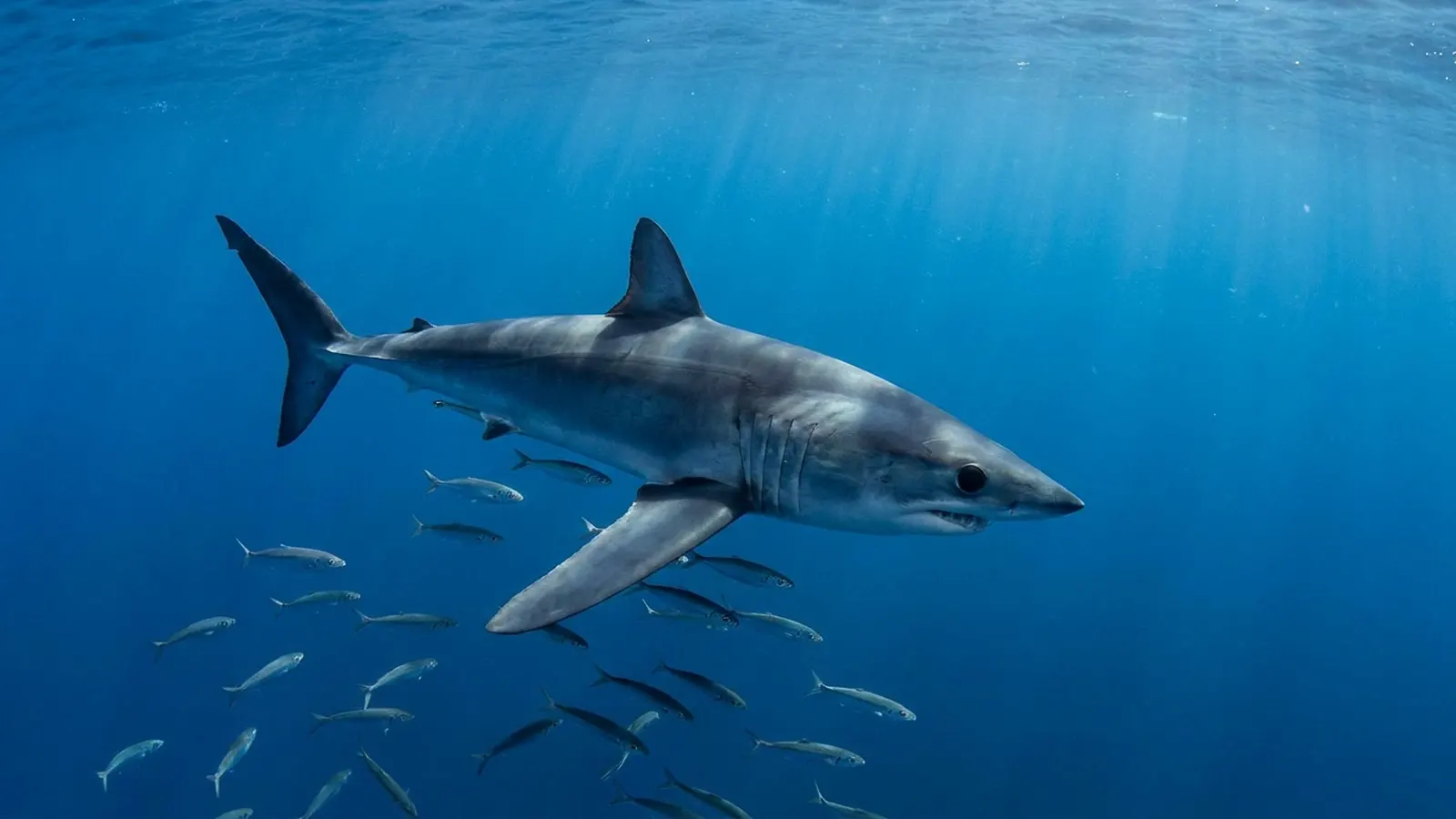
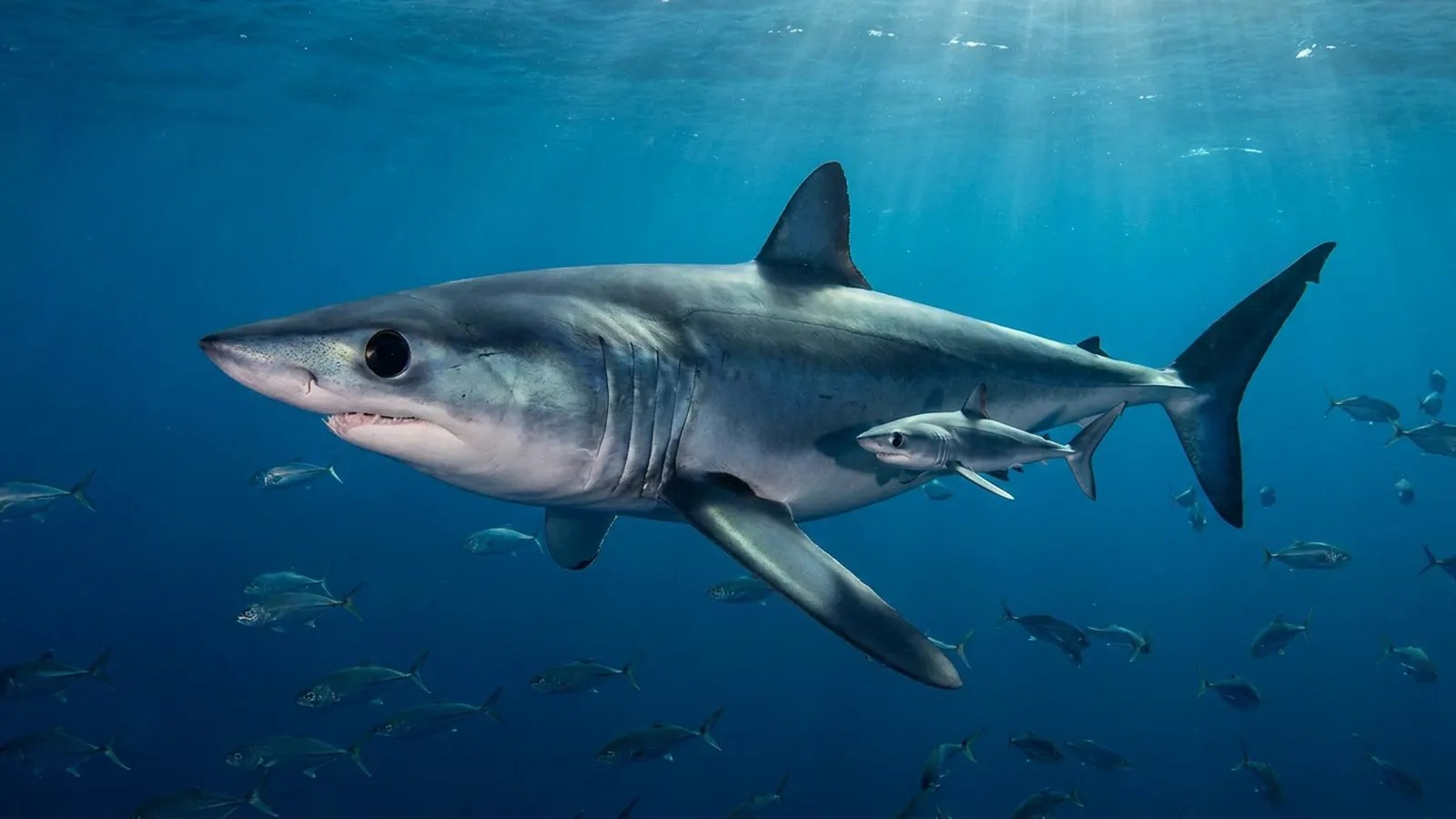
The clearest difference is the pectoral fin. In the longfin mako it is as long as or longer than the head, with a nearly straight front edge and a broad tip; in the shortfin mako it is clearly shorter than the head. The longfin also has a slimmer body, larger eyes, which lack the protective third eyelid found in many sharks, and dusky mottling under the snout and around the jaws in adults and large juveniles. The underside of the snout and the area around the mouth are dark in the longfin but white in the shortfin, which is a useful check on a shark hauled up beside a boat. The longfin’s first dorsal fin is large with a rounded tip, while its second dorsal and anal fins are tiny. Its skin denticles are elliptical, with three to seven ridges ending in a toothed rear edge.
The two species are each other’s closest relatives, a sister relationship confirmed by several mitochondrial DNA studies, and together their nearest living relative is the great white shark. Fossil teeth from Middle Miocene deposits in south-eastern Australia and central Japan, roughly 15 to 11 million years old, have been assigned to the longfin mako, so the lineage is an old one.
How big do longfin makos get?
The longfin mako is the larger of the two makos and the second-largest member of its family after the great white. Most specimens measured in fisheries are around 2 to 2.5 m long, and FishBase gives a common length of about 2 m. The largest reliable record is a female of 4.3 m caught off Pompano Beach, Florida, in February 1984, and FishBase lists maximum lengths of about 4.2 to 4.3 m. Females grow larger than males. Weights are poorly documented: typical adults weigh well over 70 kg, and large individuals exceed 200 kg, but the very high figures sometimes quoted are not backed by verified measurements. Because the body is slimmer, a longfin mako weighs noticeably less than a shortfin of the same length.
Where do longfin makos live?
In warm oceans worldwide, offshore and often deep, but records are scattered because the species is so easily confused with the shortfin.
In the western Atlantic the longfin mako is known from the Gulf Stream off the eastern United States, Florida, the Gulf of Mexico, Cuba and the Caribbean, and southern Brazil. In the eastern Atlantic it has been recorded from the Iberian Peninsula south to Guinea and Ghana, possibly including the Mediterranean and the Cape Verde Islands. Indian Ocean records come from the Mozambique Channel and Madagascar, and in the Pacific it occurs off Japan and Taiwan, northern and eastern Australia, around the central Pacific islands north of Hawaii and near the Phoenix Islands, and off southern California. Across its range it is generally rarer than the shortfin mako. In eastern Atlantic fishery landings, shortfins outnumber longfins by more than a thousand to one, while in parts of the western Atlantic and possibly the central Pacific the longfin is more regularly caught.
Older descriptions placed the species in a fairly narrow depth band. Off Cuba, longline fishers caught it most often at 110 to 220 m and rarely shallower than about 90 m, and off New South Wales most captures came from 50 to 190 m where surface waters were around 20 to 24°C. That led to the long-repeated figure of 220 m as its maximum depth. Satellite tracking has since shown that the shark goes far deeper. In the first published tracking study, led by Robert Hueter of Mote Marine Laboratory with Cuban colleagues, one adult male tagged off northern Cuba in 2015 spent most of its time shallower than 500 m but dived to 1,767 m, into water close to freezing. It generally swam deeper by day and shallower at night, apparently following the daily vertical migration of squid and other prey.
The same study tracked a second adult male tagged in the north-eastern Gulf of Mexico in 2012. Over 90 days it travelled roughly 6,800 km, through the Straits of Florida and up the Atlantic coast to a point off Virginia. The Cuban shark covered about 8,900 km in five months, looping through the Gulf of Mexico before heading north to waters off New Jersey and Virginia. Both sharks ended up in the same area off the US mid-Atlantic coast in July, which the authors suggested might be a summer feeding ground and possibly a mating area. Neither shark spent much time inside the areas closed to pelagic longlining off the US East Coast, suggesting those closures do little to protect the species.
What do longfin makos eat?
Mainly small schooling bony fishes and squid, hunted by sight in dim water.
Very few longfin mako stomachs have been examined, so its diet is known only in outline. The available records point to small, schooling bony fishes and pelagic cephalopods such as squid. Its very large eyes and its attraction to the chemical light sticks used on longlines suggest that it hunts by sight, which fits a shark that spends the day at depths where light is faint. In October 1972, a 3.4 m female caught in the north-eastern Indian Ocean had the broken bill of a swordfish lodged in her abdomen. Shortfin makos are known to hunt swordfish, but whether this longfin was attacking one or was simply struck during some other encounter is unknown.
The longfin’s body shape gives clues to how it lives. Its slender build and long, broad pectoral fins resemble those of the oceanic whitetip and the blue shark, both slow, efficient cruisers of the open ocean. Biologists therefore think the longfin mako is a less active swimmer than the shortfin, one of the fastest and most energetic of all sharks. Like the other members of its family, it has networks of blood vessels called retia mirabilia in its swimming muscles and around its eyes and brain. In great whites, porbeagles and shortfin makos these heat exchangers keep the body warmer than the surrounding water, but whether the longfin mako actually raises its body temperature has never been measured. Adults have no known natural predators except perhaps killer whales, while young ones may be taken by larger sharks.
How do longfin makos reproduce?
Females give birth to live young, usually just two at a time, after the embryos feed on unfertilised eggs in the uterus.
Like all mackerel sharks, the longfin mako is aplacental viviparous. Eggs hatch inside the mother, and once the embryos have used up their yolk they keep growing by eating a supply of unfertilised eggs that the mother continues to ovulate, a strategy called oophagy. Unlike the sand tiger shark, there is no evidence that the developing pups eat each other. Litters are typically two pups, one in each uterus, but a 3.3 m female caught in the Mona Passage near Puerto Rico in January 1983 was carrying eight well-developed embryos. Pups are large at birth, about 97 to 120 cm long, bigger than newborn shortfin makos, with proportionally longer heads and pectoral fins than adults. Capture records off Florida suggest that females may move into shallower coastal water in winter to give birth.
Males reach maturity at around 2 to 2.3 m and females at around 2.5 m. The age at maturity, the length of pregnancy and the maximum lifespan are all unknown, because no age and growth study has been possible for such a scarce species. FishBase rates its resilience as very low, with a minimum population doubling time of more than 14 years. A large, late-maturing shark that produces only two pups at a time cannot sustain much fishing mortality.
Why is the longfin mako endangered?
Because it is caught as bycatch on tuna and swordfish longlines across its range, and it reproduces very slowly.
No fishery targets the longfin mako, but pelagic longlines set for tuna, swordfish and other sharks catch it in small numbers throughout its range, and it is also taken in gillnets and on hook-and-line. Its meat is considered poor because of its soft texture, and its fins are rated lower than those of other pelagic sharks, but they are valuable enough that captured sharks are often finned, and longfin mako fins have been identified in the Hong Kong fin trade. In the early 1970s longfin makos made up about one-sixth of the shark landings of the Cuban longline fishery. The most significant recent catches have been by Japanese tropical longline fleets.
The IUCN Red List moved the species from Vulnerable to Endangered in an assessment completed in November 2018 and published in 2019, alongside the shortfin mako. The assessment inferred a large global decline from longline catch trends and the species’ very low productivity. In 2019, both makos were added to Appendix II of the Convention on International Trade in Endangered Species (CITES), which requires exporting countries to show that trade in fins and meat is legal and sustainable. The species is also listed under the Convention on Migratory Species. In the United States, landing longfin makos has been prohibited in Atlantic fisheries since 1999, so any caught must be released. Separating the two makos in catch records and fin markets remains a practical problem for managers, because a mislabelled longfin disappears into shortfin statistics.
| Feature | Longfin mako | Shortfin mako |
|---|---|---|
| Pectoral fin | As long as head or longer | Shorter than head |
| Underside of snout | Dusky | White |
| Eye | Very large | Large |
| Max length | ~4.3 m | ~4 m |
| Size at birth | 97–120 cm | ~70 cm |
| Swimming style | Slower cruiser (inferred) | Fast, energetic predator |
| IUCN status | Endangered | Endangered |
How was the longfin mako discovered?
For a shark of more than 4 m, the longfin mako was recognised remarkably late. Fishermen in Cuba distinguished it from the common mako long before scientists did, and in 1966 the Cuban marine biologist Darío Guitart Manday formally described it as Isurus paucus, based on three adult specimens from the Caribbean. The species name is Latin for “few”, a reference to how scarce it seemed compared with the shortfin mako. A year later, New Zealand shark specialist John Garrick independently described the same animal as Isurus alatus, the “winged” mako, a name that is now treated as a synonym.
There is an older name in the literature too. In 1964 the Soviet palaeontologist Leonid Glückman named Lamiostoma belyaevi from a set of fossil teeth that may belong to the same species. Under the rules of zoological naming the earlier name would normally win, but because those teeth could not be confirmed as longfin mako, paucus was kept. Some palaeontologists have also suggested that the Oligocene and Miocene fossil tooth species Isurus retroflexus could be the ancestor of the longfin mako, or even the same species.
Are longfin makos dangerous?
No attack on a person has ever been attributed to a longfin mako. That reflects where it lives more than how it behaves: it is an offshore, often deep-water shark that very few people ever meet in the water. A large longfin has big, sharp teeth and should be treated with the same caution as any large predatory shark, and FishBase lists it as potentially dangerous for that reason. Fishers who bring one alongside a boat face the main risk, since a hooked shark can thrash and bite. For divers, the problem is the opposite: a live longfin mako is one of the rarest sightings in the shark world, and most photographs of the species show animals that have been caught on longlines.
That rarity also makes the longfin mako a good example of how much remains unknown about large ocean sharks. Its age at maturity, lifespan, gestation period, population size and even the full extent of its range are still unknown. Most of what is known comes from a handful of dissected specimens, fishery records and just two satellite-tracked males. Every tagging study, genetic sample and accurately identified catch record adds substantially to what scientists know about the species.
Related on TheSea
What’s the difference between a longfin and shortfin mako?
The simplest field distinction is the length of the pectoral fins: in the longfin (Isurus paucus) they are as long as or longer than the head; in the shortfin (Isurus oxyrinchus) they are clearly shorter. The longfin is also slimmer, has a larger eye, and lives at greater depths.
Are longfin makos dangerous to humans?
No — ISAF records zero unprovoked attacks attributed to Isurus paucus. The species lives offshore in deep water and is rarely encountered alive by humans.
Why are longfin makos endangered?
The IUCN moved the species to Endangered in an assessment completed in 2018 and published in 2019, because pelagic longline bycatch is driving declines. The species’ slow reproduction and pelagic distribution make recovery measured in decades.
How big does a longfin mako get?
Most are 2–2.5 m long; the largest reliable record is a 4.3 m female from Florida. Weights of large adults exceed 200 kg, but are poorly documented, and they are lighter than shortfin makos of the same length.
Where can I see a longfin mako?
Almost nowhere, in practice. The species lives in offshore deep water and is rarely encountered alive. The few documented in-water sightings are from offshore baited dives in the western Atlantic and the central Indian Ocean, and even those are not reliable. See the shortfin mako page for the more accessible species.
How deep do longfin makos dive?
A satellite-tagged adult male tracked from Cuba dived to 1,767 m, although it spent most of its time shallower than 500 m.
How many pups does a longfin mako have?
Usually two, one in each uterus, though a female with eight embryos has been recorded. Pups are 97–120 cm long at birth.
- Hueter, R.E., Tyminski, J.P., Morris, J.J., Ruiz Abierno, A. & Angulo Valdes, J. (2017). Horizontal and vertical movements of longfin makos (Isurus paucus) tracked with satellite-linked tags in the northwestern Atlantic Ocean. Fishery Bulletin 115.
- Compagno, L.J.V. (2001). Sharks of the World, Vol. 2: Bullhead, mackerel and carpet sharks. FAO Species Catalogue for Fishery Purposes No. 1.
- Rigby, C.L. et al. (2019). Isurus paucus. IUCN Red List of Threatened Species: Endangered.
- FishBase (Froese & Pauly, eds.). Isurus paucus, Longfin mako: species summary.
- Guitart Manday, D. (1966). Original description of Isurus paucus. Poeyana, Serie A (Havana).
Blane Perun has been exploring Earth’s oceans and marine life for over 25 years. Founder of TheSea.Org in 1999, underwater photographer, coral aquaculture pioneer, and explorer of 80+ countries.
About Blane Perun → More on Sharks →