Sharks in Hawaii — The Species Around the Islands and the Law That Protects Them
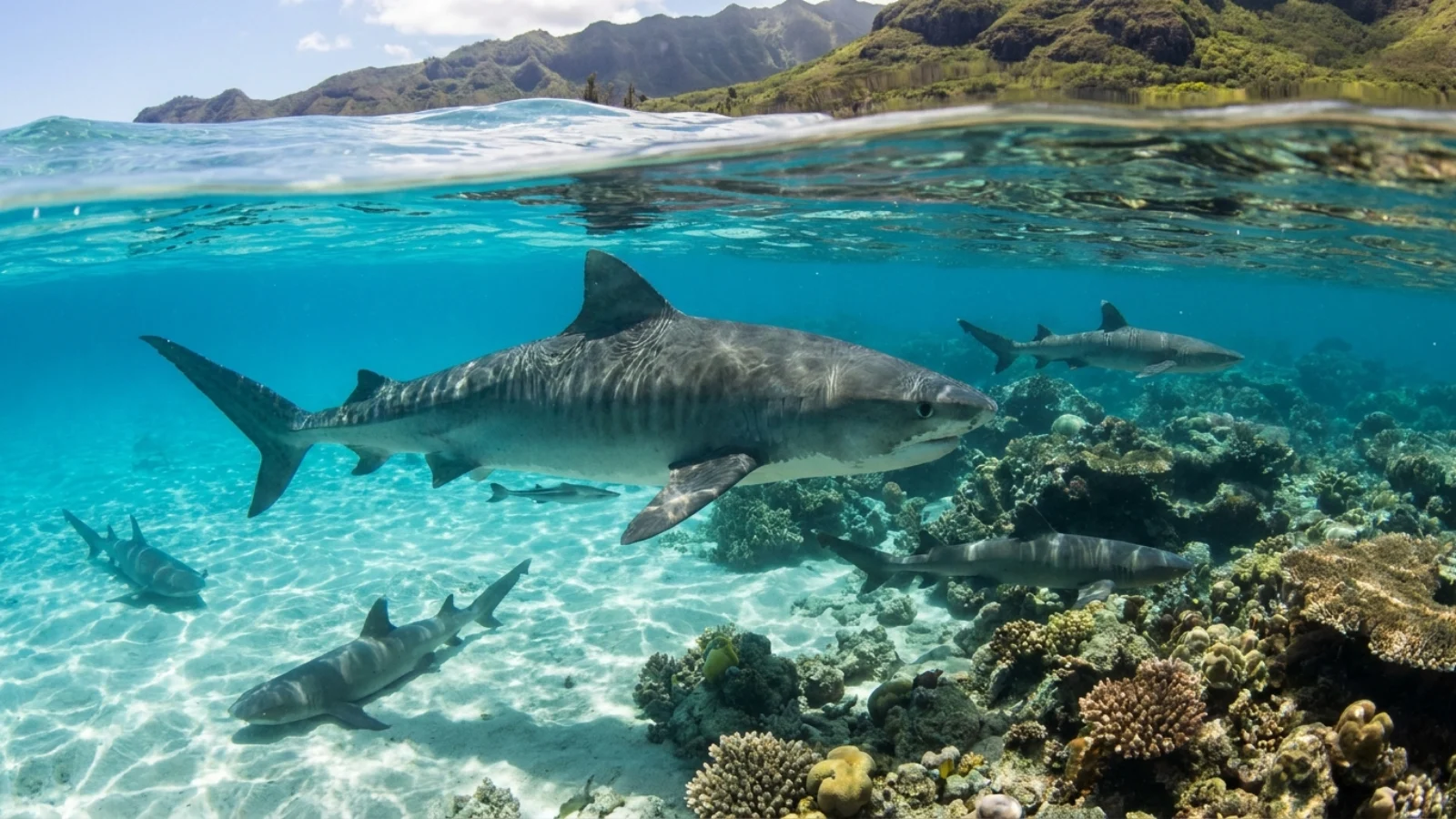
Hawaii’s state aquatic resources agency lists about 49 shark species in Hawaiian waters, but the ones people meet are mostly whitetip reef sharks, grey reef sharks, sandbar sharks, Galapagos sharks, scalloped hammerheads and tiger sharks. There are no confirmed bull sharks in Hawaii. Tiger sharks are the islands’ largest common predator, and in the remote Northwestern Hawaiian Islands some travel thousands of kilometres between feeding grounds, timing visits to French Frigate Shoals for the albatross fledging season. Since 1 January 2022, Act 51 has made it illegal to knowingly capture, entangle or kill any shark in Hawaii’s state marine waters, with fines of up to $10,000.
Hawaii’s sharks are mostly reef residents and wide-ranging tiger sharks, and the state now protects all of them in its waters.
What sharks live in Hawaii?
Hawaii sits in the middle of the North Pacific, thousands of kilometres from the nearest continent, and its sharks are a mix of island reef specialists and ocean wanderers. The Hawaii Department of Land and Natural Resources (DLNR) lists about 49 shark species from Hawaiian waters, ranging from deep-sea dogfishes and lanternsharks to whale sharks. Most of them live far offshore or in deep water and are seldom seen.
The sharks that snorkellers, divers, surfers and fishermen actually encounter belong to a much shorter list. On reefs and around lava ledges, the commonest are the whitetip reef shark and the grey reef shark. Over sand and in deeper water off the reefs swim sandbar sharks and Galapagos sharks. Scalloped hammerheads gather in sheltered bays, especially Kāneʻohe Bay on Oahu. And around all the islands roam tiger sharks, the largest sharks most people will ever see in Hawaii and the species responsible for most serious bites. This article is a guide to those species and their behaviour; the history and statistics of bites are covered separately in shark attacks in Hawaii.
Are there bull sharks in Hawaii?
No, not as far as anyone can confirm. Bull sharks are coastal and estuarine sharks of continental shores and big rivers, and they do not appear on DLNR’s list of Hawaiian species. Hawaii’s isolation and lack of large rivers and brackish estuaries make it poor bull shark habitat. Reports of “bull sharks” in Hawaii usually turn out to be misidentified sandbar, Galapagos or grey reef sharks, which share the bull shark’s stocky grey build. The evidence is examined in our article are there bull sharks in Hawaii.
What is the whitetip reef shark?
The whitetip reef shark (Triaenodon obesus) is the shark Hawaii’s divers know best. It is a slender, slow-moving shark, usually under 1.6 metres, with bright white tips on its first dorsal fin and the upper lobe of its tail. Unlike most sharks, it can rest motionless on the bottom, pumping water over its gills, and in Hawaii whitetips are often found by day lying inside underwater lava tubes and caves, sometimes several stacked together. At night they hunt in groups, forcing their long bodies into crevices and holes after fish, octopus and crustaceans hiding in the reef.
Whitetips are also opportunists. Off Hawaii they have been seen following endangered Hawaiian monk seals and trying to steal their catches. Individual whitetips stay faithful to the same patch of reef for years at a time, and that loyalty may help explain the Hawaiian belief in ʻaumākua, family ancestor spirits that take animal form, often as sharks, and watch over their descendants. A shark that is always in the same cave, year after year, is easy to think of as a guardian.
What is the grey reef shark like in Hawaii?
The grey reef shark (Carcharhinus amblyrhynchos) is a stockier, more active reef shark, recognisable by the broad black edge along its tail. It is common on outer reef slopes and around atolls, especially in the Northwestern Hawaiian Islands. Grey reef sharks often gather in groups during the day, and in the northwestern islands large numbers of pregnant females have been seen swimming slowly in circles in shallow water, sometimes showing their dorsal fins or backs; scientists suspect they use the warmer shallow water to speed their own growth or that of their embryos, and perhaps to avoid unwanted attention from males.
Hawaiian grey reef sharks are remarkably site-attached. Individuals may stay around the same part of a reef for up to three years. Females give birth to a small number of pups every other year, generally one to four, but up to six in Hawaii. That slow reproduction makes them vulnerable to fishing. The grey reef shark was the first shark known to perform a threat display, a hunched posture with dropped pectoral fins that warns it is ready to attack, typically when a diver crowds or follows it; the right response is to back away.
Which sharks live in deeper Hawaiian waters?
Off the reef edge, in water tens to hundreds of metres deep, live two larger sharks that are often confused. The sandbar shark (Carcharhinus plumbeus) is a heavy-bodied grey shark with a very tall first dorsal fin; it lives over sandy and muddy bottoms off the reefs. The Galapagos shark (Carcharhinus galapagensis) is a sleek, grey requiem shark of oceanic islands, found from Lord Howe Island and the Marshall Islands to the Galapagos and Clipperton. It remains common around Hawaii, especially in the northwestern islands such as Kure Atoll, even though it may have been wiped out from some sites in Central America. Galapagos sharks are inquisitive and persistent, and they are regarded as potentially dangerous to divers, especially where fish are being speared or caught.
Deeper still lives one of the strangest sharks in Hawaii, the cookiecutter shark. This small deep-sea shark makes daily vertical migrations of up to 3 kilometres, rising toward the surface at night, and gouges round plugs of flesh, about 5 centimetres across, from larger animals. Off Hawaii nearly every adult spinner dolphin bears its crater-shaped scars.
Where do hammerhead sharks live in Hawaii?
Scalloped hammerheads (Sphyrna lewini) use Hawaii’s sheltered bays as nurseries. Kāneʻohe Bay on Oahu’s windward coast is the best-known example: females give birth there, and thousands of hammerhead pups spend their first months in the bay’s murky water before moving out to sea. Pup survival in the bay is low, and starvation is a major cause of death. The research behind those findings, and what the pups eat, is covered in what do hammerhead sharks eat.
Why are tiger sharks so important in Hawaii?
The tiger shark (Galeocerdo cuvier) is Hawaii’s apex predator among sharks, a large shark with a broad, blunt snout and dark stripes down its body that resemble a tiger’s and fade as it matures. It eats almost anything: turtles, seabirds, reef fish, rays, other sharks, dolphins, carrion and garbage. Around Hawaii, the stomachs of tiger sharks quite often contain land mammals, including horses, goats, sheep, dogs, cats and rats, most likely scavenged from carcasses washed out to sea. In 2006 a group of tiger sharks was documented killing an ailing humpback whale near Hawaii.
Tiger sharks are also great travellers. In a study published in Marine Biology in 2010, Meyer, Papastamatiou and Holland fitted tiger and Galapagos sharks in Papahānaumokuākea Marine National Monument with both acoustic and satellite transmitters. Some tiger sharks were detected at French Frigate Shoals year-round. Others visited the atoll in summer to feed on fledging albatrosses, young birds making their first flights from the islands, many of which end up on the water. Those sharks then travelled thousands of kilometres, either along the Hawaiian chain or out to a productive ocean front in the North Pacific, and came back to French Frigate Shoals in later years. The authors suggested that each shark builds its own “cognitive map” of distant feeding sites through exploration. By contrast, all detections of Galapagos sharks were at French Frigate Shoals, suggesting they are more resident around single islands. Both species spent most of their time in the top 100 metres but sometimes dived through the thermocline to 680 metres.
What is Papahānaumokuākea?
Papahānaumokuākea Marine National Monument covers the Northwestern Hawaiian Islands, a chain of small islands, atolls and reefs stretching northwest from Kauai. Including ten islands and atolls, it encompasses about 1,510,000 square kilometres (583,000 square miles) of ocean, one of the largest marine protected areas in the world. French Frigate Shoals, the largest atoll in the chain, lies about 902 kilometres (560 miles) northwest of Honolulu, and Kure Atoll, at the far end, is the northernmost coral atoll in the world. The monument has deep cultural significance for Native Hawaiians as an ancestral place where life is believed to originate and to which spirits return after death.
For sharks, Papahānaumokuākea is a reference point for what Hawaiian reefs looked like before heavy human use, with few people and strict protection apart from traditional Native Hawaiian uses and limited tourism. The monument also protects endangered Hawaiian monk seals, green turtles and huge seabird colonies, many of which are prey for the sharks, so it offers a rare view of a Pacific island food web with its top predators intact.
How threatened are Hawaii’s sharks?
The sharks most familiar in Hawaii have very different conservation outlooks, largely because they breed at very different rates. On the IUCN Red List, the grey reef shark is now assessed as Endangered and the whitetip reef shark as Vulnerable, both because reef sharks are heavily fished across much of their range and reproduce slowly. A female whitetip carries her young for 10 to 13 months and gives birth to litters of one to six, usually two or three, pups, and is estimated to produce only about 12 pups in her whole life. Grey reef sharks, as described above, bear a handful of pups every other year.
The open-water species are faring better. The Galapagos shark, which commonly reaches 3 metres and has been recorded at up to 3.3 to 3.7 metres and 195 kilograms, is listed as Least Concern; females bear 4 to 16 pups every two to three years, and the young stay in shallow water to avoid being eaten by adults. The tiger shark is listed as Near Threatened. It is the most fertile of Hawaii’s large sharks, carrying its young for up to 16 months and giving birth to litters of 10 to 80 pups, each 51 to 76 centimetres long. Those contrasts help explain why Hawaii’s lawmakers chose to protect every shark species in state waters rather than pick out a few.
How does Hawaii protect its sharks?
Hawaii has led the United States on shark protection. In 2010 it became the first state to ban the possession, sale and distribution of shark fins, with the law taking effect on 1 July 2011. Other states followed, and a national ban on the shark fin trade passed in 2022.
In 2021 the state legislature went further. Act 51, which began as House Bill 553, made it illegal from 1 January 2022 to knowingly capture, entangle or kill any shark in Hawaii’s state marine waters, covering every shark species found there; it was widely described as the first statewide ban on shark fishing in the country. Violations are misdemeanours, with fines of $500 for a first offence, $2,000 for a second and $10,000 for a third or later offence, plus possible civil and administrative fines of up to $10,000 per shark and seizure of vessels, gear and licences. There are exceptions for DLNR permits, for public safety actions authorised by the agency, for sharks legally taken outside state waters, and for self-defence or the defence of another person. A planned non-commercial permit is to include Native Hawaiian cultural protocol, size and species limits. Our article on shark conservation and white shark status discusses protection elsewhere.
What do sharks mean in Hawaiian culture?
Sharks, manō in Hawaiian, have a special place in Hawaiian tradition. Some families regard particular sharks as ʻaumākua, ancestral guardians, and tell stories of sharks that protected fishermen or guided canoes. Reef sharks that return to the same cave for years may have helped inspire those beliefs. The Northwestern Hawaiian Islands, now protected as Papahānaumokuākea, are tied to Hawaiian cosmology as a place of origins and of the dead. That cultural relationship is reflected in the 2021 shark protection law, whose planned permit system is to include Native Hawaiian cultural protocol.
How can you see sharks safely in Hawaii?
Snorkellers and divers regularly see whitetip reef sharks resting under ledges and in lava tubes, and sometimes grey reef, sandbar or Galapagos sharks over deeper reefs. Watch from a respectful distance, do not touch or feed sharks, and back away if a shark arches its back or swims stiffly, signs of a threat display. Avoid murky water near stream mouths after heavy rain, and avoid swimming at dawn, dusk and night, when visibility is poor. Remember that, under Act 51, deliberately catching or harming a shark in state waters is now a crime.
So, what should you know about sharks in Hawaii?
Hawaii’s sharks are a window into a Pacific island ecosystem. Whitetip reef sharks sleep in lava tubes and steal from monk seals, grey reef sharks guard their stretch of reef for years, hammerhead pups crowd into Kāneʻohe Bay, cookiecutters scar the spinner dolphins, and tiger sharks commute across thousands of kilometres of ocean to catch fledgling albatrosses at French Frigate Shoals. There are no confirmed bull sharks. Since 2022 every shark in state waters has been protected by law, building on Hawaii’s pioneering 2010 ban on shark fins. Bites are rare, and most people who meet a shark in Hawaii remember it as a highlight of their trip.
What sharks are in Hawaii?
About 49 species are recorded, but most encounters involve whitetip and grey reef, sandbar, Galapagos, scalloped hammerhead and tiger sharks.
Are there bull sharks in Hawaii?
No confirmed bull sharks. They are not on DLNR’s list of Hawaiian shark species.
Is it illegal to kill sharks in Hawaii?
Yes. Since 1 January 2022 it has been illegal to knowingly capture, entangle or kill a shark in state marine waters.
What is the most common shark in Hawaii?
Divers most often see whitetip reef sharks, which rest in caves and lava tubes by day.
Are there hammerhead sharks in Hawaii?
Yes. Scalloped hammerheads use Kāneʻohe Bay on Oahu as a nursery.
Why do tiger sharks go to French Frigate Shoals?
Some arrive each summer to catch fledgling albatrosses that fall into the lagoon.
What does manō mean?
Manō is the Hawaiian word for shark. Some families regard sharks as ʻaumākua, ancestral guardians.
When did Hawaii ban shark fins?
In 2010, the first US state to do so; the law took effect on 1 July 2011.
- Hawaii Division of Aquatic Resources: Act 51 (HB 553) shark protection law, effective 1 January 2022; DLNR list of Hawaiian shark species.
- Meyer CG, Papastamatiou YP, Holland KN (2010). A multiple instrument approach to quantifying the movement patterns and habitat use of tiger and Galapagos sharks at French Frigate Shoals, Hawaii. Marine Biology, doi:10.1007/s00227-010-1457-x.
- IUCN statuses and reproduction as reported in Wikipedia articles on the whitetip reef shark, grey reef shark, Galapagos shark, cookiecutter shark and tiger shark (Wikipedia articles of those names).
- Papahānaumokuākea Marine National Monument and French Frigate Shoals (Wikipedia); state shark fin bans (Wikipedia, “Shark finning”).
Blane Perun has been exploring Earth’s oceans and marine life for over 25 years. Founder of TheSea.Org in 1999, underwater photographer, coral aquaculture pioneer, and explorer of 80+ countries.
About Blane Perun →