Are There Sharks in the Great Lakes? — Why All Five Lakes Are Shark-Free
No. There are no sharks in Lake Superior, Michigan, Huron, Erie or Ontario, and no shark has ever been confirmed in any of them. The Great Lakes hold about a fifth of the world’s surface fresh water, they are cold for much of the year, and the only routes from the sea run through hundreds of kilometres of river, the locks of the St. Lawrence Seaway and the Welland Canal around Niagara Falls. No shark that lives in the North Atlantic can survive that journey. The region did have sharks once: fossils of the early shark Cladoselache, about 360 million years old, come from the shores of Lake Erie in Ohio. The nearest living sharks today are cold-water Greenland sharks in the St. Lawrence estuary.
The Great Lakes are the largest freshwater system on Earth by area, and that is exactly why they have no sharks.
Are there sharks in the Great Lakes?
No. None of the five Great Lakes has a shark population, and no shark has ever been confirmed in Lake Superior, Lake Michigan, Lake Huron, Lake Erie or Lake Ontario. Every so often a photograph or video claims otherwise, and every one so far has turned out to be a hoax, a misidentified fish or a joke that escaped its context. Fisheries agencies in the eight US states and the Canadian province that border the lakes monitor fish populations closely, with surveys, commercial catch records and millions of angler-hours every year, and none has recorded a shark.
This article looks at the whole Great Lakes system and the reasons it cannot support sharks. For individual lakes, see our articles on sharks in Lake Michigan, which covers the Chicago canal route and the sea lamprey in detail, and bull sharks in Lake Erie.
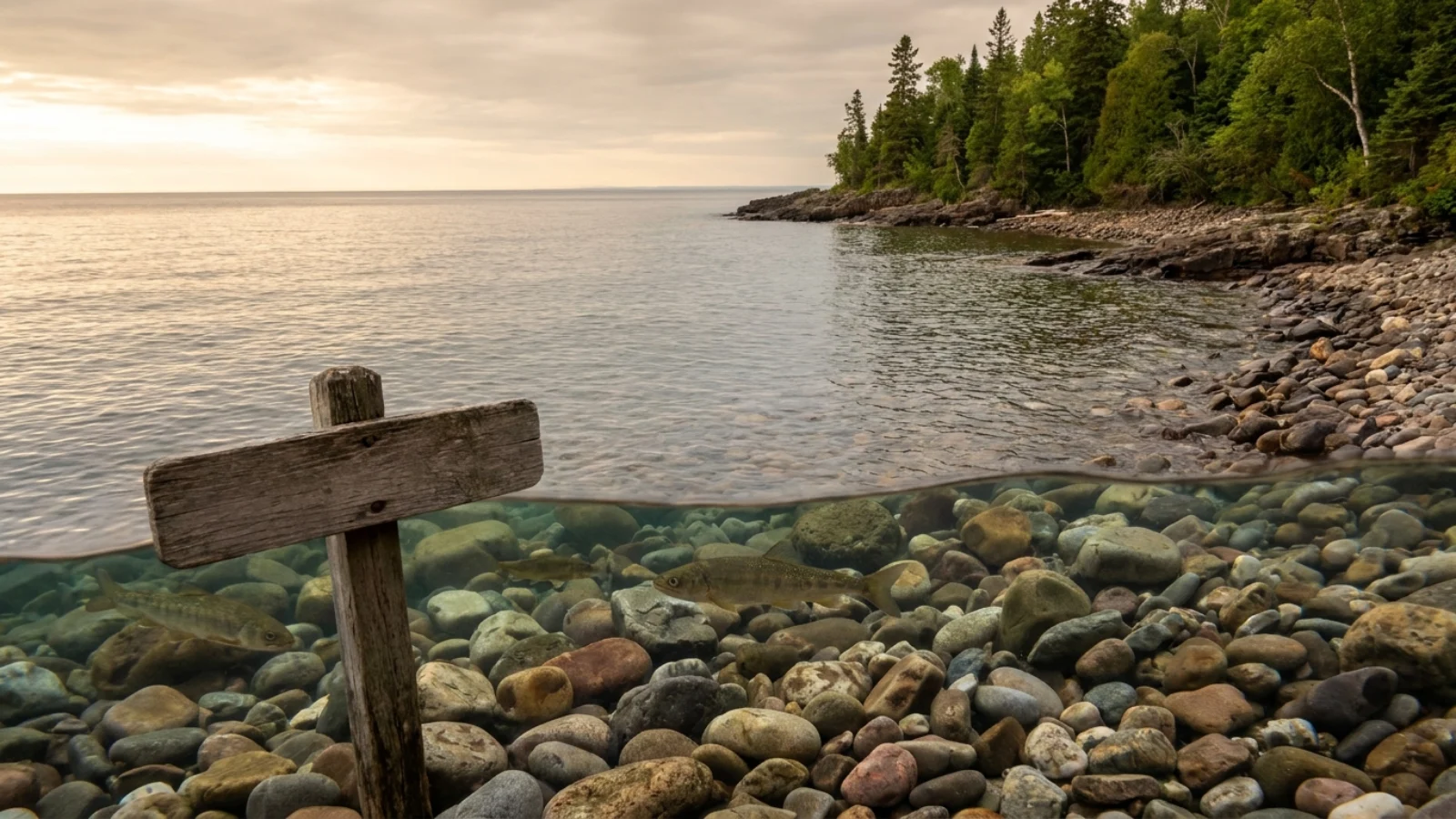
How big are the Great Lakes?
The Great Lakes are the largest group of freshwater lakes on Earth by total area and the second largest by volume. Together they cover about 244,106 square kilometres (94,250 square miles) and hold about 22,671 cubic kilometres of water, roughly 21 percent of the world’s surface fresh water, slightly less than Lake Baikal in Siberia. Although the lakes lie in separate basins, they form a single interconnected body of water draining east through the St. Lawrence River to the Atlantic. Water moves through the system slowly: only about 1 percent of the volume each year is new water from rivers, rain and groundwater.
The lakes differ a great deal. Lake Superior is the largest freshwater lake in the world by surface area, holds about 10 percent of the world’s surface fresh water on its own and reaches 406 metres (1,333 feet) at its deepest point. Below about 200 metres its water stays at an almost constant 4 °C all year. Lake Erie, at the other extreme, is the southernmost, shallowest and smallest by volume of the five, only 64 metres deep at its deepest point, and it has the shortest water residence time. Lakes Michigan and Huron share the same surface level through the Straits of Mackinac and behave as one lake. Lake Ontario, the lowest of the five, drains into the St. Lawrence.
Why can’t sharks live in the Great Lakes?
The first reason is the water itself. The Great Lakes are fresh, and almost all sharks are marine animals that cannot survive for long in fresh water. A shark keeps its body fluids about as salty as seawater by retaining urea, and in fresh water it absorbs water and loses salts faster than it can cope. The bull shark is the only large shark able to switch between salt and fresh water for long periods, and even bull sharks live mainly in warm coasts and estuaries.
The second reason is temperature. The Great Lakes sit in a region of cold winters, and parts of their surface freeze each winter. Deep water in Lake Superior never warms above about 4 °C, and even shallow Lake Erie, the warmest of the five in summer, chills to near freezing in winter. The only shark that tolerates fresh water is a tropical and warm-temperate species, while the sharks that tolerate cold water, such as the Greenland shark and the spiny dogfish, are strictly marine. No shark combines both abilities.
The way the lakes’ water is layered makes things worse for a warm-water fish. Lake Superior is seasonally stratified: in summer a warm surface layer floats over cold deep water, and twice a year, in spring and autumn, the whole water column reaches a uniform 4 °C from top to bottom and mixes completely. A tropical shark that somehow arrived in late summer would find its warm surface layer disappearing within weeks, with nowhere deeper or warmer to retreat to. Bull sharks in the Gulf of Mexico seek out water of around 29 to 32 °C; in the Great Lakes, surface water that warm is rare and short-lived even at the height of summer.
The third reason is distance and barriers. The Great Lakes are far inland, and the only connections to the sea run through long rivers, canals, locks and, between Lake Erie and Lake Ontario, Niagara Falls.
How are the Great Lakes connected to the ocean?
The natural outlet of the Great Lakes is the St. Lawrence River, which flows northeast from Lake Ontario past Montreal and Quebec City to the Gulf of St. Lawrence and the Atlantic. Rapids on the upper river once blocked ships, and since 25 April 1959 deep-draft ocean vessels have been able to travel into the lakes through the St. Lawrence Seaway, a system of locks, canals and dredged channels built jointly by Canada and the United States. The Seaway cost about C$470 million, was formally opened by President Dwight Eisenhower with a short cruise aboard the royal yacht Britannia, and lets ships reach as far inland as Duluth, Minnesota, at the western tip of Lake Superior.
To get from Lake Ontario to Lake Erie, ships use the Welland Canal, which bypasses Niagara Falls by climbing the Niagara Escarpment. The first Welland Canal opened in 1829 with forty wooden locks; the present Fourth Welland Canal, completed in 1932, does the same job with eight. The Seaway’s own locks were built to match the Welland’s dimensions. Niagara Falls itself, with a vertical drop of more than 50 metres and the highest flow of any tall waterfall in North America, is an absolute barrier to any fish swimming upstream. Even when water is diverted for hydroelectric power, which halves the flow at night and in the winter months, at least 1,400 cubic metres of water per second still pours over the falls, and no fish has ever been known to climb them. Everything that lives in the upper four lakes either arrived by the canals, came with ships, or colonised the basins as the glaciers retreated.
On the western side, the Great Lakes connect to the Mississippi River system through artificial canals at Chicago, which now flow out of Lake Michigan toward the Mississippi. That route is guarded by locks and an electric fish barrier built to stop invasive carp, and the farthest any bull shark has been recorded up the Mississippi system is Alton, Illinois, still far from Chicago. The details are in our article on bull sharks in the Mississippi River.
Could a shark swim up the St. Lawrence into Lake Ontario?
In theory a fish could follow the river, but no shark is equipped for it. The sharks that live in the St. Lawrence estuary and gulf, such as the Greenland shark, are cold-water marine species that need salt water. As the river freshens upstream of the estuary, they would have to turn back. The warm-water bull shark, which could tolerate the fresh water, has an Atlantic range that ends far to the south, around Massachusetts, and could not survive the cold of the St. Lawrence. A shark heading for the Great Lakes would also have to pass through the Seaway’s locks alongside ocean-going ships, swimming upstream through hundreds of kilometres of cold, fresh river.
Where are the nearest sharks to the Great Lakes?
The closest living sharks to the Great Lakes are probably Greenland sharks (Somniosus microcephalus) in the St. Lawrence estuary, the stretch downstream of Quebec City where river water mixes with the sea. Greenland sharks are slow-moving, cold-water giants that usually live at great depths or in the high Arctic, and they are among the longest-lived vertebrates known. In the St. Lawrence estuary, though, they come surprisingly close to the surface.
In a study published in The Canadian Field-Naturalist in 2016, Gallant and colleagues reported on eight Greenland sharks fitted with acoustic transmitters in the estuary in the summer of 2005. The sharks made daily vertical movements into shallow water of 30 metres or less. They preferred deep, cold water during daylight and moved into shallower, warmer water at night, with their rises into the shallows coinciding mostly with darkness and high tide. Even these hardy sharks stay in salt water, however; they live in the estuary, not in the fresh river leading to Lake Ontario. Our Greenland shark profile covers the species and its extraordinary lifespan.
Were there ever sharks in the Great Lakes region?
Yes, long before the lakes existed. During the Devonian period, shallow tropical seas covered much of what is now the eastern interior of North America. The Cleveland Shale, a black shale formation named in 1870 by John Strong Newberry of the Ohio Geological Survey after exposures near Cleveland, Ohio, dates to about 360 million years ago, the very end of the Devonian. It is famous for some of the best-preserved early shark fossils in the world, found along the south shore of Lake Erie.
The best known is Cladoselache, a streamlined early shark with a deeply forked tail that grew to about 1.8 metres, though many specimens were smaller. The Cleveland Shale often preserves complete bodies, including outlines of soft tissue, fin rays, gill muscles and even stomach contents. Many Cladoselache fossils still hold their last meals: small ray-finned fishes, shrimp-like arthropods and conodonts, eel-like early vertebrates. Some of the fish were swallowed tail first, evidence that Cladoselache was fast enough to chase down its prey. The same rocks yielded the giant armoured placoderm Dunkleosteus terrelli, which shared those seas with the early sharks. The ancient seas of Ohio are covered further in our article on prehistoric sharks.
Was the sea ever close to the Great Lakes after the Ice Age?
Briefly, and in a way that shows how close the region came to a marine connection. The Great Lakes began to form about 14,000 years ago, as retreating ice sheets uncovered the basins the glaciers had carved, and the basins filled with meltwater. The land had been pressed down by the weight of the ice, so as the ice melted, the Atlantic flooded inland along the St. Lawrence and Ottawa valleys, forming the Champlain Sea. It lasted from about 13,000 to about 10,000 years ago, reaching south to today’s Lake Champlain and up the Ottawa River beyond Ottawa, and for a time a glacial lake in the Lake Ontario basin, Lake Iroquois, became an arm of it.
Fossils of beluga, fin and bowhead whales, walruses and seals have been found near Ottawa and Montreal, left by animals that swam into that inland sea. As the land rebounded once the ice had gone, the sea drained away, and the lakes were left fresh. There has been no marine connection to the lakes since.
What ocean animals have reached the Great Lakes?
The real invaders of the Great Lakes are small, and most arrived with ships rather than swimming in on their own. The sea lamprey, a jawless, eel-like parasite, spread from Lake Ontario into the upper lakes after the Welland Canal was improved and devastated lake trout fisheries in the twentieth century. The round goby, a small bottom fish from the Black and Caspian Sea region, arrived in ballast water discharged by cargo ships and was first found on 28 June 1990, when an angler caught one in the St. Clair River at Sarnia, Ontario. Within a few years it had spread throughout the lakes, competing with native fish but also becoming food for them; the once-threatened Lake Erie watersnake now eats round gobies in large numbers. Ballast-water rules and canal barriers are aimed at stopping the next invader. Sharks are not on the list.
Why do people think there are sharks in the Great Lakes?
Part of the reason is that the lakes look like a sea. Lake Superior has horizons that stretch beyond sight, storm waves that have sunk large freighters, and cold, clear water that hides great depths. People who grew up on the ocean coasts sometimes assume anything that big must contain sharks. The other part is the internet: doctored photos of fins near Great Lakes beaches, fake news articles and April Fool’s jokes recirculate every summer. Large native fish such as lake sturgeon, muskellunge, salmon and lake trout, as well as carp, are often the real fins behind sighting reports.
So, are there sharks in the Great Lakes?
No. The Great Lakes are too fresh for nearly every shark species, too cold for the one shark that tolerates fresh water, and too far inland behind rapids, locks, canals and Niagara Falls for any shark to reach them. The nearest living sharks are Greenland sharks in the salty St. Lawrence estuary, and the last sharks to swim over the region did so 360 million years ago in the Devonian seas preserved in Ohio’s Cleveland Shale. If you swim in the Great Lakes, the real dangers are rip currents, cold water and sudden storms, and they deserve far more respect than any imaginary fin.
Are there sharks in the Great Lakes?
No. None of the five lakes has a shark population, and no shark has ever been confirmed in them.
Are there sharks in Lake Superior?
No. Lake Superior is fresh and very cold, with deep water near 4 °C all year.
Are there sharks in Lake Ontario?
No. The nearest sharks are Greenland sharks in the salty St. Lawrence estuary, far downstream.
Can a shark get into the Great Lakes through the St. Lawrence Seaway?
Not realistically. Cold-water sharks need salt water, and warm-water bull sharks can’t survive the cold.
Were there ever sharks in the Great Lakes?
Not in the lakes, but early sharks such as Cladoselache swam over Ohio about 360 million years ago.
Is any Great Lake salt water?
No. All five Great Lakes are fresh water, together about 21 percent of the world’s surface fresh water.
What is the biggest fish in the Great Lakes?
The lake sturgeon, which can exceed 2 metres and live for more than a century.
What is the bloodsucking fish in the Great Lakes?
The invasive sea lamprey, a jawless fish that feeds on lake trout and other fish.
- Great Lakes area, volume and water renewal; Lake Superior and Lake Erie dimensions (Wikipedia, “Great Lakes”, “Lake Superior”, “Lake Erie”).
- St. Lawrence Seaway opening and cost; Welland Canal history; Niagara Falls (Wikipedia articles of those names).
- Gallant, Rodriguez, Stokesbury et al. (2016). Influence of environmental variables on the diel movements of the Greenland shark in the St. Lawrence Estuary. The Canadian Field-Naturalist 130: 1.
- Cleveland Shale and Cladoselache fossils (Wikipedia, “Cleveland Shale”, “Cladoselache”); Champlain Sea (Wikipedia, “Champlain Sea”).
- Round goby introduction to the Great Lakes (Wikipedia, “Round goby”).
Blane Perun has been exploring Earth’s oceans and marine life for over 25 years. Founder of TheSea.Org in 1999, underwater photographer, coral aquaculture pioneer, and explorer of 80+ countries.
About Blane Perun →