Shark Attacks in Hawaii — Why Maui Has the Most Bites
Hawaii typically records a few unprovoked shark bites a year, four in 2025, and tiger sharks are the species identified most often. Maui has more bites than any other island, even though Oahu has many times more people, because Maui is surrounded by a wide, shallow insular shelf that tiger sharks favour and patrol close to popular beaches. Bites peak in autumn, especially October, when pregnant female tiger sharks arrive from the Northwestern Hawaiian Islands. Fatal bites are rare: the June 2024 death of Tamayo Perry was Oahu’s first since state record-keeping began in 1995.
Hawaii’s shark risk is small and mostly comes from tiger sharks, with Maui’s broad shelf and the autumn pupping season shaping where and when bites happen.
How many shark attacks happen in Hawaii?
Hawaii records a small number of shark bites each year, usually in single figures. The International Shark Attack File (ISAF) at the Florida Museum of Natural History counted four unprovoked bites in Hawaii in 2025, none of them fatal, out of 25 in the United States and 65 worldwide. Florida, by comparison, had 11. Hawaii has long ranked behind Florida as one of the US states with the most bites, which reflects its year-round warm water, its huge numbers of surfers, swimmers, snorkellers and divers, and the fact that every beach faces the open ocean.
The state’s own record is the shark incident list kept by the Hawaii Department of Land and Natural Resources (DLNR), Division of Aquatic Resources. It includes unprovoked and provoked incidents, from serious bites to encounters in which a shark struck a board or kayak. That list is what scientists use to study patterns in Hawaii, and it tells a consistent story about one species, one island and one season.
Which sharks bite people in Hawaii?
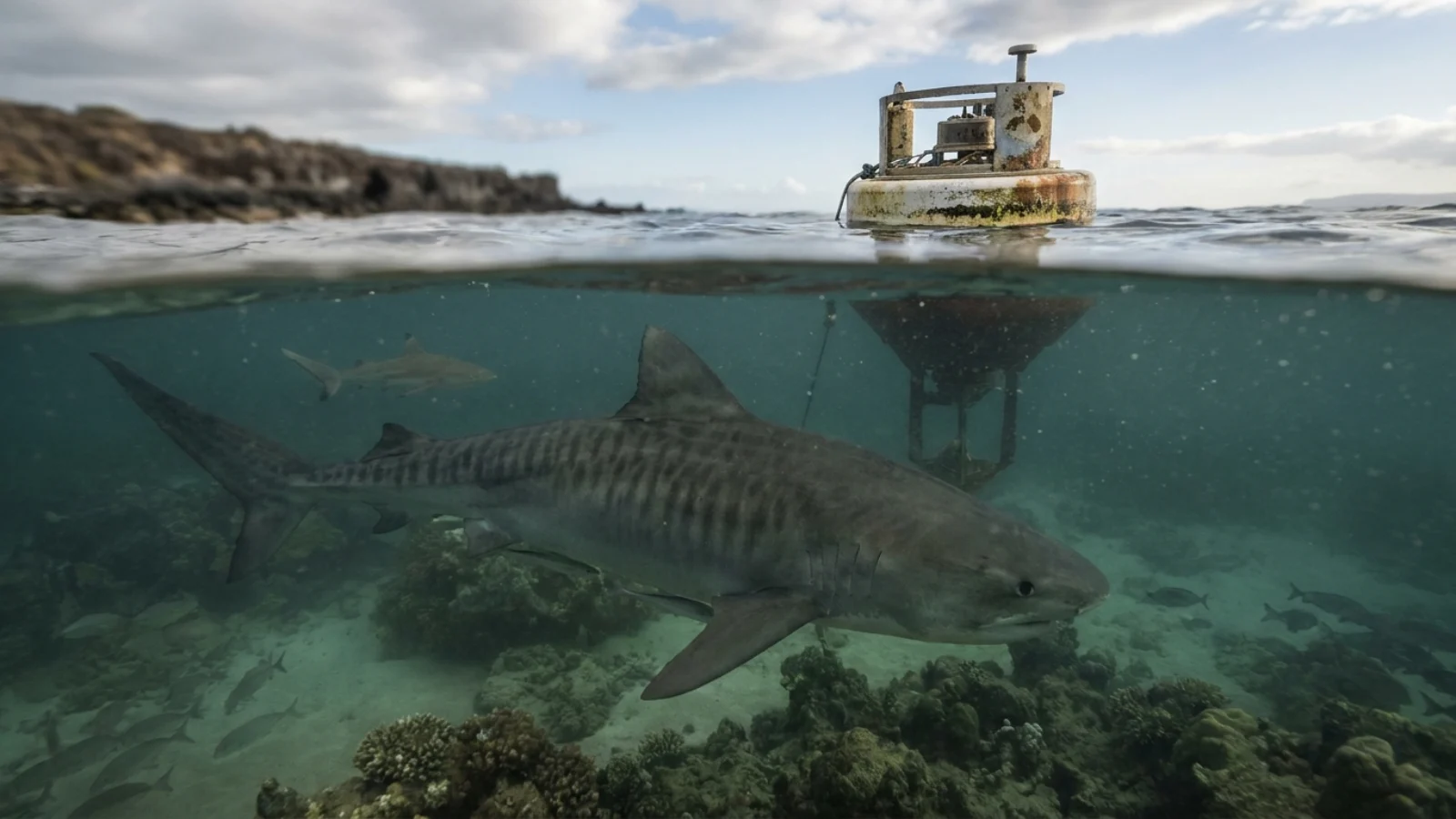
The DLNR lists 49 shark species from Hawaiian waters, from deep-sea dogfish to whale sharks, but only a few are involved in bites. By far the most important is the tiger shark (Galeocerdo cuvier), a large, wide-ranging predator that eats turtles, seabirds, fish, rays and carrion and will investigate almost anything at the surface. Grey reef sharks, Galapagos sharks, sandbar sharks and occasionally white sharks are involved in other incidents, and spearfishers sometimes attract reef sharks to their catch.
A study of shark-related injuries in Hawaii from 2009 to 2019, led by Victoria Scala and published in 2020 in Trauma Surgery & Acute Care Open, reviewed 61 cases on the DLNR list. Where the species could be identified, tiger sharks were the most frequent culprit, responsible for 25 of the 35 identified cases, about 71 percent. In 26 cases, about 43 percent, the species was unknown, which is common when bites happen quickly in murky surf.
One species that does not appear is the bull shark. Despite occasional rumours, there has never been a confirmed record of a bull shark in Hawaii, and it is absent from the state’s list of shark species. Bull sharks are animals of continental coasts, estuaries and rivers, and Hawaii’s isolated volcanic islands offer little of the habitat they need. Our article are there bull sharks in Hawaii? explains the evidence in detail.
Why does Maui have the most shark attacks?
Maui stands out in every analysis. In the 2009 to 2019 study, Maui accounted for 25 of the 61 injuries, or 41 percent, compared with 16 on Oahu, 12 on Hawaii Island and 8 on Kauai. Maui had almost one and a half times as many injuries as Oahu, even though Oahu has about six times as many residents. All four deaths in that period occurred off Maui.
The explanation lies under the water. Maui is surrounded by an extensive insular shelf, the band of shallow seafloor between the shoreline and about 200 metres deep, much broader than the shelf around Oahu. In 2018 Carl Meyer, Kim Holland and colleagues at the Hawaii Institute of Marine Biology published the results of tracking 96 tiger sharks around four islands for up to six years, in Scientific Reports. Most sharks showed fidelity to a home island but also swam between islands and sometimes ranged up to 1,400 kilometres offshore.
Crucially, the sharks’ movements were oriented to insular shelf habitat, and their core home ranges lay within it. Around Maui, the core areas of large tiger sharks lay closer to busy beaches than around Oahu. Tagged tiger sharks were detected at Maui’s ocean recreation sites on 62 to 80 percent of days, compared with less than 6 percent of days at Oahu sites. The authors concluded that Maui’s broad shelf supports a fairly resident tiger shark population and attracts visitors from other islands, and that these natural, habitat-driven patterns may partly explain Maui’s higher number of bites. It is not that Maui’s sharks are more aggressive; there are simply more tiger sharks spending more time near more people.
When do most shark bites happen in Hawaii?
Hawaii’s bites have a clear seasonal peak in autumn. In the 2009 to 2019 study, 13 of the 25 tiger shark injuries, 52 percent, happened between September and November, and October alone accounted for 8, or 32 percent. The likely reason is reproduction. The authors note that tiger sharks typically give birth around September and October, and an estimated 25 percent of mature female tiger sharks appear to migrate from French Frigate Shoals in the Northwestern Hawaiian Islands to the main islands in late summer or early autumn, possibly to give birth.
That means more large female tiger sharks are near the main islands’ coasts at exactly the time when winter swells begin to bring surfers to north- and west-facing breaks. Local surfers have long talked about October as “sharky” season; the data support them. The same pattern does not mean the ocean is unsafe in autumn, only that the already-low risk rises somewhat.
How often are shark attacks fatal in Hawaii?
Rarely. In the 2009 to 2019 review, four of 61 incidents were fatal, about 6.6 percent, and all four victims died at the scene off Maui. Hawaii’s survivors have done well partly because of fast bleeding control. Of the 12 patients treated at the state’s only level 1 trauma centre in Honolulu, nine had tourniquets applied before reaching hospital and three had pressure or haemostatic dressings. The mean time from injury to arrival at the emergency department was 63 minutes, which shows why first aid on the beach matters so much on islands where hospitals can be far from remote surf breaks.
Most injuries were to arms and legs. Among the hospital patients, 11 of 12 had limb injuries, three needed lower-leg amputations and nerve injuries were common, so the authors recommend that doctors look for nerve damage even when major blood vessels are intact.
What happened in the 2024 Oahu shark attack?
On 23 June 2024, Tamayo Perry, a 49-year-old lifeguard, professional surfer and actor, was killed by a shark while surfing off Oahu’s North Shore. His death shocked Hawaii’s surfing community. It was the first fatal shark attack in Oahu waters since 1995, the year the DLNR’s Division of Aquatic Resources began keeping its record of shark incidents. Maui, by contrast, has had eight fatalities on the incident list. A death on Oahu is so rare partly because Oahu’s narrow shelf drops quickly into deep water, giving tiger sharks less of the shallow habitat where they spend much of their time near Maui.
Did Hawaii ever try to kill sharks to prevent attacks?
Yes. After several high-profile attacks, Hawaii ran six shark control programmes between 1959 and 1976, mostly using longlines set near popular coasts. A review titled “A Review of Shark Control in Hawaii with Recommendations for Future Research”, by Bradley Wetherbee and colleagues in Pacific Science, found that the programmes cost more than 300,000 dollars and killed 4,668 sharks, about 182 dollars per shark, many of them tiger sharks. Yet they did not appear to have had any measurable effect on the rate of shark attacks in Hawaiian waters.
That conclusion has shaped Hawaii’s approach ever since. Rather than culling, the state has focused on research, public education and response protocols. When a serious bite occurs, officials typically post warning signs and close nearby beaches, often for a day or until no sharks are seen, and investigate the incident. The state announced a study of tiger shark movements in August 2013 after a run of bites around Maui, and tracking research of this kind give swimmers and surfers practical information instead of a false sense of security.
Why are tiger sharks involved in so many bites?
Tiger sharks are among the least fussy eaters in the sea. Their broad, serrated teeth can saw through turtle shells, and stomach contents have included seabirds, sea snakes, rays, other sharks, dolphins and a wide range of rubbish. That generalist diet makes them curious about unfamiliar objects at the surface, and a surfer or bodyboarder paddling over deeper water can look like something worth investigating. Large tiger sharks also hunt green sea turtles, which are common around Hawaii’s coasts and often rest or feed close to surf breaks and snorkelling spots.
Tiger sharks are not constantly patrolling the shore, though. The 2018 tracking study found that they move between core areas, offshore waters and other islands, and that individual sharks differ a great deal in how often they visit coastal sites. Most of the time, a tiger shark that passes near swimmers does nothing at all. Bites appear to be the rare outcome of many close encounters that go unnoticed, which is why scientists focus on reducing overlap in time and space rather than on removing sharks.
What do sharks mean in Hawaiian culture?
Sharks hold a special place in Native Hawaiian tradition. The Hawaiian word for shark is manō, and some families regard particular sharks as ʻaumakua, ancestral guardians that protect their descendants. Stories describe shark gods and guardian sharks that watched over certain bays and fishing grounds. For many Hawaiians, a shark bite is therefore not only a public safety matter but also a cultural one, and community leaders have often opposed culling for that reason.
That cultural respect for sharks helped shape the modern response. When officials and scientists discuss shark incidents in Hawaii, they increasingly emphasise education, research and coexistence, an approach that matches both the scientific finding that culling did not work and the long Hawaiian view of the shark as part of the ocean’s family rather than an enemy.
Is it safe to swim and surf in Hawaii?
Yes, for almost everyone. Millions of people enter the water in Hawaii each year, and only a handful are bitten. Drowning and ocean injuries from waves and currents are far greater hazards, which is why Hawaii’s lifeguards focus so much on rip currents and shore break. Still, a few habits lower the risk of a shark encounter further:
The simplest is to swim and surf at guarded beaches and ask the lifeguards about recent shark sightings. Avoid murky water, stream and river mouths after heavy rain, and harbour entrances, where visibility is poor and runoff can attract fish. Stay out of the water at dawn, dusk and night, when tiger sharks are more likely to move into shallow water to feed. Do not swim near people fishing or spearfishing, or near dead animals floating in the water. Take extra care in autumn, especially in October, around Maui’s shelf beaches. And if a shark is seen, leave the water calmly and steadily, and obey warning signs and beach closures.
Spearfishers face a particular kind of risk. A speared, struggling fish sends out sounds and scent that draw reef sharks and occasionally tiger sharks, and some bites on the state’s list involve divers who were towing fish on a stringer. Keeping catch out of the water, on a float or in a boat, and leaving an area when sharks begin to circle are standard precautions among experienced Hawaiian divers.
Turtles and monk seals attract a lot of attention from visitors, and both can be tiger shark prey. Giving them space protects them and keeps swimmers away from places where a hunting shark might be. If you plan a snorkelling trip, our guide to the best snorkelling in Hawaii focuses on calm, clear sites that lifeguards and dive operators know well.
How does Hawaii compare with Florida and Australia?
Each region has a different shark story. Florida has many more bites, 11 unprovoked in 2025, but they are mostly small, defensive bites by blacktip and spinner sharks on hands and feet in crowded surf, and deaths are very rare. Australia had 21 unprovoked bites and five deaths in 2025, mostly involving white, tiger and bull sharks. Hawaii sits in between: few bites, almost all by a single large species, with a small but real chance of serious injury. Our guides to shark attacks in Florida and shark attacks in Australia cover those regions in detail.
So, how dangerous are sharks in Hawaii?
Not very, in the grand scheme of ocean risks. Hawaii sees a handful of bites a year, most of them non-fatal, and the main species, the tiger shark, behaves in predictable ways. Bites cluster around Maui because of its broad shallow shelf and in autumn because of the tiger shark pupping season. Knowing those patterns, swimming at guarded beaches and avoiding murky water and low light keeps the risk as small as it can be.
How many shark attacks are there in Hawaii each year?
Usually a few. The ISAF counted four unprovoked bites in Hawaii in 2025, none fatal.
Which Hawaiian island has the most shark attacks?
Maui, which had 41 percent of shark injuries in 2009-2019 despite having far fewer people than Oahu.
What shark bites the most people in Hawaii?
The tiger shark, responsible for about 71 percent of bites where the species was identified.
What time of year are shark attacks most common in Hawaii?
Autumn, especially October, when female tiger sharks arrive near the main islands to give birth.
Are there bull sharks in Hawaii?
No confirmed records. Bull sharks prefer continental coasts and rivers, which Hawaii lacks.
When was the last fatal shark attack on Oahu?
June 2024, when Tamayo Perry was killed off the North Shore; it was Oahu’s first since 1995 records began.
Did Hawaii cull sharks?
Yes, from 1959 to 1976. The programmes killed 4,668 sharks but did not measurably reduce attacks.
Is it safe to swim in Hawaii?
Yes. Swim at guarded beaches and avoid murky water, river mouths, dawn, dusk and night.
- Scala, V.A. et al. (2020), “Shark-related injuries in Hawai’i treated at a level 1 trauma center”, Trauma Surgery & Acute Care Open 5.
- Meyer, C.G., Anderson, J.M., Coffey, D.M. et al. (2018), “Habitat geography around Hawaii’s oceanic islands influences tiger shark (Galeocerdo cuvier) spatial behaviour and shark bite risk at ocean recreation sites”, Scientific Reports 8.
- Wetherbee, B.M. et al., “A Review of Shark Control in Hawaii with Recommendations for Future Research”, Pacific Science.
- International Shark Attack File (2025), Yearly Worldwide Shark Attack Summary; Spectrum News Hawaii (24 June 2024), on the death of Tamayo Perry.
Blane Perun has been exploring Earth’s oceans and marine life for over 25 years. Founder of TheSea.Org in 1999, underwater photographer, coral aquaculture pioneer, and explorer of 80+ countries.
About Blane Perun →