Heracleion Artifacts — Colossal Gods, Gold and a Fleet on the Seabed
The best-known Heracleion artifacts are a 5.4 m red granite statue of the Nile flood god Hapy, matching colossi of a Ptolemaic king and queen, the 1.9 m Stele of Thonis-Heracleion that proved Thonis and Heracleion were one city, and a trove of gold coins, jewellery and bronze ritual vessels. Divers led by Franck Goddio have also recorded more than 70 ancient ships, including a Nile baris of the type Herodotus described, and some 700 anchors in the old harbour.
The artifacts of Thonis-Heracleion, the Egyptian port that now lies about 7 km out in Abu Qir Bay, range from a 5.4 m granite god to a gold amulet small enough to lose in a hand. Taken together they are one of the richest bodies of evidence for life in Egypt’s Late Period and early Ptolemaic era, and they were preserved precisely because the city slid into the sea and was sealed under sediment.
The story of the city itself, how it was found and why it sank, is told on the Thonis-Heracleion page. This page is about the objects: what the most important ones are, what each has told historians, how ships became the site’s most surprising archive, what recent seasons have added, and where the finds can be seen.
How were the artifacts found?
The site was located in 2000 by the European Institute for Underwater Archaeology (IEASM), led by the French underwater archaeologist Franck Goddio, working with Egypt’s antiquities authorities. The search began with ancient texts, which narrowed the area, followed by years of geophysical survey of the bay using a nuclear magnetic resonance magnetometer, multibeam bathymetry, side-scan sonar and sub-bottom profilers, which can see through the upper layers of sediment. Once the city’s outline was mapped, divers excavated in a grid, tagging each object and recording its exact position before it was moved.
That recording matters as much as the objects. A statue lifted without its position is a museum piece; a statue recorded beside a temple wall, a canal bank or a ship tells archaeologists how the city was laid out and how it was used. Much of what follows depends on that context. Even so, the work is far from finished: in 2018 Goddio estimated that his team had uncovered only about five percent of Thonis-Heracleion and neighbouring Canopus.
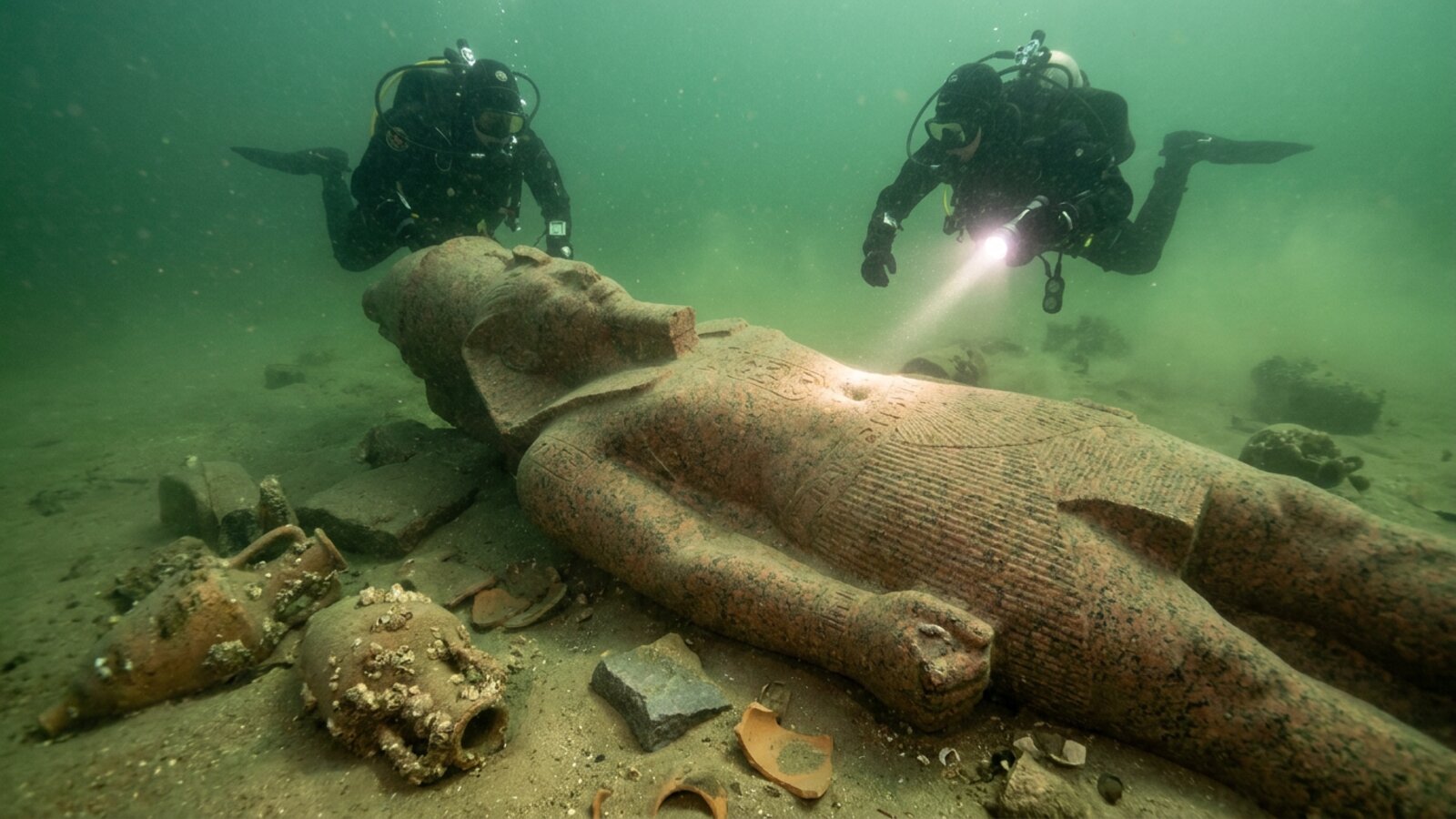
The colossal statues
The most famous single object from the site is the colossal statue of Hapy, god of the Nile flood. Carved from red granite, it is 5.4 m tall, about 90 cm deep and weighs around 6 tonnes, and it dates to the early Ptolemaic period, in the 4th century BC. It stood at the entrance to a temple of the city. For Egyptians, the annual flood that Hapy personified was the source of the country’s fertility and wealth, so a towering image of abundance at the gateway port carried an obvious message to arriving traders. When the British Museum displayed it in 2016, the museum noted that a statue of Hapy had never before been found at such a scale.
Two companion colossi, each about 5 m tall, represent a Ptolemaic king and queen. Found with Hapy near the main temple, the trio would once have formed a monumental group presenting Egypt’s new Macedonian rulers in traditional pharaonic dress.
Smaller sculpture is no less telling. A headless statue in dark stone from neighbouring Canopus, probably of Queen Arsinoe II, shows her in the role of Isis: an Egyptian pose and a shawl tied with the knot of Isis, combined with drapery handled in the Greek manner. Incomplete statues of Serapis, the Graeco-Egyptian god promoted by the Ptolemies, were also recovered. Together they illustrate the fusion of Greek and Egyptian religious images that defined the period.
The stele that named the city
The most important object for historians is a black granodiorite stele 1.90 m tall. It carries a decree of Pharaoh Nectanebo I of the 30th Dynasty, issued soon after he came to power around 380 BC. The decree diverted a tenth of the tax on imports passing through the port to the temple of the goddess Neith at Sais, and for that reason it is often called the Decree of Sais.
A near-identical stele had been found at Naukratis, a trading town further up the Nile, in 1899. The two steles match in 14 columns of hieroglyphs except one, column 13, which names the place where each was to be erected. On the Naukratis stele, that place is Naukratis. On the underwater stele it is Thonis. Because Greek writers called the port at the Canopic mouth Heracleion, and because the stele was found in that port, the inscription settled a long debate: Thonis and Heracleion were the same city, known by an Egyptian and a Greek name. The text was published in a monograph by the Egyptologist Anne-Sophie von Bomhard in the Oxford Centre for Maritime Archaeology series.
The decree also shows how the port worked. It assumes a customs post collecting duties on goods arriving from the Greek world, and it shows the pharaoh directing that revenue to buy the support of a powerful priesthood. The stele is, in effect, a tax notice that doubles as a political statement.
Why the ships are the site’s greatest archive
Thonis-Heracleion holds the largest assemblage of ancient vessels ever found in one place. According to IEASM, more than 70 ships have been located in and around the port, deposited between the 8th and the 2nd centuries BC; earlier reports gave totals of 63 and later 69 as excavation progressed, which is why published figures differ. Around 700 ancient anchors have also been recorded. Many ships appear to have been abandoned in a ship graveyard in the harbour once their working lives were over.
The best known is Ship 17. Around 450 BC, the Greek historian Herodotus described the Nile cargo boats he called baris: short planks of acacia wood laid like bricks, no ribs, papyrus caulking, and a single rudder passing through the keel. For 2,500 years no example was known, and some scholars doubted the description. Ship 17, up to about 28 m long, matched it closely. Its hull is built from short, thick planks of local acacia set in a staggered, brick-like pattern, and its keel contains a shaft for an axial rudder. The ship sank before the middle of the 4th century BC and appears to have been pinned to the seabed with wooden poles to extend a nearby pier. “It’s a very rare case when a written source and archaeological material make such a perfect match,” said the archaeologist Alexander Belov of the Russian Academy of Sciences, who studied the vessel. Belov reported that dozens of similar barides remain at the site.
Ship 11 tells a different story. It is a crescent-shaped, flat-bottomed boat about 10 m long and 2 m wide, built with mortise-and-tenon joints and with frames fixed to the planks by double-clenched copper-alloy nails. It is the only vessel in the assemblage made from sycamore fig, a tree sacred to Osiris. Scratches on the underside show that it was repeatedly beached or hauled out. It was deposited between about 400 and 325 BC, not in the ship graveyard a few hundred metres away, but at the western end of the main waterway beside the temple of Amun-Gereb, and a keel plank had been removed deliberately to sink it. Long-handled ladles laid along the waterway banks nearby are linked to the rites of Osiris. IEASM’s preliminary interpretation is that Ship 11 was a sacred barque, perhaps used to carry the god from Thonis-Heracleion to Canopus during the annual festival, and then ritually laid to rest.
A third vessel, announced in 2021, is a rare Ptolemaic galley about 25 m long. It combines classical mortise-and-tenon construction with a flat bottom suited to the Nile and the delta, and was found moored near the temple of Amun, pinned under blocks that fell when the temple collapsed. With oars and a sail, it is a fighting ship that blends Greek and Egyptian shipbuilding traditions.
Objects from the Mysteries of Osiris
Many of the site’s smaller finds relate to the Mysteries of Osiris, celebrated every year in the month of Khoiak. In the ritual, the god was carried in his ceremonial boat along the canal from the temple of Amun at Thonis-Heracleion to his shrine at Canopus. The touring exhibition of the finds included more than 30 objects depicting Osiris, among them an amulet, a vase, a statuette of the god held in the arms of Isis, and a basalt object shaped like his funeral bed. One Osiris figure in the exhibition was stone and another was made of grain, reflecting the custom of moulding figures of the god from earth and seed so that they would sprout, a symbol of resurrection.
Ritual equipment such as ladles, incense burners, bronze pails and small figures of gods was found along the waterways and harbour basins, which researchers have linked to the processional route. A pink granite garden vat from Thonis-Heracleion, dated to the Ptolemaic period between the 4th and 2nd centuries BC, was also among the objects shown with the Osiris material. A granodiorite statue of a priest carrying a jar-shaped image of Osiris-Canopus, dated between the 1st century BC and the 2nd century AD, shows that the cult continued at Canopus long after the port itself had declined.
Evidence of Greeks in an Egyptian port
The artifacts confirm what Herodotus implied: Thonis-Heracleion was an Egyptian city with a resident Greek community. In 2021 the team excavated a burial mound covered with offerings, including wicker baskets still holding fruit of the doum palm and grape seeds, dated to the early 4th century BC. With them were Greek ceramics painted in black-figure and red-figure styles, probably imported from Attica, a wooden couch of the kind used at banquets, and a high-quality gold amulet. The excavators interpreted the deposit as evidence that Greek merchants and mercenaries had settled in the city.
In September 2023 IEASM announced further finds. East of the great temple of Amun lay a sanctuary of Aphrodite containing imported bronze and ceramic objects and a cache of Greek weapons, which the team suggested belonged to Greek mercenaries defending the Canopic mouth of the Nile. The researchers noted that Greeks allowed to trade and settle under the Saite pharaohs of the 7th and 6th centuries BC had their own sanctuaries. In 2019 the team had also reported a small Greek-style round temple, or tholos, granite columns and bronze coins of Ptolemy II.
The temple of Amun and its treasure
The temple of Amun was the city’s religious centre and, according to the excavators, the place where pharaohs came to receive the titles that confirmed their rule. It partly collapsed in a cataclysmic event in the middle of the 2nd century BC. In the 2023 season divers recovered objects from the temple area including gold jewellery, silver ritual instruments, alabaster containers for perfumes or ointments, and a djed pillar, an Egyptian symbol of stability, carved in lapis lazuli. They also found underground structures supported by well-preserved wooden posts and beams dating to the 5th century BC. Goddio described it as “extremely moving” to find such delicate objects intact after the destruction of the temple.
Coins, pottery and the end of the city
Small, dated finds give the city its chronology. The main period of activity revealed by the objects runs from the 6th to the 4th century BC, and finds of pottery and coins thin out and stop at the end of the 2nd century BC, the period when much of the city collapsed into the water. Coins also show the Ptolemaic economy at work, including bronze coins of Ptolemy II. The latest coins and pottery help archaeologists date the disasters that destroyed buildings such as the temple of Amun, while earlier material shows how far back the port’s trade reached.
How underwater artifacts are conserved
Objects that spend centuries on the seabed absorb salts, and those salts crystallise and can crack or flake the surface as the object dries. Stone, ceramic and metal finds are therefore desalinated in successive baths of fresh water, monitored until salt levels fall, before being cleaned, consolidated and dried slowly. Waterlogged wood, such as ship timbers, is the most fragile material of all, because the cell structure has been weakened and can collapse if allowed to dry. That is one reason why ancient hulls are often recorded, sampled and studied where they lie rather than raised.
The same sediment that makes excavation slow is why so much survived. The collapse of the city and its burial under silt sealed the objects away from later builders who would have reused the stone and from people who would have melted the bronze down for its metal.
Where can you see Heracleion artifacts?
The finds belong to Egypt and most remain in the country, held by the Ministry of Tourism and Antiquities and displayed in museums including the Alexandria National Museum. A selection of more than 200 objects from Thonis-Heracleion and Canopus toured internationally, first as Osiris: Egypt’s Sunken Mysteries at the Institut du Monde Arabe in Paris and the Museum Rietberg in Zurich, and then as Sunken Cities: Egypt’s Lost Worlds at the British Museum in London in 2016, the museum’s first major exhibition of underwater archaeology. The show made its North American debut at the Saint Louis Art Museum in 2018 before travelling to other US venues.
The site itself is a protected excavation area and is not open to recreational divers. For other drowned ports of the ancient Mediterranean, see Cleopatra’s palace in Alexandria’s harbour and the overview of how many sunken cities there are.
What is the most famous Heracleion artifact?
The 5.4 m red granite statue of Hapy, god of the Nile flood, which was a centrepiece of the British Museum’s 2016 exhibition.
What was found in the sunken city of Heracleion?
Colossal statues, the Thonis-Heracleion stele, temple treasures, Osiris ritual objects, Greek weapons and pottery, coins, more than 70 ancient ships and about 700 anchors.
Why is the Thonis-Heracleion stele important?
Its text names Thonis as the place of erection, proving that the Egyptian port of Thonis and the Greek Heracleion were the same city.
What is the baris found at Heracleion?
Ship 17, a Nile cargo boat built of brick-like acacia planks with an axial rudder, the first match for a ship type described by Herodotus.
Who found the Heracleion artifacts?
Franck Goddio and the European Institute for Underwater Archaeology (IEASM), working with Egypt’s antiquities authorities, from 2000.
Where are the Heracleion artifacts now?
Mostly in Egypt, including the Alexandria National Museum; more than 200 objects toured museums in Europe and the US.
Can you dive Heracleion?
No. It is a protected excavation zone open only to the archaeological team.
- IEASM / Franck Goddio: Stele of Thonis-Heracleion (franckgoddio.org).
- IEASM / Franck Goddio: Ship 11 from Thonis-Heracleion, project document (franckgoddio.org).
- “As Told by Herodotus.” Archaeology, January/February 2020 (Ship 17, A. Belov).
- Sahu J. (2016). Sunken Cities exhibition, British Museum. World History Encyclopedia.
- Hyperallergic (2018). Sunken Cities: Egypt’s Lost Worlds at the Saint Louis Art Museum.
- Live Science (2023). Sunken temple and sanctuary from ancient Egypt found brimming with treasures and secrets.
- Decree of Nectanebo I and Thonis-Heracleion, Wikipedia (twin steles, 2019 and 2021 seasons).
- von Bomhard A.-S. The Decree of Saïs: the stelae of Thonis-Heracleion and Naukratis. Oxford Centre for Maritime Archaeology.
Blane Perun has been exploring Earth’s oceans and marine life for over 25 years. Founder of TheSea.Org in 1999, underwater photographer, coral aquaculture pioneer, and explorer of 80+ countries.
About Blane Perun →