African Manatee — The Least-Known Sea Cow, From the Coast to the Sahel
What is the African manatee?
The African or West African manatee (Trichechus senegalensis) is one of three living manatee species. It lives in coastal waters, lagoons, estuaries and rivers along the Atlantic coast of Africa from Mauritania to Angola.
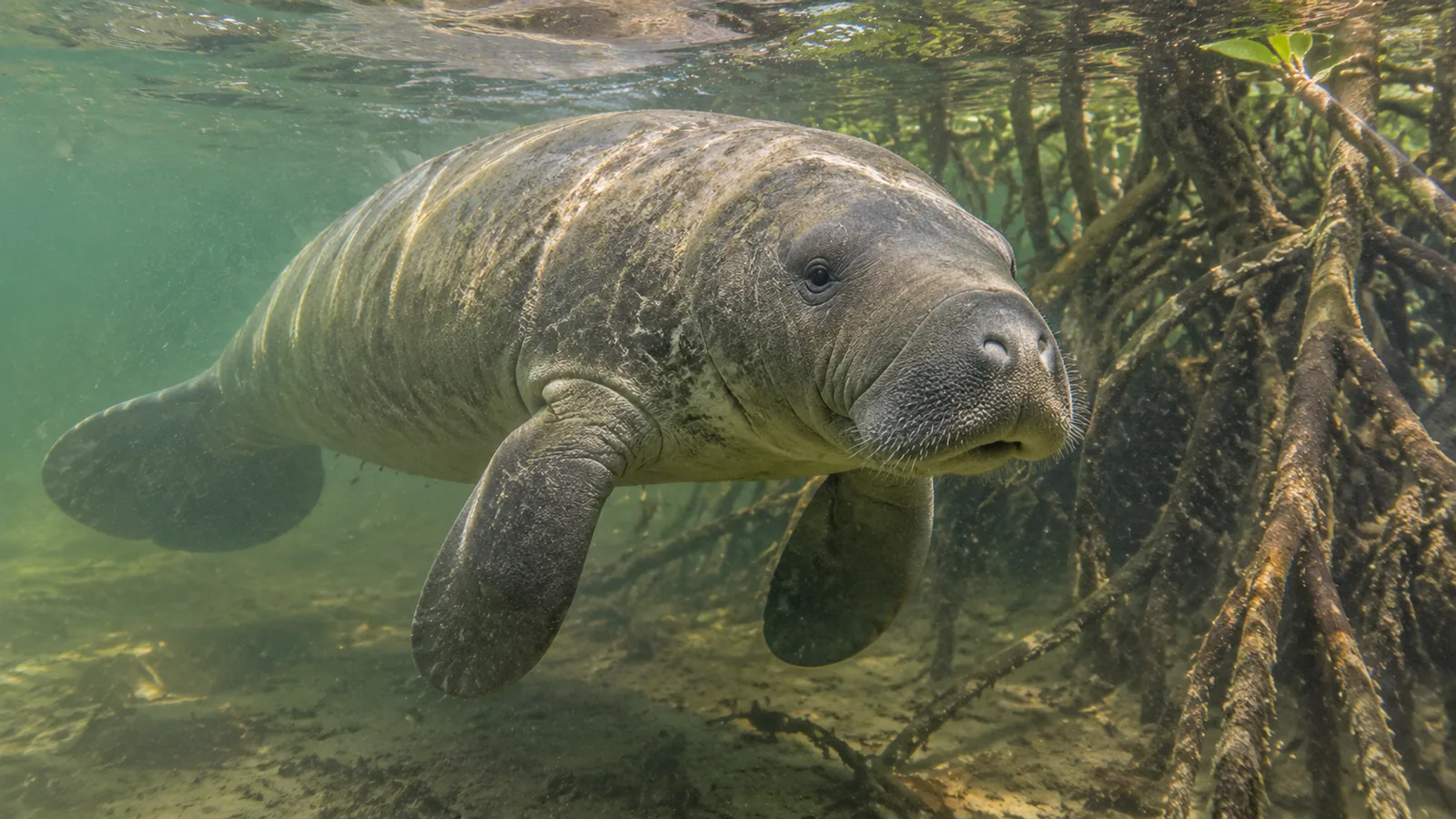
It is the least studied of all sirenians. Most of what is known comes from scattered field surveys, interviews with fishers and a handful of tagged animals. In body plan it is very close to the West Indian manatee: a gray, wrinkled, paddle-tailed grazer with small nails on its flippers. The two species are thought to share a common ancestor that crossed the Atlantic, and they differ mainly in skull shape and a slightly blunter snout in the African animal.
How big is the African manatee?
About the same as the West Indian manatee: around 3 m long on average, with large individuals reaching about 4 m.
Weights are poorly documented for wild animals, but they are assumed to fall in the same broad 360–545 kg band as other large manatees. Calves are born after a gestation of about 13 months, and a female typically produces one calf every two to three years.
Where does the African manatee live?
In 21 countries from Mauritania to Angola, in almost every kind of warm, shallow water: coastal lagoons, mangrove estuaries, river mouths, offshore archipelagos, lakes, floodplains and far up the large rivers.
The Convention on Migratory Species action plan lists the range countries from Mauritania through Senegal, the Gambia, Guinea-Bissau (including the Bijagós islands), Guinea, Sierra Leone, Liberia, Côte d’Ivoire, Ghana, Togo, Benin, Nigeria, Cameroon, Gabon, the Congo and DR Congo to Angola, plus inland Mali, Niger and Chad. Isolated populations have been reported up to 2,000 km inland: throughout the Niger River system in Mali, including the Inner Niger Delta, along the Niger in Niger, and in the Mayo Kébi River and lakes Léré and Tréné in Chad. That makes it the only manatee that regularly lives in the Sahel.
What does the African manatee eat?
Mostly plants: mangrove leaves, grasses, floating and submerged aquatic vegetation. It is more flexible than other manatees.
African manatees have been reported eating clams and other molluscs, and taking fish from nets. In Sierra Leone they are considered pests because they raid flooded rice fields. In seasonal rivers some animals get trapped in shrinking lakes as water falls and must wait for the next flood.
Is the African manatee endangered?
It is listed as Vulnerable by the IUCN, a status it has held since 1986. It is legally protected in all range countries, but enforcement is weak in many.
No one knows how many there are. The CMS action plan notes that few attempts at counting populations have been made; one of the only local counts, about 125 animals in Benin in the 1990s, gives a sense of how small and fragmented some groups are. International trade is banned under CITES Appendix I.
The main threats are:
How is the African manatee being protected?
Through national laws, international treaties and a growing number of local research and community projects.
The CMS adopted an action plan for the species, and NGOs in Senegal, Guinea-Bissau, Ghana, Cameroon and Gabon run surveys, rescue trapped animals and work with fishers to reduce bycatch. Interviews with fishing communities remain one of the most useful tools for mapping where the species still survives.
How does the African manatee behave?
Quietly and mostly out of sight. It is usually reported alone or in small groups, and in many areas it seems to be most active at night.
Field reports describe African manatees resting by day in deeper, shaded or sheltered water and moving into shallow feeding areas at dusk and through the night. Whether that pattern is natural or a response to hunting is not clear; in heavily hunted areas, cautious animals that feed in the dark are more likely to survive. Groups are typically small, often a mother and calf or a few adults, though larger temporary gatherings have been reported where food or deep water is concentrated.
Movements follow the water. In river systems and floodplains, manatees move into flooded forest, grassland and lakes as the rains raise water levels, then retreat to permanent channels and deeper lakes as the dry season sets in. Coastal animals use lagoons, mangrove creeks and estuaries, and like other manatees they appear to seek out fresh water to drink even when living in brackish or salt water.
How do you tell it apart from other sea cows?
| Species | Range | Nails on flippers | Tail |
|---|---|---|---|
| African manatee | West and Central Africa, Atlantic coast and rivers | Yes | Rounded paddle |
| West Indian manatee | Southeast US, Caribbean, northeast South America | Yes | Rounded paddle |
| Amazonian manatee | Amazon basin, fresh water only | No | Rounded paddle |
| Dugong | Indo-Pacific coasts, including East Africa | No | Fluked, like a dolphin |
In practice, location is the simplest guide, because the ranges barely overlap. The African manatee is the only sirenian on Africa’s Atlantic coast and in its western rivers; the dugong lives on the Indian Ocean side of the continent. Up close, specialists separate African and West Indian manatees mainly by skull features, and the African animal is often described as having a slightly blunter snout and more protruding eyes. See dugong vs manatee for the wider comparison.
What is known about its life history?
Very little directly. Most details of growth, age at maturity and lifespan are inferred from the closely related West Indian manatee, which is far better studied. On that basis, African manatees are thought to mature after several years, give birth to a single calf after a pregnancy of about 13 months, and nurse that calf for a year or more while it learns where to feed and shelter. Lifespan in the wild is unknown but is assumed to run to several decades if the animal avoids nets and hunters. Slow reproduction means that populations cannot recover quickly from losses, which is why even modest hunting and bycatch are considered serious.
Manatees and people in West Africa
The relationship is mixed. In parts of West Africa, manatees appear in stories about water spirits, and in some communities local beliefs or taboos have discouraged hunting them. Elsewhere they are hunted for meat, and oil, bones and other body parts are used in traditional medicine. Fishers often see manatees as competitors that damage nets and take fish, and rice farmers in some coastal areas see them as crop pests. Conservation projects increasingly work through these communities, training fishers to release manatees caught in nets, paying for reports of sightings and strandings, and involving local people in monitoring rather than relying on distant enforcement.
Can you see an African manatee?
Rarely. Very few are kept in aquariums anywhere in the world, and in the wild they are shy, often nocturnal and live in murky water. Research and community conservation effort has focused on places such as the Bijagós Archipelago in Guinea-Bissau, coastal lagoons and river mouths in Senegal, Ghana, Cameroon and Gabon, and stretches of the Niger River. Visitors on boat trips in these areas occasionally glimpse a snout or back at the surface, but there is no equivalent of Florida’s winter viewing sites. Supporting local projects that survey manatees and reduce bycatch is the most useful thing most people can do for the species.
Where do African manatees live?
In coastal lagoons, estuaries, rivers and lakes in 21 countries from Mauritania to Angola, including far inland in Mali, Niger and Chad.
How big is an African manatee?
About 3 m long on average, with large individuals reaching about 4 m, similar to the West Indian manatee.
What does the African manatee eat?
Mostly mangrove leaves, grasses and aquatic plants, but it also eats clams and has been known to raid rice fields and take fish from nets.
Is the African manatee endangered?
It is listed as Vulnerable by the IUCN, since 1986, and international trade is banned under CITES Appendix I.
How many African manatees are left?
No reliable estimate exists. Populations are poorly surveyed and many appear small and fragmented.
What are the main threats to African manatees?
Hunting and poaching, drowning in fishing nets, dams that fragment rivers, and habitat loss.
How is the African manatee different from the West Indian manatee?
They are very similar in size and shape; the differences are mostly in skull shape and range. Both have nails on their flippers.
Are African manatees nocturnal?
In many areas they are reported to feed mostly at dusk and at night and rest in deeper or sheltered water by day, possibly partly as a response to hunting.
- CMS, Action Plan for the Conservation of the West African Manatee
- SeaWorld, Manatee animal info book
- IUCN Red List, Trichechus senegalensis
Blane Perun has been exploring Earth’s oceans and marine life for over 25 years. Founder of TheSea.Org in 1999, underwater photographer, coral aquaculture pioneer, and explorer of 80+ countries.
About Blane Perun →