How Long Do Great White Sharks Live? — 70 Years and Counting
Great white sharks can live for at least 70 years. In 2014, bomb radiocarbon dating of vertebrae aged the largest male in a northwest Atlantic study at 73 years and the largest female at 40, far older than the 20 to 30 years once assumed. A 2015 follow-up found that growth bands record age reliably only up to about 44 years, and that males mature at about 26 and females at about 33. Older estimates put longevity at 23 to 60 years. Because band counts miss years in old sharks, the true maximum may be higher still.
A great white is born about 1.2 to 1.6 metres long, spends decades growing up, and may still be swimming 70 years later.
How long do great white sharks live?
The best current answer is at least 70 years. That figure comes from a 2014 study in PLOS ONE by Hamady, Natanson, Skomal and Thorrold, led from the Woods Hole Oceanographic Institution. They measured radiocarbon in the vertebrae of eight great whites from the northwest Atlantic, four females and four males, and produced the first radiocarbon age estimates for adult white sharks. The largest male, with a fork length of 493 centimetres, was about 73 years old. The largest female, with a fork length of 526 centimetres, was about 40.
Those numbers transformed the picture. Earlier studies had put the maximum age of great whites in the range of 20 to 30 years, and a Canadian status report summarising the older literature gave longevity as 23 to 60 years. The authors wrote that their results dramatically extended the maximum age and longevity of white sharks, hinted at possible differences in growth between the sexes, and raised concerns that white shark populations are considerably more sensitive to human-caused deaths than previously thought.
We cover the general question of shark lifespans, from dogfish to the Greenland shark, in our page on how long sharks live. This page focuses on the great white: how its age was worked out, what a great white lifetime looks like and why a long, slow life matters.
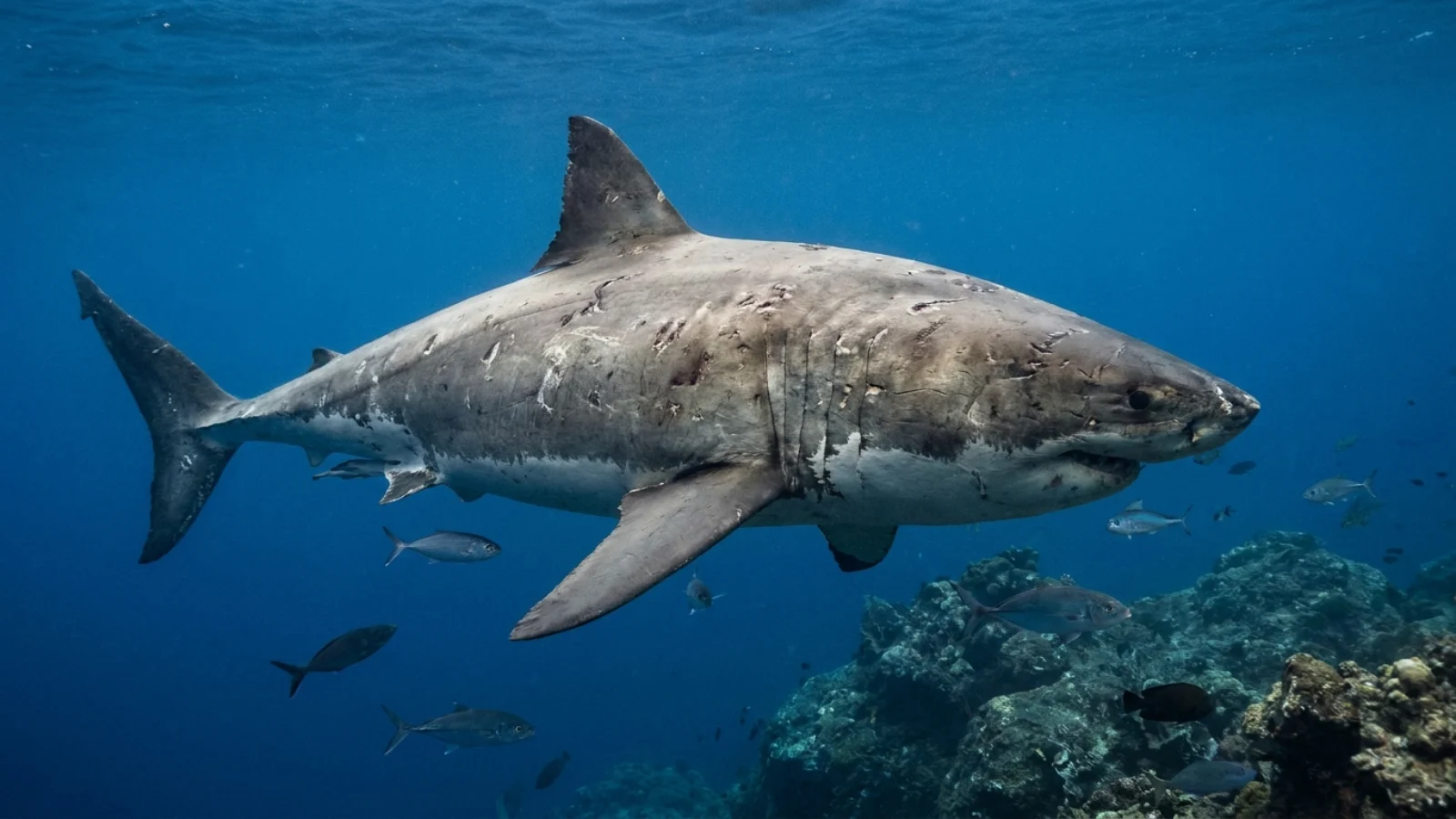
Why is it so hard to tell a great white’s age?
Most bony fish can be aged from their otoliths, tiny ear stones that lay down a ring every year. Sharks have no otoliths and no true bones. Instead, scientists cut a vertebra from the backbone and count the pairs of light and dark bands in its calcified cartilage, rather like counting tree rings. The method assumes that each band pair represents one year.
For great whites, that assumption was almost impossible to test. You cannot easily keep a great white in captivity to watch its vertebrae grow, and tagging studies rarely last long enough to follow an individual through decades. The animals sampled are usually dead sharks from fisheries, beach nets or strandings, often of unknown history. For a long time, then, great white ages were best guesses built on an untested rule.
How bomb radiocarbon solved the problem
The solution came from an unlikely source: the nuclear weapons tests of the 1950s and 1960s. Atmospheric testing sharply increased the amount of radioactive carbon-14 in the air, and that pulse entered the oceans and the food web in a well-documented pattern, peaking in the 1960s and declining since. Any animal that was laying down tissue during those years locked in a chemical timestamp.
By measuring carbon-14 along a shark’s vertebra and matching the pattern to reference records from corals and other dated marine samples, scientists can tell which band formed in which year. If the radiocarbon spike appears in a band that the count says formed in 1965, the counting method works. If it appears somewhere else, the counts are wrong. Hamady’s team found that in older white sharks the counts were wrong, and wrong in one direction: they made the sharks look younger than they really were.
What the 2015 growth study added
A year later, Natanson and Skomal published a broader study in Marine and Freshwater Research. They counted bands in vertebrae from 81 white sharks collected in the western North Atlantic between 1963 and 2010, then checked their counts against the radiocarbon results and reference chronologies. Their ages were validated up to 44 years, and they concluded that white sharks grow more slowly and live longer than previously thought.
The key finding was that the band-counting method breaks down in old sharks. Up to about 44 years the bands are a reliable record of age. Beyond that, the bands become too narrow or too compressed to read, and counts underestimate ages that could exceed 73 years. In other words, 73 is not a ceiling. It is simply the oldest age anyone has been able to confirm so far.
Researchers on the other side of the continent reached similar conclusions. In 2015, Andrews and Kerr published validated age estimates for large white sharks of the northeastern Pacific in Environmental Biology of Fishes, using bomb radiocarbon to show that perceptions of how great white vertebrae grow needed to change. Taken together, the Atlantic and Pacific studies point the same way: great whites are slow-growing, late-maturing and long-lived.
A wider problem in shark science
The great white is not an isolated case. In 2017 the shark biologist Alastair Harry reviewed age validation studies across sharks and rays in the journal Fish and Fisheries, covering 15 bomb carbon studies and 44 chemical-marking studies. He found that age was likely underestimated in 30 percent of the 53 populations studied, including half of those validated with bomb carbon. Where bomb carbon detected a problem, growth bands were reliable only up to about 88 percent of the species’ maximum length and 41 percent of its maximum age. The maximum underestimation ranged from five to 34 years and averaged 18. Harry concluded that age underestimation is likely a systemic issue with the methods used to age sharks, not a quirk of one species.
For great whites, that means the oldest individuals alive today may well be older than any yet measured.
A great white lifetime, stage by stage
Putting the studies together gives a rough timeline of a great white’s life.
Birth. Great whites give birth to live young after a long pregnancy. Birth has never been observed, but examinations of pregnant females suggest pups are born about 1.09 to 1.65 metres long, according to the Canadian COSEWIC status report, in litters of two to ten and possibly up to 17, averaging about seven. The pups receive no parental care.
Juvenile years. Young great whites live in coastal nursery areas and feed mainly on fish, rays and smaller sharks. Their jaws are not yet strong enough to tackle seals and dolphins, and reference accounts put the switch to marine mammals at around 3 metres in length. Juveniles are vulnerable to bigger sharks and to fishing gear in these shallow coastal waters.
Subadults. Through their teens and twenties, great whites grow steadily, begin to travel farther and start to visit seal colonies and whale carcasses. Many of the sharks seen by cage divers and tagged by researchers are in this stage.
Maturity. According to the 2015 study, males reach sexual maturity at about 26 years and females at about 33. Earlier estimates had put maturity at 4 to 10 years for males and 7 to 13 years for females, which shows how much the radiocarbon work changed the picture. An older summary of length at maturity gives about 3.5 to 4.1 metres for males and 4 to 5 metres for females.
Adulthood. Adult females may breed only every few years; the COSEWIC report notes that the reproductive cycle may be longer than three years and estimates the maximum lifetime output of a female at about 45 pups. That leaves a female only a few decades, and perhaps a dozen or fewer litters, in which to replace herself.
Old age. The oldest confirmed great white is the 73-year-old male from the 2014 study, and well-known giant females such as OCEARCH’s Nukumi, tagged off Nova Scotia in 2020, have been estimated at around 50. Large, old animals are rarely sampled, so their true lifespans remain an open question.
Do male and female great whites live the same length of time?
We do not know yet. In the 2014 study, the oldest male was 73 and the oldest female only 40, even though the female was the longer animal. That might mean females grow faster and reach a large size sooner, it might reflect the small number of animals sampled, or both. The authors described the results as hinting at sexual dimorphism in growth rates rather than proving it. With only eight sharks in that study, a single old female in the sample could change the conclusion.
What does the great white genome say about long life?
In 2019 a team led by Nicholas Marra published the first great white genome in the Proceedings of the National Academy of Sciences. The genome is large, about 4.63 billion base pairs with 24,520 predicted genes, and more than half of it consists of repeated sequences.
The authors found evidence of positive selection and gene-content enrichment in genes related to genome stability, the cell’s ability to repair DNA and avoid the damage that leads to cancer and ageing. They suggested that this emphasis might reflect the combined pressures of a large genome, high repeat content, large body size and a long lifespan. They also found strong signs of adaptation in genes involved in wound healing, which may help explain why great whites recover so well from injuries such as bites from other sharks. A separate 2012 study of 43 white sharks off South Africa, led by University of Miami biologists, found that despite high levels of mercury, lead and arsenic in their blood, the sharks showed no signs of a compromised immune system. None of this proves why great whites live so long, but it suggests their bodies are built for durability.
What kills great white sharks before old age?
Few great whites ever reach their maximum potential age. Natural threats include larger sharks when they are young and, for animals of all sizes, orcas, the only predator known to kill adult great whites. In South Africa, orcas have killed great whites and eaten their livers, as we explain in our page asking do orcas eat sharks?.
Human causes are far more important. Great whites are caught as bycatch in fisheries, entangled in nets and hooked on lines, and they have historically been killed in beach protection programmes and by trophy hunters. Because they take decades to mature, every shark killed young is a shark that never breeds. The Canadian status report notes that the species’ life history suggests it is unable to withstand high human-caused mortality, and estimated its intrinsic rate of population growth at only about 4 to 5.6 percent a year. Our page on great white shark predators looks at these threats in more detail.
How long do great whites live in captivity?
Not long at all. Great whites have proved almost impossible to keep in aquariums. A 3.5-metre male shown at Japan’s Okinawa Churaumi Aquarium in 2016 died after three days, and Sandy, a 2.4-metre female at San Francisco’s Steinhart Aquarium in 1980, had to be released because she would not eat. A great white’s long life is only possible in the open ocean, where it can travel thousands of kilometres and hunt the prey it is built for.
Why a long life makes great whites vulnerable
A long lifespan sounds like strength, but in conservation terms it is a weakness. Long-lived, late-maturing animals replace themselves slowly. A great white population that loses breeding adults can take decades to recover, because each new generation needs 26 to 33 years to start reproducing. The older COSEWIC report estimated generation time at about 23 years; the newer maturity ages suggest it is likely longer. That is why the radiocarbon studies have direct consequences for how great whites are protected, and why the species is listed as vulnerable worldwide.
So how long do great white sharks live?
At least 70 years, and possibly more. The oldest dated great white was a 73-year-old male from the northwest Atlantic, and the methods used to age sharks are known to underestimate the ages of the oldest animals. Great whites spend roughly a quarter to a third of a century growing up, then breed slowly for decades. They are one of the ocean’s longest-lived predators, and one of the slowest to recover when their numbers fall.
How long do great white sharks live?
At least 70 years. A 2014 radiocarbon study aged one male at 73 years.
How old is the oldest great white shark?
The oldest confirmed is a 73-year-old male from the northwest Atlantic, dated in 2014.
When do great white sharks become adults?
Males at about 26 years and females at about 33, according to a 2015 study.
How do scientists know how old a great white is?
They count bands in its vertebrae and check the counts against bomb radiocarbon from 1950s to 1960s weapons tests.
Did scientists underestimate great white ages?
Yes. Earlier studies suggested 20 to 30 years; band counts become unreliable after about 44 years.
Do female great whites live longer than males?
Unknown. The oldest dated female was 40 and the oldest male 73, but the sample was only eight sharks.
How long do great whites live in captivity?
Only days to months; no aquarium has kept an adult great white long-term.
Why does a long lifespan make great whites vulnerable?
They mature late and breed slowly, so populations take decades to recover from losses.
- Hamady, L.L., Natanson, L.J., Skomal, G.B. & Thorrold, S.R. (2014), “Vertebral bomb radiocarbon suggests extreme longevity in white sharks”, PLOS ONE.
- Natanson, L.J. & Skomal, G.B. (2015), “Age and growth of the white shark, Carcharodon carcharias, in the western North Atlantic Ocean”, Marine and Freshwater Research.
- Andrews & Kerr (2015), “Validated age estimates for large white sharks of the northeastern Pacific Ocean”, Environmental Biology of Fishes.
- Harry, A.V. (2017), “Evidence for systemic age underestimation in shark and ray ageing studies”, Fish and Fisheries.
- Marra, N.J. et al. (2019), “White shark genome reveals ancient elasmobranch adaptations associated with wound healing and the maintenance of genome stability”, PNAS; COSEWIC, White shark assessment and status report.
Blane Perun has been exploring Earth’s oceans and marine life for over 25 years. Founder of TheSea.Org in 1999, underwater photographer, coral aquaculture pioneer, and explorer of 80+ countries.
About Blane Perun →