Can Sharks Smell Blood? — Myth vs Fact
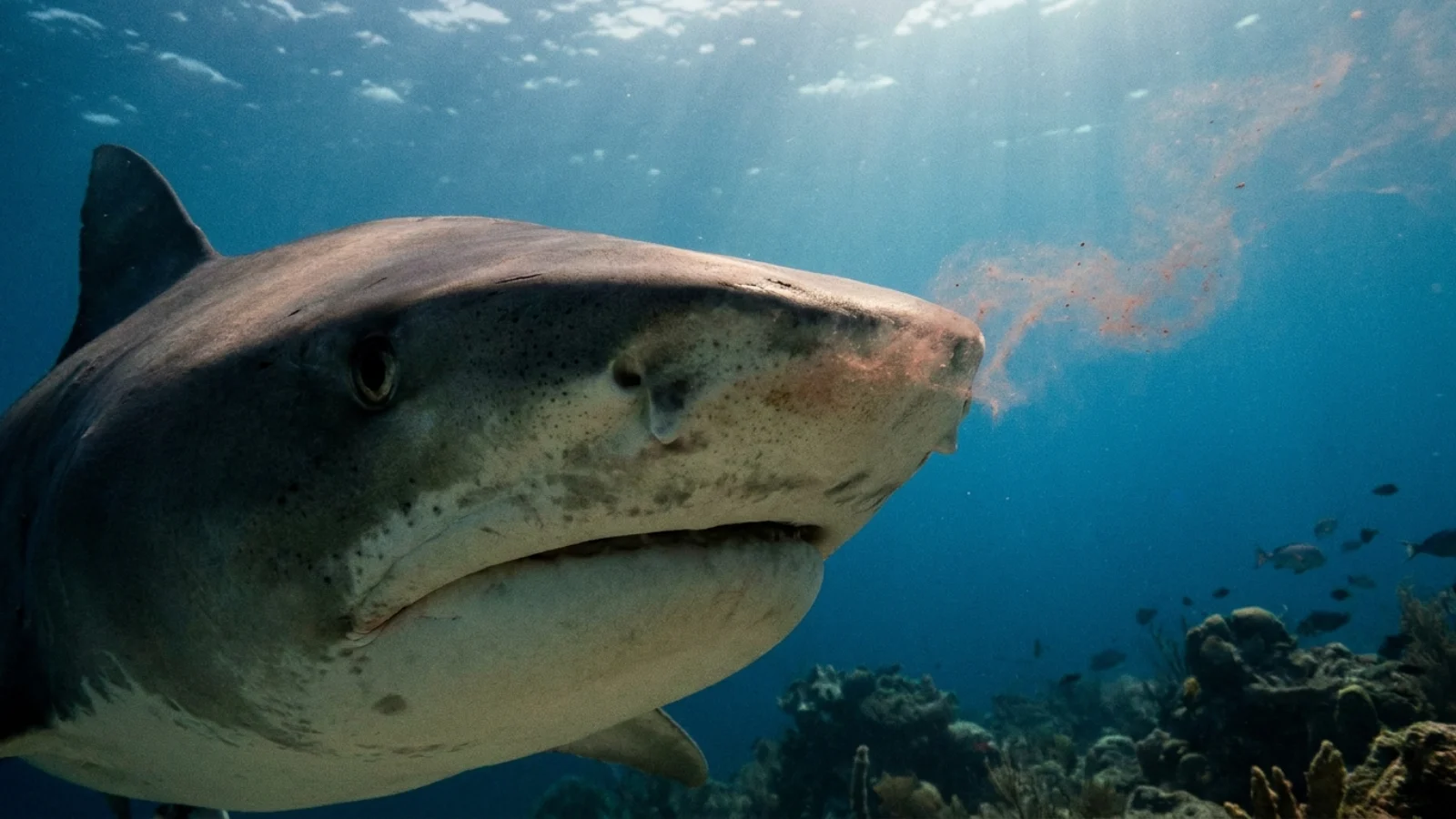
Yes, sharks can smell blood, but they cannot smell a single drop from a mile away. In tests published in 2010, sharks detected amino acids, the kind of chemicals that leak from injured fish, at about one part per billion, roughly the sensitivity of other fish. That is about one drop in a backyard swimming pool, not an Olympic pool or a mile of ocean. What makes sharks good at following a scent is not super-sensitivity but technique: they steer by the timing of odour arriving at each nostril and follow the plume upcurrent.
A shark’s nose is good, not magical: it catches faint scent on the current and is brilliant at following it home.
Can sharks really smell blood?
Yes. Sharks have a well-developed sense of smell, and they can detect chemicals released by injured or bleeding animals in the water. Smell is often the first sense a shark uses to find food, long before it can see or hear its prey. What is not true is the popular idea that a shark can detect a single drop of blood from a mile away, or in an Olympic swimming pool. That claim, repeated in books, documentaries and quiz questions for decades, does not stand up to testing.
The more accurate picture is that sharks are about as sensitive to smells as other fish, which is to say very sensitive by human standards, but not superhuman by the standards of the underwater world. Their real advantage lies in how they use their sense of smell: the way water flows through the nose, the size of the brain region devoted to smell in some species, and a clever steering trick that lets them follow a patchy scent trail to its source.
Where did the “drop of blood a mile away” idea come from?
Nobody can say exactly. Some reference works repeat a figure of one part per million: that some sharks can detect one part of blood in a million parts of seawater. Others go further and claim sharks can detect a drop in an Olympic pool, or from a mile away. These numbers circulated for years without anyone directly measuring how faint a smell a shark can detect.
As the researcher Tricia Meredith of Florida Atlantic University put it in 2010, it was a pretty logical jump to make, but no one had actually tested it. Sharks have enormous noses relative to many fish, and they arrive quickly at bleeding prey and at fishing boats putting out bait, so it was easy to assume their noses must be extraordinarily sensitive.
What the experiments show
In 2010, Meredith and colleagues published a study in the Journal of Experimental Biology that tested the idea directly. They worked with five species of elasmobranchs, the group that includes sharks, skates and rays, captured off Florida, including lemon sharks and bonnethead sharks as well as skates and stingrays. Each animal was exposed to a controlled flow of water containing one of 20 amino acids, the building blocks of proteins that leak into the water from injured fish, while an electrode recorded the electrical response of the nose.
The results were clear. At their best, the sharks detected amino acids at roughly one part in a billion, about one drop of scent dissolved in a billion drops of water. That is impressive, but it is about the same sensitivity measured in non-shark fish in other studies. The sharks also performed much like one another, and those with more surface area in the folded tissue inside the nose were no better at detecting faint smells than those with less.
Translated into everyday terms, one part per billion means a shark could detect a drop of scent in a volume of water roughly the size of a backyard swimming pool, not an Olympic pool and certainly not a mile of open ocean. Meredith’s verdict was “myth busted”. Atema of Boston University, a leading researcher on how aquatic animals follow odours, called it “only mostly busted”, a reminder that sensitivity in a lab is only part of the story.
How do scientists measure a shark’s sense of smell?
Measuring smell in a fish is harder than it sounds, because you cannot simply ask a shark whether it noticed something. Behavioural tests, in which a shark is trained to respond to a scent, are slow and are affected by motivation, hunger and stress. The 2010 study took a more direct route: it recorded the electrical response of the sensory tissue inside the nose while precisely known concentrations of amino acids flowed past. The weakest concentration that still produced a measurable signal gives the detection threshold.
This approach has strengths and limits. It measures what the nose can physically detect, independent of whether the shark cares, and it allows fair comparisons between species tested the same way. But it uses individual amino acids rather than real blood or fish fluids, which contain a complex mixture of chemicals, and it tests a restrained animal rather than one swimming through a turbulent plume. A shark in the wild might do better when many chemicals add together, or worse when background odours mask the signal. That is one reason Atema described the myth as only mostly busted: the lab threshold is a solid number, but it is not the whole story of how a hunting shark uses its nose.
Why “one part per billion” does not mean “a mile away”
Even a very sensitive nose needs the scent to reach it. In the sea, smells do not spread evenly in all directions like perfume in a still room. They are carried by currents and broken up by turbulence into a patchy plume: pockets of relatively strong scent separated by stretches of clean water. A shark upstream of a bleeding fish will smell nothing at all, however close it is, while one downstream may pick up the trail at a considerable distance if the current is steady.
There is also background noise. The 2010 report pointed out that amino acids are already present in coastal waters at around one part in a billion. A smell has to stand out from that background to be useful, which is why fresh fluids from injured prey, concentrated near their source, are what draw sharks in. The practical range of a shark’s nose therefore depends on current speed, turbulence and how much scent is released, not on a single fixed distance.
How does a shark’s nose work?
A shark’s nostrils, or nares, sit on the underside of the snout and have nothing to do with breathing. Sharks breathe through their gills. Each nostril is divided into an inflow opening and an outflow opening, and water passes through a short duct between them as the shark swims. Inside is the olfactory rosette, a structure of folded plates called lamellae covered with sensory tissue. The lamellae are large in sharks compared with many other fish, giving a big surface area for scent molecules to reach the receptor cells.
Signals from the rosette travel to the olfactory bulb in the brain. The size of the olfactory bulb varies widely among sharks, depending on how much a species relies on smell versus vision. Species living in murky water and deep-sea sharks tend to have larger olfactory bulbs, while reef-dwelling requiem sharks, which hunt in clear, bright water, have relatively smaller ones. In other words, sharks are not all equally “smelly” animals: evolution has tuned the nose to each species’ habitat.
How do sharks find the source of a smell?
This is where sharks really are remarkable. In 2010, Gardiner and Atema published a study in Current Biology on the smooth dogfish, a small coastal shark. They delivered carefully timed and measured pulses of odour directly into each of the shark’s nostrils. The sharks turned toward the side that was stimulated first, even when the second, delayed pulse was stronger.
That was the first conclusive evidence that a shark steers by differences in the arrival time of a smell at each nostril, rather than simply turning toward the stronger concentration. It makes sense in a patchy plume: concentrations jump around wildly from moment to moment, but the order in which the two nostrils meet a patch of scent tells the shark which way the patch lies. Each turn steers the shark back into the plume, keeping it in contact with the stream of patches as it swims upcurrent toward the source. The authors noted that animals with more widely spaced nostrils should be able to resolve smaller angles at higher swimming speeds, which may have contributed to the evolution of hammerhead sharks.
Do hammerheads have a better sense of smell?
The hammerhead’s wide, flattened head, called a cephalofoil, spreads the nostrils far apart, and one long-standing idea is that this improves the shark’s ability to locate the direction of a smell. The timing results support that idea: the farther apart the nostrils, the bigger the difference in arrival time for a given angle. Research on the bonnethead, the smallest hammerhead, has also shown that water flows through its olfactory chamber in a complex way, with a pressure difference between the two openings that drives flow through the chamber and leaves some parts with near-stagnant recirculating water. The microstructure of the bonnethead’s olfactory lamellae, however, turned out to be similar to that of other sharks. If hammerheads have an advantage, it seems to lie more in the geometry of the head than in a fundamentally different nose. For more on the largest species, see our profile of the great hammerhead, and for how hammerheads put that head to work hunting stingrays and crabs, see what hammerhead sharks eat.
Smell is only the first step
A shark does not hunt by smell alone. In 2014, Gardiner, Atema, Hueter and Motta published a study in PLOS ONE comparing the feeding sequence of three shark species while blocking different senses. Odour was generally the first signal detected, leading the sharks to swim upstream and follow the wake of their prey. Closer to the prey, as more cues became available, vision, the lateral line’s sense of water movement, electroreception and touch took over for orienting, striking and capturing. When some senses were blocked, the sharks often switched to others and still caught their prey.
That flexibility matters. It means a shark’s sense of smell is best thought of as a long-range alarm and guidance system, getting the shark into the right area and pointed in the right direction, while other senses finish the job. Electroreception, through the jelly-filled pores called the ampullae of Lorenzini, is especially important at very close range, where it lets a shark detect the weak electric fields produced by living prey.
What the white shark genome revealed
One of the more surprising findings about shark smell came from genetics. When the white shark genome was published in the Proceedings of the National Academy of Sciences in 2019, the authors noted that sharks, and especially apex predators like the white shark, are believed to have an acute sense of smell. Yet they found very few olfactory receptor genes, very few trace amine-associated receptors and extremely low numbers of the related receptor family that most vertebrates rely on to detect odours.
What they did find were 13 copies of a different class of receptor genes, called vomeronasal type 2 receptors, in the white shark and 10 in the whale shark. Together with similar genes reported from other cartilaginous fish, this suggests sharks may rely on a different set of chemical receptors from the ones that dominate smell in mammals and many bony fish. In other words, a shark’s nose may work very well while being built from a different genetic toolkit, one that scientists are still working to understand.
Are sharks attracted to human blood?
Sharks respond to chemicals released by injured animals, and there is no reason to think human blood is invisible to them. Whether a small amount of human blood in the water makes a bite more likely has not been well studied, however. Most shark bites on people are explained by other factors: murky water, the presence of baitfish or seals, fishing activity, and the shark mistaking a swimmer or surfer for its normal prey. We cover the real risk factors in our page on how many shark attacks happen each year. If you have a bleeding wound, it is sensible to stay out of the water anyway, for reasons of infection as much as sharks.
So, can sharks smell blood?
They can, and smell is often the first sense that leads them to food. But the drop-of-blood-a-mile-away story is a myth. Measured in the lab, sharks detect scent at about one part per billion, much like other fish: roughly a drop in a backyard pool. Their real talent is in following a broken, drifting scent trail, steering by the timing of odour at each nostril and swimming upcurrent until sight, the lateral line and electroreception take over for the final approach.
Can sharks smell a drop of blood from a mile away?
No. Tests show sensitivity of about one part per billion, roughly a drop in a backyard pool.
How sensitive is a shark’s sense of smell?
In 2010 tests, sharks detected amino acids at about one part per billion, similar to other fish.
How do sharks find where a smell is coming from?
They turn toward the nostril that detects the scent first and swim upcurrent along the plume.
Do sharks breathe through their nostrils?
No. Shark nostrils are used only for smell; they breathe through their gills.
Do hammerheads smell better than other sharks?
Their widely spaced nostrils may help them pinpoint a smell’s direction, though their nose tissue is similar.
Is the one part per million figure correct?
It is often quoted, but measurements suggest sharks detect some chemicals at about one part per billion.
Does human blood attract sharks?
Sharks can detect it, but whether small amounts make bites more likely has not been well studied.
Do sharks rely only on smell to hunt?
No. Smell guides them first; vision, lateral line, electroreception and touch take over close up.
- Meredith et al. (2010), olfactory sensitivity of elasmobranchs, Journal of Experimental Biology; reported by Inside Science (AIP), “Shark smell myth found fishy”.
- Gardiner, J.M. & Atema, J. (2010), “The function of bilateral odor arrival time differences in olfactory orientation of sharks”, Current Biology.
- Gardiner, J.M., Atema, J., Hueter, R.E. & Motta, P.J. (2014), “Multisensory integration and behavioral plasticity in sharks from different ecological niches”, PLOS ONE.
- Marra, N.J. et al. (2019), “White shark genome reveals ancient elasmobranch adaptations…”, PNAS; Simonitis, L.E. & Marshall, C.D. (2022), “Microstructure of the bonnethead shark olfactory rosette”, Integrative Organismal Biology.
Blane Perun has been exploring Earth’s oceans and marine life for over 25 years. Founder of TheSea.Org in 1999, underwater photographer, coral aquaculture pioneer, and explorer of 80+ countries.
About Blane Perun →