The Antikythera Mechanism Discovery — From a Sponge Divers’ Wreck to the World’s Oldest Computer
The Antikythera mechanism is a hand-cranked bronze gearwork device, around 2,000 years old, that modelled the movements of the Sun, Moon and planets, predicted eclipses and tracked the timing of the Olympic Games. It was recovered in 1901 from a Roman-era shipwreck off the Greek island of Antikythera, found the year before by sponge divers. It survives as 82 fragments holding 30 bronze gears, only about a third of the original, and is often called the world’s oldest known analogue computer.
The Antikythera mechanism was discovered twice. The first discovery was physical: in 1901 a corroded lump of bronze and wood came up from a shipwreck off the Greek island of Antikythera, found the year before by sponge divers from Symi. The second discovery took more than a century: working out what the lump actually was. This page follows that second story, from the first glimpse of a gearwheel in 1902 to the computer models of the 2020s. For the wreck itself and the statues, coins and other cargo recovered from it, see our companion article on treasure found on the Antikythera wreck.
What was first noticed in 1902?
Everything raised from the wreck went to the National Archaeological Museum in Athens. The mechanism did not look like much: a lump of corroded bronze and wood. The bronze had turned to atacamite, a copper chloride mineral, which cracked and shrank once it was out of the sea, and the piece was not treated after it was removed from seawater, so it deformed. For about two years it went unnoticed while museum staff concentrated on piecing together more obvious treasures such as the statues.
On 17 May 1902 the museum’s director, the archaeologist Valerios Stais, together with his cousin, the politician Spyridon Stais, saw that one of the broken pieces had a gearwheel embedded in it. Valerios Stais thought it might be an astronomical clock. Most scholars disagreed: they considered the object prochronistic, too complex to have been made in the same period as the rest of the cargo, and some suspected it was a later object that had somehow ended up on the wreck. The German philologist Albert Rehm became interested and was the first to propose that it was an astronomical calculator, but without a way to see inside the corroded fragments, little more could be done for decades.
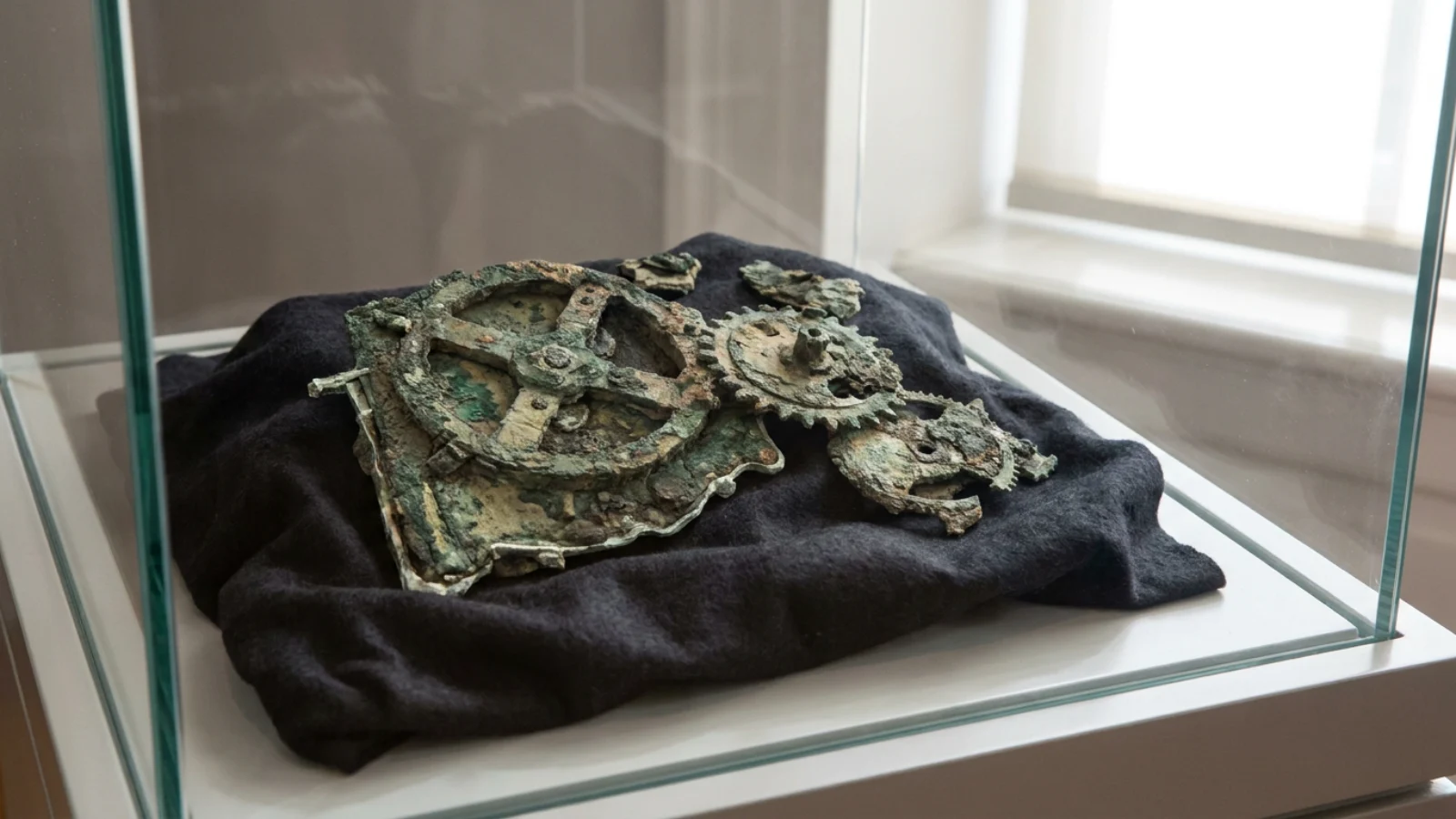
What did the device look like?
The mechanism was housed in a wooden case whose overall size is uncertain but is estimated at about 34 by 18 by 9 centimetres, roughly the size of a large shoebox. It came out of the sea as a single encrusted piece, soon split into three main fragments, and is now divided into 82 separate fragments. Some small pieces broke off during cleaning and handling, others were found on the seabed by Jacques Cousteau’s later expedition, and at least one more, Fragment F, was found in museum storage as late as 2005. Of the 82 known fragments, seven are mechanically significant and hold most of the gearing and inscriptions.
The case had a front face with dials and two doors, front and back, covered in inscriptions. The back door seems to have carried an instruction manual: one fragment reads “76 years, 19 years”, referring to two calendar cycles, and gives “223” for the eclipse cycle. The device was driven by a small hand crank, now lost, linked through a crown gear to the largest wheel, a four-spoked gear visible on the front of the main fragment. Turning the crank moved every pointer on the machine together, so the user could wind forward or backward to any date and read off the state of the sky.
How did X-rays reveal the gears?
The breakthrough came from the historian of science Derek de Solla Price of Yale University, who became interested in the mechanism in 1951. In 1971 Price and the Greek nuclear physicist Charalampos Karakalos made X-ray and gamma-ray images of the 82 fragments, allowing them to count teeth on gears hidden inside the corrosion. Price published his findings in 1974 as Gears from the Greeks, arguing that the device was a calendar computer that calculated the positions of the Sun and Moon. He built a simple model in the 1970s. Some of his gear counts and interpretations were later revised, but he established beyond doubt that the mechanism was an ancient geared calculator.
The next phase was led by the mechanical engineer Michael Wright. Wright showed that the mechanism displayed the phase of the Moon as well as its position, using a small ball set into the lunar pointer, half white and half black, which rotated to show new, quarter and full moon. That required a differential gearing arrangement that combines two rotations. In 2002 Wright designed and built the first working model of the known mechanism, with his own reconstruction of a planetarium display showing the true Sun and the five planets known in antiquity.
What did the 2005 CT scans find?
In 2005 the Antikythera Mechanism Research Project, a collaboration including a Cardiff University team led by Mike Edmunds, brought two new imaging techniques to Athens. High-resolution X-ray computed tomography let researchers slice through the fragments digitally and trace gears and inscriptions inside them, while advanced surface imaging picked out faint lettering on the outer surfaces. The scans suggested the mechanism had at least 35 meshing bronze gears, 30 of which survive, and they revealed thousands of hidden inscription characters that had never been read.
The results, published in Nature in 2006 by Tony Freeth and colleagues, showed that the machine followed the movements of the Sun and Moon through the zodiac, predicted eclipses and modelled the irregular motion of the Moon, which travels faster near perigee, its closest point to Earth, than near apogee. It did this with a beautifully simple trick. Two identical gears, k1 and k2, sit face to face on slightly different centres; a pin on one runs in a slot on the other. As they turn, the pin slides in and out of the slot, so the driven gear speeds up and slows down once per cycle, reproducing the Moon’s varying speed. This lunar theory matches the work of the astronomer Hipparchus in the second century BC.
What do the dials show?
The front face carried a fixed zodiac ring divided into twelve equal 30-degree sectors, following the Babylonian convention, and a rotating outer calendar ring marked with Egyptian month names written in Greek letters. Pointers showed the date, the position of the Sun and Moon, and the Moon’s phase. Small letters on the zodiac dial keyed into a parapegma, an early star almanac inscribed above and below the dials, marking the rising and setting of particular stars through the year.
The back of the case had five dials. The large upper dial is a five-turn spiral covering the Metonic cycle of 235 lunar months, which is within less than 13 parts in a million of 19 solar years and so served to reconcile lunar and solar calendars. A smaller dial beside it tracked the 76-year Callippic cycle, made up of four Metonic cycles. The large lower spiral is the Saros dial, covering 223 lunar months, about 18 years and 11 days, after which eclipses repeat; glyphs in its cells say whether each predicted eclipse is solar or lunar and give its day and hour. Because the Saros is about eight hours longer than a whole number of days, a small exeligmos dial, tracking a triple Saros of 54 years or 19,756 days, told the user how many hours to add to the predicted times.
The gear ratios are remarkably accurate. Calculated from the surviving tooth counts, the Metonic pointer has a period of 6,939.5 days against a modern value of 6,939.69; the Saros pointer completes its four-turn spiral in 1,646.3 days against 1,646.33; and the exeligmos pointer turns once in 19,756 days against 19,755.96.
Did it really track the Olympic Games?
In 2008 the research project reported new findings in Nature. The month names on the Metonic dial turned out to belong to a Greek regional calendar, and a small upper dial, at first called the Olympiad dial, tracked the four-year cycle of the great athletic games. It has since been renamed the Games dial, because the four-year cycle it follows most closely is not the Olympiad as such. Its four sectors name the four “crown” games of Isthmia, Olympia, Nemea and Pythia, plus two lesser festivals: the Naa, held at Dodona in Epirus, and the Halieia of Rhodes. Its pointer is the only one on the instrument that turns anticlockwise.
The calendar clues have sparked a long debate about where the mechanism was made. The month names match calendars from Epirus in north-western Greece and the island of Corfu, ancient Corcyra, and in 2008 the project suggested an origin in a Corinthian colony, perhaps even Syracuse, the home of Archimedes. In 2017 the calendar was shown to be of the Corinthian type but not that of Syracuse, and one study argued that the device was probably based on a prototype from Rhodes, modified for a client in Epirus. Rhodes, a busy port and a centre of astronomy and mechanical engineering where Hipparchus worked from about 140 to 120 BC, remains a favourite candidate. Astronomical events in the parapegma have been argued to fit latitudes between about 33.3 and 37 degrees north.
When was it made?
The date of manufacture is still debated. The wreck itself is dated by its cargo to the first half of the first century BC. The machine was presumably made somewhat earlier. In 2014 a study by Christián Carman and James Evans identified the start-up date of the Saros dial as the lunar month that began shortly after the astronomical new moon of 28 April 205 BC, which would put the design around 200 BC; they also argued that its eclipse predictions follow Babylonian arithmetical methods rather than Greek geometrical ones. Others prefer a date in the second or early first century BC. A start-up date for the dials is not necessarily the date of construction, so the question remains open. Our article on when the Antikythera mechanism was made sets out the arguments in more detail.
How did researchers rebuild the missing planets?
The biggest gap is the planets. The front of the main gear has fixtures and space that strongly suggest more gearing once sat there, now lost. Over the years researchers proposed several solutions. James Evans, Christián Carman and Alan Thorndike suggested in 2010 that simple dials showed each planet, and calculated that showing the mean positions of the five planets would need only 17 more gears. In 2012 Freeth and Alexander Jones published a compact design using pin-and-slot gear trains like the Moon’s, with a total of 54 gears, three slotted bars and eight pointers.
New evidence then overturned these models. In 2016 the numbers 462 and 442 were found in CT scans of inscriptions dealing with Venus and Saturn. They are periods in years linked to the synodic cycles of those planets, and showed that the planetary display was more accurate than previously assumed. In March 2021 a University College London team led by Freeth published a new reconstruction of the entire front “cosmos” display in Scientific Reports. They used ancient period relations with small prime factors, finding that gears based on the factors 7 and 17 could be shared among the gear trains of different planets, and concluded that none of the previous models was compatible with all the known data, while theirs was.
Even a perfect reconstruction would not have been perfectly accurate. Freeth and Jones found that their simulated Mars pointer could be up to 38 degrees wrong at some points in the planet’s retrograde loop. The error lies not in the gearing but in the Greek planetary theory of the time, which was not improved until Ptolemy’s Almagest around AD 160. Hand-cut triangular gear teeth and friction in the bearings would also have introduced play that probably swamped the finest corrections built into the machine.
Was the calendar ring 365 or 354 days?
For more than a century researchers assumed that the rotating outer ring on the front face was a 365-day Egyptian solar calendar, with twelve months of 30 days plus five extra days. In 2020 a study by Budiselic and colleagues challenged that assumption, presenting statistical evidence that the ring’s surviving holes imply about 354 intervals, the length of a lunar year. Two research teams then estimated the count independently by different methods; Graham Woan and Joseph Bayley calculated 354 to 355 intervals, confirming the earlier result with higher precision and concluding that 365 holes is not plausible. If they are right, the ring may be the first physical example of an Egyptian lunar calendar proposed by the Egyptologist Richard Parker in 1950. It is a reminder that, more than 120 years after its recovery, the mechanism is still yielding new discoveries from old fragments.
Why does the discovery matter?
Nothing comparable survives from the ancient world. The miniaturisation and complexity of the mechanism are comparable to those of fourteenth-century astronomical clocks, and its use of a clockwork-type gear train with a pin-and-slot mechanism to model varying motion predates the first known medieval European clocks by more than a thousand years. Ancient writers hint that such machines were not unique: Cicero, writing in the 50s BC, describes two planetarium-like devices said to have been built by Archimedes and brought to Rome after the siege of Syracuse in 212 BC. The Antikythera mechanism is the only physical example to survive, and only because it sank. For what the device was used for, see the purpose of the Antikythera mechanism, and for visiting it today, where it is on display. The divers who found it were part of a centuries-old trade; see sponge diving, from Kalymnos to Tarpon Springs.
Who discovered the Antikythera mechanism?
Sponge divers from Symi found the wreck in 1900, and the mechanism was raised in 1901. On 17 May 1902 museum director Valerios Stais and his cousin Spyridon Stais noticed a gearwheel in one of the fragments.
How old is the Antikythera mechanism?
Roughly 2,100 to 2,200 years. The wreck dates to the first half of the 1st century BC, and the device was made earlier; one study puts its design around 205 BC, others prefer the 2nd or early 1st century BC.
How many gears does the Antikythera mechanism have?
Thirty bronze gears survive in 82 fragments; CT scans suggest at least 35 originally, and full reconstructions need more than 50.
How was the inside of the mechanism seen?
With X-ray and gamma-ray images in 1971 (Price and Karakalos) and high-resolution X-ray CT and surface imaging from 2005.
What did the Antikythera mechanism do?
It modelled the Sun, Moon and planets, showed lunar phases, predicted eclipses with the 223-month Saros cycle, and tracked calendar cycles and the Panhellenic games.
Who made the Antikythera mechanism?
Its maker is unknown. Its lunar theory follows Hipparchus, and Rhodes, Corinthian colonies and the tradition of Archimedes have all been proposed.
Where is the Antikythera mechanism now?
In the National Archaeological Museum in Athens.
Is the Antikythera mechanism the oldest computer?
It is often called the oldest known analogue computer, a mechanical calculator for astronomical cycles.
- Freeth, T. et al. (2006). Decoding the ancient Greek astronomical calculator known as the Antikythera Mechanism. Nature.
- Freeth, T. et al. (2008). Calendars with Olympiad display and eclipse prediction on the Antikythera Mechanism. Nature.
- Freeth, T. et al. (2021). A model of the cosmos in the ancient Greek Antikythera Mechanism. Scientific Reports 11: 5821.
- Price, D. de Solla (1974). Gears from the Greeks: The Antikythera Mechanism, a Calendar Computer from ca. 80 B.C. American Philosophical Society.
- Carman, C.C. & Evans, J. (2014). On the epoch of the Antikythera mechanism and its eclipse predictor. Archive for History of Exact Sciences.
- Freeth, T. & Jones, A. (2012). The cosmos in the Antikythera Mechanism. ISAW Papers 4; Evans, J., Carman, C.C. & Thorndike, A.S. (2010). Solar anomaly and planetary displays in the Antikythera Mechanism. Journal for the History of Astronomy.
- Budiselic, C. et al. (2020) and Woan, G. & Bayley, J. on the calendar-ring hole count; summarised with other research history in the Antikythera mechanism entry, Wikipedia (accessed November 2026).
- Iversen, P. (2017). The calendar on the Antikythera Mechanism and the Corinthian family of calendars. Hesperia.
Blane Perun has been exploring Earth’s oceans and marine life for over 25 years. Founder of TheSea.Org in 1999, underwater photographer, coral aquaculture pioneer, and explorer of 80+ countries.
About Blane Perun →