Lantern Shark — The Tiny Deep-Sea Sharks That Glow in the Dark
Lantern sharks are about 50 species of small deep-sea dogfish sharks in the family Etmopteridae that produce their own light from thousands of tiny photophores in the skin. They include the dwarf lanternshark (Etmopterus perryi), at about 20–21 cm the smallest shark known, and the velvet belly lanternshark of the northeast Atlantic, whose spines glow like miniature lightsabers. Most live at about 200–1,500 m and are harmless to people.
Lantern Sharks
Why do lantern sharks glow?
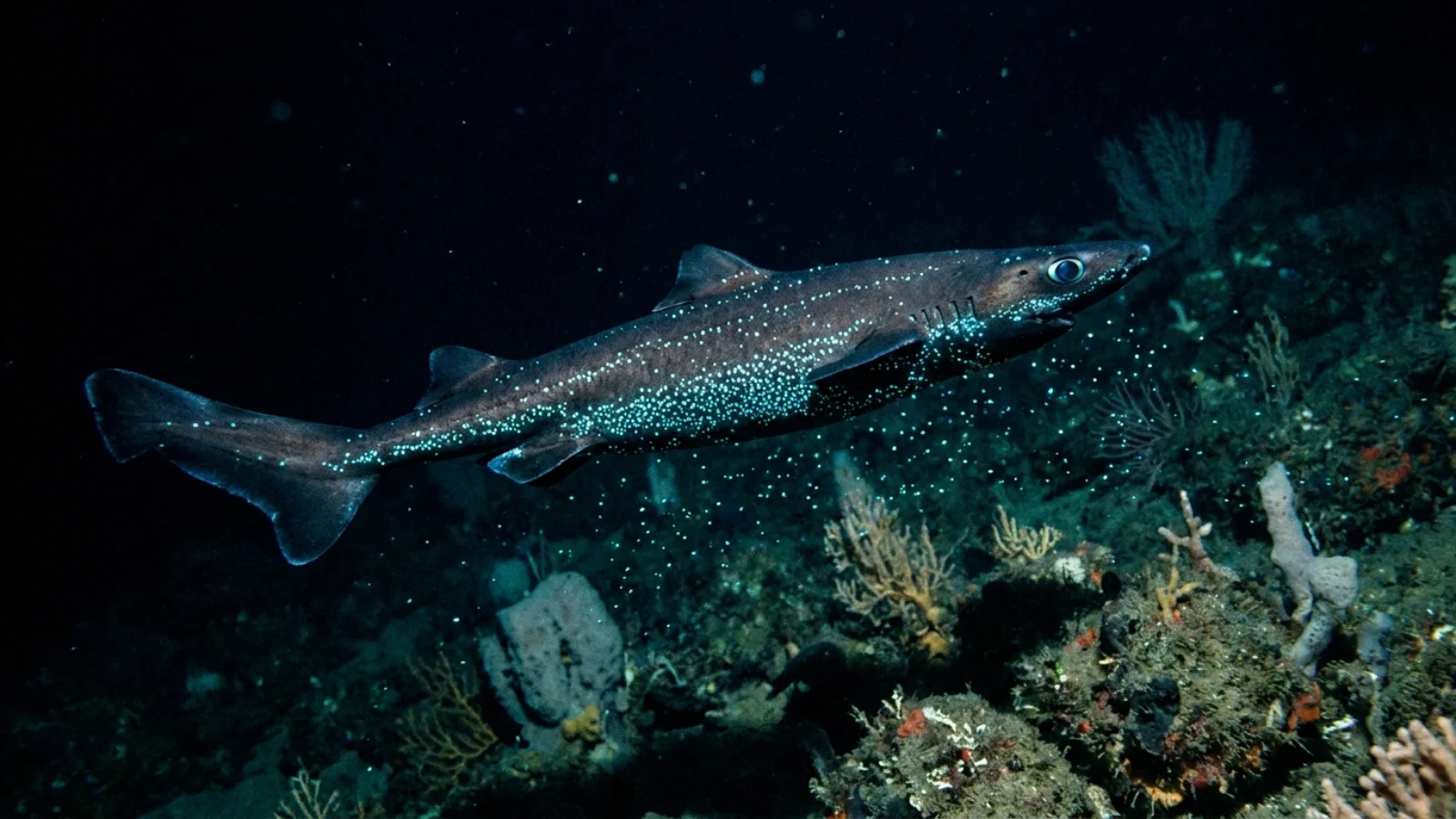
Lantern sharks glow mainly for camouflage. Light organs on their bellies match the faint light filtering down from the surface, hiding their silhouettes from predators and prey below, a trick called counter-illumination.
In the twilight zone, from about 200 m to 1,000 m, the only light comes from above, so any animal looks like a dark shape to something below it. Lantern sharks cancel out that shadow with thousands of tiny photophores, light organs each only a fraction of a millimetre across, packed along the belly and flanks. Unlike many glowing fish, they make the light themselves rather than hosting bioluminescent bacteria, and they control it with hormones rather than nerves, dimming or brightening it to match the light from above. Many species also have distinctive patterns of light on the flanks and tail, which may help them recognise others of their kind in the dark, and possibly find mates.
At least one species uses light for advertisement as well as camouflage. A 2013 study by Julien Claes, Jérôme Mallefet and colleagues showed that the velvet belly lanternshark (Etmopterus spinax) has light organs along the sharp spines in front of its dorsal fins, so the spines glow like small lightsabers. The light seems to warn predators that this little shark comes with a painful mouthful. For more on how deep-sea animals make light, see our guide to bioluminescent drifters.
What is the smallest shark in the world?
The dwarf lanternshark (Etmopterus perryi) is generally recognised as the smallest shark. Adult females reach about 20 cm, and the largest one ever measured was 21.2 cm, small enough to hold in one hand.
The dwarf lanternshark is known only from the upper continental slope of the southern Caribbean, off Colombia and Venezuela, at depths of about 283–439 m. It is dark brown with black markings on the belly that contain light-producing photophores. Males mature at about 16–17.5 cm and females from about 15.5 cm, and pregnant females carry just two or three pups, each about 5.5–6 cm long at birth. It was described in 1985 by Stewart Springer and George Burgess. Other contenders for the title of smallest shark include the pygmy shark and the spined pygmy shark, which also glow and also live in deep water.
Are there bigger glowing sharks?
Yes. In 2021, scientists confirmed that the kitefin shark, a deep-sea relative that grows to about 1.8 m, glows, making it the largest known luminous vertebrate.
Researchers led by Jérôme Mallefet caught kitefin sharks (Dalatias licha), along with blackbelly and southern lanternsharks, on the Chatham Rise off New Zealand in 2020 and photographed them glowing blue-green in the dark. The kitefin shark belongs to the same order as lantern sharks and the cookiecutter shark, another glowing species. Together they suggest that bioluminescence is widespread among deep-sea sharks: estimates suggest more than 10% of shark species can glow.
Where do lantern sharks live?
Lantern sharks live on continental and island slopes and seamounts in all the world’s oceans, mostly between about 200 m and 1,500 m, with some species deeper.
The velvet belly lanternshark is one of the most common deep-water sharks in the northeast Atlantic, from Norway and Iceland to West Africa and the Mediterranean, and is a frequent bycatch in deep trawls. Several species, such as the smooth lanternshark in the Gulf of Mexico and western Atlantic, live in large schools. Most lantern sharks stay deep by day and may rise somewhat at night following their prey, part of the daily migration of the deep-sea animal community.
What do lantern sharks eat?
Lantern sharks eat small, deep-living animals: krill, shrimp, squid, lanternfish and other small fish. Larger species take bigger prey.
Many lantern sharks have teeth that differ between jaws: small, pointed teeth with several cusps in the upper jaw for gripping and blade-like teeth in the lower jaw for cutting.
How do lantern sharks reproduce?
Lantern sharks are aplacental viviparous: the embryos develop on yolk inside the mother and are born live, in small litters.
The dwarf lanternshark has litters of only 2–3 pups. The velvet belly lanternshark has litters of roughly 6–20, and research has shown that its embryos develop working light organs before birth. Growth and lifespan for most species are poorly known, but deep-sea sharks generally grow slowly and mature late.
Are lantern sharks dangerous?
No. Lantern sharks are small, live far below where people swim, and have never been recorded biting a human.
Are lantern sharks endangered?
Most lantern sharks are listed as Least Concern or Data Deficient by the IUCN. The dwarf lanternshark is Least Concern (2020). The main threat is bycatch in deep-sea trawl fisheries.
Because they live on the same deep slopes targeted by trawlers for shrimp, hake and other fish, lantern sharks are caught in large numbers and usually discarded. Their slow growth and small litters make some species vulnerable where deep-sea fishing is intense, as in parts of the Mediterranean and northeast Atlantic.
How do lantern sharks compare with other sharks?
Lantern sharks are the smallest members of the dogfish order, Squaliformes, which also includes the spiny dogfish, cookiecutter and the giant Greenland shark.
They share their glowing skin with the cookiecutter shark and are distant relatives of the spiny dogfish, sleeper sharks and Greenland shark. For the other end of the size scale, see the whale shark.
| Species | Max length | Max weight | Unprov. bites (ISAF) | Lifespan | IUCN |
|---|---|---|---|---|---|
| Dwarf lanternshark | 0.21 m | under 0.1 kg | 0 | n/a | LC |
| Cookiecutter shark | 0.56 m | n/a (small) | 5 | n/a | LC |
| Spiny dogfish | 1.6 m | 9 kg | 0 | 70–100 yrs | VU |
| Greenland shark | 6.4–7.3 m | ~1,000+ kg | 0 | 272–512 yrs (est.) | VU |
| Whale shark | 18.8 m | 19,000 kg | 0 | 80–130 yrs | EN |
Bite counts: Florida Museum International Shark Attack File, species-implicated table (1580–2022). * Genus-level total. IUCN: LC Least Concern, NT Near Threatened, VU Vulnerable, EN Endangered, CR Critically Endangered, DD Data Deficient.
Lantern sharks are just one of many glowing deep-water animals; see deep-sea bioluminescence for counter-illumination, lures and burglar-alarm displays.
Lanternsharks are not the only sharks that glow; see bioluminescent sharks for the kitefin shark, the largest known luminous vertebrate, and its relatives.
What is the smallest shark in the world?
The dwarf lanternshark (Etmopterus perryi), which reaches about 20 cm; the largest recorded was 21.2 cm.
Why do lantern sharks glow?
Mostly for camouflage: belly light organs match the light from above so the shark casts no shadow. Some species also use light patterns for communication or to warn predators.
Are lantern sharks dangerous?
No. They are small, live in deep water and have never bitten a person.
How many species of lantern shark are there?
About 50, most in the genus Etmopterus.
Where do lantern sharks live?
On deep continental and island slopes and seamounts in all oceans, mostly at about 200–1,500 m.
Do lantern sharks have glowing spines?
Yes. The velvet belly lanternshark has light organs along the spines in front of its dorsal fins, which glow like miniature lightsabers and may warn predators.
What is the largest glowing shark?
The kitefin shark, a deep-sea relative of lantern sharks that grows to about 1.8 m, confirmed to glow in 2021.
Are lantern sharks endangered?
Most are Least Concern or Data Deficient. Deep-sea trawl bycatch is the main threat.
Blane Perun has been exploring Earth’s oceans and marine life for over 25 years. Founder of TheSea.Org in 1999, underwater photographer, coral aquaculture pioneer, and explorer of 80+ countries.
About Blane Perun → All Shark Species A–Z →