George Bass — The Archaeologist Who Learned to Dive and Changed History Underwater
An American archaeologist, born in 1932, often called the father of underwater archaeology. In 1960, as a graduate student who had just learned to dive, he co-directed the excavation of a Bronze Age shipwreck at Cape Gelidonya off southern Turkey, the first time an ancient wreck was excavated completely on the seabed using the same standards as a land dig. He went on to found the Institute of Nautical Archaeology in 1972, later affiliated with Texas A&M University, directed the first season at the Uluburun wreck, and received the U.S. National Medal of Science (awarded for 2001). He died in 2021.
Why is George Bass called the father of underwater archaeology?
Because he insisted that shipwrecks be excavated by archaeologists, under water, with the same care as a dig on land, rather than salvaged by divers for objects.
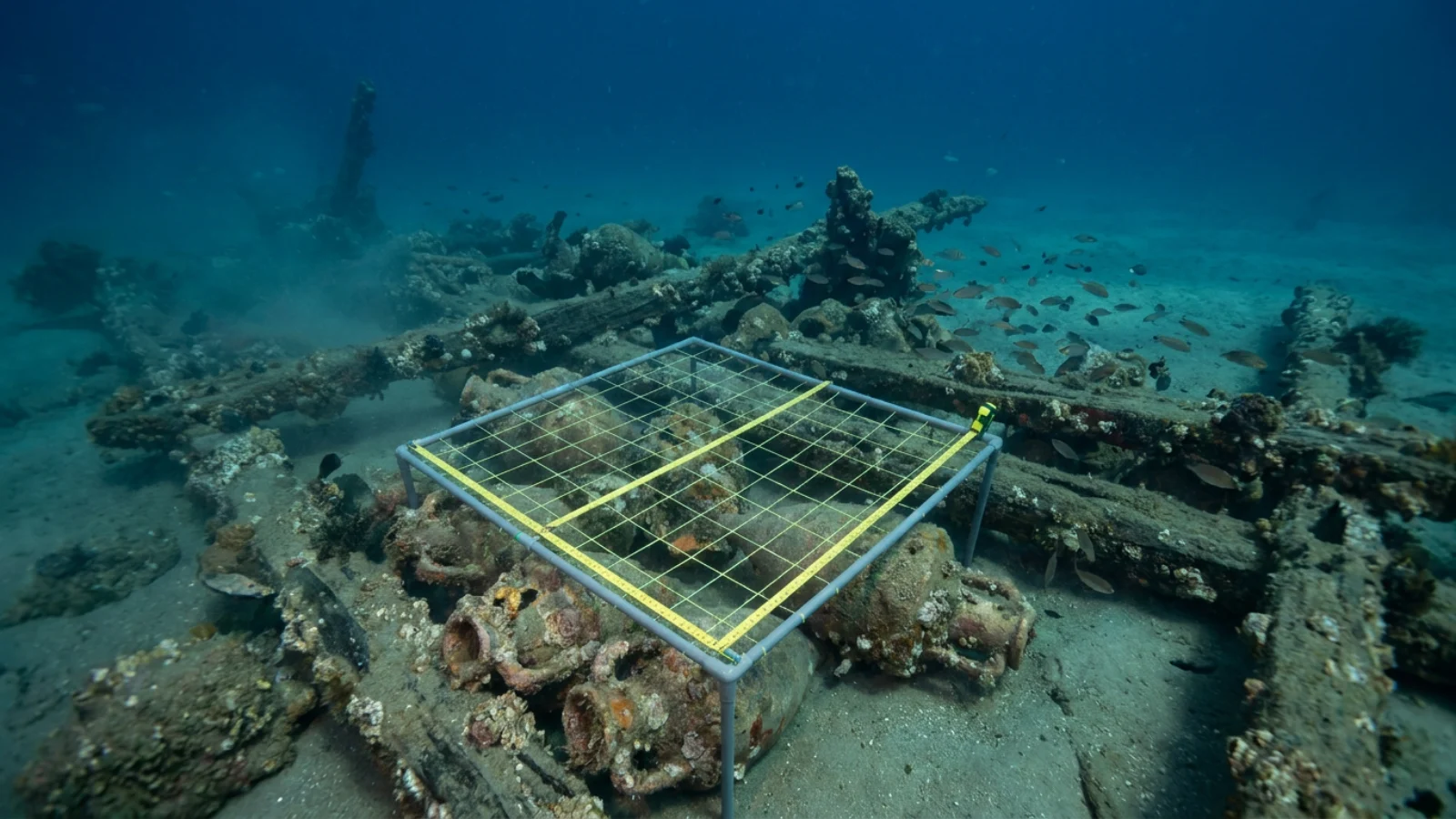
Before 1960, ancient wrecks in the Mediterranean were mostly stripped by sponge divers and treasure hunters, or worked by hired divers while the archaeologists stayed on the surface. Bass changed that by going down himself. As he put it in a 1963 National Geographic article, “Our aim was to proceed underwater just as archeologists work on land.” That meant laying grids over the wreck, digging layer by layer, drawing and photographing every object where it lay and recording its position before it was moved. “We had not come to dive for sport or for treasure,” he wrote of that first season.
The approach sounds obvious now, but in 1960 it had never been carried through on an ancient wreck, with limited bottom time, poor visibility and the physical demands of diving all working against it. Bass and his teams spent the following decades proving them wrong, and in the process built the academic discipline of nautical archaeology, trained most of its first generation of professionals and developed many of the tools it still uses.
How did George Bass become an underwater archaeologist?
Almost by accident, and with barely any diving experience.
George Fletcher Bass was born on 9 December 1932 in Columbia, South Carolina. His father, Robert Duncan Bass, was an English professor and historian of the American Revolutionary War; his mother, Virginia Wauchope, was a writer; and his uncle was the archaeologist Robert Wauchope. The family moved to Annapolis, Maryland, in 1940, where his father taught English at the US Naval Academy during the Second World War. As a teenager Bass was interested in astronomy and the sea, and did odd jobs for Ben Carlin, the adventurer who drove an amphibious jeep around the world.
He started out as an English major at Johns Hopkins University. During an exchange year in England he was suspended, along with about forty other students, for a prank, and with time on his hands joined friends on a spring trip to Taormina in Sicily, where he decided to become an archaeologist. Johns Hopkins had no archaeology department, so it assembled a degree for him from Near Eastern and Classics courses, and he received an MA in Near Eastern archaeology in 1955. He then spent two years at the American School of Classical Studies at Athens, digging at Gordion in Turkey, before military service in South Korea from 1957, where he ran logistics for a small army unit attached to the Turkish Brigade near the demilitarised zone. Suddenly responsible for equipment, food and operations, he found it a formative lesson in running expeditions.
Back at the University of Pennsylvania as a doctoral student, he was invited by the archaeologist Rodney Young to take part in the planned excavation of a Bronze Age wreck off Cape Gelidonya. To prepare, he took diving lessons at a YMCA in Philadelphia; by most accounts he had only one practical lesson, or as National Geographic later described it, “a few turns in a YMCA pool”, before he went to Turkey. He married Ann Singletary, a pianist, in 1960. She became his long-time expedition partner, and they had two sons.
What was found at Cape Gelidonya?
A small Late Bronze Age merchant ship carrying copper and tin ingots and metalworking scrap, about 3,200 years old.
The wreck lies at about 27 m on a rocky bottom off one of the small islands at Cape Gelidonya, on the southern coast of Turkey between the Gulf of Antalya and the Bay of Finike. A Bodrum sponge-boat captain, Kemal Aras, had seen its metal cargo in 1954 without realising what it was. The American photojournalist and diver Peter Throckmorton, who had been collecting sponge divers’ stories of ancient sites, relocated it in 1958 or 1959 (accounts differ) and persuaded the University of Pennsylvania Museum to sponsor an excavation. The 1960 team was co-directed by Bass and the British archaeologist Joan du Plat Taylor, with Throckmorton and the French diving pioneer Frédéric Dumas.
The finds included copper and tin ingots, many in the four-handled “oxhide” shape, scrap bronze, tools and a set of merchant’s weights, suggesting a travelling metalsmith or metal trader. The ship dates to around 1200 BC. Its origin was debated for decades. Bass argued that the ship and crew were from the Levant, the coast of Syria and Canaan, rather than Mycenaean Greece, a controversial view at the time because Bronze Age Aegean trade was usually credited to the Mycenaeans. Others have read the cargo and pottery as Mycenaean. The argument itself was productive: it pushed scholars to look at the eastern Mediterranean as a connected trading world rather than a Greek monopoly.
Above all, Cape Gelidonya proved a method. It was the first time an ancient shipwreck was excavated in its entirety on the seabed, and at the time it was the oldest known shipwreck. Together with the raising of the Swedish warship Vasa in 1961 and the excavation of the Viking Skuldelev ships in Denmark from 1962, it is counted among the projects that founded modern nautical archaeology.
What other wrecks did Bass excavate in the 1960s?
Byzantine ships off Yassi Ada, using new tools he helped invent.
Yassi Ada, a tiny island off Bodrum, lies beside a reef that rises almost to the surface and has wrecked ships for millennia. Bass’s Penn teams worked there through the 1960s. One wreck was a 7th-century Byzantine merchant ship about 21 m long, in service in or after 625/626 AD, lying at 32–39 m and carrying hundreds of amphoras. Another, excavated in 1967 and 1969 with funding from the Penn Museum and the National Geographic Society, was a 4th-century vessel about 19 m long at 36–42 m, with a hull of cypress and a keel of white oak. A third wreck excavated under his direction at the same reef was a 16th-century Ottoman ship. The 7th-century wreck was published in 1982 in a full monograph by Bass and his colleague Frederick van Doorninck.
The Yassi Ada work was also a testing ground for technology. Bass adapted land surveying methods to the seabed and helped develop an underwater “telephone booth”, an air-filled dome where divers could rest and talk to the surface; stereo photography and photogrammetry to map sites in three dimensions; and side-scan sonar to find wrecks. In 1964 he began using Asherah, a two-person submersible built by General Dynamics’ Electric Boat Division and launched on 28 May 1964, the first commercially built American research submarine. It was 16 ft long, could dive to about 180 m and was used to map and photograph wrecks, including a Byzantine wreck at about 285 ft (87 m) off Yassi Ada in 1967. Limited navigation, six small portholes and an insurance bill approaching 10,000 dollars a year led Penn to sell it in 1969.
What did Bass do for museum ethics?
He helped shape one of the first museum policies against buying looted antiquities.
In 1966 the director of the Penn Museum, Froelich Rainey, asked Bass, then an assistant curator in the Mediterranean Section, to report on the museum’s controversial purchase from a dealer of a set of gold objects said to come from Troy. His report influenced the museum’s Pennsylvania Declaration of 1970, a statement of museum ethics on how antiquities should be acquired. The declaration anticipated the UNESCO Convention of the same year against the illicit trade in cultural property. The same principle ran through his underwater work: a wreck is an archaeological site, and its value lies in the context of the objects, not their sale price.
What is the Institute of Nautical Archaeology?
The world’s oldest organisation devoted to the archaeology of seafaring, founded by Bass in 1972.
Bass set up the Institute of Nautical Archaeology (INA) as a non-profit in 1972 and left the University of Pennsylvania the following year. In 1976 INA moved its headquarters to Texas A&M University in College Station, where its affiliation gave rise to the university’s graduate Nautical Archaeology Program. Bass became a professor there and held the George T. and Gladys H. Abell Chair in Nautical Archaeology. Hundreds of archaeologists have since trained in the program, and many leading figures in the field hold its degrees.
Under Bass, INA studied wrecks from the Bronze Age to the Middle Ages and well beyond, from Revolutionary War-era vessels in Lake Champlain to an Ottoman frigate in Japan, with projects on every inhabited continent. In Turkey, it worked closely with the Bodrum Museum of Underwater Archaeology, housed in the medieval Castle of St Peter, and in the 1990s opened its own research centre in Bodrum, staffed by Turkish archaeologists and conservators. One of the best known of its Turkish projects is the 11th-century shipwreck at Serçe Limanı, famous for its cargo of glass, which Bass and colleagues published in a multi-volume study. Bass also brought local students into projects and helped many attend Texas A&M, which built a generation of Turkish nautical archaeologists.
What is the Uluburun shipwreck?
The richest Late Bronze Age shipwreck ever found, sunk off southern Turkey in the late 14th century BC.
In the summer of 1982 Mehmet Çakır, a sponge diver from Yalıkavak near Bodrum, described seeing “metal biscuits with ears” on the seabed. INA’s survey team had long worked with Turkish sponge divers to identify ancient wrecks, and the description matched oxhide ingots. The director of the Bodrum Museum, Oğuz Alpözen, sent a team from the museum and INA, which found copper ingots about 50 m off the eastern shore of the Uluburun (“Grand Cape”) headland, about 9.7 km south-east of Kaş. The wreck lies on a steep slope at 44–52 m, with objects scattered down to about 61 m. Bass directed the first season in 1984; his colleague Cemal Pulak led the excavation from 1985 to 1994. Eleven campaigns of three to four months each added up to 22,413 dives.
The cargo transformed knowledge of Bronze Age trade. It included about ten tonnes of copper in 354 oxhide ingots plus 121 bun and oval ingots, most of the copper sourced to Cyprus by lead-isotope analysis; about a tonne of tin, enough with the copper to make some 11 tonnes of bronze; about 175 glass ingots in cobalt blue, turquoise and lavender, the earliest intact glass ingots known; at least 149 Canaanite jars, most filled with terebinth resin; African blackwood, elephant and hippopotamus ivory, tortoise shells and ostrich eggshells; and gold and silver jewellery, including a gold scarab bearing the name of Nefertiti. The objects come from nine or ten cultures, from northern Europe to Africa and from Sicily and Sardinia to Mesopotamia. A 2022 study traced about a third of the tin to the Mušiston mine in Uzbekistan.
The ship itself was about 15–16 m long, built of Lebanese cedar with mortise-and-tenon joints and carrying 24 stone anchors. Tree-ring and radiocarbon dating place its sinking around 1320 BC, plus or minus about 15 years; the Nefertiti scarab shows it cannot have sunk before her time. Uluburun overtook Cape Gelidonya as the oldest known shipwreck of its kind and is still the benchmark for the international Bronze Age trade described in texts such as the Amarna letters. Much of it is displayed, with a life-size replica of the ship, at the Bodrum Museum of Underwater Archaeology.
How did Bass change the way divers treat wrecks?
By making the case, over and over, that context matters more than objects.
Bass was an unusually public scientist. His Archaeology Under Water (1966) sparked wide popular interest, and he wrote for National Geographic for decades, receiving 36 research grants from the National Geographic Society over 39 years. The marine archaeologist James Delgado called him “a public communicator of science at a time when that was particularly frowned upon.” His books, from A History of Seafaring Based on Underwater Archaeology (1972) to Beneath the Seven Seas (2005), explained to divers why a scatter of broken pottery, recorded properly, can be worth more than a chest of coins hauled up without notes.
That message shaped attitudes far beyond academia. The idea that recreational divers should look and photograph rather than take, and that historic wrecks deserve legal protection, gained credibility because Bass’s generation showed what careful excavation could reveal. Explorers such as Robert Ballard, who called Bass “a giant in the field” and a great friend, and wreck hunters such as Robert Sténuit worked in a world that his standards had helped define. For another famous ancient Mediterranean wreck, see the Antikythera mechanism; for the diving pioneers who made his work possible, see Jacques Cousteau.
What honours did George Bass receive, and when did he die?
Bass received the Archaeological Institute of America’s Gold Medal for Distinguished Archaeological Achievement in 1986, the National Geographic Society’s La Gorce Gold Medal in 1979 and Centennial Award in 1988, the Society for Historical Archaeology’s J.C. Harrington Medal in 1999, the University of Pennsylvania’s Lucy Wharton Drexel Medal in 2010, and honorary doctorates from Boğaziçi University in Istanbul and the University of Liverpool. He was elected to the American Philosophical Society in 1989 and the American Academy of Arts and Sciences in 2012. His highest honour was the US National Medal of Science, awarded for 2001 and presented by President George W. Bush at the White House on 12 June 2002, which is why sources give either year.
He died on 2 March 2021, aged 88, in the Bryan–College Station area of Texas, home of Texas A&M. He was survived by Ann and their sons, Alan and Gordon. At his death he was still an adviser to INA and a distinguished professor emeritus at Texas A&M. The field he started on a rocky Turkish seabed in 1960, with one diving lesson behind him, now spans every ocean.
Who is the father of underwater archaeology?
George F. Bass (1932–2021), who co-directed the first complete excavation of an ancient shipwreck on the seabed, at Cape Gelidonya, Turkey, in 1960.
What did George Bass discover?
He excavated the Bronze Age Cape Gelidonya wreck, Byzantine wrecks at Yassi Ada and the 11th-century Serçe Limanı glass wreck, and directed the first season at Uluburun.
What is the Uluburun shipwreck?
A Late Bronze Age ship that sank around 1320 BC off southern Turkey, carrying about 10 tonnes of copper, a tonne of tin and goods from nine or ten cultures.
What is the Institute of Nautical Archaeology?
A non-profit founded by Bass in 1972 and affiliated with Texas A&M University since 1976; it is the world’s oldest organisation devoted to nautical archaeology.
Did George Bass know how to dive?
Barely. Before Cape Gelidonya in 1960 he had taken diving lessons at a YMCA pool in Philadelphia, reportedly with only one practical lesson.
When did George Bass die?
On 2 March 2021, aged 88, in Texas.
When did George Bass get the National Medal of Science?
It was awarded for 2001 and presented at the White House on 12 June 2002.
Where can you see the Uluburun finds?
At the Bodrum Museum of Underwater Archaeology in Bodrum Castle, Turkey, alongside a life-size replica of the ship.
- Wikipedia: George Bass (archaeologist); Uluburun shipwreck; Cape Gelidonya; Yassi Ada; Asherah (submarine); Institute of Nautical Archaeology; Peter Throckmorton (accessed via offline mirror).
- National Geographic (2021). Underwater archaeology pioneer George Bass dies at 88.
- Pulak, C. (1998). The Uluburun shipwreck: an overview. International Journal of Nautical Archaeology 27(3).
- Bass, G.F. (1967). Cape Gelidonya: A Bronze Age Shipwreck. American Philosophical Society.
- Bass, G.F. & van Doorninck, F.H. (1982). Yassi Ada. Texas A&M University Press.
- Bass, G.F. et al. (2004–2009). Serçe Limanı: An Eleventh-Century Shipwreck, vols. 1–2. Texas A&M University Press.
Blane Perun has been exploring Earth’s oceans and marine life for over 25 years. Founder of TheSea.Org in 1999, underwater photographer, coral aquaculture pioneer, and explorer of 80+ countries.
About Blane Perun →