Charles Darwin and the Ocean — How Coral Atolls, Barnacles and a Five-Year Voyage Shaped Evolution
Because his first great scientific success was about the sea. During the HMS Beagle voyage (1831–1836) he developed a theory of how coral reefs and atolls form through slow subsidence of volcanic islands, published in 1842 and confirmed by deep drilling more than a century later. He then spent about eight years classifying barnacles, work that shaped his thinking on variation before he published On the Origin of Species in 1859.
Charles Darwin (1809–1882) is famous for evolution by natural selection, but his first major scientific success was about the sea. On HMS Beagle he worked out how coral reefs and atolls form, published the theory in 1842, and was proved right in its essentials by drilling more than a century later. He then spent eight years on barnacles, and the work earned him a Royal Medal and his reputation as a biologist before On the Origin of Species appeared in 1859.
This page follows Darwin the marine scientist: the plankton net he towed behind the Beagle, the atoll survey in the Indian Ocean, the long scientific argument his reef theory started, the barnacle monographs, and the marine iguanas of the Galápagos. For other explorers who shaped ocean science, see the oceanographers hub.
How did a young naturalist end up studying reefs?
Darwin arrived on the Beagle better prepared for marine work than his later fame suggests. As a student at Edinburgh in 1827 he assisted the anatomist Robert Edmond Grant in studies of marine invertebrates. In his final year at Cambridge, in 1831, he studied geology under Adam Sedgwick. Captain Robert FitzRoy wanted a gentleman companion who could examine geology ashore while the crew carried out its hydrographic survey, and Darwin fitted the role.
Coral reefs were already on the agenda. The Admiralty’s instructions for the voyage asked for an inquiry into how coral reefs form, and the Athenaeum of 24 December 1831 called that question “the most interesting part of the Beagle’s survey”. At the time the puzzle was simple to state and hard to solve. In 1824 and 1825 the French naturalists Quoy and Gaimard had shown that reef corals live only in shallow water, yet atolls rise out of the deep ocean. Leading geologists, including Charles Lyell, thought the coral grew on the rims of submerged volcanic craters, which would explain the ring shape.
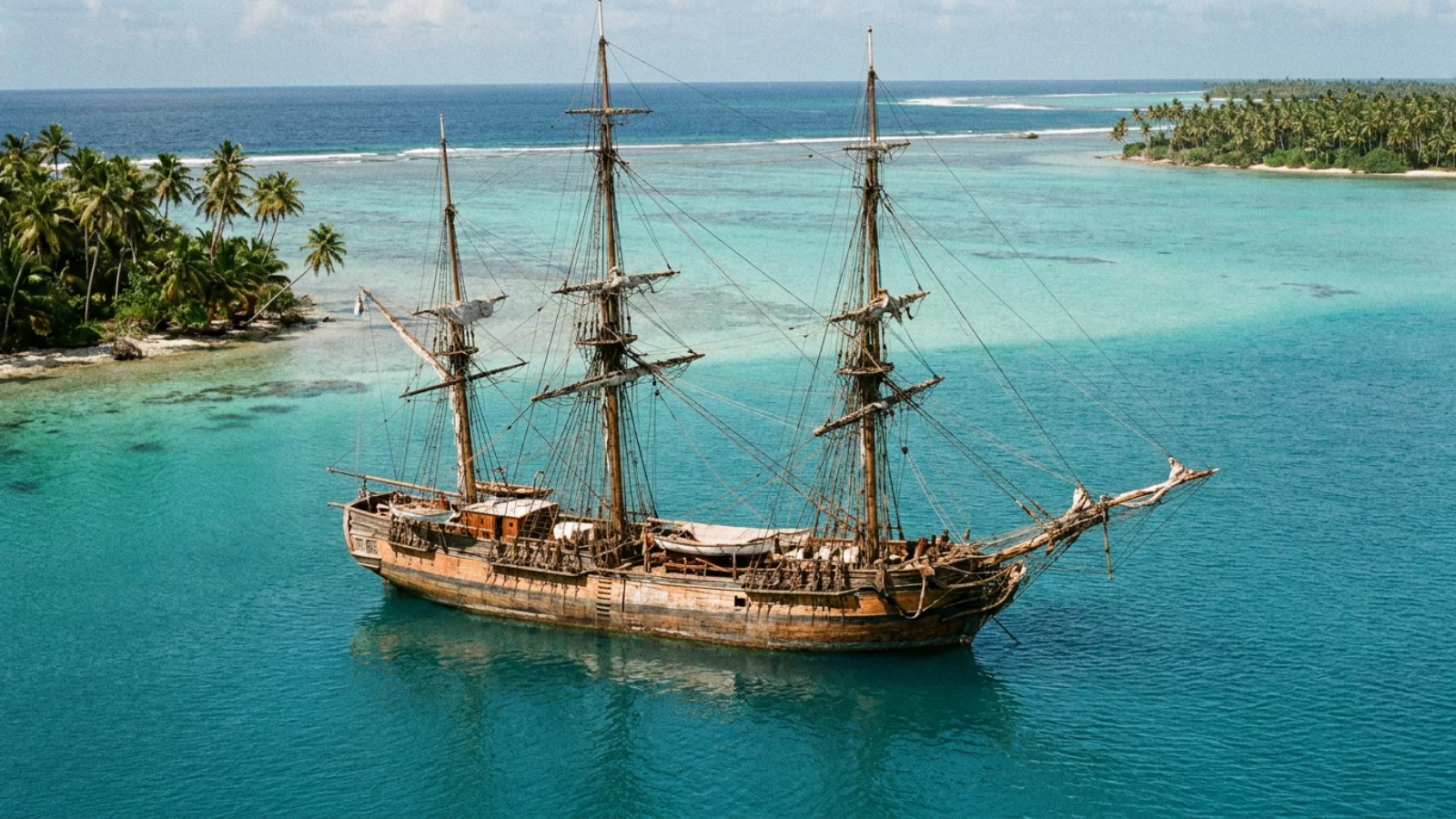
The voyage began on 27 December 1831 and lasted almost five years. FitzRoy gave Darwin the first volume of Lyell’s Principles of Geology before they sailed. Lyell’s idea that the land rises and falls slowly over immense periods became the key to Darwin’s own reef theory.
What did Darwin find in the open ocean?
Darwin is usually pictured ashore, but some of his first discoveries came from the water itself. On 10 January 1832, only days into the voyage, he tried out a plankton net of his own design, towed behind the ship. According to the history of the voyage, it was only the second recorded use of such a net, after John Vaughan Thompson in 1816. The next day he wrote about the great number of animals collected far from land: “Many of these creatures so low in the scale of nature are most exquisite in their forms & rich colours.”
The ship spent much of the next four years surveying the coasts of South America, while Darwin made long trips inland. He saw signs that the continent was rising: after the 1835 earthquake in Chile he found mussel beds stranded above the high-tide line, and high in the Andes he found seashells. He reasoned that if great areas of land were being raised, other areas, such as the floor of the Pacific, must be sinking. That idea, conceived in South America before he had seen a single coral island, is the root of his reef theory.
What did Darwin discover about coral reefs?
That fringing reefs, barrier reefs and atolls are stages of one process, driven by the slow sinking of the land beneath them.
Darwin knew that reef-building corals grow only in a narrow band of shallow water, starting just below low tide. Where land stays still, coral grows around the coast as a fringing reef. If the land slowly sinks, the coral keeps pace by growing upward on its own dead skeletons, and the reef ends up separated from the shore by a lagoon: a barrier reef. If the island disappears altogether, only a ring of living reef remains at the surface, enclosing a lagoon: an atoll. He predicted that beneath each lagoon there should be the bedrock of the original volcanic island. See how an atoll reef forms and our coral reef definition.
He first glimpsed atolls on 9 November 1835, passing through the Tuamotus. At Tahiti on 15 November he saw an island “encircled by a Coral reef separated from the shore by channels & basins of still water”. Looking across to the neighbouring island of Eimeo (Moorea), he wrote that if the central mountains were removed, “there remains a Lagoon Isd.” He wrote up the first full draft of his theory as an essay titled Coral Islands, completing it by about November 1835 as the ship crossed the Pacific.
What happened at the Cocos (Keeling) Islands?
FitzRoy’s orders required a detailed survey of a circular coral atoll, including tide measurements with specially built gauges. He chose the Keeling Islands in the Indian Ocean, and the Beagle arrived on 1 April 1836. The whole crew set to work. Boats went all round the atoll taking soundings, and FitzRoy took the deep soundings himself, using a weight armed with tallow that picked up an impression of the seabed.
Darwin examined each piece of tallow. On the steep outer slope, the impressions showed living coral down to about 10 fathoms (18 m). Deeper, they showed fewer coral marks and more sand, until it was clear there was no living coral below about 20–30 fathoms (36–55 m). Little more than a mile from shore, FitzRoy let out a line 7,200 feet long and found no bottom. To Darwin, that meant the atoll was the summit of a huge submarine mountain capped by coral that could only have grown near the surface.
He also looked at the reef as a living system. Having heard that parrotfish browse on living coral, he dissected some and found finely ground coral in their guts. He concluded that such fish, along with coral-eating invertebrates such as sea cucumbers, could explain banks of fine mud in the lagoon, and that even reef-builders were subject to the law of “consume and be consumed”. Leaving after eleven days, he summed up his view in his diary: an atoll is “a monument raised by myriads of tiny architects, to mark the spot where a former land lies buried in the depths of the ocean”.
How was the theory published and received?
The Beagle returned on 2 October 1836. Lyell met Darwin later that month and quickly abandoned his own volcanic-crater theory, writing that “the whole theory is knocked on the head”. Darwin spent more than three years on the reef book, much of it slowed by illness. The Structure and Distribution of Coral Reefs appeared in May 1842, priced at 15 shillings, as the first of three volumes on the geology of the voyage. It included a large coloured world map of every reef then known, marking regions of fringing reefs as areas of uplift and regions of atolls and barrier reefs as areas of subsidence. A revised second edition followed in 1874.
Historians have noted that the book’s structure foreshadows On the Origin of Species: detailed descriptions of each type of reef, then a single theory that unites them, then a demonstration of its wider explanatory power. Unlike the Origin, it was fully backed by citations and a long appendix of reef data. In 1853 the Royal Society awarded Darwin its Royal Medal, citing both the coral reef work and the barnacle studies.
Was Darwin’s coral reef theory correct?
Yes in its core, though the full story turned out to be more complicated.
The theory set off a long dispute. The American geologist James Dwight Dana, who had seen reefs in Hawaii and Fiji on the United States Exploring Expedition of 1838–42, supported Darwin. The Scottish oceanographer John Murray, a veteran of the Challenger expedition, argued instead that reefs grew on mounds of sediment that had built up to shallow depths, and Alexander Agassiz financed expeditions to back him. To settle the matter, the Royal Society drilled into Funafuti atoll (now in Tuvalu) in 1896, 1897 and 1898. The bore reached 339.7 m and was still in coral. At the time the result was considered inconclusive.
The decisive test came at Enewetak Atoll in the Marshall Islands. In 1952, before nuclear weapons tests there, the United States Atomic Energy Commission drilled exploratory bores that went through more than a kilometre of reef limestone to the volcanic basalt beneath. Sources give the thickness as 4,610 feet (1,405 m) or about 4,200 feet (1,300 m). Either way, coral had kept growing upward as its foundation sank, as Darwin predicted. He had even guessed that reefs could be about 5,000 feet (1,525 m) thick. See atolls of the Marshall Islands.
Some details have changed. Darwin worked with a depth limit for reef corals of about 30 fathoms (55 m); later findings suggest about 100 m, still a small fraction of ocean depths of 3,000–5,000 m. His idea that rising land is balanced by sinking ocean floor has been replaced by plate tectonics, which explains why volcanic islands cool, sink and drift away from hot spots and ridges. An alternative “antecedent karst” model argues that the ring shape of many modern atolls owes more to rainwater dissolving the interiors of flat-topped reefs when they were exposed during ice-age low sea levels. Researchers also describe a “Darwin Point”, where water is just warm enough for reef growth to keep pace with subsidence; beyond it, sinking islands become seamounts instead of atolls. Darwin’s central insight, that atolls sit on sunken islands, still stands.
What is “Darwin’s paradox”?
Darwin also left a puzzle that marine scientists still discuss. Tropical surface waters are poor in nutrients, almost a desert, yet coral reefs rising out of them are among the most productive ecosystems on Earth. The question of how so much life can flourish in such nutrient-poor water is sometimes called Darwin’s paradox. Proposed answers include efficient recycling within the reef and the partnership between corals and their symbiotic algae, but the label is a reminder of how early the contrast was noticed.
Why did Darwin spend eight years on barnacles?
To master one group of animals in depth, and because one strange barnacle from South America would not let him go.
During the voyage Darwin found a tiny barnacle living in minute cavities in the shells of a sea snail of the genus Concholepas. In a letter to John Stevens Henslow in March 1835 he described it as a new genus in the family Balanidae. His notes recorded three pairs of feeding legs (cirri) instead of six, and no true shell; he asked “who would recognise a young Balanus in this ill-formed little monster?” He nicknamed it “Mr Arthrobalanus”. It is now known as Cryptophialus minutus, a burrowing barnacle.
He set it aside for more than a decade. In October 1846 he returned to it, planning only a short paper. Within weeks he was borrowing barnacle collections, including specimens from the Royal College of Surgeons museum arranged through Richard Owen, and the paper grew into a monograph on all living and fossil barnacles. Two volumes on the stalked barnacles, the Lepadidae, appeared in 1851, and the work on the remaining groups followed, with the main monographs published by 1854. The study took eight years. At the end of it Darwin declared, “I hate a barnacle as no man ever did before.”
The effort paid off scientifically. Barnacles had been classed as molluscs by Linnaeus and Cuvier until 1830, when John Vaughan Thompson showed that their nauplius and cypris larvae resemble those of crustaceans. Darwin’s monographs placed barnacles firmly among the crustaceans and used comparative anatomy to trace how the same body parts had been modified for different ways of life. In some genera he found minute males living as parasites on hermaphrodites, which he took as an intermediate stage in the evolution of separate sexes. He also gathered abundant evidence of individual variation within species, which became central to the argument of the Origin. Several barnacle names still carry his authorship, including the infraclass Thoracica and the barnacle Balanus improvisus. See barnacles and crustacean larvae.
What marine animals did Darwin study in the Galápagos?
Marine iguanas above all, the only lizards that feed in the sea.
The Beagle left for the Galápagos on 7 September 1835. Darwin made extensive observations of the marine iguana, but he was not charmed. He wrote of “large (2–3 ft), most disgusting, clumsy Lizards” on the black lava, “as black as the porous rocks over which they crawl & seek their prey from the Sea”, adding that someone called them “imps of darkness”. Before reaching the islands, he and FitzRoy had also discussed why the Galápagos lack coral reefs. FitzRoy suggested the sea was too cold, and Darwin began following the sea temperatures recorded in the ship’s weather journal, an early link between ocean temperature and reef distribution. For the iguanas today, see why marine iguanas are endangered.
Why does Darwin matter to ocean science today?
Even without his work on evolution, Darwin would be remembered as the author of The Voyage of the Beagle, as the geologist who solved the puzzle of coral atolls, and as the biologist who wrote the definitive study of barnacles. His reef map was the first global picture of where reefs grow and why. His approach of reading present-day patterns as the record of slow historical change became a model for the historical sciences, from geology to ecology.
Modern reef science still works with his framework, even as it adds plate tectonics, sea-level history and reef ecology. The questions he raised about how deep reef corals can grow, how reefs keep pace with sinking islands and rising seas, and how they thrive in nutrient-poor water are now urgent ones, as reefs face warming, acidification and sea-level rise. For a fellow navigator whose voyages mapped the same Pacific, see James Cook.
What did Charles Darwin discover about coral reefs?
That fringing reefs, barrier reefs and atolls are stages of one process driven by slowly sinking land, published in 1842 in The Structure and Distribution of Coral Reefs.
Was Darwin’s atoll theory proven?
Yes, in its core. Drilling at Enewetak Atoll in 1952 passed through roughly 1,300–1,405 m of reef limestone before reaching volcanic basalt.
Where did Darwin study an atoll?
At the Cocos (Keeling) Islands in the Indian Ocean, where the Beagle arrived on 1 April 1836 and stayed eleven days.
Did Darwin study barnacles?
Yes, for about eight years from 1846, publishing monographs on living and fossil barnacles between 1851 and 1854.
What was Mr Arthrobalanus?
Darwin’s nickname for a tiny burrowing barnacle he found in snail shells during the voyage, now called Cryptophialus minutus.
How long was Darwin’s Beagle voyage?
Almost five years, from 27 December 1831 to 2 October 1836.
What is Darwin’s paradox?
The puzzle of how coral reefs can be so productive in tropical waters that are very poor in nutrients.
Was Darwin an oceanographer?
Not by title, but his coral reef theory, plankton sampling and barnacle studies make him a founder of marine geology and biology.
- Darwin, C. (1842). The Structure and Distribution of Coral Reefs. London: Smith, Elder & Co. (2nd ed. 1874).
- Darwin, C. (1851–1854). Monographs on the sub-class Cirripedia (living and fossil).
- Darwin Correspondence Project, University of Cambridge: “Darwin and barnacles”.
- Ladd, H.S. et al. (1953). Drilling on Eniwetok Atoll, Marshall Islands. AAPG Bulletin.
- Wikipedia: Charles Darwin; Second voyage of HMS Beagle; The Structure and Distribution of Coral Reefs; Atoll; Barnacle; Marine iguana; John Vaughan Thompson.
Blane Perun has been exploring Earth’s oceans and marine life for over 25 years. Founder of TheSea.Org in 1999, underwater photographer, coral aquaculture pioneer, and explorer of 80+ countries.
About Blane Perun →