Tiger Sharks in the Bahamas — Tiger Beach, the Operators, and the Science Behind It
The Bahamas is the most reliable place on Earth to see tiger sharks — specifically Tiger Beach, a shallow sand flat off the western tip of Grand Bahama. Multiple operators run baited dives there 200–300 days a year, and resident female tiger sharks — many individually identified across decades — show up consistently. It’s the best-studied tiger shark population in the world and the model for how the species can be observed safely at scale.
People asking about tiger sharks in the Bahamas mostly want one of two things: information about whether to dive Tiger Beach (yes, it’s worth it; here’s how it works), or context for whether tiger shark presence in Bahamian waters means swimming and snorkelling are dangerous (no, the relationship is the opposite of what intuition suggests). This page covers both.
Tiger Beach — what and where
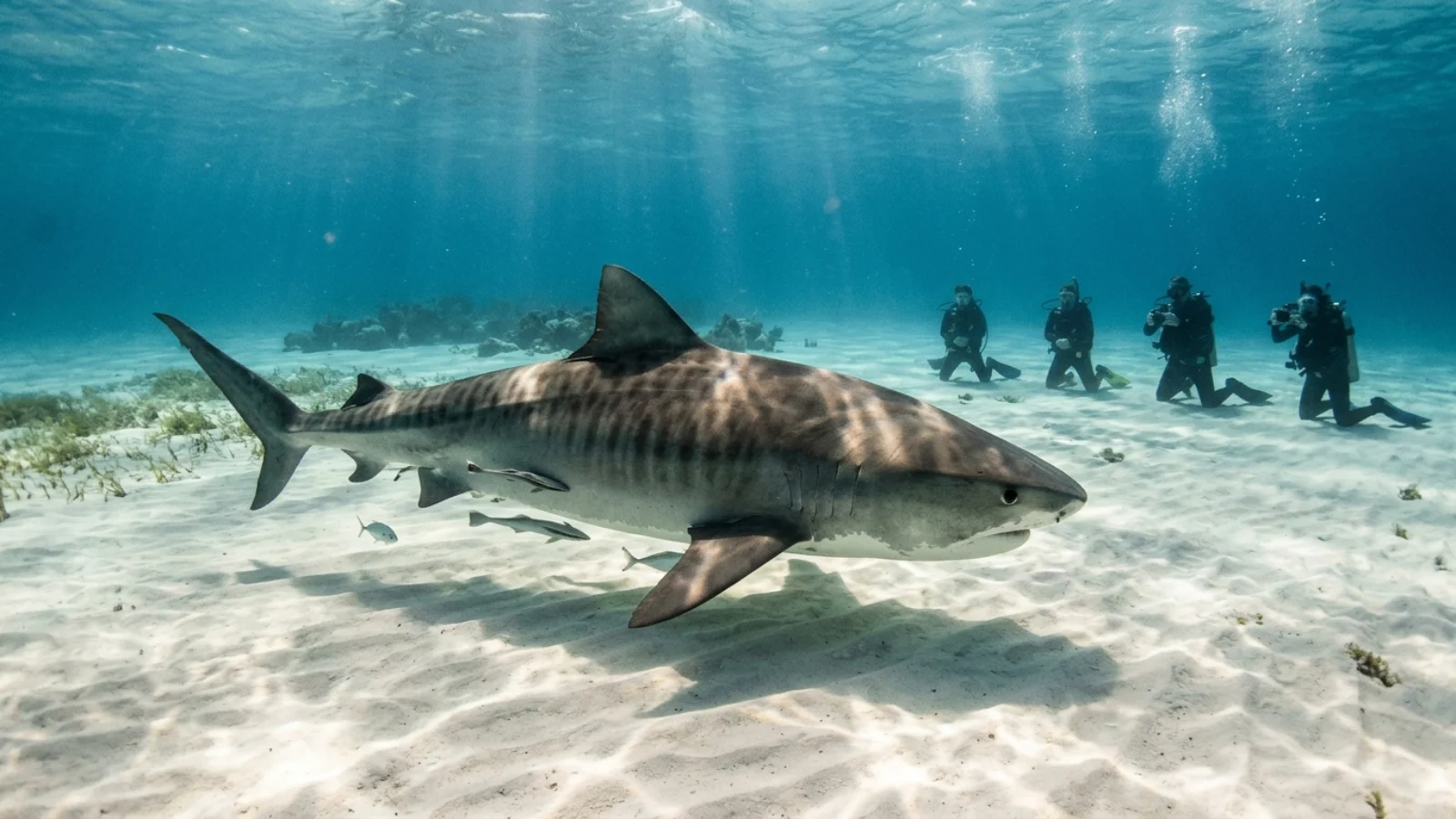
Tiger Beach is not actually a beach. It’s a 6-metre-deep sand flat about 32 km off the northwest tip of Grand Bahama, in the Little Bahama Bank.
The site sits in the middle of clear, calm water with consistent visibility of 20–30 m and almost no current. It’s accessed by boat from West End, Grand Bahama (about 1.5 hours) or from Florida ports like Jupiter and West Palm Beach (about 4 hours by fast catamaran). Operators anchor or hold position over the sand flat and bring shark presence in with chum and frozen-fish bait, kept in a sealed crate that the dive master controls.
The resident tiger sharks are mostly large adult females, ranging 3–4.5 m. Many have been individually identified by photo-ID over twenty-plus years, and the dive operators know them by name — Emma, the most famous, was a 4.3-metre adult female estimated at 50 years old, regular at Tiger Beach since the 1990s and still being sighted as recently as 2024. The same animals return seasonally, year after year, which is what makes the destination predictable.
Why the sharks are reliably there
A mix of habitat and history. The Little Bahama Bank is shallow, productive, sheltered from open Atlantic swell, and adjacent to deeper water that tiger sharks use for cooler-water rest. It’s high-quality habitat independent of any human activity.
The decades of dive-operator presence have created site fidelity in individual sharks — a behavioural conditioning effect studied in detail by Hammerschlag and colleagues (2012). The sharks associate the site with reliable food (the bait) and have shifted their movement patterns to spend more time there. Conservation researchers debate the ecological implications — provisioning ecotourism is contentious, with reasonable arguments on both sides — but the practical effect for visitors is that tiger shark sightings at the site are essentially guaranteed.
Other Bahamas tiger shark destinations
Tiger Beach is the most famous, but it isn’t the only Bahamian site where tigers are seen.
The northern Bimini chain, particularly off South Bimini’s southwestern coast, has resident tiger sharks year-round and is closer to Florida (a 90-minute boat ride from Miami). Sightings there are less consistent than Tiger Beach but the diving is calmer and the trip logistics easier. Cat Island in the central Bahamas hosts oceanic whitetip dives with occasional tiger sharks during the spring months. Bahamas Aggressor liveaboards run scheduled tiger shark expeditions that combine Tiger Beach with several less-trafficked sites.
| Site | Reliability | Depth | Avg sharks/dive | Best season |
|---|---|---|---|---|
| Tiger Beach (Grand Bahama) | Very high | 6 m | 3–6 | Oct–Jan peak |
| South Bimini | Moderate | 10–18 m | 1–3 | Year-round |
| Cat Island | Variable | 30+ m | 0–2 | Apr–Jun (oceanics) |
| Long Island Cays | Variable | 15–30 m | 0–2 | Year-round |
Cost, season, operators
Tiger Beach is run as a regulated commercial dive operation with a small number of established operators.
Day-trip cost from Florida runs $400–600 per diver, including transit, two dives, equipment, and lunch. Multi-day liveaboard trips on operators like Bahamas Master, Bahamas Aggressor, or Dolphin Dream run $3,000–5,000 for 5–7 nights with up to 4 dives per day. Peak tiger shark season is October through January when the resident females aggregate at the site — September and February are still good but slightly less consistent. Spring and summer months produce fewer tiger sightings and more lemon shark activity.
Certification requirements: most operators ask for Advanced Open Water or equivalent with at least 25 logged dives. Specific shark-diving experience is not required — the site is shallow, calm, and the dive masters manage the interactions — but comfort with bottom-time and good buoyancy are. Free-diving Tiger Beach is also possible with a separate set of operators and a more rigorous experience prerequisite.
Are tiger sharks a problem for casual Bahamas swimmers?
No — not in the way the headline numbers might suggest.
The Bahamas as a whole averages fewer than one shark attack per year. The country has more shark-diving tourists than almost any other Caribbean destination and yet a low absolute attack rate, because the conditions that put divers in productive water with sharks (clear water, calm conditions, controlled bait) are exactly the opposite of attack-elevation conditions (murky water, rough conditions, lone swimmers near fish-cleaning stations). Casual snorkellers in clear water at popular Bahamian beaches almost never encounter tiger sharks — the species prefers deeper bottom and the sand flats only really concentrate them where bait is provided. More on tiger shark behaviour and risk.
When is the best time to dive Tiger Beach?
October through January is the peak season, when resident adult female tiger sharks aggregate at the site. Visibility, water temperature (around 24°C), and shark count all peak in those months. Summer months see fewer tigers and more lemon sharks — still excellent diving, just a different cast.
Is Tiger Beach dangerous?
It has an excellent safety record across more than 25 years of commercial operation. The site has clear water, predictable conditions, and protocol-driven operations — the opposite of attack-condition variables. Some incidents have occurred over the decades, including one fatality of a diver in 2014, but the cumulative dive count runs into the tens of thousands without serious injury.
Do I need to be an experienced diver?
Most Tiger Beach operators require Advanced Open Water or equivalent with at least 25 logged dives. The dive itself is shallow (6 m) and easy mechanically, but you need solid buoyancy control and comfort holding position on the bottom for 40–60 minutes while large sharks circle close. Beginners do not dive Tiger Beach.
How much does a Tiger Beach dive trip cost?
Day trips from Florida ports run $400–600 per diver for two dives. Multi-day Bahamas liveaboards run $3,000–5,000 for 5–7 nights including 3–4 dives per day, with the trip combining Tiger Beach and several other Bahamas dive sites. Hotel-based options out of Grand Bahama are slightly cheaper but add overnight cost.
Are tiger sharks the only sharks at Tiger Beach?
No. Lemon sharks are the most abundant species at the site — resident year-round in large numbers. Caribbean reef sharks, nurse sharks, and occasionally bull sharks all show up. Tiger sharks are the headline animal but you’ll typically see four or five species on a single dive.
- Hammerschlag, N., Gallagher, A. J., et al. (2012). Don’t bite the hand that feeds: assessing ecological impacts of provisioning ecotourism on an apex marine predator. Functional Ecology, 26, 567–576. The primary academic study of Tiger Beach.
- Sulikowski, J. A., Wheeler, C. R., et al. (2016). Seasonal and life-stage variation in the reproductive ecology of a marine apex predator, the tiger shark. Marine Ecology Progress Series, 539, 169–177.
- Florida Museum International Shark Attack File (ISAF). Bahamas attack records.
- Bahamas Diving Association. Operator listings and dive site information for Grand Bahama and Bimini.
Blane Perun has been exploring Earth’s oceans and marine life for over 25 years. Founder of TheSea.Org in 1999, underwater photographer, coral aquaculture pioneer, and explorer of 80+ countries.
About Blane Perun → Back to Tiger Shark →