Will Dolphins Kill Sharks? — Sometimes Small Ones, but Sharks Are the Bigger Threat
Yes, occasionally, but only small sharks. Bottlenose dolphins have been seen ramming, mobbing and killing small sharks, and a few populations eat them now and then. They do not hunt sharks as regular prey, and the old idea that sharks fear dolphins has no scientific support. Large tiger, bull and white sharks prey on dolphins far more often than dolphins kill sharks. The real shark-killer in the dolphin family is the orca.
Dolphins sometimes kill small sharks by ramming them with their beaks or attacking as a group, but sharks are not a regular part of a bottlenose dolphin’s diet, which is built mainly on fish and squid. These are rare events. Shark researcher Michael Heithaus of Florida International University found no data showing that sharks avoid dolphins; instead dolphins change their behavior to avoid sharks. The exception is the killer whale, a dolphin that regularly kills great white and other large sharks.
How would a dolphin kill a shark?
By ramming it with the beak and head, usually with several dolphins working together.
A bottlenose dolphin weighs 300 to 1,400 pounds and can accelerate hard over short distances. When dolphins go after a shark they do not bite and shake it the way a shark would. Accounts describe them striking the shark’s flank or gill area with the rostrum (beak) and forehead, then wheeling for another pass. Several animals may take turns. A shark’s skeleton is cartilage, and its gills and internal organs are vulnerable to blunt impact, so repeated ramming can injure or kill a small shark.
These attacks are opportunistic. Heithaus has told reporters that dolphins will kill small sharks, other fish and even small porpoises, usually without eating them. Bottlenose dolphins in the North Sea and along the US Atlantic coast have killed harbor porpoises the same way, which tells you this is a general dolphin behavior and not a targeted anti-shark strategy.
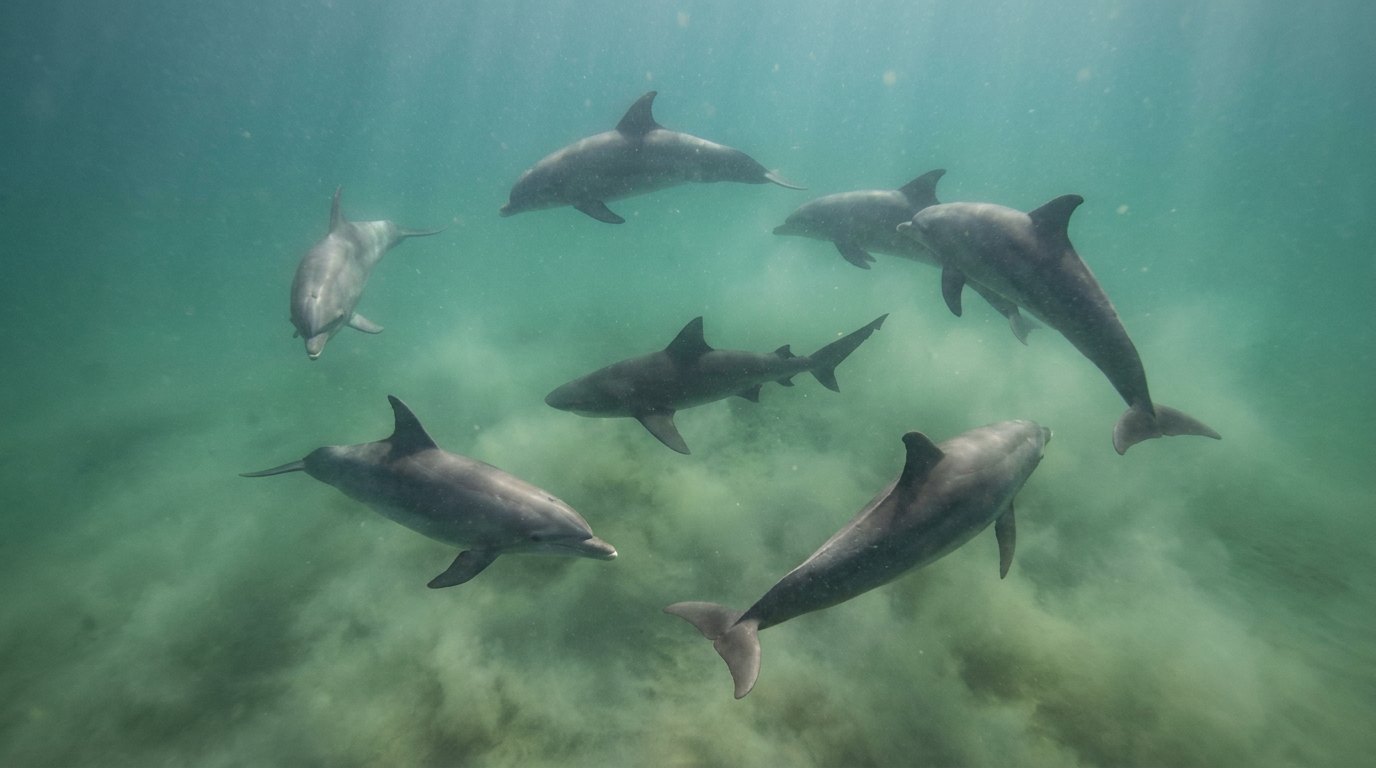
Are sharks afraid of dolphins?
There is no evidence that they are. The research points the other way.
The belief that sharks flee from dolphins is an old sailor’s story. Heithaus, who spent years studying tiger sharks and bottlenose dolphins in Shark Bay, Western Australia, found that dolphins are the ones who change their behavior: they leave rich shallow seagrass feeding banks when tiger sharks are abundant, and move to safer edges where they can escape.
Scar surveys back this up. In a 2017 Sarasota Bay study led by Krystan Wilkinson, about 35.5% of resident bottlenose dolphins carried at least one shark-bite scar; bull sharks were the suspected culprits. In Shark Bay, Heithaus found scars on 74.2% of non-calves (95 of 128), mostly from tiger sharks, and estimated that 11 to 13% of dolphins survive an attack each year. Those numbers only count survivors, so the true toll is higher.
| Location | Dolphins with shark-bite scars | Main shark involved |
|---|---|---|
| Sarasota Bay, Florida | About 35.5% | Bull sharks suspected |
| Shark Bay, Western Australia | 74.2% of non-calves | Tiger shark |
| South-east Queensland, Australia | 38.5% common bottlenose; 27.7% Indo-Pacific bottlenose; 50.3% humpback dolphins | Tiger and white sharks |
| Bimini, The Bahamas | At least 29% bottlenose; 15% Atlantic spotted | Not specified |
Which sharks eat dolphins?
Tiger sharks, bull sharks and great white sharks are the main predators of dolphins.
Tiger sharks are the biggest threat because they patrol the same warm, shallow coastal water that bottlenose dolphins use. Bull sharks take dolphins in bays and estuaries, and great whites prey on dolphins in temperate seas such as South Africa and southern Australia. Calves, sick animals and dolphins separated from their group are most at risk. Large sharks usually attack from below or behind, aiming for the tail stock or belly. See tiger shark, bull shark and great white shark diet for more.
Size explains why the contest is usually one-sided. Adult tiger sharks commonly reach 3.5 to 4.7 m and weigh 300 to 900 kg, and large females can pass 5 m. A bottlenose dolphin is typically 2.5 to 3.5 m long. Against a shark of that size, a dolphin’s best defence is its group, its speed and its choice of where to feed, not a counter-attack.
How do scientists read a shark bite on a dolphin?
Attacks by sharks on dolphins are fast and rarely seen. As Heithaus put it to Hakai Magazine, they happen so quickly that the chances of watching one are low. So most of what is known comes from the survivors. Researchers photograph dolphins during routine photo-identification surveys and look for the jagged, crescent-shaped lines of tooth marks that a shark leaves behind, then compare fresh wounds with the jaw shapes of local shark species.
The location of the bite carries information too. In south-east Queensland, a 2026 study of photographs of several coastal dolphin species found that the tail stock, or peduncle, was the most frequently bitten body region in every species, and attributed most fresh wounds to tiger and white sharks. Off Bimini in the Bahamas, and at Ponta do Ouro in southern Mozambique, researchers found that shark injuries were concentrated on the dorsal side of the body. A bite from above or behind fits a predator that approaches from outside the dolphin’s field of view and aims for the part of the body that drives swimming.
Not every bite is a failed predation attempt. In Shark Bay, Heithaus found bites from small carcharhinid sharks on 6.2% of dolphins and suggested that some of these small sharks may act more like ectoparasites than predators, taking a mouthful and leaving. Large sharks over 3 m long were responsible for a disproportionate share of serious attacks. And every scar survey shares the same blind spot: dolphins killed outright leave no scar to count, so these percentages are minimums.
Which dolphins are bitten most often?
Scar rates vary a lot between places and species, which is why researchers treat them as a rough index of predation pressure. In south-east Queensland, 50.3% of Australian humpback dolphins carried shark-bite scars, against 38.5% of common bottlenose dolphins and 27.7% of Indo-Pacific bottlenose dolphins. Habitat mattered as much as species: dolphins in sheltered waters were scarred far more often (42.6%) than those in open waters (16.3%), and non-calf humpback dolphins in sheltered water were the group most at risk.
Off Bimini, a 2021 study in Marine Mammal Science found that at least 29% of common bottlenose dolphins had evidence of a past, non-lethal shark bite, compared with only 15% of Atlantic spotted dolphins. The authors did not identify the sharks responsible, but noted that both dolphin species share the water with tiger and bull sharks. Shark Bay still stands out at the top of the range, which Heithaus has linked to its robust shark population.
A bite that a dolphin survives can still change its life. In 2025 veterinarians working with the Sarasota Dolphin Research Program described a juvenile male bottlenose dolphin with healed scars, possibly from a tiger shark, on both sides of the lower tail stock near the genital slit. The bite had left a narrowed urethra and an abnormal opening between the urinary tract and the body wall. The animal stayed in good body condition, but the authors noted that it may not be able to reproduce if it reaches breeding age.
How does fear of sharks shape dolphin behaviour?
Heithaus’s 2001 review in the Journal of Zoology argued that shark predation can influence dolphin population sizes, habitat use, group size and behaviour, and that risk varies with habitat both near shore and in the open sea. It also sorted shark species into regular predators, occasional predators, potential predators and ectoparasites, noting that some sharks long suspected of being major dolphin predators were probably at most occasional ones, while others had been overlooked.
The best field test of that idea came from Shark Bay. In a 2002 paper in Ecology, Heithaus and Lawrence Dill examined how bottlenose dolphins balanced food against danger. Shallow seagrass banks there hold the richest feeding, but tiger sharks are abundant in the warm season, and the dolphins shift their habitat use between shallow and deeper water as both food and risk change. In other words, the dolphins pay a cost in lost feeding to stay safe.
The same review also pointed to competition. Heithaus presented the first analysis of dietary overlap between sharks and dolphins, and found it significant between common dolphins and several shark species, including some that also prey on those dolphins. Large sharks and dolphins often hunt the same schools of fish, which is one reason both can turn up at the same feeding frenzy without any contest between them.
Which sharks have been caught eating dolphins?
Diet studies sometimes find dolphin remains inside sharks, but stomach contents alone cannot always show whether the shark killed the dolphin or scavenged a carcass. A 2025 note in the Journal of Fish Biology reported dolphin remains, from an Indo-Pacific bottlenose dolphin and a Clymene dolphin, in the stomachs of three large shortfin mako sharks. Pre-mortem bite marks suggested active predation in at least one case, and it was the first record of a Clymene dolphin in a mako’s diet. The authors concluded that makos are opportunists that may take juvenile dolphins under some conditions.
At the other end of the scale, the cookiecutter shark, a small deep-water species, gouges round plugs of flesh from whales and dolphins, leaving circular scars on many cetaceans. It is a parasite rather than a predator, and the wounds are not fatal on their own.
Do orcas kill sharks?
Yes. Killer whales, the largest dolphins, kill great white sharks, makos and other large sharks.
Orcas are dolphins (family Delphinidae), and they are the one member of the family that hunts big sharks deliberately. Off South Africa, a pair of orcas nicknamed Port and Starboard has killed great whites to eat their large, oily livers, and on 18 June 2023 Starboard was filmed off Mossel Bay killing a juvenile white shark of about 2.5 m on his own in under two minutes. Off California’s Farallon Islands, white sharks left their seal-hunting grounds for the rest of the season after orcas killed one in 1997. Orcas are also known to flip sharks upside down, inducing tonic immobility before the kill. Read more in orca (killer whale) and great white shark predators.
How do orcas hunt sharks?
Orcas take a far wider range of sharks and rays than most people realise. A global image-based repository published in Scientific Data in 2026 gathered 320 photos and videos of 82 separate interactions between orcas and elasmobranchs from 12 countries. At least 18 species of sharks, skates and rays were identified, and the authors recorded ten different types of interaction, including both predatory and non-predatory behaviour. Some orca populations, such as the offshore orcas of the eastern North Pacific, are regarded as shark-eating specialists.
White sharks are the most dramatic prey. A 1999 paper in Marine Mammal Science described an orca killing a white shark at the Farallon Islands and a possible case of competitive displacement. Twenty years later, Salvador Jorgensen and colleagues used long-term tagging and survey data to show that even brief visits by orcas to Southeast Farallon Island drove white sharks away for extended periods. In years with close orca encounters, white sharks killed fewer seals there, and tagged sharks moved to other sites such as Año Nuevo Island.
In South Africa, Port and Starboard, two males named for the way their dorsal fins bend, became known for killing white sharks and removing their livers. In 2022, Alison Towner and colleagues linked orca predation to the absence of white sharks from Gansbaai, once the country’s largest white shark aggregation site. After Starboard’s solo kill at Mossel Bay in June 2023, white sharks left the area for about four months.
The behaviour is not limited to Africa. In October 2023 a 4.7 m white shark washed ashore in south-eastern Australia at a time when people had reported orcas hunting large prey nearby. The liver, digestive organs and reproductive organs were missing, and genetic swabs from the largest bite wound contained orca DNA, while the smaller bites carried DNA from scavenging broadnose sevengill sharks. A 2025 paper in Ecology and Evolution treated it as confirmed orca predation and suggested such kills may be more widespread than assumed. Unlike bottlenose dolphins, orcas are true shark predators.
Will dolphins protect humans from sharks?
There are stories, but no evidence that dolphins defend people on purpose.
Several well-publicised cases, including a 2004 incident off New Zealand in which bottlenose dolphins circled lifeguards near a great white, are often cited as dolphins protecting swimmers. Scientists point out that dolphins may have been reacting to the shark for their own reasons. Seeing dolphins nearby is no guarantee that sharks are absent; both are drawn to the same baitfish. Read will dolphins attack you? for the other side of dolphin-human encounters.
Can a dolphin kill a shark?
Yes. Dolphins can kill small sharks by ramming them, usually in groups, but this is uncommon.
Are sharks scared of dolphins?
No scientific evidence supports this. Studies in Shark Bay show dolphins avoid tiger sharks, not the reverse.
Who would win, a dolphin or a shark?
It depends on size. A large tiger or bull shark usually wins against a single dolphin; a group of dolphins can drive off or kill a small shark.
Do dolphins eat sharks?
Rarely, and not as regular prey. Bottlenose dolphins live mainly on fish and squid; the dolphin that regularly eats sharks is the orca.
What dolphin kills great white sharks?
The orca (killer whale), which hunts white sharks for their livers.
Why do dolphins ram sharks?
To drive them away from the group, especially from calves, or during aggressive social bouts.
Do dolphins protect humans from sharks?
There are anecdotes but no evidence of deliberate protection.
How many dolphins are attacked by sharks?
About a third of Sarasota Bay dolphins and about three quarters of Shark Bay non-calves carry shark-bite scars.
- Heithaus, M. R. (2001). Predator–prey and competitive interactions between sharks (order Selachii) and dolphins (suborder Odontoceti): a review. Journal of Zoology 253.
- Heithaus, M. R. (2001). Shark attacks on bottlenose dolphins (Tursiops aduncus) in Shark Bay, Western Australia: attack rate, bite scar frequencies, and attack seasonality. Marine Mammal Science 17.
- Wilkinson, K. A., Wells, R. S., Pine, W. E. & Borkhataria, R. R. (2017). Shark bite scar frequency in resident common bottlenose dolphins (Tursiops truncatus) in Sarasota Bay, Florida. Marine Mammal Science 33.
- Hakai Magazine: Tracking the scars of dolphin-shark battles.
- Discover Magazine: The idea that sharks fear dolphins may just be an old sailor’s myth.
- NOAA Fisheries: Common bottlenose dolphin species profile.
- Heithaus, M. R. & Dill, L. M. (2002). Food availability and tiger shark predation risk influence bottlenose dolphin habitat use. Ecology 83.
- Melillo-Sweeting, K. et al. (2021). Examining shark bite scars on dolphins off Bimini, The Bahamas: comparisons between bottlenose and Atlantic spotted dolphins. Marine Mammal Science 38.
- Hume, G. V. et al. (2026). Investigating the predation risk of coastal dolphins via the presence of shark bite scars across southeast Queensland, Australia. Ecology and Evolution.
- Marley, S. A. et al. (2024). Dolphins, sharks, and barnacles: use of photographs to examine intra- and inter-specific interactions in bottlenose dolphins in Mozambique. Ecology and Evolution.
- Wilkinson, K. A. et al. (2025). Case report: shark bite resulting in a urethral obstruction and urinary tract-body wall fistula in a bottlenose dolphin in Sarasota Bay, Florida. Frontiers in Veterinary Science.
- Mucientes, G. et al. (2025). Do shortfin mako Isurus oxyrinchus hunt dolphins actively? Journal of Fish Biology.
- Pyle, P. et al. (1999). Predation on a white shark (Carcharodon carcharias) by a killer whale (Orcinus orca) and a possible case of competitive displacement. Marine Mammal Science 15.
- Jorgensen, S. J. et al. (2019). Killer whales redistribute white shark foraging pressure on seals. Scientific Reports 9.
- Towner, A. V. et al. (2022). Fear at the top: killer whale predation drives white shark absence at South Africa’s largest aggregation site. African Journal of Marine Science 44.
- Reeves, I. M. M. et al. (2025). Genetic evidence of killer whale predation on white sharks in Australia. Ecology and Evolution.
- Luck, E. et al. (2026). A global image-based data repository of killer whale interactions with elasmobranchs. Scientific Data.
- Wikipedia: Tiger shark; Common bottlenose dolphin; Cookiecutter shark (accessed November 2026).
- Smithsonian Magazine (2024): Single orca spotted killing a great white shark for the first time ever.
Blane Perun has been exploring Earth’s oceans and marine life for over 25 years. Founder of TheSea.Org in 1999, underwater photographer, coral aquaculture pioneer, and explorer of 80+ countries.
