Stede Bonnet — The Gentleman Pirate Who Bought His Way to the Gallows
Stede Bonnet was a Barbadian plantation owner and landowner — wealthy, educated, with no maritime experience — who in 1717 purchased a sloop, hired a crew on wages rather than the customary pirate share, and went pirating. He is known as the Gentleman Pirate. His career was unsuccessful by any operational measure, he was dominated and humiliated by Blackbeard, and he was hanged in Charleston, South Carolina in December 1718. The puzzle of why a prosperous gentleman abandoned everything to become an incompetent pirate has attracted speculation ever since.
Bonnet is remarkable as a pirate specifically because he has no business being a pirate. The Golden Age of Piracy produced figures who turned to maritime crime from poverty, unemployment, naval service, or pressed labour. Bonnet turned to it from wealth and comfort, for reasons he apparently never explained clearly even to himself. His career was a series of failures rescued briefly by his alliance with Blackbeard and then collapsed entirely when that alliance ended. He was hanged less than two years after he started.
The inexplicable turn to piracy
Bonnet was a Major in the Barbados militia, a landowner with a successful plantation, and by all accounts a man of genuine social standing. The motivations attributed to him by contemporaries — an unhappy marriage, a desire for adventure, some form of mental instability — are all speculation. He left no clear explanation.
In 1717 he purchased a sloop of 10 guns — the Revenge — outright, rather than capturing one in the standard pirate fashion. He hired approximately 70 men on wages, again departing from the standard pirate model of share-based compensation. He had no maritime skills and was dependent on his more experienced crew for basic navigation. He sailed north from Barbados, raided several ships off the Virginia and Carolina coasts with modest success, and then made the fateful decision to sail to Nassau, where he encountered Blackbeard.
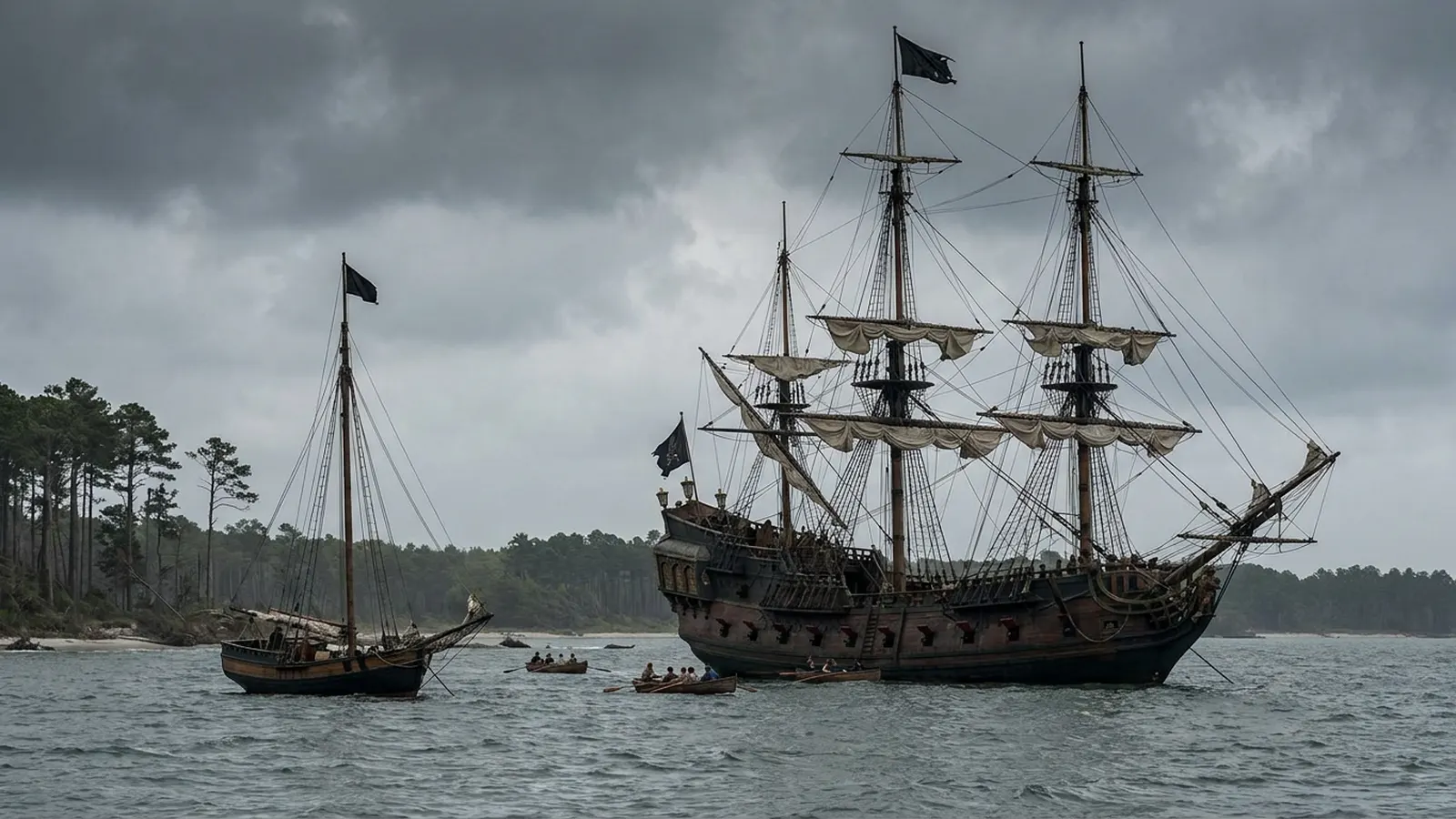
The Blackbeard humiliation
Bonnet’s encounter with Blackbeard in 1717 was the defining episode of his career, and it was entirely humiliating. Blackbeard recognised immediately that Bonnet had a good ship and an incompetent captain, and acted accordingly.
Blackbeard effectively took command of the Revenge, placing one of his own officers in charge and relegating Bonnet to passenger status aboard his own vessel. Bonnet sailed with Blackbeard’s fleet for months, his ship crewed by Blackbeard’s men, while he was effectively a supernumerary with no role in operations. Eventually Blackbeard marooned him — left him with some of his original crew on a sandbar — before making off with the plunder. Bonnet was rescued by another of his own crew and returned to his ship. He spent much of the rest of his short career attempting to track down Blackbeard for revenge, a pursuit that went nowhere.

Capture and trial
In September 1718, Colonel William Rhett of South Carolina was commissioned to hunt Bonnet, who had been raiding the North Carolina coast. Rhett located Bonnet in the Cape Fear River and a five-hour battle ensued, ending with Bonnet’s capture. The engagement was the most substantial naval action in colonial South Carolina history.
Bonnet was taken to Charleston for trial. He escaped briefly — apparently with some assistance from the civilian population who found his gentlemanly manner sympathetic — but was recaptured on Sullivan’s Island. His trial was presided over by Nicholas Trott, the same judge who had handled Blackbeard’s former crew members. Trott was unsympathetic. Bonnet wrote letters to the Governor pleading for clemency and promising to reform. The Governor did not intervene. Twenty-nine of Bonnet’s crew were hanged in November 1718; Bonnet was hanged on December 10, 1718, at White Point, Charleston.
Legacy
Bonnet’s story has a quality unique in the Golden Age: genuine pathos. He was not a man ground down by poverty and circumstance who chose piracy as the only viable option. He had options. He threw them away for an adventure he was manifestly unqualified for, was humiliated by the most famous pirate of his era, achieved nothing of significance, and was hanged less than two years after he started. His letters from prison — pleading, undignified, desperate — are the most humanising documents to survive from any Golden Age pirate’s life. They reveal a man who understood, too late, exactly what he had done.

Related on TheSea
Why is Stede Bonnet called the Gentleman Pirate?
Because he was genuinely a gentleman — a wealthy Barbadian plantation owner with social standing, education, and a comfortable life — who abandoned it to become a pirate. The contrast between his background and his career was remarkable to contemporaries and has fascinated historians ever since. He also reportedly maintained gentlemanly habits aboard ship, including keeping a library.
What was Stede Bonnet’s relationship with Blackbeard?
Blackbeard took effective command of Bonnet’s ship, the Revenge, placing one of his own officers in charge and reducing Bonnet to a passenger. Bonnet sailed with Blackbeard’s fleet for months with no operational role. Blackbeard eventually marooned him. Bonnet subsequently pursued Blackbeard seeking revenge, without success. The relationship was defined entirely by Bonnet’s humiliation.
Why did Stede Bonnet become a pirate?
No reliable explanation survives. Johnson’s account attributes it to a “disorder of the mind” and an unhappy marriage. Other accounts suggest financial pressure, desire for adventure, or simple midlife dissatisfaction. Bonnet left no clear statement of his own motivations. His prison letters focus on pleading for clemency rather than explaining his decision.
How was Stede Bonnet captured?
Colonel William Rhett of South Carolina located Bonnet in the Cape Fear River in September 1718 and captured him after a five-hour naval engagement. Bonnet escaped briefly from Charleston but was recaptured on Sullivan’s Island. He was tried and hanged in December 1718.
What makes Bonnet unique among Golden Age pirates?
He purchased his ship outright rather than capturing one, which was unique among documented Golden Age pirates. He paid his crew wages rather than shares, also unusual. He had no maritime experience. He was genuinely wealthy before turning pirate, with no economic motive for the career. Every aspect of his entry into piracy contradicted the standard model.
Blane Perun has been exploring Earth’s oceans and marine life for over 25 years. Founder of TheSea.Org in 1999, underwater photographer, coral aquaculture pioneer, and explorer of 80+ countries.
About Blane Perun → More on Pirates →