Nuestra Señora de Atocha — The 1622 Galleon the Florida Keys Swallowed
The Nuestra Señora de Atocha was a Spanish treasure galleon that sank in a hurricane about 35 miles west of Key West, Florida, on September 6, 1622, killing all but five of the 265 people aboard. Treasure hunter Mel Fisher found its main cargo pile on July 20, 1985, after a 16-year search, and it remains one of the richest shipwreck recoveries ever made.
This page is the ship’s story: who built it, why it sailed late, how it sank, how Spain tried and failed to salvage it, and the court case that decided who owned it. For the inventory of silver bars, coins and emeralds, see our companion page on the treasure found on the Atocha.
What was the Nuestra Señora de Atocha?
The Atocha was a galleon of about 550 tons, built in Havana for the Spanish Crown and commissioned in 1621. It was named for the shrine of Our Lady of Atocha in Madrid. Its job was to guard and carry the wealth of the Americas: silver from Potosí and Mexico, gold and Colombian emeralds, copper, tobacco and indigo, all moved each year from ports like Cartagena and Portobelo to Havana and on to Seville. The Atocha sailed as the almiranta, the rear guard of the Tierra Firme fleet, so it was heavily armed with about 20 bronze guns. That also made it a favored ship for merchants and officials shipping registered cargo and contraband.
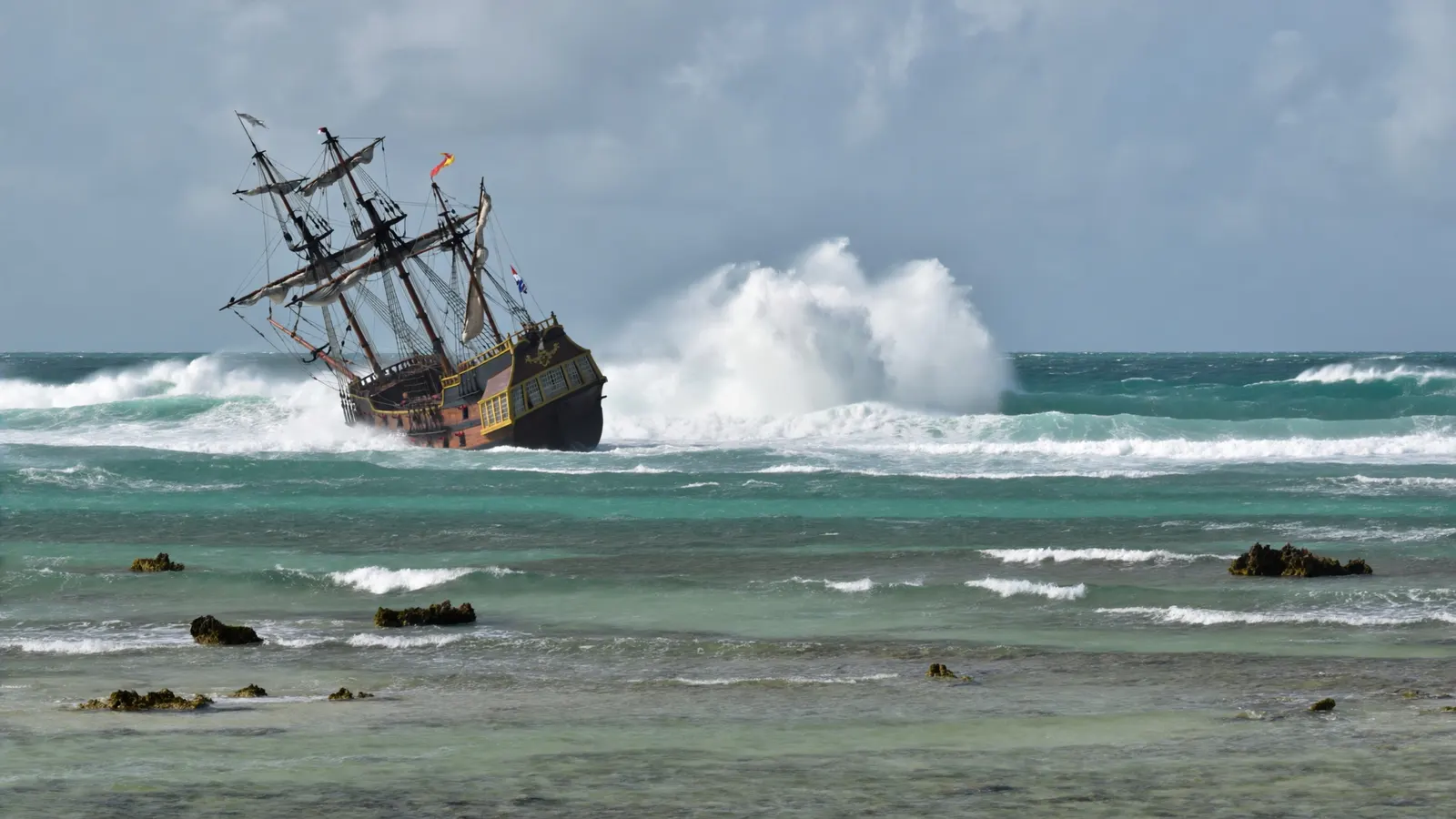
Why did the Atocha sink?
Timing. The 1622 fleet of 28 ships left Havana on September 4, about six weeks behind schedule, which pushed it into the peak of hurricane season. A storm hit on the second day out. The Atocha was driven onto the reefs near the Marquesas Keys, its hull split, and it sank in about 55 feet of water. By the morning of September 6, several ships of the fleet had gone down (eight by the most common count), including the Atocha’s sister ship, the Santa Margarita. On the Atocha, only three sailors and two enslaved men survived, by clinging to the stump of the mizzenmast that still stood above the waves.
| Date | Event |
|---|---|
| 1620–21 | Atocha ordered and built in Havana |
| Sept 4, 1622 | 28-ship fleet leaves Havana, six weeks late |
| Sept 5–6, 1622 | Hurricane sinks 8 ships, including Atocha and Santa Margarita |
| Oct 5, 1622 | Second hurricane scatters the Atocha wreck |
| 1969 | Mel Fisher begins searching |
| 1975 | Dirk Fisher finds five bronze cannon with Atocha markings |
| July 1, 1982 | US Supreme Court rules for Treasure Salvors |
| July 20, 1985 | Main cargo pile found |
Did Spain try to salvage the Atocha?
Yes. Spanish salvors found the wreck soon after the storm, but 55 feet was too deep to open the hull with 17th-century gear. A second hurricane on October 5, 1622, tore the wreck apart and scattered it. Salvors did recover much of the Santa Margarita’s registered cargo over the following years, using a bronze diving bell and enslaved divers forced to work in dangerous conditions; many died. The Atocha itself was lost to them, and for more than 300 years it was a name in the archives of Seville.
How did Mel Fisher find the Atocha?
Fisher, a former chicken farmer turned dive-shop owner, began searching in 1969 with his company, Treasure Salvors. His team searched the wrong area at first, until historian Eugene Lyon found a 1622 document in Seville’s Archive of the Indies, in 1970, saying survivors had camped on the “Cayos del Marqués.” That pointed the search to the Marquesas Keys, and Fisher moved his operation to Key West. Clues came slowly: silver bars in 1973, then five bronze cannon in 1975 found by his son Dirk. Days later Dirk, his wife Angel and diver Rick Gage drowned when their salvage boat capsized. Fisher kept going under his motto, “Today’s the day.” On July 20, 1985, his son Kane radioed from the boat Dauntless that they had found the main pile.
Who owns the Atocha treasure?
The finders do. Florida first claimed the wreck and took a 25% share under salvage contracts, but federal courts later recognized Treasure Salvors’ title and rejected a separate claim by the United States. In 1982 the US Supreme Court, in Florida Department of State v. Treasure Salvors, Inc., ruled that Florida could not use the Eleventh Amendment to keep artifacts it held, without deciding the state’s ownership itself. The case helped push Congress to pass the Abandoned Shipwreck Act of 1987, which gave states title to many historic wrecks in their waters.
A Havana-built galleon for the treasure convoys
Spain moved the silver of its American empire in armed convoys, and the Atocha was built specifically for that job. Ordered in 1620 and completed at the Havana shipyard for King Philip IV, it was rated at 550 toneladas, with a length of about 34 m, a beam of about 10 m and a draft of a little over 4 m. It carried two square-rigged masts and a lateen-rigged mizzen, and its armament is usually given as 20 heavy guns plus four to eight small swivel pieces known as versos. A ship of that size normally had a working crew of around 110, with soldiers and passengers added for the Atlantic crossing.
No plans survive, so its appearance is reconstructed from what was typical of an early 17th-century Spanish galleón: a high forecastle and an even higher sterncastle, separated by a low waist. That tall stern matters to the modern story. It held the cabins of senior officers and wealthy passengers, and therefore much of the private and smuggled wealth, which is one reason the missing stern section is still hunted today.
As almiranta of the Tierra Firme fleet, the Atocha sailed at the rear of the convoy to protect stragglers from attack. Rear-guard galleons were among the strongest ships in a fleet, and that strength made them the preferred vessels for registered silver. Part of the treasure reached the fleet by mule train across Panama, and recording and loading the Atocha’s share alone reportedly took about two months. Delays in Veracruz and Havana then stacked up until the 28-ship convoy left Cuba on September 4, far into the season every pilot in the Caribbean feared.
The people aboard
Accounts of the number aboard vary slightly. Most give 265 people, while a numismatic history of the wreck gives a complement of 260; either way only five lived. The survivors, three sailors and two enslaved men, were picked up by the merchant ship Santa Cruz after clinging to the mizzenmast stump above the reef. Among the drowned was the navigator Bartolomé García de Nodal, who had explored the waters around Cape Horn at the southern tip of South America a few years earlier.
The losses went far beyond one ship. The Santa Margarita alone lost 142 people, and the fleet’s total death toll across all the wrecks is usually put at about 550. Exactly how many ships went down is reported differently: the Atocha’s usual history says eight, while accounts centred on the Santa Margarita count six wrecked near the Marquesas Keys. The difference reflects which smaller vessels are included and where they were lost along the stretch from the Marquesas to the Dry Tortugas.
Spain’s salvage campaign and a diving bell
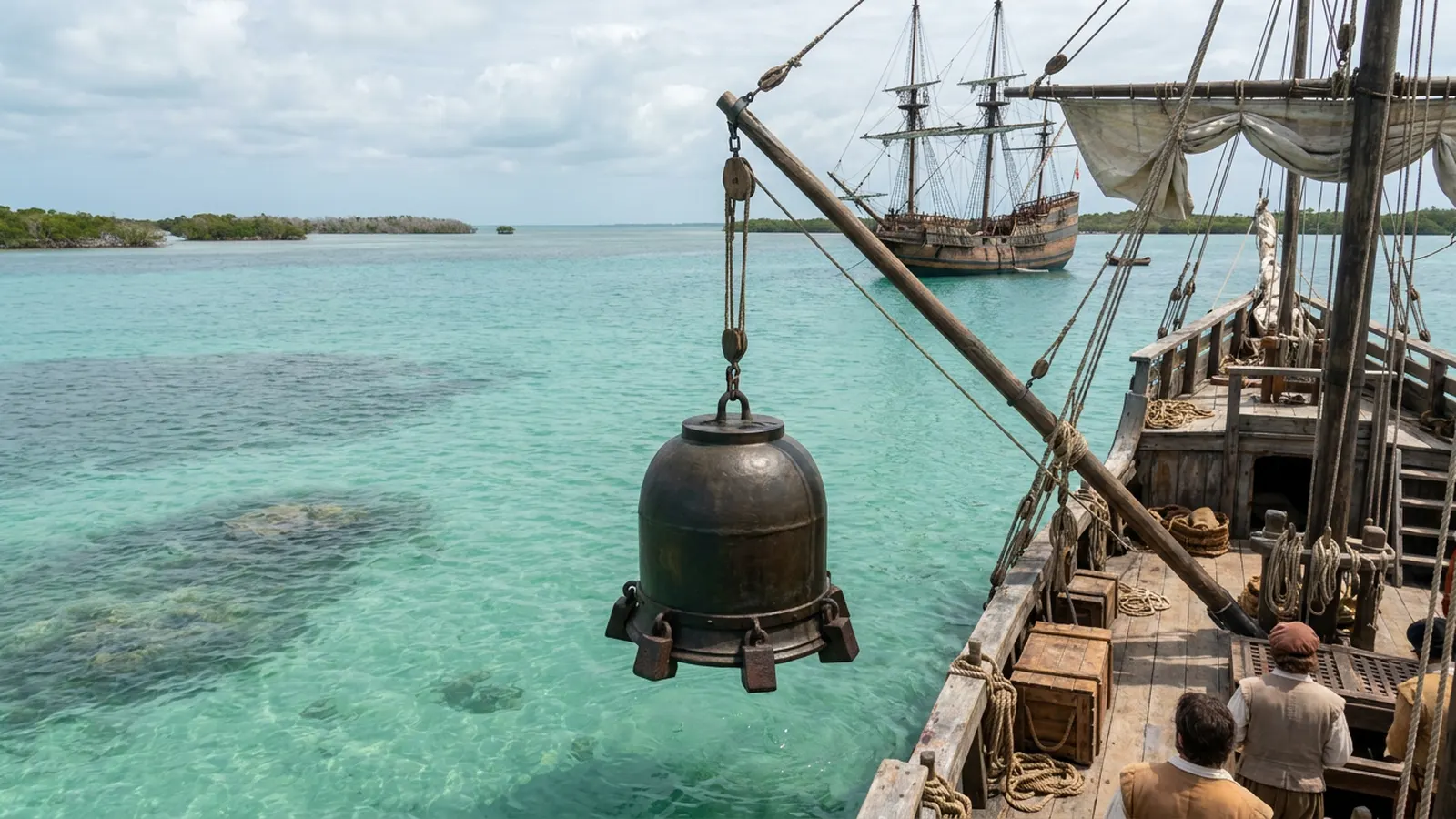
Spain did not simply write the fleet off. Captain Gaspar de Vargas began searching almost at once and sent for pearl divers from the island of Margarita off Venezuela, men whose breath-hold skills were the best available. In 1624 the Havana official Francisco Núñez Melián won a royal contract to salvage the lost galleons. He had a metal diving bell made, a chamber that let a diver see and breathe on the bottom for longer than a single breath allowed, and on 3 June 1626 one of his enslaved divers, recorded with the surname Bañón, located the Santa Margarita. Records say the find won him his freedom.
Melián’s crews worked the Santa Margarita for several years, interrupted by bad weather and by Dutch warships, and are reported to have recovered around 350 silver ingots, thousands of coins and eight cannons, close to half of that ship’s registered cargo. Enslaved divers did the dangerous work, and deaths were logged as a business cost. The Atocha, scattered by the October storm into deeper water and shifting sand, defeated them; Spanish searchers never located its main hull in roughly 60 years of trying. Melián’s reports survived in the archives, and three and a half centuries later they helped modern searchers find the Santa Margarita again in 1980.
That 1980 work produced a curious object: a large copper dome about 147 cm across, made from two sheets and edged with a heavy riveted rim. In 2023 the maritime archaeologists Sean Kingsley and Jim Sinclair argued in Wreckwatch magazine that it could be the top of Melián’s bell, or an earlier one lost in the area. The idea is plausible but unproven. No document says a bell was lost there, the argument has not been through peer review, and other specialists have said the seams need close study before the dome can be called a diving bell rather than a cauldron or other fitting.
What the loss cost Spain
The 1622 disaster arrived at a bad moment for the Spanish crown. Spain was fighting in the Thirty Years’ War, and the treasure fleets were the collateral behind its loans. Losing the Atocha, the Santa Margarita and their consorts forced the crown to borrow more and to sell several galleons to raise money. For merchants in Seville the blow was personal as well, because much of what sank was private silver and goods registered to individual traders, plus an unknown amount of contraband smuggled aboard to avoid the royal fifth, a tax of 20 percent on precious metals.
Reading the wreck: manifests, scatter and the missing stern
The Atocha is an unusual wreck because Spanish bureaucracy recorded its cargo so closely. The ship’s register listed 901 silver ingots, about 255,000 silver coins and 161 pieces of gold. Each silver bar carried a serial number and a fineness mark among its stamps, and those details were copied into the ship’s register. That turned recovered bars into fingerprints. One bar raised in 1985 carries the manifest number 767 and weighs 88 pounds 8.96 ounces at 2,380 parts in 2,400 fine, details that match the register and tie the object to the ship beyond reasonable doubt.
The physical site is a long scatter rather than a single pile. Dirk Fisher’s five bronze cannons, found on July 13, 1975, lay in about 39 feet of water, while the main ballast and silver pile of 1985 lay in about 55 feet. Between and around them stretched a trail of coins, bars and fittings left by the hull as it broke up and was dragged by the second hurricane. Salvors call one productive sandy area about 22 feet deep the “Bank of Spain.” Treasure Salvors hired the archaeologist Duncan Mathewson to direct recording during the main search, and the company built up long experience in conserving metal and organic finds from seawater.
What remains unfound is substantial. Beyond the sterncastle, histories of the search list about 300 silver bars and eight bronze cannons still unaccounted for. Each new find is still checked against the 1622 register, which is how divers know what the sea is still holding back.
The legal fight, in more detail
The ownership battle is often summarized as “Fisher beat Florida,” but the case was more technical. After the early finds, Florida claimed the wreck under a state statute and signed contracts with Treasure Salvors that gave the company 75 percent of the appraised value of what it raised. Then, in an unrelated 1975 case, United States v. Florida, the Supreme Court ruled that the seabed where the Atocha lay belonged to the United States as against Florida, putting the wreck outside state waters.
Treasure Salvors filed an admiralty action against the wreck itself in the federal district court for southern Florida. The district court and the Fifth Circuit rejected the federal government’s own claim to the galleon and recognised the finders’ title. Florida, however, still held some of the most valuable artifacts in Tallahassee. The 1982 Supreme Court decision, Florida Department of State v. Treasure Salvors, decided only that the Eleventh Amendment did not stop the federal court from seizing those objects from state officials; it expressly declined to rule on Florida’s ownership. The practical result was that the salvors got the artifacts back.
The case and others like it alarmed archaeologists and state governments. Congress responded with the Abandoned Shipwreck Act of 1987, which gave states title to most abandoned historic wrecks embedded in their submerged lands. Internationally, concern over commercial salvage of historic sites fed into the 2001 UNESCO Convention on the Protection of the Underwater Cultural Heritage, which discourages the sale of recovered heritage. The Atocha remains a reference point in both debates, admired as a feat of persistence and criticized as treasure hunting.
Mel Fisher beyond the Atocha
Mel Fisher was born in Hobart, Indiana, in 1922 and moved to California, where he opened one of the state’s first dive shops, See Da Sea. His wife and business partner, Dolores “Deo” Fisher, was one of the early women divers and once stayed underwater for 50 hours to set a women’s record. Besides the Atocha, his company found the Santa Margarita and the remains of the slave ship Henrietta Marie, lost in 1700, and it later sold its rights to wrecks of Florida’s 1715 Fleet. Fisher sold Treasure Salvors in 1986, the year after the main find, and died in Key West on December 19, 1998. His company’s successors kept working the Atocha site after his death.
Can you visit the Atocha?
Not the wreck site. It lies in open water west of Key West and is worked under the salvors’ admiralty claim. The best place to see the ship’s story is the Mel Fisher Maritime Museum at 200 Greene Street in Key West, which holds a large share of the recovered gold, silver bars, coins and emeralds, plus ship’s gear. If you dive the Keys, the reefs that sank the 1622 fleet are the same spur-and-groove coral you can swim over today; see our Florida Keys dive galleries.
How does the Atocha compare with other treasure wrecks?
Guinness World Records listed the Atocha in 2014 as the most valuable shipwreck ever recovered. The San José, sunk off Colombia in 1708, is often said to hold more, but it has not been raised. For other Spanish treasure ships compare the Mercedes, sunk in battle in 1804, and the El Cazador, a silver brig lost in the Gulf of Mexico. For a 19th-century gold wreck, read the SS Central America.
When did the Atocha sink?
On September 6, 1622, in a hurricane off the Florida Keys, two days after leaving Havana.
Where is the Atocha shipwreck?
About 35 miles west of Key West, near the Marquesas Keys, in about 55 feet of water.
How many people died on the Atocha?
260 of the 265 aboard. Three sailors and two enslaved men survived.
Who found the Atocha?
Mel Fisher’s company Treasure Salvors, which found the main cargo pile on July 20, 1985, after a 16-year search.
What was found on the Atocha?
Silver bars and coins, gold, emeralds, copper and artifacts. See our Atocha treasure page for the inventory.
Has all the Atocha treasure been found?
No. The sterncastle, thought to hold much of the gold and emeralds, is still missing.
Who won the Atocha court case?
Treasure Salvors. Federal courts recognized the company’s title, and in 1982 the US Supreme Court ruled that Florida could not keep the artifacts it held.
Where can I see the Atocha treasure?
At the Mel Fisher Maritime Museum, 200 Greene Street, Key West, Florida.
- Wikipedia: Nuestra Señora de Atocha (construction, 1622 fleet, salvage, litigation).
- Mel Fisher Maritime Heritage Society: The 1622 galleons.
- Florida Department of State v. Treasure Salvors, Inc., 458 U.S. 670 (1982).
- Florida Department of State v. Treasure Salvors, Inc., 458 U.S. 670 (1982), syllabus (on United States v. Florida, 1975, and the 75% contracts).
- Sedwick Coins: history of the Atocha and silver bar 767 (manifest of 901 bars, 255,000 coins, 161 gold pieces).
- Wikipedia: Santa Margarita (shipwreck); Francisco Núñez Melián; Mel Fisher.
- Live Science (September 2023): copper dome from the Santa Margarita site proposed as a 17th-century diving bell (Kingsley and Sinclair, Wreckwatch).
Blane Perun has been exploring Earth’s oceans and marine life for over 25 years. Founder of TheSea.Org in 1999, underwater photographer, coral aquaculture pioneer, and explorer of 80+ countries.
About Blane Perun →