Sharks in California — White Shark Nurseries, Leopards and the Red Triangle
California’s waters hold a wide range of sharks, and the most famous, the white shark, uses the coast in two ways. Young white sharks of about 1.5 to 3 metres gather for weeks or months within about 500 metres of Southern California beaches, with drone surveys showing them at popular beaches on 97 percent of days when aggregations had formed, yet bites remain extremely rare. Adults hunt seals at central California hotspots such as the Farallon Islands and Año Nuevo, then migrate far offshore. Leopard sharks, broadnose sevengills, common threshers, horn sharks and angel sharks are common closer to home. California recorded 5 unprovoked bites in 2025, one of them fatal.
California’s sharks are mostly quiet neighbours: the white sharks that patrol its beaches are usually young fish-eaters, and the big seal hunters work offshore islands and headlands.
What sharks live in California?
California’s long coast spans cold, upwelling-fed water in the north and warmer water in the Southern California Bight, the curve of coast from Point Conception south to the Mexican border. That range supports a varied shark fauna. In the bays and estuaries live leopard sharks, broadnose sevengill sharks, brown smoothhounds and grey smoothhounds. On rocky reefs and kelp forests there are horn sharks, swell sharks and Pacific angel sharks. Offshore, in the open ocean, swim blue sharks, shortfin makos, common threshers and, in colder northern waters, salmon sharks. And along the whole coast, from Southern California beaches to islands off San Francisco, there are white sharks.
Most of these species are small or shy. Swell sharks and horn sharks rest in crevices by day, angel sharks bury themselves in sand, and leopard sharks cruise the shallows eating clams, worms and crabs. The species that matter for beachgoers are, in practice, white sharks, and most of what follows is about how they use the California coast. Our leopard shark, sixgill shark and thresher shark profiles cover some of the other residents.
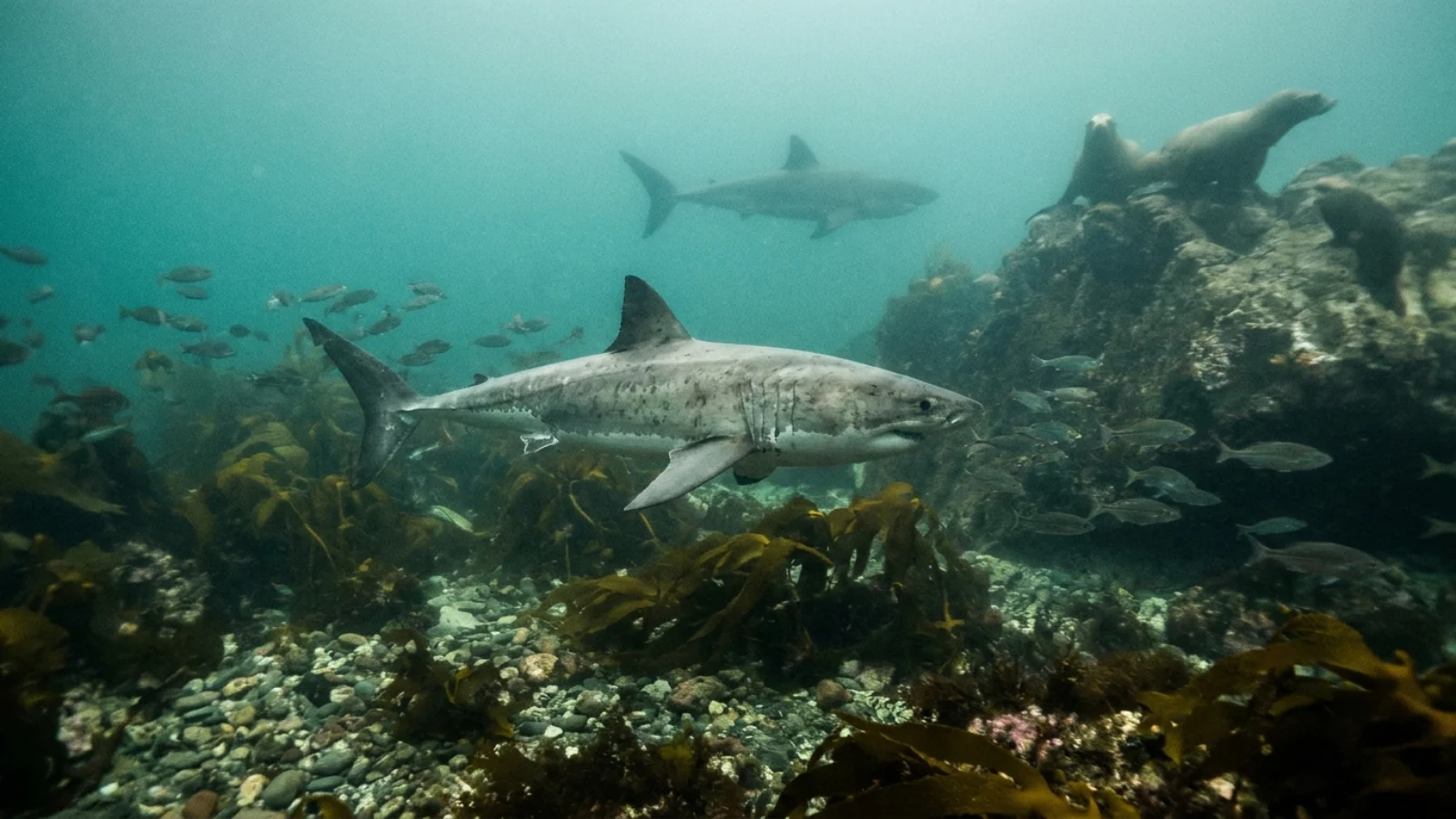
Where do great white sharks live in California?
California’s white sharks belong to the northeastern Pacific population, which scientists consider demographically separate from white sharks elsewhere. In a 2009 study in Proceedings of the Royal Society B, Jorgensen and colleagues combined satellite tags, acoustic monitoring and genetics to show that eastern Pacific white sharks follow a highly predictable migratory cycle, returning year after year to the same network of coastal hotspots after long oceanic migrations. Their DNA showed they form a population distinct from other known lineages, probably founded by migrants from Australia or New Zealand during the late Pleistocene and kept separate since by strong homing behaviour.
The adults’ coastal hotspots in California are in the centre of the state, at places where seals and sea lions haul out, including Southeast Farallon Island west of San Francisco and Año Nuevo Island to the south. The region is nicknamed the “Red Triangle”, a roughly triangular area with its corners at Bodega Bay north of San Francisco, the Farallon Islands, and Big Sur or Monterey Bay to the south. It is rich in elephant seals, harbor seals, sea lions and sea otters, and around 38 percent of recorded white shark attacks on people in the United States have happened inside it. The sharks congregate along the north and central coast each autumn, leave in December for a patch of deep ocean roughly halfway between California and Hawaii that researchers call the White Shark Café, and begin returning in August; adults are absent from the Red Triangle in May. Females tend to return to the Gulf of the Farallones every two years, probably in step with their reproductive cycle.
Much of this was worked out by the Tagging of Pacific Predators programme, an international collaboration that began fitting electronic tags to white sharks and other large ocean animals off California in 1999. Its results confirmed that Red Triangle white sharks are genetically distinct from those off South Africa and Australia, and its maps of tagged sharks crossing thousands of kilometres of open Pacific to the Café and back changed how scientists thought about the species, from a coastal predator to an ocean wanderer with fixed coastal addresses.
How many are there? When the US National Marine Fisheries Service reviewed the population in 2013, after petitions to list it under the Endangered Species Act, photo-identification at central California and Guadalupe Island in Mexico gave a combined estimate of about 339 subadult and adult white sharks, and a model for central California alone gave 219. The agency decided that listing was not warranted, identifying bycatch of newborn and juvenile sharks in gillnet fisheries off Southern California and Baja California as the main threat. California itself had already given the species temporary protection in 1993, confirmed by state law in 1997. The global picture is in are great white sharks endangered.
What happens at the Farallon Islands?
The Farallon Islands, about 48 kilometres (30 miles) outside the Golden Gate, are one of the most studied white shark sites in the world, and their history explains why. In the early nineteenth century the islands were stripped of seals. Russian hunters maintained a sealing station there from 1812 to 1840, taking 1,200 to 1,500 fur seals a year, and in 1810 alone American sealing ships there took at least 30,000 seal skins. By 1818 seal numbers had collapsed, and within a few years fur seals had been wiped out on the islands. The recovery of elephant seals, sea lions and other pinnipeds after protection brought the white sharks back to hunt them.
The Farallones have also shown that white sharks have something to fear. In a 2019 study in Scientific Reports, Jorgensen and colleagues used long-term tagging and survey data to show that brief visits by killer whales repeatedly drove white sharks away from Southeast Farallon Island, disrupting their feeding for extended periods. Seal kills by white sharks at the island in a given year fell as close encounters with killer whales rose, and tagged sharks that left moved to other sites, producing detectable increases in white shark numbers at Año Nuevo Island. That story is told in more detail in do orcas eat sharks.
Why are young white sharks off Southern California beaches?
Southern California is a white shark nursery. Newborn and young white sharks spend their first years in the warm, shallow waters of the Southern California Bight, eating fish and other small prey rather than seals, and they have been studied intensively. A 2018 study in the Journal of Fish Biology measured 112 juvenile white sharks caught in the Bight between June 2008 and August 2017 and found they gain more mass per unit length than juveniles in other populations, a sign of a rich nursery.
Young white sharks form loose groups of mixed sizes, roughly 1.5 to 3 metres long, that stay at a particular beach for weeks or months, often within 500 metres of shore. In a 2023 study in PLOS ONE, Rex and colleagues flew 1,644 drone surveys at 26 beaches across Southern California between January 2019 and March 2021 to measure how often sharks and people overlap. The sharks were strongly clumped: 1,096 of 1,204 shark sightings were at just two locations, Carpinteria and Del Mar. They were close enough to the surf zone to meet water users, at a median distance of 101 metres from shore (range 2 to 702 metres), and at beaches where groups had formed, sharks and people were in the water together on 97 percent of days. Stand-up paddleboarders overlapped with the sharks most.
The striking finding was what did not happen. Despite daily encounters, unprovoked bites in Southern California remained extremely rare. High overlap, the authors concluded, does not translate into more bites, and juvenile white sharks appear to have little interest in people. A 2025 study in Wildlife Research found that young white sharks caught near shore fed mainly on coastal prey, while those caught more than 5 kilometres offshore relied more on offshore food, suggesting different behavioural groups within the nursery, with the offshore sharks more exposed to fishing gear.
What other sharks are common in California?
The leopard shark is the shark most Californians see. It is a slim, boldly spotted shark of shallow bays, beaches and estuaries, found from Coos Bay in Oregon to Mazatlán in Mexico, including the Gulf of California. It is harmless to people and feeds mainly on clams, spoon worms, crabs, shrimp, small fish and fish eggs, often following the rising tide onto mudflats. Leopard sharks move with the temperature: a study in Tomales Bay found they leave when the water falls below 10 to 12 °C, and one tagged shark swam about 140 kilometres south. Genetic work has identified seven discrete gene pools along the California coast between Humboldt Bay and San Diego, which means local groups are surprisingly separate. The species is fished mainly off California, and after a decline in the 1980s new regulations in the early 1990s brought catches back to sustainable levels.
The broadnose sevengill shark is a very different animal, a primitive shark with seven gill slits instead of the usual five. It is especially common in San Francisco Bay, around the Golden Gate Bridge and Alcatraz Island, and it occasionally hunts in groups to take larger prey. Sevengills were targeted by commercial fisheries along the California coast as recently as the 1930s and 1940s, and recreational fishing for them grew in the 1980s and 1990s. Further offshore, the common thresher, which reaches about 6 metres, uses its enormously long upper tail lobe like a whip to deliver stunning blows to schooling fish.
Where can you see sharks in California?
The safest place to see a white shark up close was once the Monterey Bay Aquarium, which in 2004 became the first aquarium to successfully keep and display one. Before that, the longest any white shark had survived in an aquarium was 16 days; the first Monterey shark was displayed for six months and then released. Six young white sharks were shown in the aquarium’s million-gallon Open Sea exhibit between 2004 and 2011, an effort that was controversial but is generally credited with scientific and educational value. The aquarium no longer displays white sharks.
In the wild, snorkellers and kayakers often see leopard sharks in shallow, sandy bays in summer, and divers meet horn sharks and angel sharks on Southern California reefs. Shark-watching from shore is possible at nursery beaches, where lifeguards and researchers monitor juvenile white sharks, although the sharks are usually only visible from the air.
How common are shark attacks in California?
Rare, and much rarer per swimmer than in Florida. The International Shark Attack File recorded 5 unprovoked shark bites in California in 2025, one of them fatal, compared with 11 in Florida and 25 in the United States as a whole. Nearly all serious bites in California involve white sharks, and the Red Triangle alone accounts for a large share of the country’s white shark attacks, because surfers, divers and swimmers there share the water with seal-hunting adults.
California’s fatal attack record is short but grim. Since the 1950s, almost every fatal attack in the state has been attributed to a white shark. Early cases include 17-year-old Barry Wilson in December 1952 and abalone diver Robert Pamperin, who was taken at La Jolla Cove in June 1959. Later deaths include swimmer Michelle von Emster off Point Loma, San Diego, in April 1994; bodyboarder Lucas Ransom and surfer Francisco Javier Solorio Jr., killed at the same spot, Surf Beach, in October 2010 and October 2012; surfer Ben Kelly at Manresa State Beach near Watsonville in May 2020; and Tomas Butterfield at Morro Bay on Christmas Eve 2021. Considering the enormous number of people who surf, swim and dive along the coast every year, the numbers are very small. Global statistics are in our article on how many shark attacks happen each year.
How is California protecting its sharks?
California was an early mover on shark conservation. Besides protecting white sharks since 1993, the state passed a ban on the possession and sale of shark fins, following Hawaii’s lead; Governor Jerry Brown cited the cruelty of finning and threats to the environment and commercial fishing when he signed it. A national ban on the shark fin trade, the Shark Fin Sales Elimination Act, followed in 2022. Bycatch of young white sharks in gillnets off Southern California and Baja California remains the main threat identified for the population.
How do you stay safe from sharks in California?
Most advice reflects the different habits of adult and juvenile white sharks. In central and northern California, avoid swimming or surfing near seal and sea lion colonies and river mouths, especially in autumn, and stay out of the water if a marine mammal carcass is nearby. In Southern California, follow lifeguard warnings and beach advisories when juvenile white sharks are reported, swim and surf in groups, and avoid murky water and the low light of dawn and dusk. Do not swim with bleeding wounds, and leave the water calmly if a shark is seen close by.
So, what should you know about sharks in California?
California’s sharks are as varied as its coast. Leopard sharks patrol the shallows, sevengills hunt San Francisco Bay, threshers whip through schools of fish offshore, and white sharks use the coast twice over: as a nursery for young fish-eaters along Southern California beaches, and as seal-hunting grounds for adults at the Farallones, Año Nuevo and the headlands of the Red Triangle. Drone studies have shown just how often people and young white sharks share the water without incident. Bites are rare, but the adults deserve respect, especially near seal colonies in autumn.
Are there great white sharks in California?
Yes. Juveniles live off Southern California beaches and adults hunt seals at central California sites such as the Farallon Islands.
Where are the most sharks in California?
Juvenile white sharks gather most at Carpinteria and Del Mar; adults gather at the Farallones, Año Nuevo and nearby headlands.
What is the Red Triangle?
The area between Bodega Bay, the Farallon Islands and Big Sur or Monterey Bay, known for its seal-hunting white sharks.
How many shark attacks were there in California in 2025?
The International Shark Attack File recorded 5 unprovoked bites in California in 2025, one of them fatal.
Are leopard sharks dangerous?
No. Leopard sharks eat clams, worms and crabs and are considered harmless to people.
Are great white sharks protected in California?
Yes. California has protected white sharks since 1993, confirmed by state law in 1997.
What sharks live in San Francisco Bay?
Leopard sharks, broadnose sevengill sharks and smoothhounds are common in the bay.
Did Monterey Bay Aquarium have a great white shark?
Yes. It displayed six young white sharks between 2004 and 2011, the first aquarium to do so successfully.
- Jorgensen SJ et al. (2009). Philopatry and migration of Pacific white sharks. Proceedings of the Royal Society B, doi:10.1098/rspb.2009.1155; Jorgensen SJ et al. (2019). Killer whales redistribute white shark foraging pressure on seals. Scientific Reports, doi:10.1038/s41598-019-39356-2.
- Rex et al. (2023). Patterns of overlapping habitat use of juvenile white shark and human recreational water users along southern California beaches. PLOS ONE, doi:10.1371/journal.pone.0286575.
- Logan et al. (2018). Body condition and morphometric relationships in southern California juvenile white sharks. Journal of Fish Biology, doi:10.1111/jfb.13785; Samara Chacon et al. (2025). Wildlife Research, doi:10.1071/wr24183.
- National Marine Fisheries Service (2013) northeastern Pacific white shark status review findings, as summarised in our article on white shark status; International Shark Attack File 2025 summary.
- Red Triangle geography and white shark seasonality (Wikipedia, “Red Triangle (Pacific Ocean)”).
- Farallon Islands sealing history, Monterey Bay Aquarium white shark exhibits, California fatal attacks, leopard, sevengill and thresher sharks, state fin bans (Wikipedia articles of those names).
Blane Perun has been exploring Earth’s oceans and marine life for over 25 years. Founder of TheSea.Org in 1999, underwater photographer, coral aquaculture pioneer, and explorer of 80+ countries.
About Blane Perun →