Is the Red Sea Safe to Swim? — What Actually Hurts Swimmers, and How to Avoid It
Yes — for most people the Red Sea is safe to swim, and millions do so every year at resorts such as Sharm el-Sheikh, Hurghada, Marsa Alam, Dahab, Aqaba and Eilat. The water is warm, clear and usually calm. The real risks are mostly small and avoidable: stepping on stonefish or sea urchins, brushing fire coral, currents off reef edges, and sunburn and dehydration. Shark bites are rare but not unknown; there were fatal attacks near Hurghada in 2022 and 2023, so always follow local beach closures and guidance.
Calm, warm, extremely clear water, sheltered lagoons and jetties to reach the reef, and a well-developed tourism industry with lifeguards, marked swimming zones and dive guides at most resorts. Water temperatures range from about 21–22 °C in winter in the north to around 30 °C in summer in the south, so hypothermia is rarely a concern.
What are the real dangers when swimming in the Red Sea?
Most injuries in the Red Sea come from touching or stepping on small reef animals, from currents off the reef edge, and from the sun. Big predators make the headlines, but they account for a tiny share of the problems swimmers actually run into.
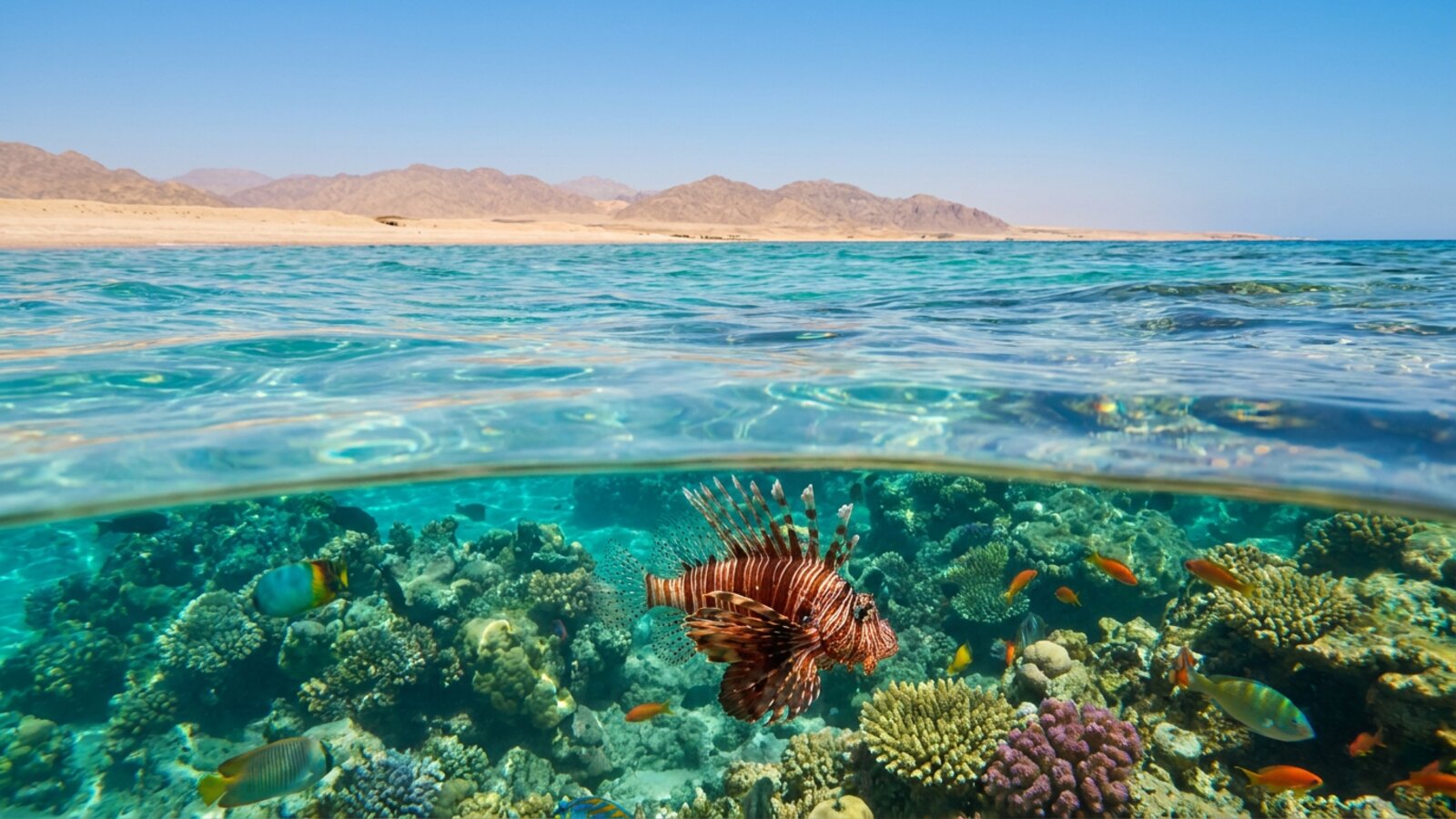
The Red Sea is a long, narrow basin, roughly 2,250 km from Suez to the Bab-el-Mandeb strait and 355 km across at its widest. Its coasts are lined with about 2,000 km of fringing coral reef, and in many resorts the reef starts a few metres from the beach. That is what makes the sea so rewarding for snorkellers, and it is also the main source of risk: the shallow reef flat is covered with animals that sting, spike or cut, and the reef edge can drop away into deep blue water within a few strokes.
The typical holiday injuries follow a predictable pattern. Cuts and grazes from coral, spines from sea urchins, burns from fire coral, stings from venomous fish, sunburn, heat exhaustion and ear infections are far more common than any encounter with a large animal. Serious incidents usually involve swimming outside marked areas, exhaustion in a current, or a diver pushing beyond training. Keeping those categories in mind is more useful than worrying about sharks.
How dangerous are stonefish, urchins and fire coral?
These three cause most of the painful injuries, and all three are avoided by the same rule: do not stand on, kneel on or touch the reef.
Stonefish belong to the genus Synanceia, and they are generally regarded as the most venomous fish known. Two species occur in the Red Sea: the reef stonefish, Synanceia verrucosa, which ranges from the Red Sea across the Indo-Pacific, and the smaller Red Sea stonefish, Synanceia nana, found in the Red Sea and the Persian Gulf. Both look like a lump of algae-covered rock and sit motionless in shallow water, often right where people wade. Venom glands sit at the base of the needle-like dorsal spines, which rise when the fish is disturbed, and the amount injected rises with the pressure applied, so a full step is far worse than a brush. Stings cause intense pain and can bring respiratory weakness, cardiovascular effects, convulsions and paralysis; deaths are rare but documented.
First aid for stonefish and other venomous fish stings is heat. Immersing the wound in water of at least 45 °C, as hot as the person can tolerate without scalding, helps break down the protein venom and eases the pain. Antivenom exists and is used for severe cases, so anyone stung should still go to a clinic. Scorpionfish and lionfish carry related venoms; their stings are usually less severe, but the treatment is the same. Reef shoes with thick soles are the single best prevention, together with entering the water from a jetty or pontoon rather than wading across the reef flat.
Long-spined sea urchins gather in crevices and on sand patches in the shallows, especially near jetties. Their spines are brittle, break off under the skin and can work their way in over days. Small fragments often dissolve or are expelled on their own, but spines near a joint, or wounds that become red and swollen, need a doctor. The cause is almost always the same: walking on the reef flat at low water or putting a hand down to steady yourself.
Fire corals, genus Millepora, are not true corals at all but hydrozoans, closer relatives of Hydra and the siphonophores. They grow as mustard-yellow to brown branches, plates or crusts, often over other corals, and are easy to mistake for weed or rock. Tiny stinging cells protrude from pores on the surface. Contact causes burning pain that can last from two days to two weeks, with redness, raised welts and sometimes fever; the venom is not lethal, but the sharp skeleton also scrapes the skin, so wounds can become infected. Rinse with seawater, not fresh water, avoid rubbing, and see a pharmacist or doctor if the rash spreads.
Cone snails, crown-of-thorns starfish, bristle worms and some sea anemones round out the list of animals best left alone. None of them chase people; nearly every sting happens because someone picked up a shell, leaned on the reef or reached into a hole.
Are there sharks in the Red Sea?
Yes. The Red Sea has a rich shark fauna, most often given as 44 species, including whitetip and grey reef sharks, hammerheads, thresher, silky, oceanic whitetip, mako and tiger sharks. Most live along deep walls and offshore reefs and are rarely seen from resort beaches.
The figure of 44 shark species is the one quoted most widely in reference works; general guides often round it to “more than 40”. It sits within a wider fish fauna that is itself counted differently by different authors. The 2010 checklist by Daniel Golani and Sergey Bogorodsky in Zootaxa listed 1,078 valid fish species, while other summaries put the total at more than 1,200, with around 10% found nowhere else. The gap reflects how species are counted, whether deep-water fish are included, and new records added since.
The Red Sea’s geography is part of the shark story. The basin averages about 490 m deep and reaches 3,040 m in the Suakin Trough, and the fringing reefs often fall steeply into hundreds of metres of water. Reference accounts note that this combination of a narrow sea, great depth and sharp drop-offs means large ocean-going sharks can patrol deep water yet be within a hundred metres of a swimming area. That is why incidents, though rare, involve open-ocean species such as oceanic whitetips, makos and tiger sharks more often than reef sharks.
When have shark attacks happened in the Red Sea?
Fatal attacks are rare, but there has been a run of serious incidents on Egypt’s coast since 2010. Dates and species below are taken from contemporary news and reference reports; species identifications were often provisional.
Sharm el-Sheikh, December 2010. On 1 December 2010 four snorkellers, three Russians and a Ukrainian, were badly injured within minutes of each other near Ras Nasrani; two lost limbs. On 5 December a 71-year-old German woman, Renata Seifert, was killed while snorkelling in the shallows at Naama Bay. An expert team later concluded that both oceanic whitetips and makos had been involved. Suggested triggers included sheep carcasses dumped from livestock ships around Eid al-Adha, illegal feeding of fish and sharks near shore, overfishing of natural prey and unusually warm water. Swimming and water sports were suspended along the coast while the investigation ran.
Sahl Hasheesh, July 2022. On 1 July 2022 a 68-year-old Austrian woman who lived locally was killed while snorkelling in the bay at Sahl Hasheesh, south of Hurghada. A Romanian woman in her late 40s died in a second attack reported on 3 July, her body found about 600 m from the first site. Early reports blamed a mako; later reports suggested an oceanic whitetip or tiger shark, and the species was never firmly confirmed. The Red Sea Governorate suspended in-water activities, including diving, around Sahl Hasheesh and Makadi Bay for several days.
Hurghada, June 2023. A 23-year-old Russian man, Vladimir Popov, was killed by a shark while swimming off Hurghada. Early reports suggested a mako or oceanic whitetip; Egyptian authorities later identified a tiger shark. Around 74 km of coastline was closed to swimming and water sports for several days.
Marsa Alam, December 2024. On 29 December 2024 two Italian tourists snorkelling off the northern Marsa Alam area, near Sataya, were attacked after reportedly straying into deep water outside the designated swimming area. A 48-year-old man from Rome was killed and a 69-year-old companion was injured. Italian news agency reports quoted Egyptian officials as saying a tiger shark was responsible. The surrounding waters were closed while the incident was investigated.
Several less publicised cases fill the gaps between these, including fatal attacks near Marsa Alam in 2015 and elsewhere on the Egyptian coast in 2018, and a non-fatal attack in the Gulf of Suez in 2019, though details in secondary sources are thinner. Put against the many millions of swims taken each year along Egypt’s Red Sea Riviera, the absolute risk to an individual swimmer remains very low. The pattern of recent cases is clear, however: open-ocean sharks, swimmers in deeper water off the reef or outside marked zones, and in 2010 a strong link to food entering the water.
How can swimmers reduce the risk of a shark encounter?
Swim where the beach is guarded and the zone is marked, stay close to shore, and get out when you are told to.
Every recent fatal case involved swimmers in deeper water away from the shallow lagoon, or in an area where authorities later found sharks were being drawn in by food. Staying inside netted or buoyed swimming areas, and on the shallow side of the reef edge, puts distance between you and the drop-off where pelagic sharks travel. Avoid swimming at dawn, dusk and night, when many sharks feed closer to the surface and near shore, and stay away from fishing boats, fish-cleaning stations and boats throwing food scraps.
Do not feed fish, and do not swim with anyone who is. Feeding by snorkellers and divers was one of the factors cited after the 2010 attacks, and it trains reef fish and larger predators to associate people with food. Shiny jewellery and splashing at the surface are commonly cited as attractants too, though the evidence is weaker. If a large shark is sighted, leave the water calmly and tell a lifeguard or dive centre; Egyptian authorities have repeatedly closed beaches and coastlines after sightings and incidents, and those closures should always be respected.
Divers on offshore sites such as the Brothers, Daedalus and Elphinstone are more likely to meet oceanic whitetips, which are curious and persistent. Standard advice on these sites is to stay with the group, avoid lingering at the surface, and follow the guide’s instructions if a shark shows interest. These sites are open-water, current-swept reefs intended for experienced divers, not for casual snorkellers.
Is the Red Sea safe for snorkelling and diving?
Yes, with sensible precautions. The Red Sea is one of the world’s most popular dive destinations, served by many well-run operators.
Modern scuba divers were exploring sites such as the Blue Hole by the late 1960s, and resorts such as Sharm el-Sheikh, Hurghada, Dahab, Marsa Alam, Aqaba and Eilat now train large numbers of beginners. Shore entries via jetties, sheltered house reefs and a long diving season make it an easy place to learn. The flip side is that the clear, warm water makes deep dives feel easier than they are. Use a reputable, licensed centre, dive within your training and certification limits, check your equipment and keep a conservative profile, particularly on multi-day liveaboards with several dives a day.
Boat safety is part of the picture too. Liveaboards visit remote southern reefs, and the late-2024 sinking of the liveaboard Sea Story, which left eleven people dead or missing according to diving-press reports, was a reminder to choose operators with a good record, listen to the safety briefing and know where life jackets and exits are.
Snorkellers should treat reef walls with respect. In many places the bottom falls from a metre or two to tens of metres in a single stroke, and a weak swimmer can tire quickly in a mild current. A snorkel vest or other flotation, fins, a buddy and a plan for getting out are worth more than any amount of reading about sharks.
How deep is the Blue Hole in Dahab, and why is it so dangerous?
The Blue Hole north of Dahab is a submarine sinkhole whose depth is reported differently: reference accounts give a maximum depth of just over 100 m, while some travel guides say it may reach about 130 m. The danger lies in an underwater tunnel, the Arch, far below recreational limits.
The rim of the hole sits close to shore, so divers and snorkellers can reach it directly from the beach. On the seaward side a shallow bank about 6 m deep, known as the Saddle, links the hole to the open sea. Deeper down is the Arch, a tunnel about 26 m long. Its ceiling is generally given as about 55 m, although some guides put the archway at around 65 m, and its floor falls away toward the seaward side to roughly 120 m; beyond the reef the seabed drops to more than 1,000 m. Recreational diving is generally limited to 40 m, so passing the Arch on air or a single tank is far beyond normal training.
The site is often described as having the most diver deaths of any in the world, though nobody keeps a reliable count. One estimate puts the toll at about 130 divers between 1997 and 2012; another claims as many as 200. The figures include some snorkelling deaths at the surface unrelated to the Arch. The suggested causes are consistent: the clear water makes the tunnel look shorter than its true 26 m; the entrance is hard to find, so divers can miss it and keep descending with no visual reference; an inward current often slows the swim through; nitrogen narcosis clouds judgement at that depth; and the dive requires decompression and careful gas management that a single tank cannot reliably provide. The best-known case is the death of 22-year-old Russian instructor Yuri Lipski on 28 April 2000, who descended uncontrollably to 115 m while filming.
The Blue Hole itself, at recreational depths, is no more dangerous than other Red Sea sites, and the popular Bells to Blue Hole dive stays above about 30 m. Egypt’s Chamber of Diving and Water Sports now stations a police officer at the site to check that divers go in with a certified guide. Freedivers also use the hole because of the deep water close to shore and the lack of current, always under supervision.
Is the water clean, and why is it so salty?
Generally yes. Very low rainfall and the absence of major rivers mean little silt or runoff, so visibility is usually excellent.
Rainfall over the Red Sea and its coasts averages about 60 mm a year, and evaporation can reach about 2,050 mm a year. With no significant rivers draining into it and only a narrow connection to the Gulf of Aden, the sea is one of the saltiest bodies of seawater in the world. Salinity ranges from about 36‰ in the south to 41‰ in the north around the Gulf of Suez, with an average of about 40‰, compared with roughly 35‰ for the world ocean. In practice that means slightly better buoyancy, so many people float more easily, and a salty film on the skin that is worth rinsing off to avoid irritation and stinging eyes.
Water quality can be poorer near large resort developments, harbours and desalination plants. Sewage, construction runoff and the warm brine discharged by desalination plants on the Saudi coast are documented pressures on reefs, though their effects are mostly local. For swimmers the practical advice is to choose established beaches away from outfalls and marinas, keep cuts covered, and avoid swallowing water near harbours. Jellyfish are generally less of a problem than in many other seas, though blooms can occur.
When is the best time to swim, and how warm is the water?
The Red Sea is swimmable all year, but conditions change by season and by latitude.
Average summer surface temperatures are about 26 °C in the north and 30 °C in the south, and the overall average is about 22 °C. Surveys off Sudan and Eritrea have recorded surface water of 28 °C in winter and up to 34 °C in summer. The northern gulfs around Sinai, Aqaba and Eilat are the coolest parts of the sea in winter, so many swimmers and divers there wear a thin wetsuit from about December to March. In midsummer the risk shifts from cold to heat: air temperatures on the Egyptian and Saudi coasts are high, the desert air is dry, and sunburn and dehydration are the most common reasons tourists seek medical help.
The northern Red Sea is dominated by persistent north-westerly winds, and the sea is known for strong winds and unpredictable local currents. Tidal currents squeezing through gaps in reefs and sandbars commonly exceed 1 to 2 m per second, faster than most people can swim. On windy days, choose sheltered bays and house reefs, watch the flags, and ask the dive centre where the current is running before you get in.
Safety checklist for swimming in the Red Sea
A few simple habits prevent nearly all problems.
| Do | Don’t |
|---|---|
| Wear reef shoes and enter from jetties or sand | Walk or stand on coral |
| Swim in marked zones with a buddy | Swim alone off reef edges or outside buoys |
| Use a rash vest and reef-safe sunscreen | Touch fish, urchins, fire coral or cone shells |
| Drink plenty of water | Swim at dawn, dusk or night near open water |
| Follow beach closures and flags | Feed fish or swim near fishing boats |
| Dive with a licensed centre within your training | Attempt the Blue Hole Arch without technical training |
Related reading: lionfish and threats to Red Sea reefs.
Is it safe to swim in the Red Sea?
Yes, for most people at established resorts. The main risks are reef animals, currents and sun; shark attacks are rare but have occurred, most recently near Marsa Alam in December 2024.
How many shark species live in the Red Sea?
The figure most often cited is 44 species; general guides round it to more than 40. Most live along deep walls and offshore reefs.
When were the recent fatal shark attacks in Egypt?
Sharm el-Sheikh in December 2010, Sahl Hasheesh near Hurghada in July 2022 (two deaths), Hurghada in June 2023, and Marsa Alam in December 2024.
How deep is the Dahab Blue Hole?
Reference accounts give a maximum depth of just over 100 m; some guides say up to about 130 m. The Arch ceiling is usually given as about 55 m, some guides say about 65 m.
How salty is the Red Sea?
About 40‰ on average, from about 36‰ in the south to 41‰ in the north, compared with about 35‰ for the open ocean.
What should I do if stung by a stonefish?
Immerse the wound in hot water of at least 45 °C, as hot as tolerable without scalding, and get medical help; antivenom is available for severe cases.
Is the Red Sea safe for kids?
Sheltered lagoons and sandy beaches with lifeguards are good choices. Use reef shoes and a snorkel vest for children snorkelling over reefs.
Is the Red Sea warm enough to swim in winter?
Yes, though the northern gulfs are cooler; many people wear a thin wetsuit there from about December to March.
- Golani, D. & Bogorodsky, S.V. (2010). The fishes of the Red Sea: reappraisal and updated checklist. Zootaxa 2463 (1,078 species).
- Wikipedia. Red Sea (dimensions, 44 shark species, salinity 36–41‰, temperature, rainfall and evaporation, desalination); Blue Hole (Red Sea); Stonefish; Fire coral; 2010 Sharm El Sheikh shark attacks.
- Lonely Planet. Blue Hole, Dahab (depth up to about 130 m, archway about 65 m).
- Divernet (July 2022). Second woman dies at Sahl Hasheesh.
- DIVE Magazine (June 2023; December 2024). Russian tourist killed in Hurghada shark attack; One dead, one injured in fatal Marsa Alam shark attack.
- ANSA (30 December 2024). Tiger shark killed Italian tourist, says Egypt.
Blane Perun has been exploring Earth’s oceans and marine life for over 25 years. Founder of TheSea.Org in 1999, underwater photographer, coral aquaculture pioneer, and explorer of 80+ countries.
About Blane Perun → More on Red Sea →