What Are Coral Reefs Made Of? — Limestone Built by Living Animals
Coral reefs are made mostly of limestone, or calcium carbonate. Tiny coral animals called polyps take calcium and carbonate from seawater and build hard skeletons of a mineral form called aragonite. Over thousands of years, those skeletons pile up into a reef framework, which is bound together by coralline algae that act like cement, and filled in with sand and rubble made from broken coral, shells, algae and other skeletons. Only a thin surface layer of a reef is alive. Underneath lies the stony remains of countless generations of coral, and within the living coral tissue are microscopic algae, zooxanthellae, that help power the whole process.
Run your hand over a coral reef (gently, and only where it’s allowed) and it feels like rock. In a sense it is. But unlike ordinary rock, a reef’s stone was made by living things, one microscopic layer at a time, over thousands of years. Coral reefs are some of the largest structures built by living organisms on Earth. This guide explains what reefs are made of, from the limestone framework to the algal cement, sand and living tissue, how all those ingredients are produced, how they come together over time, and why the reef’s building material is now under threat.
Mostly limestone
The hard substance of a reef is calcium carbonate, the same mineral found in chalk, marble and seashells.
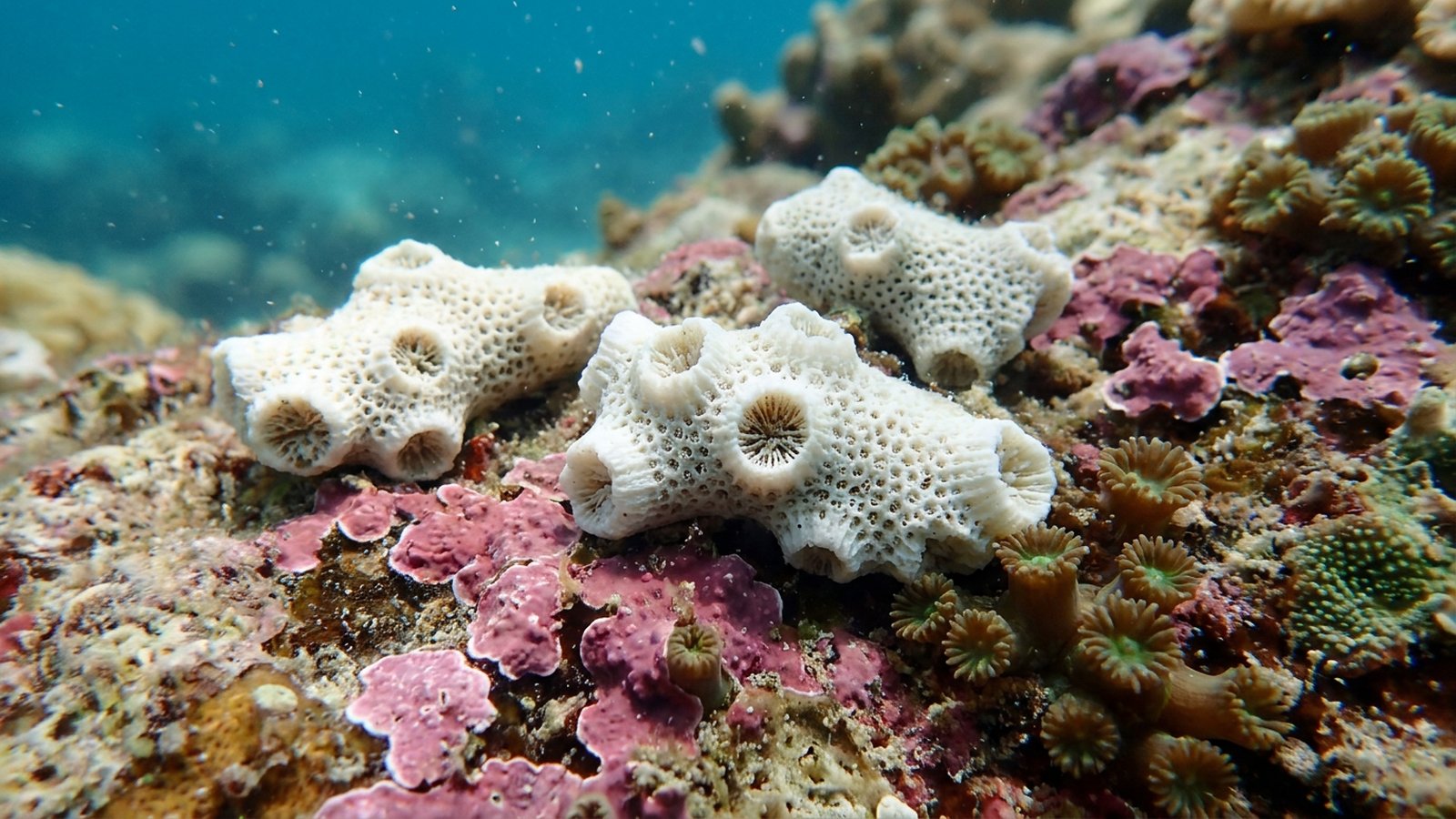
The bulk of a coral reef is limestone, made of the mineral calcium carbonate. Unlike limestone formed by geological processes alone, reef limestone is biogenic: it was built by living organisms. Stony corals, also called hard or scleractinian corals, produce skeletons of a form of calcium carbonate called aragonite. Coralline algae, molluscs and many other reef organisms add their own calcium carbonate in slightly different mineral forms.
The process starts with the coral polyp, a small soft-bodied animal related to sea anemones. A layer of cells at the base of each polyp draws calcium and carbonate ions from seawater and lays down aragonite crystals beneath itself, building a small stony cup called a corallite. As the polyp grows, it lifts itself up and adds more skeleton below. Most reef-building corals are colonies of many polyps connected by living tissue, so their skeletons merge into branching, plate-like, boulder-shaped or encrusting forms. Learn more about the animals in the animals that make coral reefs are called polyps.
Only the surface of all this limestone is alive. The bulk of a reef is the accumulated skeletons of past corals and other organisms, with a thin skin of living coral on top. A reef is mostly stone, thinly coated with life.
More than coral: the other builders
Corals build the framework, but many other organisms help make a reef solid.
Coralline algae. Crustose coralline algae are pink, purple or reddish algae that deposit calcium carbonate in their cell walls and grow as hard crusts over rock and dead coral. They bind coral skeletons and rubble together like living cement, helping the reef resist the pounding of waves. On the most exposed reef crests, they can be as important to the structure as corals themselves. They also help coral larvae settle, as described in invertebrate metamorphosis.
Calcifying green algae. Green algae such as Halimeda grow segmented “leaves” stiffened with calcium carbonate. When they die, the segments break apart and become a major source of reef sand in many places.
Shells and skeletons. Molluscs, foraminifera (single-celled organisms with tiny shells), sea urchins, bryozoans, tube worms and others all contribute their hard parts. When they die, their shells and skeletons become part of the reef’s sediment.
Even reef fish play a role. Parrotfish scrape algae off dead coral with their beak-like teeth, grinding up limestone as they feed and excreting it as fine sand. On many reefs, a large share of the white sand on nearby beaches was produced this way.
How the ingredients come together
A reef is a constant contest between building and breaking down.
A reef grows through a cycle. Corals and coralline algae build the framework. At the same time, bioeroders, organisms that break down limestone, attack it. Boring sponges, worms, clams and microscopic algae drill into coral skeletons; sea urchins and parrotfish scrape and grind the surface; and storms snap branches and topple coral heads.
The fragments this produces are not lost. Rubble and sand settle into gaps in the framework, where coralline algae and natural chemical processes gradually cement them in place. Over time, framework, sediment and cement fuse into solid reef rock. New corals settle on top and the cycle continues.
When building outpaces erosion, the reef grows upward and outward. Individual branching corals can grow several centimetres a year, and massive boulder corals around a centimetre a year in good conditions, but the reef as a whole typically accumulates much more slowly. That is why large reefs take thousands of years to form. See how this structure develops in what forms the structure called a coral reef.
The living ingredients
A reef’s thin living layer is what makes it a reef rather than a fossil.
Over the limestone grows a living skin of coral tissue. These polyps feed, reproduce and keep adding new skeleton, so the reef keeps growing. If the living layer dies, the reef stops building and erosion begins to win. Read what happens when coral reefs die.
Inside the coral tissue live microscopic algae called zooxanthellae. They photosynthesise and pass sugars and other nutrients to the coral, providing much of its energy. That extra energy helps reef-building corals lay down skeleton quickly enough to build reefs. It also gives many corals their colour. When stressed by heat, corals can expel these algae and turn white, which is called bleaching. See why corals expel zooxanthellae.
Living coral surfaces are also coated with mucus and home to communities of bacteria and other microbes that help protect the coral and recycle nutrients. And woven through the structure is the wider reef community of fish, invertebrates, sponges and algae. They are not part of the stone itself, but they are part of what a reef is in the fuller sense: a living ecosystem. For more, see what animals and plants live in coral reefs.
From microscopic to monumental
Reefs are built from tiny increments, added over deep time.
The basic building blocks of a reef are crystals laid down by animals a few millimetres across. Yet the result can be large enough to see from space, like the Great Barrier Reef, which stretches more than 2,000 kilometres along the coast of Australia. Drilling into Pacific atolls has found reef limestone more than a kilometre thick, built up over millions of years as the volcanic islands beneath them slowly sank.
Reef building is also ancient. Different groups of organisms have built reefs for hundreds of millions of years, and modern stony corals have been building reefs for more than 200 million years. Any particular living reef may sit on foundations laid down during many earlier phases of reef growth, interrupted by changes in sea level. Explore that history in how have coral reefs changed over time and the oldest coral reef.
Building material under threat
The chemistry that lets corals build limestone is changing.
As the ocean absorbs carbon dioxide from the atmosphere, seawater becomes more acidic, a process called ocean acidification. This reduces the concentration of carbonate ions that corals and coralline algae need to build their skeletons, making calcification harder and more energy-intensive. It can also speed up the dissolving and bioerosion of existing reef limestone. Learn more in ocean acidification and coral reefs.
At the same time, warming seas kill living corals through bleaching, removing the builders that produce new limestone. When a reef’s living coral dies, erosion can begin to outpace building, and over years the reef framework flattens and crumbles. Pollution, overfishing and physical damage add to the pressure. Protecting the conditions that let corals keep laying down limestone is at the heart of coral reef conservation.
Related on TheSea
- How Fast Does Living Coral Grow?
- How Is Coral Formed?
- Why Are Zooxanthellae Important to Corals?
- What Do Coral Reefs Eat?
- What Kills Coral Reefs?
- What Do Coral Reefs Do?
- Why Are Coral Reefs In Tropical Waters?
- Why Do Coral Reefs Have Such High Productivity?
- Why Are Coral Reefs Important In A Marine Ecosystem?
- Why Are Coral Reefs Overexploited?
- What Animals Live In The Coral Reef?
- Why Are Coral Reefs Dying?
What are coral reefs made of?
Mostly limestone (calcium carbonate). Coral polyps build aragonite skeletons, coralline algae cement them together, and sand and rubble fill the gaps, with a thin layer of living coral on top.
Is coral a rock, a plant or an animal?
Coral is an animal. Each coral is made of polyps, small animals related to sea anemones. Reef-building corals produce a rock-like limestone skeleton and host microscopic algae in their tissues.
How do corals make their skeletons?
Cells at the base of each polyp take calcium and carbonate ions from seawater and lay down crystals of aragonite, a form of calcium carbonate, building a stony cup that grows as the polyp grows.
What holds a coral reef together?
Crustose coralline algae grow over coral skeletons and rubble, binding them into solid rock. Sediment trapped in gaps is also gradually cemented in place.
Is coral reef sand made of coral?
Partly. Reef sand comes from broken coral, but also from calcifying algae such as Halimeda, shells, foraminifera and limestone ground up by parrotfish as they feed.
How long does it take to build a coral reef?
Individual corals can grow a centimetre to several centimetres a year, but large reefs take thousands of years to form, and some atolls sit on reef limestone accumulated over millions of years.
How does ocean acidification affect coral reefs?
It reduces the carbonate ions corals need to build their skeletons, making growth harder, and it can speed up the breakdown of existing reef limestone.
- NOAA Ocean Service: what are coral reefs? and coral anatomy
- Spalding, M.D., Ravilious, C. & Green, E.P. (2001), World Atlas of Coral Reefs, UNEP-WCMC
- Perry, C.T. et al. (2013), caribbean-wide decline in carbonate production threatens coral reef growth, Nature Communications
- Smithsonian Ocean: corals and coral reefs
Blane Perun has been exploring Earth’s oceans and marine life for over 25 years. Founder of TheSea.Org in 1999, underwater photographer, coral aquaculture pioneer, and explorer of 80+ countries.
About Blane Perun → More on Coral Reefs →