What Do Hammerhead Sharks Eat? — Stingrays and Seagrass
Hammerhead sharks eat mostly bottom-living and schooling prey: stingrays and skates, bony fish, crabs, shrimp, squid, octopus and smaller sharks. What they eat depends heavily on the species. The great hammerhead is a stingray specialist that uses its broad head to pin rays to the seabed. The small bonnethead lives largely on blue crabs in Florida and, uniquely among sharks studied so far, also eats and digests seagrass. Adult scalloped hammerheads make rapid dives below 800 metres into cold water, while their pups in Hawaiian nursery bays often struggle to find enough shrimp and small fish to eat.
Every hammerhead is a predator, but the menu runs from stingrays and other sharks in the great hammerhead to crabs and seagrass in the bonnethead.
What do hammerhead sharks eat?
Hammerhead sharks are carnivorous predators with a broad menu. Across the family Sphyrnidae, recorded prey includes bony fish of many kinds, other sharks, skates and stingrays, squid, octopus, crabs, lobsters and shrimp. Most hammerheads hunt close to the seafloor or in the water column over continental shelves and around islands, and their small, crescent-shaped mouths sit underneath the head, which suits prey that lies on or near the bottom.
The family is small, with nine recognised species ranging from the bonnethead, which rarely tops a metre, to the great hammerhead, which can reach about 6 metres. That size range alone tells you their diets cannot be the same. A shark that can be swallowed whole by its larger cousin is not going to eat what the larger cousin eats. So the honest answer to “what do hammerhead sharks eat?” is that it depends on which hammerhead you mean, how old it is and where it lives.
Three species dominate both the research and most people’s encounters: the great hammerhead, the scalloped hammerhead and the bonnethead. Between them they show almost the full range of hammerhead feeding, from stingray hunting to deep diving to grazing on seagrass meadows.
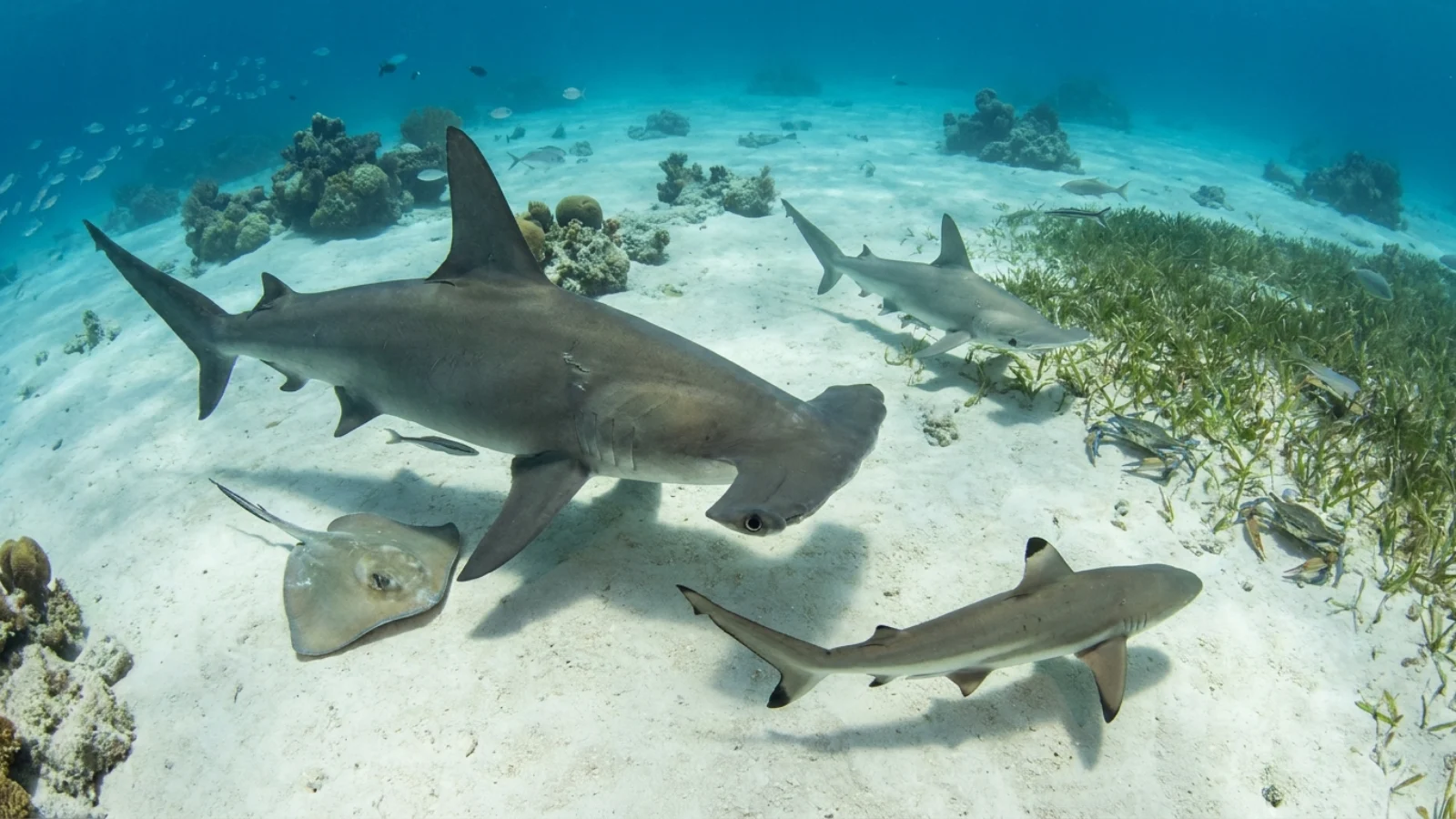
Why are great hammerheads called stingray specialists?
The great hammerhead (Sphyrna mokarran) is the largest member of the family and the one with the most striking diet. Its known prey includes crabs, lobsters, squid and octopus, a long list of bony fish such as tarpon, sardines, sea catfish, toadfish, porgies, grunts, jacks, groupers, flatfish, boxfish and porcupinefish, and smaller sharks. But the prey it is most famous for is the stingray. Great hammerheads are regarded as specialists at feeding on other sharks, skates and rays, and stingray spines are often found embedded in their mouths without appearing to cause them much trouble. One great hammerhead caught off Florida was reported to have 96 stingray spines in and around its mouth.
That reputation is not just anecdote. When scientists used DNA metabarcoding on the gut contents of great hammerheads caught in bather-protection gillnets off northern New South Wales, Australia, they found the sharks had fed mainly on stingrays and skates, with bony fish as a secondary item, in a study published in Scientific Reports in 2021. The same study made a useful methodological point. DNA from the prey’s own last meal turns up in the predator’s gut, a “Russian doll” effect that makes it hard to separate what the shark ate from what its prey ate. That is one reason diet studies still combine DNA with old-fashioned visual identification of stomach contents.
Great hammerheads also feed on other sharks, including smaller hammerheads, and larger individuals have been recorded eating members of their own species. As an apex predator among sharks, an adult great hammerhead has few natural enemies apart from larger sharks and people, and that position at the top of the food web shapes what it can afford to eat.
How does a hammerhead use its head to catch a stingray?
The best-known description comes from a 1990 paper in the journal Copeia by Strong, Snelson and Gruber, which documented a great hammerhead attacking a southern stingray in the Bahamas. The shark struck the ray from above with a heavy blow that knocked it to the seabed, then pinned it there with its head. With the ray held down, the shark pivoted and took large bites from each side of the ray’s disc, effectively disabling it before eating it.
This is one of the clearest examples of the cephalofoil, the hammer-shaped head, being used as a tool rather than only as a sensory platform. Pinning a ray to the sand stops it from fleeing and keeps its tail and spine away from the shark’s body, and biting out the wings removes the ray’s ability to swim. Great hammerheads have been seen patrolling sandy flats with their heads swinging close to the bottom, a search pattern that fits a predator looking for animals buried just under the sand.
How do hammerheads find hidden prey?
Stingrays, crabs and flatfish spend much of their time buried. To find them, hammerheads rely heavily on electroreception, the ability to detect the faint electric fields produced by the muscles and nerves of living animals. Sharks sense these fields through jelly-filled pores called ampullae of Lorenzini, which are spread across the underside of the hammerhead’s wide head.
For years the leading explanation for the hammer was that it improves this sense. Stephen Kajiura and Kim Holland tested the idea in 2002 in the Journal of Experimental Biology, comparing juvenile scalloped hammerheads with sandbar sharks of similar size. Both species oriented to prey-like electric fields from about 30 centimetres away and showed similar sensitivity, with response thresholds below one nanovolt per centimetre. The difference lay in how they turned. The hammerheads pivoted sharply, keeping the edge of the head nearest the signal stationary while bending the body round toward it, whereas sandbar sharks swam in a wider arc. The wide head appears to give the hammerhead a larger search swath and the ability to make tight, fast turns onto prey, rather than a more sensitive receiver.
The same kind of sweeping search has been described in bonnetheads, which swing their heads in arcs over the seafloor like a metal detector, then turn sharply and bite into the sediment where they detect a signal. Smell matters too. The widely spaced nostrils of hammerheads may help them work out the direction of an odour, a point covered in our guide to whether sharks can really smell blood. Vision plays a part as well, as the eyes at the tips of the hammer give these sharks a wide field of view above and below.
What do bonnethead sharks eat?
The bonnethead (Sphyrna tiburo) is the smallest and most common hammerhead in the shallow bays and seagrass beds of the southeastern United States, including Florida’s Gulf coast and estuaries. It feeds mostly on crustaceans, especially blue crabs, along with shrimp, molluscs such as small clams and snails, and small fish. A 2010 study of bonnethead feeding mechanics described the diet in South Florida waters as consisting almost entirely of blue crabs, which the sharks crush or swallow whole.
To deal with hard-shelled food, the bonnethead has small, sharp teeth at the front of the jaw for grabbing and flat, broad molar-like teeth at the back for crushing. Even so, it is not a powerful biter. The same study measured maximum theoretical bite forces from about 26 newtons at the front of the jaw to about 108 newtons at the back, and found the bonnethead has the second-lowest mass-specific bite force of any fish measured at the time. It makes up for this with technique, positioning crabs at the back of the jaw, where the force is greatest, before grinding through the shell and swallowing with suction.
Do bonnethead sharks really eat seagrass?
Yes, and this is the most surprising fact in hammerhead feeding. Earlier gut-content studies had found that seagrass can make up as much as 62.1 percent of the contents of a bonnethead’s stomach by mass. For a long time, scientists assumed the grass was swallowed by accident while the sharks grabbed crabs and shrimp in seagrass beds, or that it passed straight through undigested.
In 2018, Samantha Leigh, Yannis Papastamatiou and Donovan German tested this directly, in a paper in Proceedings of the Royal Society B titled “Seagrass digestion by a notorious carnivore”. They fed captive bonnetheads a diet that included seagrass labelled with the carbon-13 isotope, then tracked where that carbon went. The sharks digested about 50 percent of the seagrass organic matter, and the labelled carbon turned up in the sharks’ own tissues, showing that nutrients from the plants were assimilated. The researchers also detected enzyme activity in the hindgut capable of breaking down components of cellulose.
That makes the bonnethead the first shark shown to be an omnivore in a meaningful sense: not just a predator that happens to swallow plants, but one that gains nutrition from them. Seagrass may still not be its main food, and a shark that relies on crabs is not about to become a grazer. One suggestion is that plant material may also help protect the stomach from spiky crab shells. Either way, the finding changed how biologists think about shark digestion, and it hints that bonnetheads may move nutrients around within the seagrass meadows that are vital nurseries for so many Florida fish.
What do scalloped hammerheads eat?
The scalloped hammerhead (Sphyrna lewini) is a generalist and opportunistic predator, feeding on whatever is available and abundant. Its diet is dominated by fish, including sardines, mackerel and herring, along with squid and octopus. Larger sharks take larger prey, and adults have been recorded eating smaller sharks such as blacktip reef sharks. There is no clear difference between what males and females eat, but there is a strong difference with age: juveniles feed inshore, while adults add prey from deeper water.
Adults are famous for schooling by day around seamounts and islands such as the Galapagos and Cocos, then dispersing at night to feed. A 2022 stable isotope study in the Galapagos Marine Reserve found evidence of a shift in resource use between subadults and adults, with adult females showing signatures consistent with feeding in highly productive waters around the islands.
How deep do scalloped hammerheads dive to feed?
Very deep, and in a remarkable way. A 2023 study published in Science by Mark Royer and colleagues attached biologgers to adult scalloped hammerheads off Hawaii. The sharks dived rapidly and repeatedly from warm surface water at about 26 degrees Celsius to depths beyond 800 metres, where the water can be as cold as 5 degrees. For a tropical shark that should be a problem, because blood passing through the gills normally exchanges heat with the surrounding water, chilling the body within minutes.
Yet the sharks’ muscle stayed warm throughout the deepest part of each dive. Heat-transfer modelling suggested that the sharks were suppressing gill function during the deep phase, in effect holding their breath, so that cold water could not draw heat out of the blood. Cooling only began late in the ascent, and once it started it was rapid. The researchers compared the strategy to the breath-hold dives of marine mammals. These deep, cold excursions are thought to give adult scalloped hammerheads access to the squid and fish of the deep scattering layer, a rich food source that most tropical sharks cannot exploit for long.
Why do baby hammerheads go hungry?
Young scalloped hammerheads tell the other side of the story. Kaneohe Bay on Oahu is one of the best-studied hammerhead nurseries in the world. Juvenile hammerheads there feed mainly on small bottom-living animals, chiefly shrimp and small fish such as gobies, with most feeding happening at night, according to Aaron Bush’s 2003 diet study. Bush and Kim Holland had already estimated the pups’ daily ration in 2002 and titled their paper “Food limitation in a nursery area”.
A 28-month tagging study by Kanesa Duncan and Kim Holland, published in 2006 in Marine Ecology Progress Series, put numbers on the problem. Kaneohe Bay receives an estimated 7,700 newborn hammerheads each year, but only about 7 to 15 percent are still there a year later. Many recaptured pups had lost weight, especially in their first weeks, and body condition was lowest in late summer and early autumn. The authors concluded that a main cause of the low survival was starvation, and that the bay probably offers more protection from predators than it does food. For a hammerhead pup, the trade-off between eating and being eaten is very real.
Do hammerheads change their diet as they grow?
Almost all of them do. Great hammerheads are a good example, and one with a Florida connection. A 2025 study by Jacob Hlavin and Catherine Macdonald analysed carbon and nitrogen isotopes in great hammerheads from 63 to 287 centimetres fork length in and around Biscayne Bay, an urban nursery area next to Miami. Young sharks depended mainly on rays and other batoids in the bay, supplemented by bay fish. At around 125 centimetres fork length, or roughly two years old, they began a partial shift toward coastal prey dominated by bony fish, and some larger sharks added other sharks to the menu.
Older sharks also had broader diets, and subadults switched between coastal feeding in the dry season and bay feeding in the wet season, possibly to avoid competition with adult hammerheads that become more common in the area at that time. The authors suggested that the narrow diets of young great hammerheads could make them especially vulnerable to damage to nursery habitats and the prey that live there.
Do hammerheads eat people?
No. People are not hammerhead prey. The great hammerhead is large enough and has sharp enough teeth to injure a swimmer, and it has a reputation as the most dangerous of its family, but divers usually report it as shy or uninterested. Bites by hammerheads are rare and almost never fatal. Our separate guide to whether hammerhead sharks attack humans looks at the records in detail.
Why does the hammerhead diet matter for conservation?
Hammerheads are among the most threatened sharks. The great hammerhead is listed as Critically Endangered on the IUCN Red List, and an analysis published in Nature in January 2021 that included the species found that oceanic sharks and rays had declined by 71 percent in about 50 years. Hammerhead fins are among the most valuable in the fin trade, and the sharks often die quickly after being hooked, which makes catch-and-release less forgiving than for hardier species.
Their diets add to the risk in subtle ways. Juveniles depend on shallow nursery bays and the rays, crabs and small fish that live there, so dredging, pollution and loss of seagrass can reduce food in exactly the places young sharks need it. Bonnetheads are tied closely to seagrass meadows, and great hammerheads to the stingrays of sand flats and bays. Protecting hammerheads therefore means protecting the habitats that feed them, not just limiting fishing.
So, what do hammerhead sharks eat?
In short, almost anything that lives near the bottom or schools over the shelf, with each species leaning toward its own speciality. Great hammerheads hunt stingrays, skates and other sharks, pinning rays to the sand with their heads. Scalloped hammerheads eat schooling fish and squid, diving into cold, deep water to reach them, while their pups scrape by on shrimp and gobies. Bonnetheads crunch blue crabs and, alone among sharks so far, digest the seagrass they live in. For more on each species, see our profiles of the great hammerhead, scalloped hammerhead and bonnethead.
What is a hammerhead shark’s favorite food?
For the great hammerhead, stingrays. Bonnetheads favour blue crabs, and scalloped hammerheads eat mostly fish and squid.
Do hammerhead sharks eat stingrays?
Yes. Great hammerheads specialise in stingrays and skates, pinning them to the seabed with their heads before biting.
Do hammerhead sharks eat plants?
Bonnetheads eat and digest seagrass, absorbing about half of its organic matter in a 2018 study.
Do hammerheads eat other sharks?
Yes. Great hammerheads eat smaller sharks, including other hammerheads, and large scalloped hammerheads take small reef sharks.
How do hammerheads find buried prey?
They sweep their wide heads over the bottom, sensing the weak electric fields of animals hidden in the sand.
What do baby hammerhead sharks eat?
Pups eat small shrimp, crabs and fish such as gobies; in Hawaii’s Kaneohe Bay many struggle to find enough.
When do hammerhead sharks hunt?
Many hunt at dusk and night; scalloped hammerheads school by day and disperse to feed after dark.
Do hammerhead sharks eat humans?
No. People are not prey, and bites by hammerheads are rare and almost never fatal.
- Strong, W.R., Snelson, F.F. & Gruber, S.H. (1990), “Hammerhead shark predation on stingrays: an observation of prey handling by Sphyrna mokarran“, Copeia.
- Kajiura, S.M. & Holland, K.N. (2002), “Electroreception in juvenile scalloped hammerhead and sandbar sharks”, Journal of Experimental Biology 205.
- Leigh, S.C., Papastamatiou, Y.P. & German, D.P. (2018), “Seagrass digestion by a notorious ‘carnivore'”, Proceedings of the Royal Society B; Mara, K.R., Motta, P.J. & Huber, D.R. (2010), bonnethead bite force, J. Exp. Zool. A.
- Royer, M. et al. (2023), “‘Breath holding’ as a thermoregulation strategy in the deep-diving scalloped hammerhead shark”, Science.
- Bush, A. (2003), Environ. Biol. Fishes; Duncan, K.M. & Holland, K.N. (2006), juvenile scalloped hammerheads in Kaneohe Bay, Marine Ecology Progress Series 312.
- de Bruyn, M. et al. (2021), DNA diet of great hammerheads, Scientific Reports; Hlavin, J.F. & Macdonald, C.C. (2025), great hammerhead resource use in Biscayne Bay, Ecology and Evolution; Cerutti-Pereyra, F. et al. (2022), PLOS ONE.
Blane Perun has been exploring Earth’s oceans and marine life for over 25 years. Founder of TheSea.Org in 1999, underwater photographer, coral aquaculture pioneer, and explorer of 80+ countries.
About Blane Perun →