Are Great White Sharks Endangered? — Status by Region
Not globally. The IUCN Red List classifies the great white shark as Vulnerable, one category below Endangered. That global label hides big regional differences. In the Mediterranean the species is regarded as Critically Endangered after steep declines. New Zealand lists it as Nationally Endangered and Australia as Vulnerable. In the United States it is not listed under the Endangered Species Act, because federal scientists judged the northeastern Pacific population to be at low risk, and Atlantic numbers have been rising since protections began in the 1990s. Internationally the species is on CITES Appendix II and on both appendices of the Convention on Migratory Species.
Great whites are a protected, vulnerable species almost everywhere they live, endangered in some regions and slowly recovering in others.
Are great white sharks endangered?
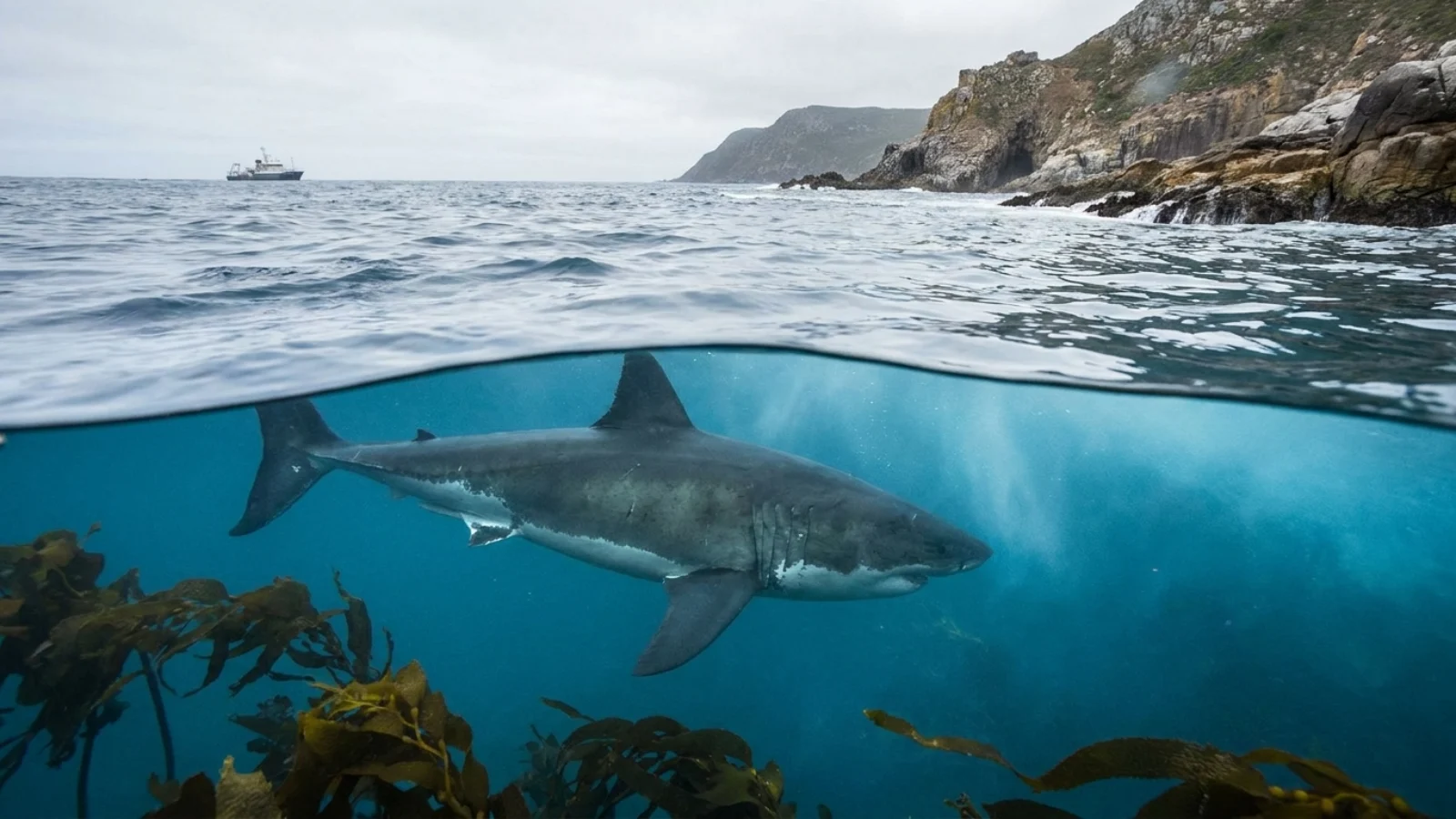
Not in the strict, global sense. The International Union for Conservation of Nature (IUCN), whose Red List is the standard reference for extinction risk, classifies the white shark, Carcharodon carcharias, as Vulnerable. That is the lowest of the three “threatened” categories, below Endangered and Critically Endangered. The current global assessment was led by Cassandra Rigby and a team of shark specialists, and it replaced an earlier assessment by Ian Fergusson, Leonard Compagno and Marie Marks that had also placed the species in the Vulnerable category.
So the short answer to “are great white sharks endangered?” is no, but they are threatened. And because the white shark lives in several largely separate populations around the world, the global label is only part of the story. Some regional populations are in serious trouble, others appear stable, and at least one has been visibly recovering for three decades.
What does “Vulnerable” mean on the Red List?
The Red List uses a ladder of categories from Least Concern through Near Threatened, Vulnerable, Endangered and Critically Endangered to Extinct in the Wild and Extinct. Species are placed using quantitative criteria, such as how much a population has declined over three generations, how small it is, or how restricted its range has become. A Vulnerable species is considered to face a high risk of extinction in the wild. Endangered means a very high risk, and Critically Endangered an extremely high risk.
For a long-lived, slow-breeding shark like the white, three generations is a long time, spanning many decades. Declines that happened in the 1970s and 1980s still weigh on today’s assessment, even where populations have since stabilised. The category reflects the long view, not just the latest season of sightings at a favourite dive site.
Why are great white sharks considered threatened?
Three features make white sharks vulnerable to human pressure. They are naturally scarce top predators, so even a healthy population is small compared with most fish. They grow slowly, mature late and produce few young, so losses take a long time to replace. And they range widely along coasts where people fish, swim and build, which brings them into contact with gillnets, longlines and protective beach nets.
The main threat today is accidental capture. When the US National Marine Fisheries Service reviewed the northeastern Pacific population in 2013, it identified fishery bycatch, mostly of newborn and juvenile sharks in gillnet fisheries off southern California and Baja California, as the principal threat. Historically, trophy hunting and targeted fishing added to the toll, and jaws, teeth and fins have long fetched high prices, which is why international trade controls matter. Shark-control programmes that use nets and drumlines off beaches in parts of Australia and South Africa also catch white sharks.
Where are great white sharks critically endangered?
The Mediterranean Sea holds the most threatened white shark population. It is fairly isolated from Atlantic populations and has been assessed as Critically Endangered at the regional level. A study by Stefano Moro, Giovanna Jona-Lasinio, Francesco Ferretti and colleagues, published in Fish and Fisheries, combined more than 700 sightings with museum and institutional records and the scientific literature to reconstruct trends over 160 years. The decline was uneven across the basin, but the authors estimated a 52 percent decrease in central Mediterranean sectors and a 96 percent decrease in the Sea of Marmara, with the steepest losses in the second half of the twentieth century.
The European Union responded in 2018 with Council Regulation (EU) 2018/120, which bars EU vessels from fishing for, keeping, transshipping or landing great white sharks in any waters, and bars other countries’ vessels from doing so in EU waters. Malta protected the species nationally in 2000. These are some of the strongest rules anywhere, but because white sharks in the Mediterranean are so rare, every accidental capture still matters.
Are great white sharks endangered in New Zealand?
New Zealand’s own threat classification system, which runs alongside the IUCN Red List, lists the white shark as Threatened: Nationally Endangered. The species was moved into the threatened category in a 2018 government science report that reassessed 113 kinds of sharks, rays and chimaeras; in the previous report, from 2005, it had been listed as “at risk”.
The reassessment drew on new population estimates. White sharks in New Zealand belong to a shared population with eastern Australia, and a 2018 study by Richard Hillary, Mark Bravington and Toby Patterson in Scientific Reports used close-kin genetics, which counts parent-offspring and sibling pairs among sampled juveniles, to estimate its size. They estimated roughly 280 to 650 adults and a total population of about 2,500 to 6,750. Survival was high, over 90 percent a year for adults and about 73 percent for juveniles. New Zealand’s Department of Conservation summarises the 2018 estimates as an east Australasian population of about 5,500 sharks, with about 750 of breeding age and fewer than 1,000 sharks in New Zealand waters.
White sharks have been fully protected in New Zealand waters since 2007, under the Wildlife Act 1953 and the Fisheries Act 1996. Tagging shows that sharks from aggregation sites at Stewart Island and the Chatham Islands migrate north between about March and September to tropical and subtropical waters around Fiji, Tonga and Vanuatu, spending at least five to seven months away before returning, often to the place where they were tagged. That migration takes them beyond New Zealand’s protections.
Are great white sharks endangered in Australia?
Australia lists the white shark as Vulnerable under its national environment law, the Environment Protection and Biodiversity Conservation Act 1999, and as a migratory species. It is also protected under fisheries law in every state and territory. A regional Red List assessment for Australia, by Peter Kyne and colleagues in 2021, also classed it as Vulnerable.
Australia recognises two populations: an eastern one shared with New Zealand and a southwestern one. A 2023 national report for the Fisheries Research and Development Corporation, drawing on work by Barry Bruce and colleagues, gives estimates of about 750 adults in the eastern population, with a total population above 2,000, and about 1,500 adults in the southwestern population. It assesses the species as recovering. The report notes that historic declines did occur, but that an earlier figure of about a 90 percent decline in the eastern population is now considered an over-estimate. The sharks are now thought to be stable but at relatively low levels.
Are great white sharks endangered in the United States?
No. White sharks are not listed under the federal Endangered Species Act. In 2012 two petitions, one from WildEarth Guardians and a joint one from Oceana, the Center for Biological Diversity and Shark Stewards, asked the National Marine Fisheries Service to list the northeastern Pacific population, which gathers off central California and Guadalupe Island, Mexico. In its 12-month finding on 3 July 2013, the agency agreed that this population is a distinct population segment, markedly separate from other white sharks, but concluded that listing was not warranted. Its review team judged the population to be at low to very low risk of extinction.
The finding is an interesting look at how hard sharks are to count. Photo-identification at the two aggregation sites gave a combined estimate of about 339 subadult and adult white sharks, and a model for central California alone gave 219. The review team concluded that the true adult female population was most likely 200 to 400 animals, and that the site counts underestimate the real number. Genetic diversity was consistent with a population larger than the estimates suggested.
State and federal fishing rules protect white sharks on both US coasts. California gave the species temporary protection in 1993, confirmed by state law in 1997. On the Atlantic and Gulf coasts, federal rules have prohibited commercial catches since 1997, and Florida also protects white sharks in state waters, which matters because many Atlantic white sharks spend the winter off Florida. Our guide to great white sharks in Florida covers where and when they appear.
Are great white sharks recovering in the Atlantic?
The northwest Atlantic is one of the better news stories. A 2014 study in PLOS ONE by Tobey Curtis, Camilla McCandless and John Carlson compiled 649 confirmed white shark records from 1800 to 2010, the largest dataset ever assembled for the region. It found a significant decline in abundance in the 1970s and 1980s, followed by apparent increases since the 1990s, when a range of conservation measures came into effect. The authors concluded that while the species still needs protection, the outlook for its recovery in the Atlantic is more optimistic than earlier studies suggested.
The same records show that white sharks of all life stages use continental shelf waters year-round. They are concentrated between Massachusetts and New Jersey in summer and off Florida in winter, spreading along the whole coast in spring and autumn. The rise in white sharks off Cape Cod, where they now hunt a recovered population of grey seals, is the most visible sign of that recovery.
What international laws protect great white sharks?
Two international treaties cover the species. Under CITES, the Convention on International Trade in Endangered Species, white sharks were added to Appendix II at the 13th Conference of the Parties in October 2004. Australia and Madagascar proposed the listing with a zero export quota; the quota was withdrawn before the vote, and the listing was adopted by secret ballot with 87 votes in favour, 34 against and 9 abstentions. Appendix II does not ban trade, but it requires export permits showing that products such as jaws, teeth and fins were legally obtained and that the trade is not harmful to the species’ survival.
The Convention on the Conservation of Migratory Species of Wild Animals (CMS) has listed the white shark on both Appendix I and Appendix II since 2002. Appendix I commits member states to strictly protect the species, while Appendix II encourages international agreements for its conservation, including the CMS Memorandum of Understanding on migratory sharks.
Which country protected great white sharks first?
South Africa. On 11 April 1991 it used its fisheries law to prohibit the intentional killing or sale of white sharks, becoming the first nation to protect the species. Namibia followed in 1993, California in 1993 and 1997, the US Atlantic in 1997, Australia in 1999, Malta in 2000 and New Zealand in 2007. Mexico lists the species as threatened under its national standard NOM-059. Today, white sharks are protected across most of their range, though enforcement and bycatch remain challenges, especially for juveniles in coastal gillnets.
Why does the difference between “Vulnerable” and “Endangered” matter?
Labels shape policy and public attention. Calling the white shark endangered everywhere would overstate the risk for populations that are stable or growing, such as those off California and the US east coast, and could undermine trust in conservation science. Calling it safe would ignore the Mediterranean, where the species may be close to disappearing, and the small adult numbers estimated for Australia and New Zealand. The Vulnerable listing captures both realities: a species that is not on the brink globally, but that cannot absorb much more loss.
It also explains why protection works slowly. White sharks take many years to reach breeding age and have few pups, so even after fishing pressure is removed, recovery takes decades. The Atlantic rebound began in the 1990s and is still under way. Our article on how long great white sharks live explains just how slow their life cycle is.
How can people help great white sharks?
Most of the pressure on white sharks comes from fishing gear and coastal development rather than from deliberate hunting, so the most useful actions are practical ones. Anglers who hook a white shark by accident should keep it in the water, cut the line as close to the hook as is safe and let it go; in US waters, as in most countries, keeping one is illegal. Reporting sightings to regional tagging and research programmes adds to the photo-identification and tracking records that underpin population estimates like the ones above.
Supporting well-designed protected areas and bycatch rules also helps, especially in the shallow bays and coastal waters used as nurseries, where young sharks are most likely to end up in gillnets. And because so much of the debate about white sharks is driven by fear after rare bites, accurate information matters too. Understanding that these sharks are scarce, slow-breeding and still recovering in many places is the first step toward living alongside them.
So, are great white sharks endangered?
Globally, no: they are Vulnerable on the IUCN Red List. Regionally, the answer ranges from Critically Endangered in the Mediterranean to Nationally Endangered in New Zealand, Vulnerable in Australia, and stable or recovering in the United States, where federal scientists found no case for Endangered Species Act listing. Everywhere, the species is protected by fishing bans and international trade rules, and its future depends on keeping bycatch of young sharks low while slow-growing populations rebuild.
Are great white sharks endangered?
Not globally. The IUCN Red List classes them as Vulnerable, though they are Critically Endangered in the Mediterranean.
How many great white sharks are left?
There is no reliable global count. Regional estimates run to hundreds of adults per population, e.g. 280-650 in eastern Australia and New Zealand.
Are great white sharks protected in the US?
Yes, by state and federal fishing rules since the 1990s, but they are not listed under the Endangered Species Act.
Is it illegal to catch a great white shark?
In most countries, yes. Keeping or landing one is banned in the US, EU, Australia, New Zealand and South Africa.
What is the biggest threat to great white sharks?
Accidental capture in fishing gear, especially of young sharks in coastal gillnets, plus beach nets and drumlines.
Are great white shark numbers increasing?
In the northwest Atlantic, yes, since the 1990s. Australian populations are thought stable; the Mediterranean has declined sharply.
When did great white sharks get protected?
South Africa was first, in 1991, followed by Namibia, California, the US Atlantic, Australia, Malta and New Zealand.
Is the great white shark on CITES?
Yes, on Appendix II since 2004, so international trade in parts needs permits.
- Rigby, C.L. et al., Carcharodon carcharias, IUCN Red List of Threatened Species (current global assessment, Vulnerable); Fergusson, I., Compagno, L.J.V. & Marks, M., earlier IUCN assessment.
- Moro, S. et al., “Abundance and distribution of the white shark in the Mediterranean Sea”, Fish and Fisheries; Sapienza University of Rome news release.
- Hillary, R.M., Bravington, M.V., Patterson, T.A. et al. (2018), “Genetic relatedness reveals total population size of white sharks in eastern Australia and New Zealand”, Scientific Reports; NZ Department of Conservation, great white shark species page.
- FRDC (2023), Status of Australian Fish Stocks, Carcharodon carcharias report.
- NMFS (2013), 12-month finding on petitions to list the northeastern Pacific white shark under the ESA, Federal Register, 3 July 2013; Curtis, T.H., McCandless, C.T. & Carlson, J.K. (2014), PLOS ONE.
- CITES CoP13 Proposal 32 (Australia and Madagascar); Earth Negotiations Bulletin, CITES CoP13 daily report, 12 October 2004; CMS species page; Council Regulation (EU) 2018/120.
Blane Perun has been exploring Earth’s oceans and marine life for over 25 years. Founder of TheSea.Org in 1999, underwater photographer, coral aquaculture pioneer, and explorer of 80+ countries.
About Blane Perun →