Manatee — The Gentle Sea Cow of Warm Rivers and Coasts
What is a manatee?
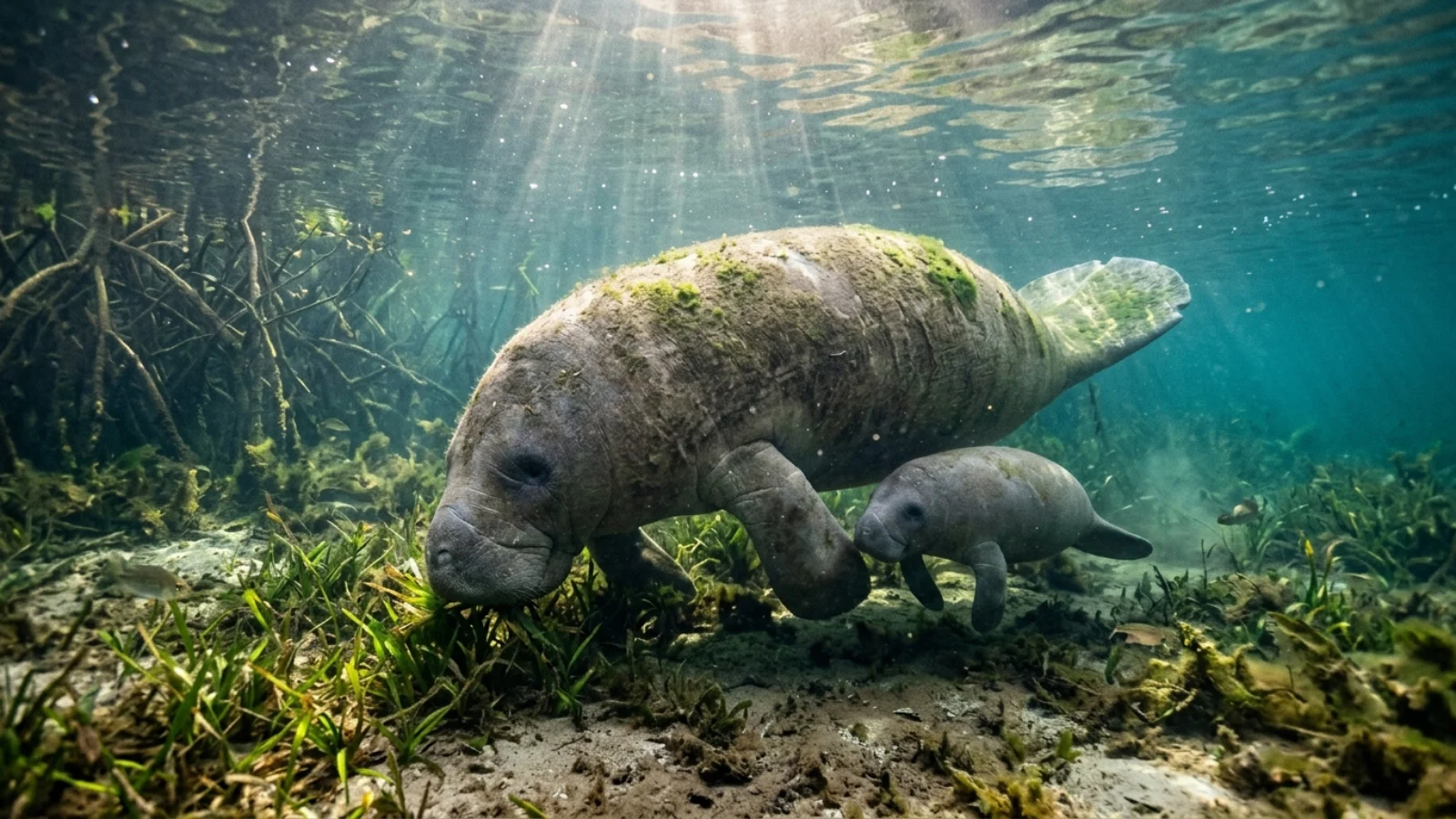
A manatee is a large, slow-moving, fully aquatic mammal that eats only plants. It lives in warm, shallow coastal waters, rivers and springs, and it has a rounded, paddle-shaped tail.
Manatees belong to the order Sirenia, the “sea cows,” together with the dugong of the Indo-Pacific. The only other sirenian known from historic times, the giant Steller’s sea cow, was hunted to extinction in the 18th century. Sirenians are the only plant-eating marine mammals, and their closest living land relatives are elephants and hyraxes. That kinship shows up in manatee molars, which march forward through the jaw and are replaced from behind throughout life, and in the small nails on the flippers of two species.
The manatee is not a fish, a seal or a walrus. It breathes air, gives birth to live young, nurses its calves, and never comes onto land. For a short primer, see what is a manatee?
Where does the name manatee come from?
Nobody is certain. The two leading explanations point to the Latin word for hand and to a word for breast in the Taíno language of the Caribbean.
The word reached English through Spanish manatí, and one theory traces it to a Taíno word meaning breast, a nod to the female’s teats, one under each flipper. Another links it to Latin manus, “hand,” for the way the animal uses its flippers. The genus name Trichechus comes from a classical root meaning hair and refers to the bristles around the mouth. “Sea cow” is simpler: a large, placid animal that spends its day grazing.
Sirenians descend from four-legged land mammals, and fossils of early members of the group go back to the Early Eocene, roughly 50 million years ago; some estimates place the split from their land-dwelling relatives more than 60 million years ago. The manatee family itself took shape in South America. In the Late Miocene its members lived mainly in coastal rivers, while dugongs grazed seagrass in the western Atlantic and Caribbean. As manatees moved onto gritty, silt-covered plants, they evolved their unusual supply of extra molars, which is still their most distinctive feature.
How many species of manatee are there?
Three living species, all in the genus Trichechus.
| Species | Range | Max size | Water | IUCN |
|---|---|---|---|---|
| West Indian manatee (T. manatus) | Florida, Gulf of Mexico, Caribbean to NE Brazil | ~4 m, ~1,650 kg | Fresh, brackish, salt | Vulnerable |
| West African manatee (T. senegalensis) | Mauritania to Angola, 21 countries | ~4–4.5 m | Coastal and far inland rivers | Vulnerable |
| Amazonian manatee (T. inunguis) | Amazon Basin: Brazil, Peru, Colombia, Ecuador | ~2.8 m, ~380–480 kg | Freshwater only | Vulnerable |
Two subspecies make up the West Indian manatee: the Antillean (T. m. manatus) and Florida (T. m. latirostris) manatees. A proposed fourth species, the dwarf manatee of the Brazilian Amazon, is not accepted by most scientists; DNA suggests the animals described were young Amazonian manatees.
How big do manatees get?
Adult West Indian and African manatees are typically about 3 m (10 ft) long and weigh around 360–545 kg (800–1,200 lb). Big ones top 4 m and well over a tonne.
The U.S. Fish and Wildlife Service gives a typical adult Florida manatee as 9–10 feet and about 1,000 lb, with some exceeding 13 feet and 3,500 lb. SeaWorld’s records list the largest Florida manatee at 1,655 kg (3,650 lb). Females tend to be a little bigger than males. The Amazonian manatee is the small, slender one: the longest measured animal was about 2.8 m.
Published maximums vary because very large manatees are rarely weighed. General references give exceptional animals as up to about 4.6 m (15 ft) and 1,775 kg (3,913 lb), heavier than the SeaWorld record above. The Amazonian manatee is far lighter: free-ranging adults weigh about 120–270 kg, and the heaviest on record, a captive female, reached 379 kg. A newborn West Indian calf weighs around 30 kg, while an Amazonian calf is only about 10–15 kg.
What do manatees eat?
Plants, and a lot of them. A manatee eats 4–9% of its body weight in wet vegetation a day, and up to about 10%, grazing for up to eight hours.
Florida manatees are known to eat more than 60 plant species. In salt water the staple is seagrass (turtle grass, manatee grass, shoal grass); in rivers and springs they eat hydrilla, water hyacinth, eelgrass and overhanging plants. A split, muscular upper lip works like a pair of hands, gathering plants into the mouth. Manatees take the odd invertebrate along with the greenery, and West African manatees have been seen eating clams and raiding rice paddies. More on the menu in manatee diet and manatee teeth.
How is a manatee built for eating plants?
With a split, muscular upper lip, horny pads instead of front teeth, a conveyor belt of molars and an extremely long gut.
The upper lip pad is divided into left and right halves that move independently, driven by seven muscles that let the animal grip and tear at plants. Front flippers help too: a feeding manatee often “walks” along the bottom on them while it digs for roots, then sweeps the loosened plants toward its mouth. There are no incisors or canines. Ridged, horny pads on the roof of the mouth and the lower jaw shred the food first.
Grinding happens at the back, on 6 to 8 high-crowned molars along each side of each jaw, for a total of 24 to 32 teeth at full count. Grit in the vegetation wears them down, and the enamel is relatively weak, so worn teeth are shed at the front while new ones erupt behind and slowly move forward. Estimates of that forward drift range from about 0.1 cm to about 1 cm a month, depending on the study, and the process continues for life.
Digestion is handled the way a horse does it, not a cow. A manatee has a simple stomach, a large cecum and roughly 45 m of intestine, and gut microbes in the hindgut break down the cellulose. Larger estimates of daily intake reach 10–15% of body weight, about 50 kg for a big adult, gathered over as much as seven hours of grazing.
Where do manatees live?
In warm, shallow water: coastal bays, estuaries, rivers, lagoons and freshwater springs on both sides of the tropical Atlantic, plus the Amazon Basin.
Manatees cannot handle cold. USFWS says they can’t tolerate water below about 68°F (20°C) for long, and the Marine Mammal Commission notes that water below 18°C (65°F) can be lethal. In winter, Florida manatees crowd into springs such as Crystal River and Blue Spring, and into the warm-water outflows of power plants. In summer some wander far: Florida manatees reach Texas and Delaware Bay, and a few have turned up in Massachusetts. The manatee habitat post covers the details, and Crystal River and Apollo Beach are the classic places to see them.
The headsprings of Florida’s Crystal, Homosassa and Chassahowitzka rivers stay at about 22°C (72°F) all year, and between November and March roughly 600 manatees gather in the Citrus County rivers alone. Georgia’s coast usually marks the northern edge of the regular range, but individuals wander much farther. Manatees have been reported off Cape Cod, in New York City in 1995 and again in 2006, and in Rhode Island’s Narragansett Bay. One turned up in a harbor off the Mississippi in downtown Memphis in 2006 and was later found dead downstream. A manatee found dead on a New Jersey beach in February 2020, in water below 7°C, showed how fatal a wrong turn in winter can be.
The African species has the widest choice of homes of any sirenian, from islands up to 75 km offshore to rivers in the Sahel. In the Niger River it lives as far inland as Koulikoro in Mali, about 2,000 km from the sea. Dams have cut some river populations off entirely; the Diama Dam, for example, isolated the Senegal River manatees. The Amazonian manatee follows the flood: it spreads into flooded forest and meadows when water is high and returns to permanent lakes and channels as the water falls.
How do manatees breathe, swim and behave?
Slowly. A resting manatee surfaces every 3–5 minutes and can stay down about 20 minutes; it cruises at about 3–5 mph and can sprint briefly at around 15 mph, with some sources giving up to 20 mph.
Manatees are semi-social. There is no herd structure or territory: they gather loosely at food and warm water, and the only lasting bond is between a mother and her calf. Mating is a free-for-all in which a female in season is followed by a “mating herd” of a dozen or more males (see manatee mating). They communicate with chirps and squeaks, especially between mother and calf.
A typical day is split roughly in half. Manatees spend about 50% of it sleeping underwater, rising to breathe at intervals of less than 20 minutes, and much of the rest grazing in water only 1–2 m deep. Their small eyes have lids that close in a circular, drawstring-like way. The ears are large inside the head but open to the outside through tiny holes about four inches behind each eye.
They are also smarter than their sleepy reputation suggests. In laboratory tests manatees learn discrimination tasks about as well as dolphins and seals do in comparable sound and vision studies, show complex associative learning, and remember what they have learned over long periods. Their social signals, including touch, sound and probably taste and smell, are still poorly understood.
The skeleton has one odd detail. Almost every mammal, from mice to giraffes, has seven neck vertebrae, but manatees have six, a trait they share only with sloths.
How do manatees reproduce?
One calf, after a pregnancy of about a year, roughly every two to five years.
Gestation is about 12 months in the Florida manatee and 12–14 months in the Amazonian. A newborn West Indian calf is 1.2–1.4 m long and 27–32 kg (60–70 lb), swims to the surface on its own, and nurses from teats under its mother’s flippers. It begins nibbling plants within weeks but stays with its mother for up to two years. That slow breeding is the species’ biggest weakness: a population cannot bounce back quickly from a bad year. See baby manatee and manatee lifespan.
Are manatees endangered?
All three species are listed as Vulnerable by the IUCN. In the U.S. the West Indian manatee was moved from endangered to threatened in 2017.
The Florida population is the best counted. Aerial surveys in 2021–2022 produced a statewide estimate of about 9,790 animals, up from a minimum of 1,267 counted when surveys began in 1991. USFWS puts the whole West Indian species at 13,000 or more, with fewer than about 7,000 Antillean manatees spread across the Caribbean and Latin America, and the IUCN Sirenia Specialist Group estimates only about 2,500 mature Antillean adults. In January 2025 USFWS proposed listing the two subspecies separately and uplisting the Antillean manatee to endangered.
Recent years show how fast things can go wrong. Seagrass in Florida’s Indian River Lagoon collapsed after years of algal blooms, and manatees starved: an Unusual Mortality Event declared in March 2021 recorded 1,255 deaths before it ended in 2022, and it was formally closed in March 2025. Boat strikes remain the leading human cause of death; 2019 set a record, with FWC’s preliminary tally passing 130 watercraft deaths before the year was out. Cold snaps, red tide, habitat loss, and entanglement add to the toll. Outside the U.S., hunting and fishing-net bycatch are the larger threats, especially for the African and Amazonian species.
Why do boats hit manatees so often?
Manatees are slow, rest and feed near the surface, and appear to have trouble hearing the low-pitched hum of an approaching boat until it is too close.
Manatee hearing is tuned to higher frequencies than you might expect for such a large animal, while many boats produce mostly low-frequency noise. Near the surface, a physical effect known as Lloyd’s mirror further weakens those low sounds, and that is exactly the zone where most collisions happen. Research suggests manatees move away quickly from boats that produce higher-pitched sound, which is one reason idle-speed and slow-speed zones matter.
The result is written on the animals’ backs. Many adult Florida manatees carry patterns of propeller scars, and researchers use those scars to tell individuals apart in photo-identification catalogues. Some animals have been found with more than 50 separate scars. Watercraft account for roughly a quarter of all Florida manatee deaths in many years; in 2009, for example, vessels killed 97 of the 429 manatees recorded dead.
Natural threats are fewer. Crocodiles sometimes take young manatees, and cold, disease and red tide kill others, but adults have no major predator. When threatened, a manatee dives as deep as it can, a habit that suggests its main historical danger came from people hunting from above rather than from sharks or caimans.
How can you help manatees?
Slow down in manatee zones, never feed or harass them, and report injured animals.
In Florida, report injured, dead or orphaned manatees to the FWC Wildlife Alert hotline. Wear polarized glasses and watch for the “footprints” (smooth swirls) a manatee leaves on the surface. Give them space when snorkeling; it’s illegal to chase, touch from above, or separate a mother and calf. Keeping lawn fertilizer out of waterways helps the seagrass they depend on.
The world’s oldest known manatee.
Where to see manatees around Tampa Bay.
Daily counts and the 932 record.
Where to paddle in Florida and the rules.
Why sea cows gather at warm outflows.
Resting on the bottom and rising to breathe.
Cruising vs burst speed.
Are manatees dangerous to swimmers?
Kayaking the spring river in winter.
A month-by-month Florida guide.
Tail, face, eyes and whiskers.
Birth, calf, adult and old age.
Where to see the Antillean manatee.
From land mammals to sea cows.
Aggregations and herds.
Canals, power plant and best viewing.
Seeing manatees at the FPL center.
Causes and yearly mortality counts.
Tags, photo-ID and aerial surveys.
Idle speed and slow speed rules.
Status, threats and population.
How manatees communicate.
How long manatees stay underwater.
How smart are manatees?
What is a manatee?
A manatee is a large, fully aquatic, plant-eating mammal of the order Sirenia that lives in warm, shallow coastal waters and rivers. It is related to the dugong and, more distantly, to elephants.
How many species of manatee are there?
Three: the West Indian manatee (including the Florida and Antillean subspecies), the West African manatee and the Amazonian manatee. A proposed dwarf manatee is not widely accepted.
How big is a manatee?
Adults are typically about 3 m (10 ft) long and weigh 360–545 kg (800–1,200 lb). The largest Florida manatee on record weighed about 1,655 kg (3,650 lb).
What do manatees eat?
Only plants: seagrasses in salt water and plants such as hydrilla and water hyacinth in fresh water. They eat roughly 4–10% of their body weight a day.
How long do manatees live?
Up to about 50–60 years, although many wild manatees die much younger from boat strikes, cold stress and starvation.
How many manatees are left in Florida?
The latest statewide estimate, from 2021–2022 aerial surveys, is about 9,790 Florida manatees.
Are manatees endangered?
All three species are listed as Vulnerable by the IUCN. In the U.S. the West Indian manatee is listed as threatened under the Endangered Species Act.
Are manatees dangerous to humans?
No. Manatees have no defenses beyond size and are not aggressive. They are protected, and it is illegal to harass or feed them.
- U.S. Fish and Wildlife Service, West Indian Manatee species profile
- Marine Mammal Commission, Florida Manatee
- SeaWorld Parks & Entertainment, Manatee animal info book
- CMS, Action Plan for the Conservation of the West African Manatee
- Florida Fish and Wildlife Conservation Commission, Atlantic Coast Manatee Unusual Mortality Event (closed March 14, 2025) and manatee mortality statistics
- PEER, “Record Florida Manatee Boat Kills in 2019” (FWC preliminary data)
- Reep & Bonde, The Florida Manatee: Biology and Conservation; studies of manatee hearing, learning and feeding anatomy
- IUCN Red List assessments: Trichechus manatus, T. senegalensis, T. inunguis
Blane Perun has been exploring Earth’s oceans and marine life for over 25 years. Founder of TheSea.Org in 1999, underwater photographer, coral aquaculture pioneer, and explorer of 80+ countries.
About Blane Perun →