The Biggest Great White Sharks Ever Recorded — Deep Blue, Nukumi and the Record Books
The biggest great white sharks reliably measured are females of about 6 metres (20 feet). The ichthyologist John E. Randall regarded a 5.94 m shark from Ledge Point, Western Australia, as the largest accurately measured, and the largest preserved specimen, in Lausanne, measures 5.83 m. Two 1987 sharks from Kangaroo Island (estimated over 6.9 m) and Malta (about 7.13 m) remain unconfirmed but could not be ruled out by a 1996 review. The famous living giant Deep Blue is estimated at about 20 feet, and OCEARCH’s Nukumi measured 17 feet and 3,541 pounds when tagged in 2020.
The biggest great whites are old females of about 6 metres; every claim of 9 to 11 metres has collapsed under scrutiny.
What is the biggest great white shark ever recorded?
There is no single, universally accepted record holder, and that is the first thing to understand about the biggest great white sharks. Unlike a world-record fish weighed on certified scales, most giant great whites were measured long ago, by people without scientific training, using methods that were not written down. The honest answer is a range: the largest great whites measured to a reasonable standard are females of about 6 metres (20 feet), and a handful of larger claims sit in a grey zone between possible and proven.
The usual benchmark comes from John E. Randall, one of the most respected ichthyologists of the twentieth century, who spent years examining claims of giant sharks. In his assessment, the largest white shark reliably measured was a 5.94-metre (19.5-foot) specimen reported from Ledge Point, Western Australia, in 1987. Even here there is a caveat: it is unclear whether that length was taken with the tail in its natural position or pushed down in line with the body, which adds length.
For context, ordinary adult great whites are much smaller. Males average 3.4 to 4 metres and females 4.6 to 4.9 metres, as we explain on our page about how big great white sharks get. A 6-metre female is therefore not a typical great white, but an exceptional one near the top of the species’ natural range.
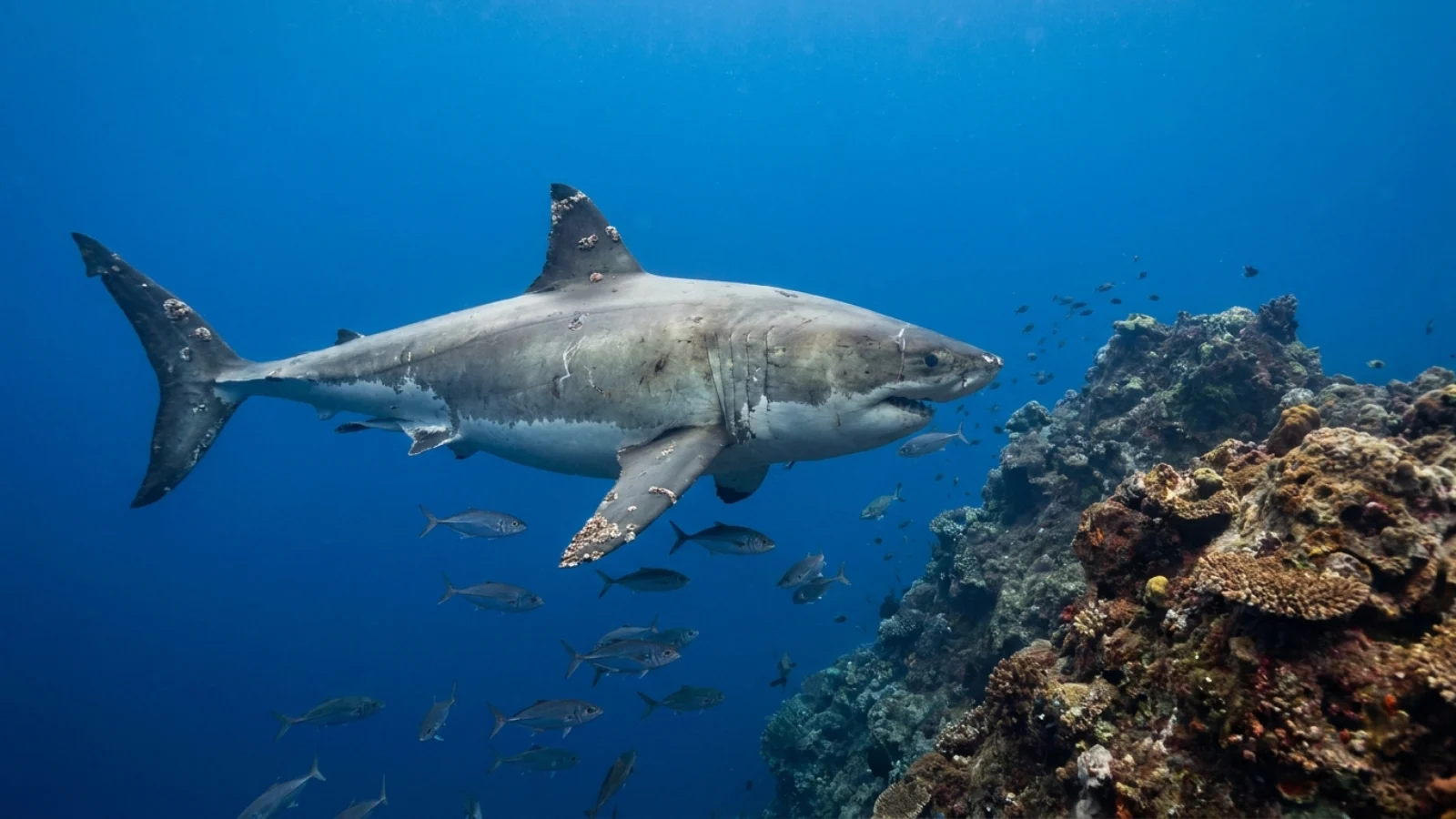
The largest preserved great white shark
The most solid physical evidence for a giant great white sits in a museum. The Museum of Zoology in Lausanne, Switzerland, holds a complete female specimen that De Maddalena and colleagues described in 2003 as the largest preserved great white. It measures 5.83 metres (19.1 feet) in total length with the tail lowered and is estimated to have weighed about 2,000 kilograms. Because the animal itself still exists, its size can be checked by anyone, which is more than can be said for almost every other record on the list.
Museum specimens matter because they settle arguments. A photograph can mislead through perspective, and an old newspaper report can be exaggerated or mistyped, but a preserved body, a set of jaws or a measured tooth can be re-examined decades later with new methods. Many of the records discussed below rise or fall on whether such material survived.
KANGA and MALTA: the two great disputed giants
Two sharks caught in April 1987 are at the heart of the debate over the true maximum size of great whites. The first was captured near Kangaroo Island, South Australia, on 1 April 1987, and was estimated by Peter Resiley at more than 6.9 metres (23 feet). It became known in the scientific literature as KANGA. Just over two weeks later, on 16 April 1987, Alfredo Cutajar caught a great white off Malta that John Abela estimated at around 7.13 metres (23.4 feet). This one became known as MALTA.
Both estimates were challenged. The researcher Cappo used Randall’s size-estimation methods to suggest that KANGA was really 5.8 to 6.4 metres, and I. K. Fergusson applied the same methods to MALTA and arrived at 5.3 to 5.7 metres. Randall’s approach relates the size of a shark’s teeth to its overall length, and it works well for typical animals, but critics noted that photographs of the two sharks suggested they were bigger than the tooth-based estimates allowed.
In 1996 a team of scientists, H. F. Mollet, G. M. Cailliet, A. P. Klimley, D. A. Ebert, A. D. Testi and the shark taxonomist Leonard Compagno, reviewed both cases. They carried out a detailed analysis of body proportions using the surviving remains and photographs, and concluded that the original estimates by Resiley and Abela were reasonable and could not be ruled out. That is not the same as confirming a 7-metre great white, but it means the possibility is taken seriously by specialists. If either estimate is correct, the true maximum length of the species is about a metre longer than the commonly quoted 6 metres.
Deep Blue: the most famous living giant
No individual great white is better known than Deep Blue, a huge female first filmed off Guadalupe Island, Mexico. Shark researcher Mauricio Hoyos Pallida filmed her in 2013 while working on a Discovery Channel Shark Week production, and the footage appeared in the 2014 episode “Jaws Strikes Back”. She swam up to the crew’s dive cage, and researchers attached a tag during the expedition. Hoyos later posted a video of her on Facebook in June 2015 that went viral.
Deep Blue is usually estimated at about 6.1 metres (20 feet). That figure is an estimate from footage and comparison with divers and equipment, not a tape-measure reading, so it should be treated with the same caution as any free-swimming size estimate. She has been described as possibly more than 50 years old, which is consistent with what we now know about how slowly great whites grow.
In January 2019, Deep Blue appeared far from Mexico, off Oahu in Hawaii, scavenging the carcass of a dead sperm whale. Divers filmed her swimming slowly alongside them in open water, including the marine biologist Andrew Gray, the photographer Kimberly Jeffries and the dive operator Ocean Ramsey. Gray later said the shark was way bigger than any shark he would expect. Her swollen belly led some observers to suggest she might be pregnant, although a recent meal of whale blubber could explain the same shape. Great whites are uncommon visitors to Hawaii, which made the encounter all the more remarkable; we discuss which sharks do live there on our page about bull sharks and other sharks in Hawaii.
Nukumi, Mary Lee and the tagged matriarchs
Some of the most reliable modern size figures for very large great whites come from tagging programmes. When scientists catch a shark to fit a satellite tag, they can measure it directly while it is restrained alongside the boat, then release it. The nonprofit OCEARCH, led by Chris Fischer, tags great whites this way, and several of its largest animals have become public celebrities.
The biggest of these in the northwest Atlantic is Nukumi, a female caught and tagged off Nova Scotia on 2 October 2020. She measured 17 feet (about 5.2 metres) and weighed 3,541 pounds (about 1,600 kilograms), the heaviest of the eight great whites tagged on that expedition, and she was estimated to be about 50 years old. Her name comes from a wise grandmother figure in the traditions of the Mi’kmaq people of Nova Scotia. OCEARCH called her a matriarch of the ocean.
Before Nukumi, the best-known giant from the same population was Mary Lee, tagged off Cape Cod in 2012 at about 16 feet and 3,456 pounds. Her satellite track was followed online by a large public audience and helped show how far northwest Atlantic great whites travel along the coast. Neither shark approaches the 6-metre benchmark, but both are well documented, which gives them a scientific value that many larger claims lack.
The heaviest great white caught on a rod and reel
Anglers have their own record book. The largest great white recognised by the International Game Fish Association is a shark caught by Alf Dean in southern Australian waters in 1959, which weighed 1,208 kilograms (2,663 pounds). Today great whites are protected in Australia and many other countries, so records of this kind will not be broken, and the modern measure of a giant is a tag, a drone image or a photograph rather than a carcass on a dock.
The monsters that were not: Port Fairy, New Brunswick and Cojímar
For decades, many scientific books and the Guinness Book of World Records listed two great whites as the largest of all. One was a 10.9-metre (36-foot) shark said to have been captured near Port Fairy in southern Australia in the 1870s. The other was an 11.3-metre (37-foot) shark trapped in a herring weir in New Brunswick, Canada, in the 1930s. Researchers had long doubted both, because they were so much larger than any accurately reported sighting.
The doubts proved justified. In the 1970s Randall examined the jaws of the Port Fairy shark and found that the animal had been of the order of 5 metres long, suggesting that a mistake had been made in the original 1870 record. The New Brunswick shark may have been a basking shark, a harmless filter feeder that typically grows to 7 or 8 metres, with some individuals reported at 9 to 11 metres, and that has a broadly similar body shape. Misidentification between the two species is a recurring theme in old records, especially when only a stranded or decomposing carcass was seen.
A third famous giant was caught off Cojímar, Cuba, in May 1945. It was reported as 6.4 metres (21 feet) long and an estimated 3,175 to 3,324 kilograms, and at the time some experts considered the record reliable. Later studies placed it at about 4.9 metres, well within the normal range for a large female. Photographs from the period, which show the shark next to fishermen, were probably affected by forced perspective, a problem that also undermines several later claims from around the world.
How do scientists judge a record claim?
When a new giant is reported, researchers ask a sequence of questions. Was the shark measured with a tape, and if so, along the curve of the body or in a straight line? Was the tail lowered or in its natural position? Are there photographs taken side-on, with a scale object at the same distance? Were the jaws or teeth kept? A single measured tooth can be compared with tooth-to-length relationships from many known sharks, which is why Randall and others put so much weight on jaws and teeth.
Weight is even trickier. Few giant sharks were weighed whole, and many reported weights were estimates or were calculated from length. Some combinations of length and weight that appear in the literature are physically implausible, because a shark of the reported length would have to be either far heavier or improbably thin. Researchers also look for internal consistency: a record that fits neither the shark’s proportions nor its teeth is usually set aside.
Why are the biggest great whites always females?
Every one of the best-documented giants, from the Lausanne specimen to Deep Blue and Nukumi, is female. That is no coincidence. Great whites show strong size differences between the sexes, and females grow larger, probably because a bigger body allows a female to carry larger litters of large pups. A 2015 study by Natanson and Skomal, using radiocarbon-validated vertebral ages, found that females in the northwest Atlantic reach maturity at about 33 years, compared with about 26 years for males. The biggest females are therefore not only large but old, animals that may have survived half a century or more of fishing, ship strikes and predators.
This has a conservation side. Big, old females produce the most young, and in many fish species they also produce the healthiest young. Losing them removes a disproportionate share of a population’s breeding potential. Protecting the giants is not just about preserving a spectacle, but about protecting the animals that keep the species going.
Could there be bigger great whites out there?
Possibly. Great whites are found in temperate and subtropical waters around the world, most individuals are never measured, and Randall himself believed the species may exceed 6.1 metres. The KANGA and MALTA cases suggest that animals of 6.5 to 7 metres cannot be dismissed. What seems very unlikely is anything approaching the 9 to 11-metre giants of older books. Great whites are already exceptionally heavy for their length, and a doubling of length would mean an animal several times heavier than any confirmed specimen.
It also helps to keep great whites in perspective. They are the largest predatory fish alive, but they are dwarfed by their famous extinct cousin. Megalodon, which some estimates put at up to 14 to 20 metres, would have made Deep Blue look modest; see our comparison of megalodon vs great white. Among living predatory sharks, the tiger shark is the closest competitor, confirmed to at least 5.5 metres, and our page on tiger shark vs great white compares the two.
So which is the biggest great white shark?
If you want a measured animal, the answer is the 5.94-metre Ledge Point shark or the 5.83-metre Lausanne specimen. If you are willing to accept carefully reviewed estimates, the 1987 Kangaroo Island and Malta sharks may have reached 6.9 to 7.1 metres. If you want the most famous living giant, it is Deep Blue, at around 20 feet. And if you want the best-documented big female of recent years, it is Nukumi, measured on the side of a research vessel at 17 feet and 3,541 pounds. What you can safely ignore are the 30-foot and 36-foot monsters of old: they belong to the history of exaggeration, not the history of sharks.
What is the biggest great white shark ever recorded?
The largest reliably measured was a 5.94 m (19.5 ft) shark from Ledge Point, Western Australia, reported in 1987.
How big is Deep Blue?
About 6.1 m (20 ft), an estimate from footage rather than a direct measurement.
Is Deep Blue still alive?
She was last widely reported off Oahu in January 2019; there is no confirmed record of her death.
How big was Nukumi?
17 ft (about 5.2 m) and 3,541 lb when OCEARCH tagged her off Nova Scotia in October 2020.
Has a 30-foot great white ever been caught?
No. The 10.9 m Port Fairy and 11.3 m New Brunswick records were errors or misidentified basking sharks.
What is the largest great white caught on rod and reel?
Alf Dean’s 1,208 kg (2,663 lb) shark from southern Australia in 1959, the IGFA record.
Could great whites reach 7 metres?
Possibly. A 1996 review could not rule out estimates of 6.9 m and 7.13 m for two 1987 sharks.
Why are the biggest great whites female?
Females grow larger than males, probably to carry bigger litters, and the giants are usually old.
- Mollet, H.F. et al. (1996), review of the KANGA and MALTA white shark length estimates, in Klimley, A.P. & Ainley, D.G. (eds.), Great White Sharks: The Biology of Carcharodon carcharias, Academic Press.
- De Maddalena, A. et al. (2003), on the largest preserved white shark specimen, Museum of Zoology, Lausanne.
- Natanson, L.J. & Skomal, G.B. (2015), “Age and growth of the white shark, Carcharodon carcharias, in the western North Atlantic Ocean”, Marine and Freshwater Research.
- Smithsonian Magazine (2020), “Researchers catch and tag 17-foot matriarch of the sea, a 50-year-old great white shark” (OCEARCH, Nukumi).
- ABC7 News (2019), “Deep Blue, one of the biggest great white sharks ever filmed”.
Blane Perun has been exploring Earth’s oceans and marine life for over 25 years. Founder of TheSea.Org in 1999, underwater photographer, coral aquaculture pioneer, and explorer of 80+ countries.
About Blane Perun →