Flor de la Mar — The Treasure of Malacca, Lost Off Sumatra Since 1511
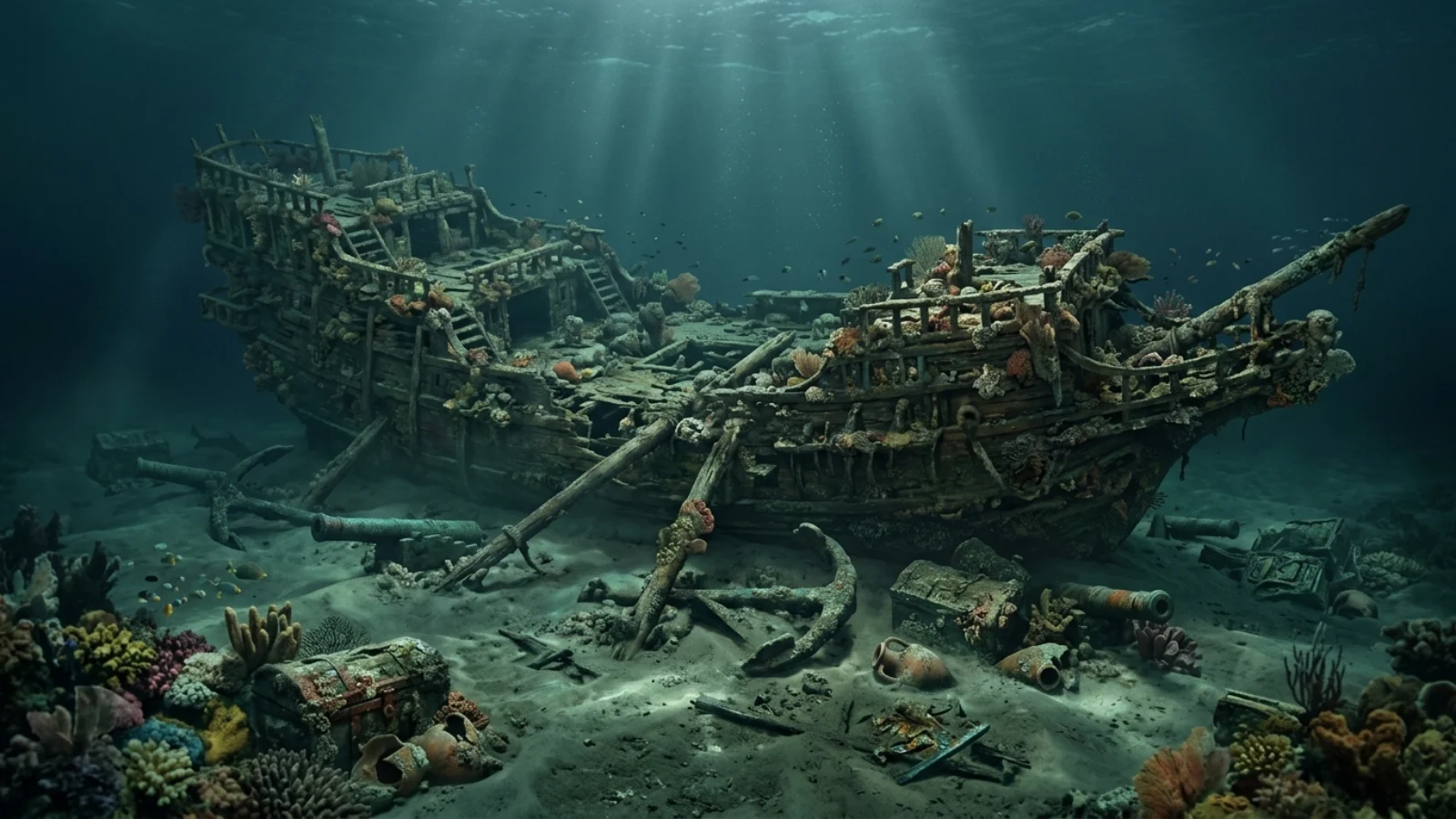
The Flor de la Mar is often called the richest shipwreck never found. The Portuguese carrack sank in a storm off the coast of Sumatra on the night of 20 November 1511, carrying the treasure Afonso de Albuquerque had looted from the Sultanate of Malacca. More than 400 people died, the cargo was lost, and more than five centuries later nobody has proven where the wreck lies.
The ship is known in Portuguese as Flor do Mar, and in all 16th-century Portuguese chronicles as Frol de la Mar, “Flower of the Sea”. A full-size replica stands at the Maritime Museum in Malacca, Malaysia. For other lost cargoes, see our shipwreck treasure hub.
What was the Flor de la Mar?
She was a nau, the big ocean-going carrack of the Portuguese India run. Built in Lisbon in 1502, at about 400 tons she was the largest carrack yet built, nearly twice the size of earlier ships on the route. She sailed to India on her maiden voyage in 1502 under Estêvão da Gama, a cousin of Vasco da Gama, but she was a poor cargo ship. Heavily loaded with spices, she leaked and handled badly in the fast currents of the Mozambique Channel, and she spent long stretches stuck at Mozambique Island for repairs.
Her troubles had a lasting effect. Portuguese captains of heavily laden ships were afterwards ordered to avoid the Mozambique Channel and take the “outer route” east of Madagascar, and the average India nau settled at around 400–450 tons, making the Flor de la Mar something of a prototype.
What is the timeline of the Flor de la Mar?
| Year | Event |
|---|---|
| 1502 | Built in Lisbon; maiden voyage to India under Estêvão da Gama |
| 1503 | Returns to Portugal after leaks and two months of repairs in Mozambique |
| 1505–1507 | Sails with Francisco de Almeida’s fleet; stuck about ten months in Mozambique; joins Tristão da Cunha’s armada |
| 1507 | Takes part in the conquest of Socotra, Muscat and Hormuz under Albuquerque |
| 1509 | Flagship of Almeida at the Battle of Diu |
| 1510 | Supports the Portuguese conquest of Goa |
| 1511 | Supports the conquest of Malacca; loaded with its treasure |
| 20 Nov 1511 | Wrecks on shoals in a storm off Sumatra; sinks at night |
At a time when India ships were expected to last three or four years, nine years of hard service made her one of the longest-lived ships of the route, even though she completed only one full voyage home.
What treasure did the Flor de la Mar carry?
After capturing Malacca in August 1511, then the largest commercial centre of the East Indies, Albuquerque chose the big carrack to carry the spoils back toward Portugal. Accounts describe plunder from the sultan’s palace: gold, precious stones and jewellery, and gifts intended for King Manuel I. There is no surviving inventory, so the size of the cargo is not known.
That has not stopped the estimates. Popular articles often value the treasure at around $2.6 billion, and in 1988 the chief minister of Malacca told reporters a foreign salvage team had found the wreck and that its contents were thought to be worth more than $3 billion. No find was ever demonstrated. Treat every figure as speculation built on chronicles written to glorify the conquest.
How did the Flor de la Mar sink?
Even before leaving Malacca, she was considered unsafe. In late 1511 Albuquerque sailed north-west along the coast of Sumatra with a small fleet. Off the north-eastern Sumatran state of Pasai, in the Strait of Malacca, the ships were caught in a storm and the Flor de la Mar was driven onto shoals. She broke up and sank during the night of 20 November 1511, off Timia Point in the Kingdom of Aru. Albuquerque survived on an improvised raft, but more than 400 people died and the cargo was lost.
Why has the Flor de la Mar never been found?
- Uncertain position. Chronicles give only general places such as Timia Point and the Aru coast, and the shoreline and seabed of the Strait of Malacca have changed over five centuries.
- Burial. The Strait carries heavy sediment, and wooden wrecks on shoals tend to break up, scatter and be buried under mud and sand.
- Busy, murky water. It is one of the world’s busiest shipping lanes, with poor visibility for divers.
- Legal disputes. Portugal, Indonesia and Malaysia all claim salvage rights, which has discouraged serious, legal search work.
- Possible early salvage. Some historians suggest part of the cargo could have been recovered soon after the wreck, though there is no firm evidence either way.
Several treasure-hunting groups have searched for her since the late 20th century, but no confirmed wreck site or artefacts have been published.
Who would own the treasure if it were found?
That is the biggest unanswered question. The wreck probably lies in Indonesian waters, but Malaysia sees the treasure as its own heritage, stolen from the Malacca Sultanate, and Portugal could claim the ship as a former state vessel. International law on underwater cultural heritage, including the 2001 UNESCO Convention, discourages commercial treasure hunting and favours leaving wrecks in place, which makes any legal salvage complicated. See shipwrecks that have been raised for how other nations have handled recovered wrecks.
Where can you see the Flor de la Mar today?
In Malacca. The Maritime Museum (Muzium Samudera) occupies a large replica of the ship on the riverbank, about 36 m long, which houses exhibits on the city’s maritime history. The lost treasure also features in popular culture, including the 2022 Doctor Who special “Legend of the Sea Devils”.
Has the Flor de la Mar been found?
No. Its wreck and treasure have never been located or verified, despite several searches and a 1988 claim of a find.
Where did the Flor de la Mar sink?
Off Timia Point, in the Kingdom of Aru on the north-east coast of Sumatra, in the Strait of Malacca.
When did the Flor de la Mar sink?
During the night of 20 November 1511.
How much is the Flor de la Mar treasure worth?
Popular estimates range from about $2.6 billion to over $3 billion, but there is no inventory and the figures are speculative.
Who was on board the Flor de la Mar?
Afonso de Albuquerque, the Portuguese governor of India, who survived on a raft; more than 400 others died.
What was the Flor de la Mar carrying?
Treasure from the conquest of Malacca, including gold, jewels and gifts for King Manuel I of Portugal.
Who owns the Flor de la Mar treasure?
It is disputed: Portugal, Indonesia and Malaysia all claim salvage rights.
Is there a replica of the Flor de la Mar?
Yes. A replica houses the Maritime Museum in Malacca, Malaysia.
- Wikipedia: Flor de la Mar.
- UPI (31 May 1988). 16th-century man-of-war may contain $3 billion in treasure.
- Diffie, B.W. & Winius, G.D. (1977). Foundations of the Portuguese Empire, 1415–1580. University of Minnesota Press.
- UNESCO (2001). Convention on the Protection of the Underwater Cultural Heritage.
Blane Perun has been exploring Earth’s oceans and marine life for over 25 years. Founder of TheSea.Org in 1999, underwater photographer, coral aquaculture pioneer, and explorer of 80+ countries.
About Blane Perun →