Steller’s Sea Cow — The 10-Metre Sea Cow That Lasted 27 Years After Discovery
What was Steller’s sea cow?
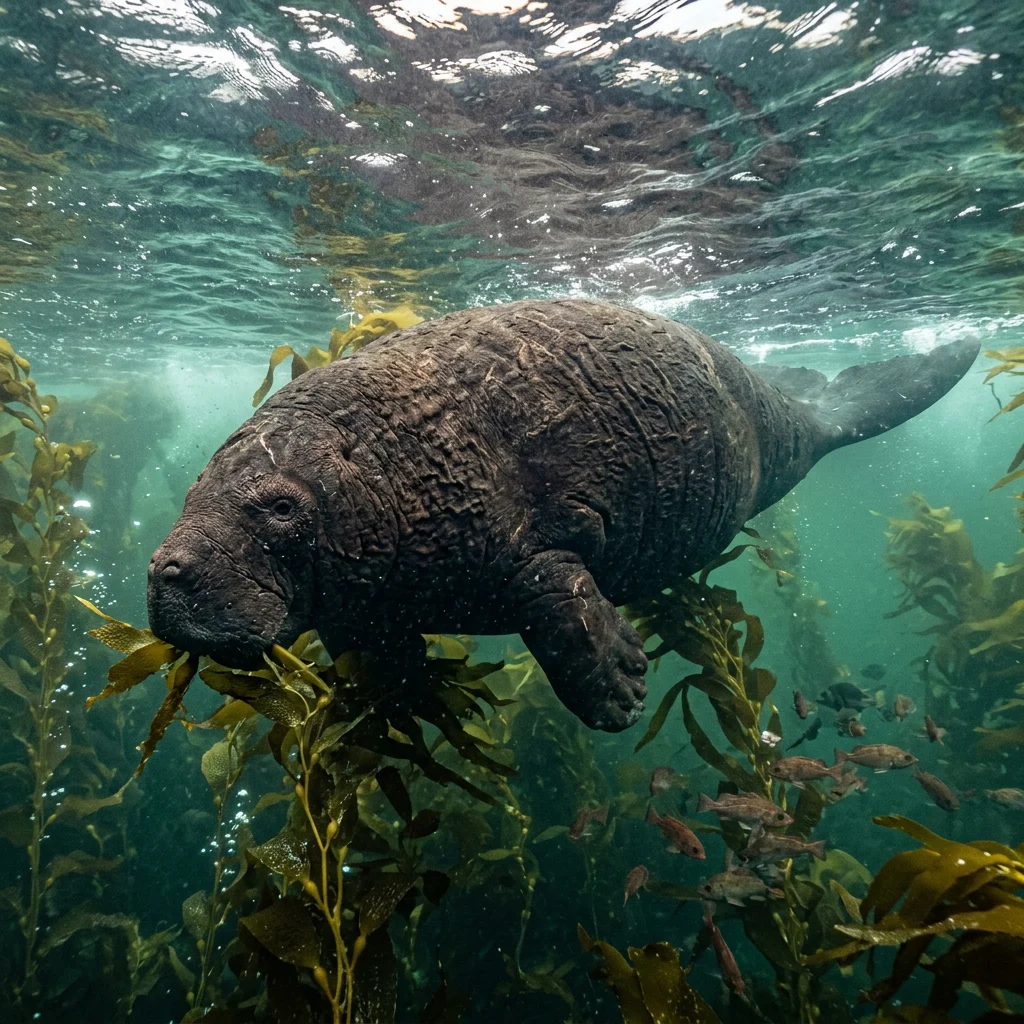
Steller’s sea cow (Hydrodamalis gigas) was an enormous, cold-water relative of the manatee and dugong that grazed kelp in the shallow seas of the North Pacific. Described in 1741, it was hunted to extinction by 1768.
It is the only sirenian adapted to cold water and by far the largest known from historic times. Britannica gives its length as roughly 9–10 m and its weight as perhaps 10 tonnes; London’s Natural History Museum says up to 10 m and 11 tonnes. Even at the low end, that is several times the mass of a large West Indian manatee. Despite the name, its closest living relative is the dugong, not the manatee: it had a forked, whale-like tail rather than a manatee’s paddle.
How was Steller’s sea cow discovered?
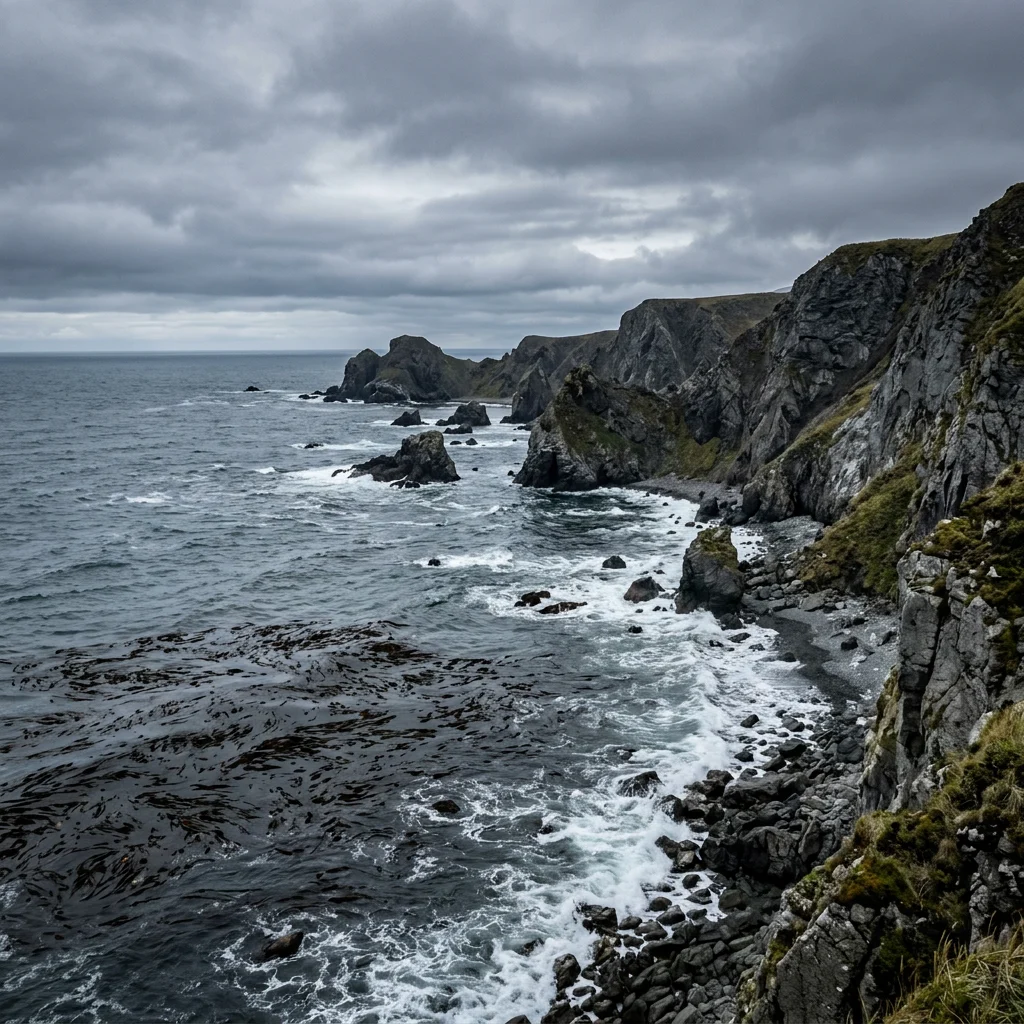
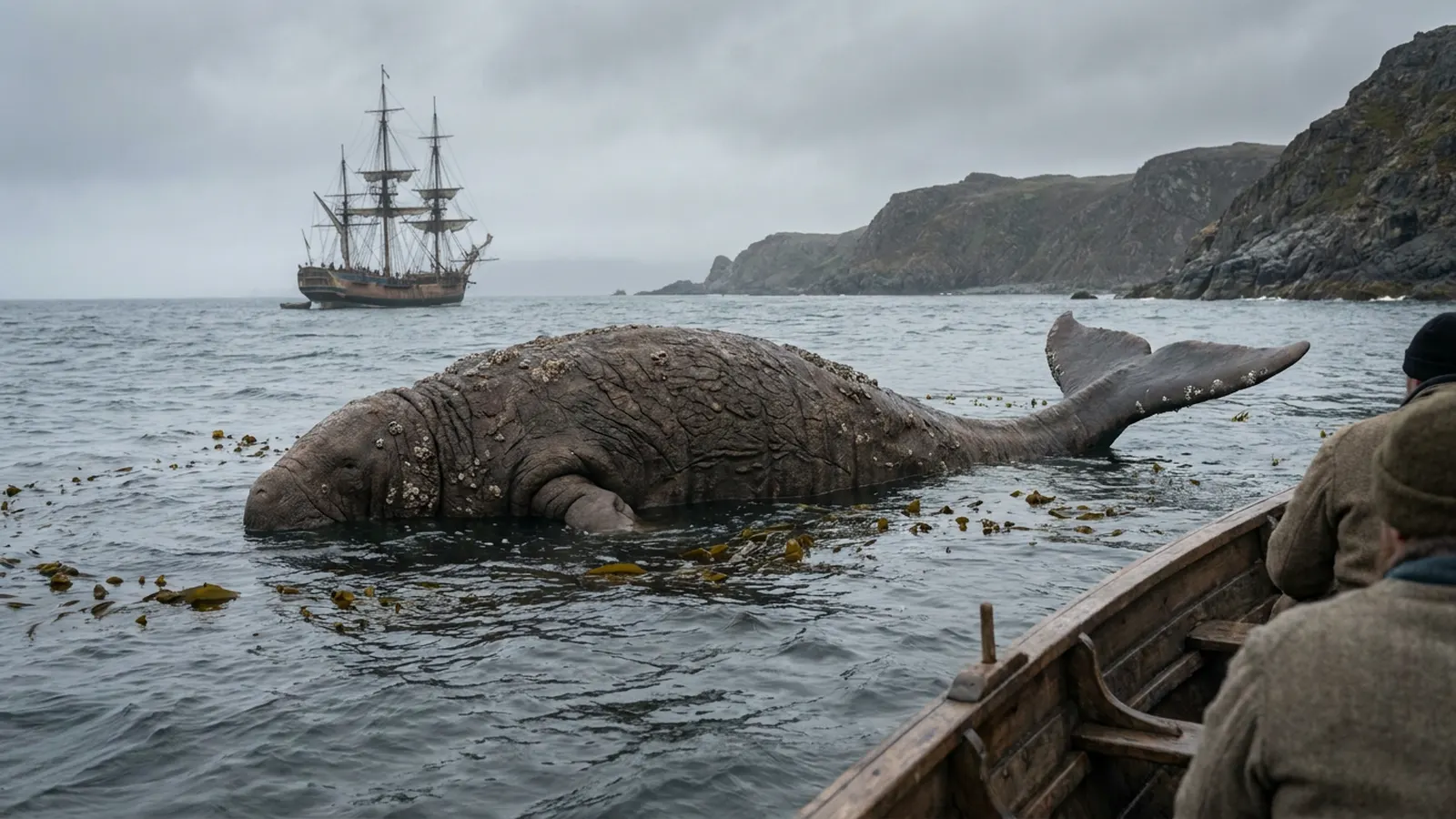
In 1741, when Vitus Bering’s ship was wrecked on what is now Bering Island, and the expedition’s naturalist, Georg Wilhelm Steller, described the animals living in the shallows.
The crew spent the winter marooned, and Steller became the first, and only, scientist to study the sea cow alive. He recorded its behaviour, anatomy and feeding in detail, and much of what we know comes from his notes plus skeletons collected later. The animals were found only around the Commander Islands (Bering and Medny islands), off Kamchatka.
What happened on Bering Island in 1741?
Steller’s encounter with the sea cow was a by-product of disaster. Vitus Bering’s ship, the St Peter, was returning from the first European voyage to reach north-western America when it was driven onto an uninhabited island off Kamchatka in November 1741. Scurvy had already crippled the crew, and Bering himself died there that winter; the island now carries his name. The survivors stayed for about a year, living in dugouts dug into the sand, eating sea otters, fur seals, sea lions and, increasingly, sea cows, until they built a smaller boat from the wreck and sailed back to Kamchatka in 1742.
Killing the first sea cow was not easy. The crew’s first attempt, using a large iron hook attached to a heavy cable, failed because the hook could not penetrate the thick hide. A month later a harpooner managed to spear one, men on shore hauled on the line while others stabbed it repeatedly, and the animal was dragged into the shallows and left to be stranded by the falling tide before it could be butchered. After that the hunting became routine. Steller measured and dissected at least one animal and wrote down everything he could, from the length of the intestines to the behaviour of mates and calves. His account, De bestiis marinis (On the Beasts of the Sea), was published by the Russian Academy of Sciences in 1751, five years after his death. The species was formally named in 1780 by Eberhard von Zimmermann, who called it Manati gigas; the current name, Hydrodamalis gigas, came into use in the 1890s.
What did Steller’s sea cow look like?
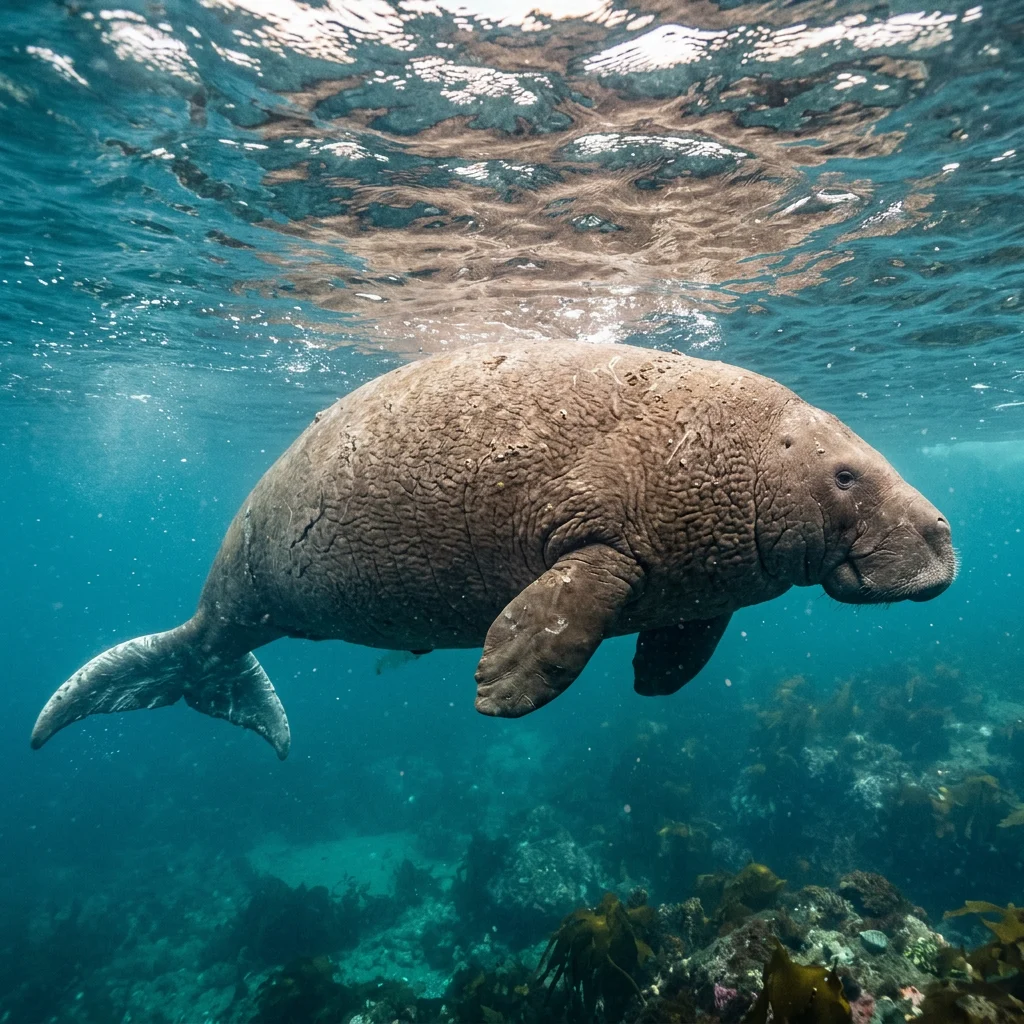
A huge, spindle-shaped body with a small head, stumpy flippers, a forked tail and thick, dark brown, bark-like skin.
Steller compared its skin to the bark of an old oak. It was sometimes streaked or spotted with white. Beneath the skin lay a layer of blubber up to about 10 cm thick that kept it warm in sub-Arctic water. It had no teeth at all: instead, two horny plates in the mouth crushed and ground soft kelp. The short forelimbs were used to pull the animal along rocky bottoms and to hold on in surf.
What made its body so unusual?
Almost everything about Steller’s sea cow was scaled for cold water. Its huge body reduced the surface area exposed to the sea relative to its volume, the same principle that keeps whales and walruses warm. The skin was extraordinarily thick, about 2.5 cm, and so rough and creased that sailors called it the “bark animal”. Under it lay 8 to 10 cm of blubber. A 2022 genome study in Science Advances led by Diana Le Duc of Leipzig University found that the sea cow had lost working copies of several lipoxygenase genes needed for the normal outer layer of the skin; defects in the same genes cause a scaly skin condition, ichthyosis, in humans. The researchers suggested that the bark-like skin, once blamed on parasites, was genetically built in and may even have helped protect the animal from ice and rocks.
Unlike every living sea cow, it was positively buoyant and could not fully submerge, so its back was often exposed as it fed. It had no teeth at all. Instead, two horny plates in the mouth, one on the palate and one on the lower jaw, ground up kelp, and a dense fringe of white bristles on the broad upper lip helped tear and hold seaweed. Its forelimbs were short, about 67 cm long, and every collected skeleton lacks the bones of the hand; because its closest fossil relatives had reduced finger bones, it may have had no hand skeleton at all. Steller recorded that it used these stumps to pull itself over rocks, brace against waves and hold its mate. Internally it was built for a high-volume, low-quality diet: the heart weighed about 16 kg, the stomach was some 1.8 m long, and the intestinal tract ran to roughly 151 m, more than 20 times the length of the body.
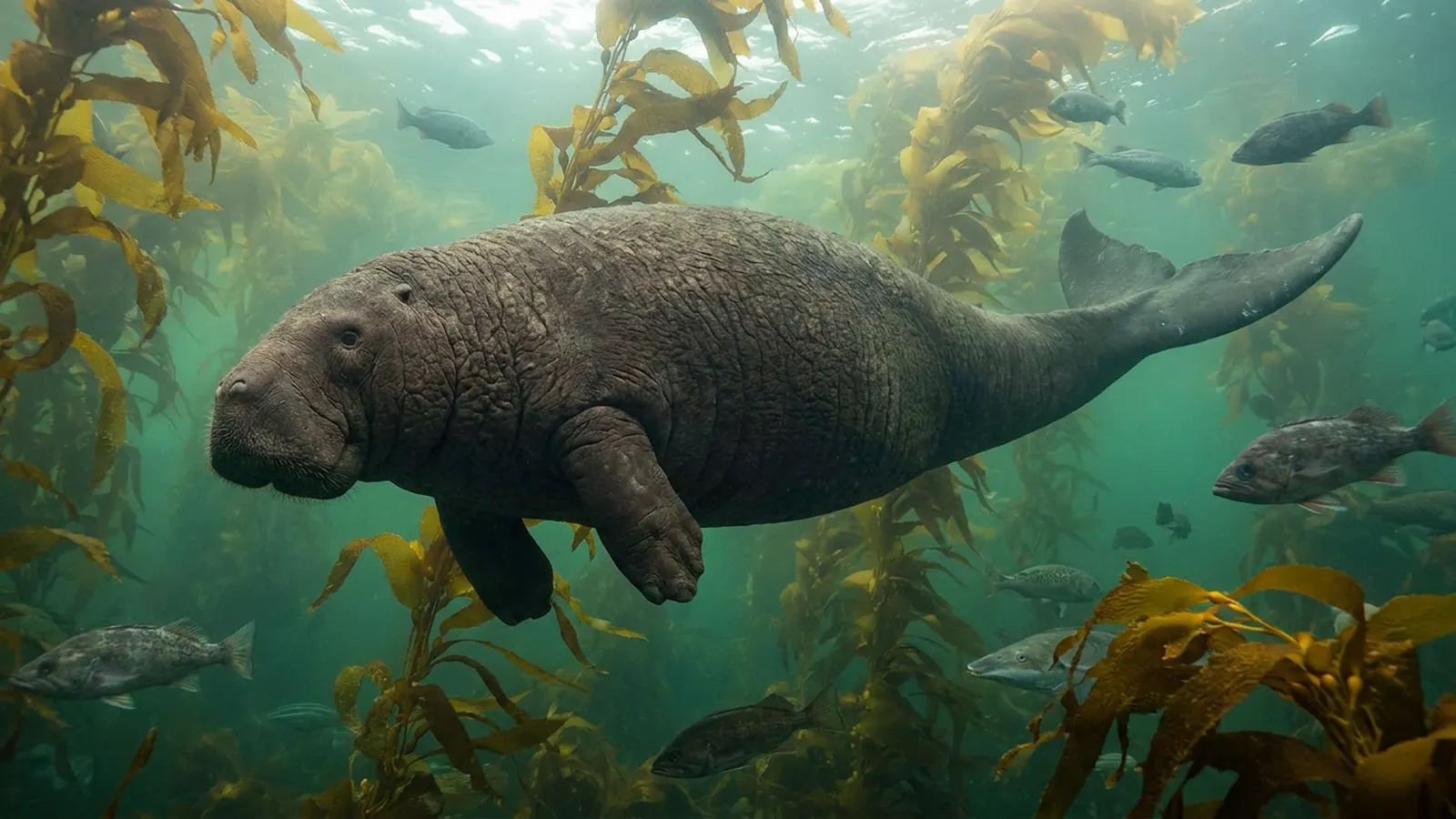
Size estimates vary because no complete animal was ever preserved. Steller left two contradictory weights, about 4 and about 24 tonnes, and modern estimates fall between them at around 8 to 10 tonnes for large adults, with lengths of 8 to 9 m, while some museum sources allow up to 10 m and 11 tonnes. Skeletons found on Bering Island in 1987 and 2017 measured about 3 m and 5.2 m, reminders that not every animal was a giant. Fossils from the Aleutian Islands suggest that Pleistocene sea cows there grew larger than the Commander Islands population, which may have been stunted by limited food.
| Feature | Steller’s sea cow | Dugong | West Indian manatee |
|---|---|---|---|
| Length | ~9–10 m | ~2.5–3 m | ~3 m (to 4 m) |
| Weight | ~8–11 t | ~250–400 kg | ~450 kg (to ~1.6 t) |
| Tail | Forked | Forked | Rounded paddle |
| Teeth | None (horny plates) | Molars, tusks in males | Replacing molars |
| Water | Cold sub-Arctic | Warm Indo-Pacific | Warm Atlantic |
| Status | Extinct (1768) | Vulnerable | Vulnerable |
How did Steller’s sea cows behave?
Steller’s notes describe a gentle, gregarious animal. Sea cows grazed in herds in shallow water close to shore, often near river mouths, with the young kept toward the front of the group or between their mothers and the shore, which suggests they had predators, most likely killer whales. They fed almost continuously, raising their heads every four or five minutes to breathe with a snort, and they slept on their backs after feeding. Steller reported that they were almost silent, making only heavy breathing, horse-like snorts and sighs, and that they were so unafraid of people that he could touch them from the shore.
He also described what he took to be strong pair bonds. When the crew harpooned a female, other sea cows tried to help her by crowding around the boat, rocking it and trying to knock out the hook, and her mate followed the boat to the shore and returned on the following days, even after she had died. Steller believed they were monogamous, that mating took place in early spring and that pregnancy lasted a little over a year, with most calves born in autumn. Females had a single pair of mammary glands, so they probably raised one calf at a time. Seabirds often perched on the animals’ exposed backs and picked off a parasitic crustacean, now known as Cyamus rhytinae, a relationship that has been compared with oxpeckers riding on African mammals. It was the only whale-louse-type amphipod ever recorded on a sirenian, and it vanished with its host.
What did Steller’s sea cow eat?
Kelp and other soft seaweeds growing near the surface along rocky shores.
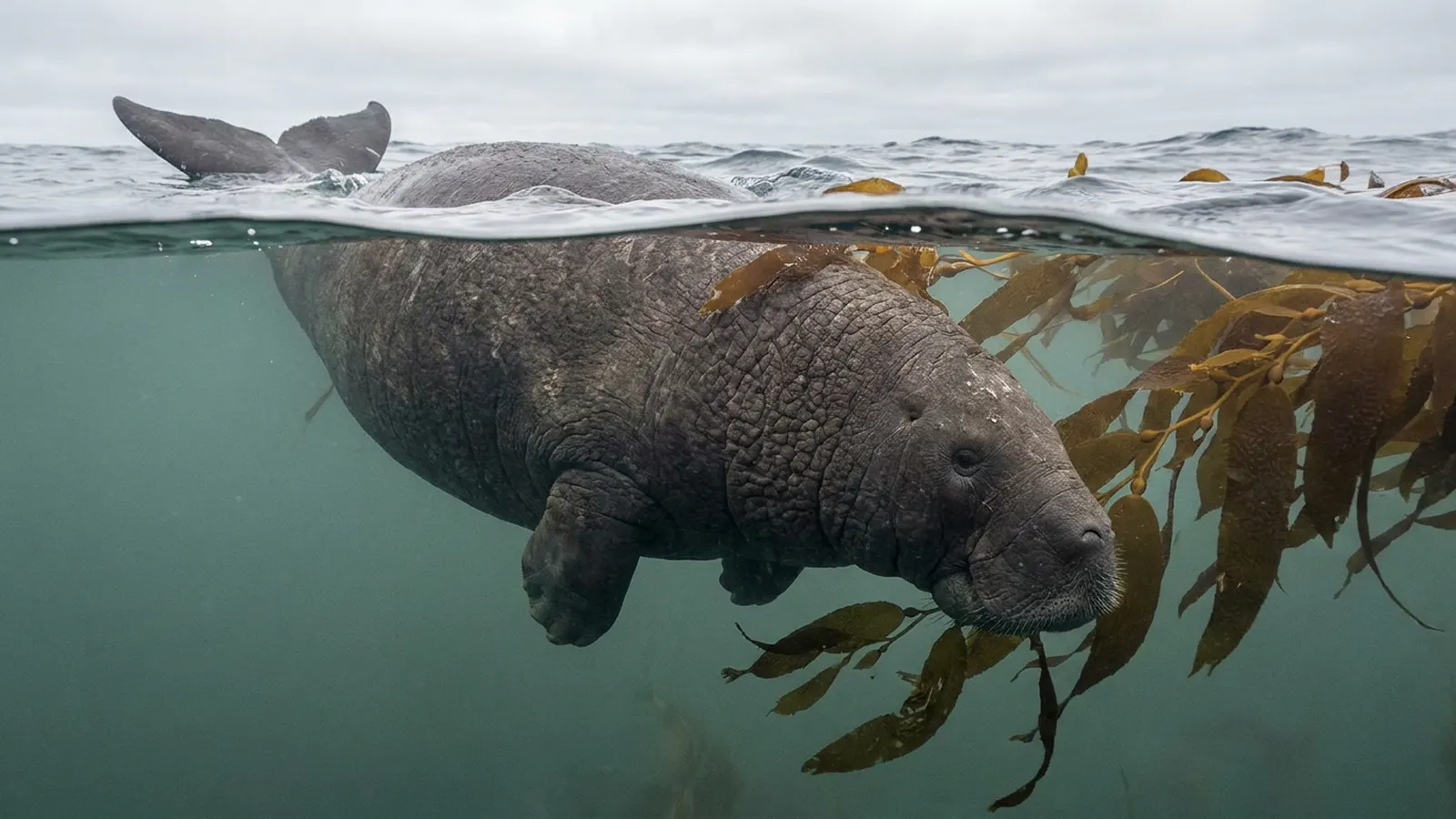
It fed in shallow water with its back often exposed. Britannica notes that it floated high and could hardly submerge, which made it easy to approach and harpoon. Steller described the animals feeding almost continuously, much like modern manatees grazing seagrass.
Which seaweeds did it eat?
Because it floated, the sea cow probably fed mainly on canopy kelp within about a metre of the surface. Researchers have identified likely food species from Steller’s descriptions and the local flora, including Agarum, Alaria praelonga, sugar kelp and bull kelp (Nereocystis luetkeana). Steller noticed that the animals ate only the soft blades and left the tough stalks and holdfasts, which washed up on the beaches in heaps wherever sea cows had been feeding. He also observed that they became very thin in winter, when kelp growth slowed, and could be seen with their ribs showing through the skin. Seagrass was probably not important: the species available in the region either grew too deep for a floating animal or were too sparse to support such large grazers.
Ecologists now think the sea cow may have shaped North Pacific kelp forests in ways that disappeared with it. By cropping the surface canopy it would have let more light reach the plants below, possibly increasing overall productivity, and by tearing loose blades and fragments it may have helped bull kelp spread its spores to new areas. Some researchers have even suggested that its grazing allowed sea otters and large invertebrates to coexist more easily than they do today. Those ideas are hard to test for an animal that has been gone for more than 250 years, but they are a reminder that extinction removes ecological roles as well as species.
How far did sea cows once range?
Steller’s sea cow was the last survivor of a lineage, the subfamily Hydrodamalinae, that split from other sirenians roughly four to eight million years ago. Its direct ancestor is thought to be the Cuesta sea cow, Hydrodamalis cuestae, a tropical-to-temperate species from the coast of California that died out as the oceans cooled during the ice ages. A related animal from Japan, the Takikawa sea cow, is sometimes treated as a separate species. The evolution of the genus was marked by increasing size and the loss of teeth and finger bones as the animals adapted to colder water and tougher food. For the wider story of the order, from four-legged ancestors onward, see manatee evolution.
In the Pleistocene, sea cows lived far beyond the Commander Islands. Fossils have been found on Amchitka in the Aleutians, in Monterey Bay in California and on Honshu in Japan, with the southernmost find a rib from the Bōsō Peninsula near Tokyo. More recent remains show the animals lingered in parts of the North Pacific into the last two thousand years: a rib from St Lawrence Island has been dated to around 800 to 920 CE, and a rib found on Kiska Island in 1998 may be only a few centuries old once the marine radiocarbon effect is taken into account. By the time Bering arrived, though, the only known population lived around Bering Island and Copper (Medny) Island, which had no human inhabitants. Researchers have suggested that hunting by Aleut and Siberian Yupik peoples, climate shifts such as the Medieval Warm Period, or local loss of kelp after sea otters were hunted may have removed sea cows from other areas before Europeans ever saw them.
Why did Steller’s sea cow go extinct?
It was hunted for meat by Russian fur traders and seal hunters, who passed through the Commander Islands to hunt sea otters and fur seals.
The sea cows were probably already a small, relict population when found; estimates for 1741 range from fewer than 1,500 to about 2,000 animals, and fossils suggest they once had a much wider range around the North Pacific. One animal reportedly fed 33 men for a month, so every hunting crew had an incentive to kill them, and much of the killing was wasteful, with wounded animals escaping to die at sea. Slow, surface-feeding, tied to shallow kelp beds and, according to Steller, inclined to stay near wounded companions, the sea cows had no way to escape. By 1768 they were gone.
How fast did the last sea cows disappear?
The surviving population was small when Steller found it. Leonhard Stejneger estimated in 1887 that fewer than 1,500 animals remained, and other estimates put the number at around 2,000. Once the survivors of Bering’s expedition returned with sea otter pelts, Russian fur hunters began to sail the same route, and the Commander Islands became a regular stop for meat. Records collected by the zoologist Johann Friedrich von Brandt show that hunters led by Ivan Krassilnikov killed sea cows there in 1754 and that Ivan Korovin’s party took them in 1762, but by 1772 Dmitri Bragin and later visitors saw none. Brandt concluded that the last animals were killed around 1768, just 27 years after Steller first described them. Accounts from the period suggest that many harpooned animals escaped wounded and died at sea, so the toll was higher than the number actually eaten.
Some ecologists argue that hunting the sea cows directly was not the whole story. In a paper in the Proceedings of the National Academy of Sciences, James Estes, Alexander Burdin and Daniel Doak modelled what would have happened when fur hunters wiped out sea otters around the Commander Islands by about 1753. Using data from the Aleutians in the 1990s, when killer whales had removed otters and urchins had destroyed kelp, they estimated that the islands’ kelp forests would have collapsed within a few years. Starting from about 1,500 sea cows, starvation alone could have reduced the population to a single animal by 1768. The model left out direct hunting, which certainly happened, so the authors argued that both forces together made extinction almost inevitable.
Was the species doomed before people arrived?
Ancient DNA has added a third layer to the story. A nuclear genome study published in Nature Communications in 2021 by Fedor Sharko and colleagues found that the last sea cows had very low genetic diversity, comparable to that of the inbred woolly mammoths that survived on Wrangel Island until about 4,000 years ago. The authors concluded that the population had been shrinking for a very long time as ice-age changes in sea level and temperature fragmented its habitat, and that by the time sea levels stabilised, about 5,000 years ago, the species was already rare. The Leipzig-led study reached a similar conclusion, dating the start of a dramatic decline to roughly half a million years before discovery, based on genetic material from the bones of twelve individuals.
That does not let humans off the hook. A small, genetically weakened population might have lingered for centuries on two remote islands if nobody had found it. What the genetics show is that Steller’s sea cow was already a relict, the last pocket of a once widespread animal, and that relict species have almost no buffer against a new pressure. Twenty-seven years of hunting, and perhaps the loss of kelp after sea otters were removed, was enough to finish a lineage that had survived several ice ages.
What remains of Steller’s sea cow today?
For decades after the extinction, scientists had nothing but Steller’s description. The first bones were dug up around 1840, a partial skull was collected by Ilya Voznesensky on the Commander Islands in 1844, and the first skeleton was found on northern Bering Island in 1855 and sent to St Petersburg two years later. The most productive period came between 1878 and 1883, when collectors including Leonhard Stejneger, Benedykt Dybowski and Adolf Erik Nordenskiöld excavated bones along the island’s shores. As of 2006, about 27 nearly complete skeletons and 62 complete skulls were known, but most mounted skeletons are composites built from the bones of two to sixteen different animals; only a handful come from a single individual. New finds still turn up, including a skeleton in 1983, about 90 bones collected in 1991 and a 5.2 m skeleton in 2017.
No skin, no photograph and only a few contemporary drawings survive. The so-called Pallas Picture, published in 1840 and probably based on a drawing by Friedrich Plenisner, a painter and surveyor on Bering’s expedition, is thought to be the only image made from a complete animal. Today visitors can see sea cow bones in several museums: the Finnish Museum of Natural History in Helsinki displays a mounted skeleton, the Natural History Museum in London has a skull and a life-size model, and Russian collections hold many more, where they are often displayed alongside dugong and manatee skeletons to show just how much larger the North Pacific giant was.
Could Steller’s sea cow still be alive?
No. Occasional reports of sea cows in the Bering Sea have never been confirmed, and an animal that size, feeding at the surface near shore, could not go unseen.
What survives are bones, a few skeletons in museums, and Steller’s descriptions. The story is a standard warning in conservation biology: a large, slow-breeding animal with a small range can vanish with startling speed. Its closest living relative is the dugong of the Indian and western Pacific Oceans; see dugong facts.
How big was Steller’s sea cow?
About 9–10 m (over 30 ft) long and an estimated 8–11 tonnes, far larger than any living manatee or dugong.
When did Steller’s sea cow go extinct?
By 1768, about 27 years after it was described by Georg Steller in 1741.
Why did Steller’s sea cow go extinct?
It was hunted for meat by Russian fur traders and seal hunters travelling through the Commander Islands. Its small population and slow, surface-feeding habits made it easy to kill.
Where did Steller’s sea cow live?
In historic times only around the Commander Islands in the Bering Sea. Fossils show it once ranged more widely around the North Pacific.
What did Steller’s sea cow eat?
Kelp and other soft seaweeds, which it ground with horny plates because it had no teeth.
Is Steller’s sea cow related to the manatee?
Yes. It was a sirenian, most closely related to the dugong and more distantly to manatees.
How many Steller’s sea cows were there?
Estimates range from fewer than 1,500 (Stejneger, 1887) to about 2,000 animals in 1741.
Could Steller’s sea cow still exist?
No. Unconfirmed reports have occurred, but there is no evidence any survived after the 1760s.
- Natural History Museum, London, Steller’s sea cow: the first historical extinction of a marine mammal at human hands
- Encyclopædia Britannica, Sea cow
- Estes, J.A., Burdin, A. & Doak, D.F. (2016). Sea otters, kelp forests, and the extinction of Steller’s sea cow. PNAS 113: 880–885.
- Sharko, F.S. et al. (2021). Steller’s sea cow genome suggests this species began going extinct before the arrival of Paleolithic humans. Nature Communications 12.
- Le Duc, D. et al. (2022). Genomic basis for skin phenotype and cold adaptation in the extinct Steller’s sea cow. Science Advances; Leipzig University press release.
- Steller, G.W. (1751). De bestiis marinis (On the Beasts of the Sea). St Petersburg Academy of Sciences.
- Steller’s sea cow, Wikipedia summary of anatomy, range, specimen history and extinction records (Brandt, Stejneger).
Blane Perun has been exploring Earth’s oceans and marine life for over 25 years. Founder of TheSea.Org in 1999, underwater photographer, coral aquaculture pioneer, and explorer of 80+ countries.
About Blane Perun →