#1 Bonaire Coral Reefs — The Whole Coast Is a Marine Park
Bonaire ranks first on TheSea’s Top Ten because its entire coastline is a protected reef you can walk into. Bonaire National Marine Park, established in 1979, covers about 2,700 hectares (6,700 acres) of sea around Bonaire and Klein Bonaire, from the high-water line down to 60 m (about 200 ft), including coral reef, seagrass and mangroves. There are 86 public dive sites, most of them reached by driving to a yellow-painted roadside stone and wading in. Decades of protection have kept fish life unusually rich for the Caribbean, the sheltered west coast is calm most of the year, and local groups grow and replant elkhorn and staghorn coral.
Bonaire is small, dry and quiet above the water, and it has built its reputation almost entirely on what lies just off its shore. It protected its reefs earlier and more completely than almost anywhere else in the Caribbean, and it made them easy to reach. This page explains why Bonaire tops our list, where its reefs are, what lives on them, the rules visitors must follow in 2026, and what research says about the pressures and restoration efforts shaping the reef today.
Why Bonaire tops the Top Ten
Protection, access and consistency.
Three things put Bonaire first. Protection: the marine park has covered the whole coastline since 1979, so fish populations, from parrotfish to groupers and tarpon, are healthier than on many neighbouring islands. Access: because the reef starts a few steps from shore, divers can make as many dives a day as they like without a boat. Consistency: the island lies south of the main hurricane belt, and its leeward west coast is sheltered from the trade winds, so conditions are calm most of the year.
The reef profile is classic for the island: a shallow sandy terrace close to shore, then a drop-off where the coral begins in earnest and slopes away into deeper water. Most of the life is concentrated along the edge of that drop-off. Compared with boat-based destinations such as Little Cayman, known for its sheer Bloody Bay Wall, or Cozumel, known for current-swept drift dives, Bonaire suits every level of diver and is a favourite of underwater photographers.
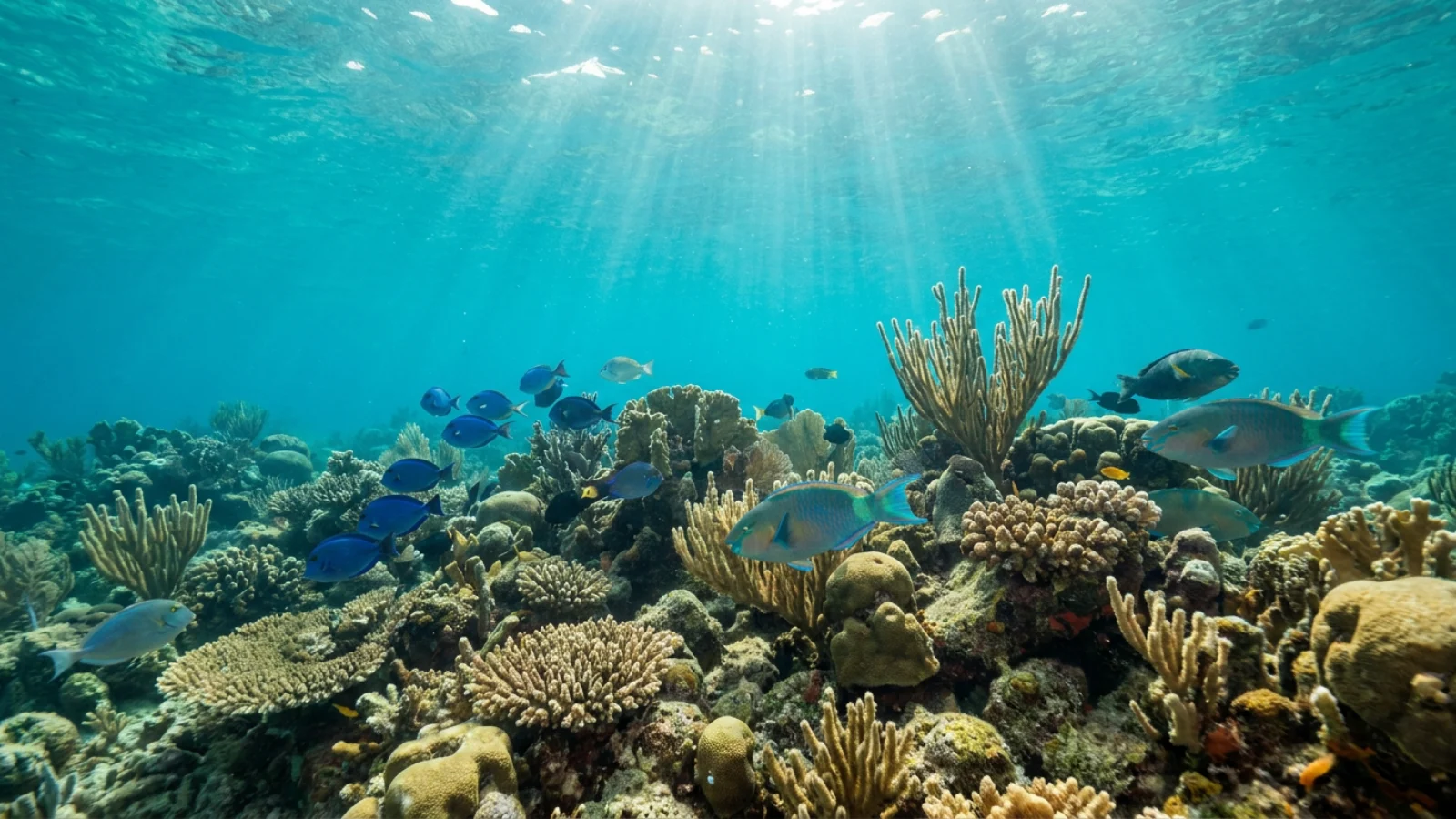
Where Bonaire’s reefs are, and why the water is so clear
The sheltered west coast and Klein Bonaire hold almost all the diving.
Almost all recreational diving happens along Bonaire’s leeward west coast and around Klein Bonaire, the small, uninhabited island roughly 800 m (half a mile) off the main town of Kralendijk. The trade winds blow from the east, so the western shore stays in the island’s wind shadow. The windward east coast is rougher and largely undived; the one east-coast area in the marine park is Lac Bay, included for its mangroves and seagrass beds rather than its diving.
The island is ringed by a fringing reef that starts almost at the waterline. Bonaire’s shelf is steep: after a short sandy terrace the bottom tips over and keeps falling, so a dive that begins in knee-deep water can be over deep water within a short swim. That geometry makes shore diving practical, and the shallow terrace is an easy place to check buoyancy and practise skills before heading down the slope.
Clear water is the other half of the appeal. A 2024 survey of the waters around Aruba, Bonaire and Curaçao, published in Marine Pollution Bulletin, found typical nutrient-poor tropical water above a density boundary at roughly 50 m, with dissolved inorganic nitrogen lowest around Bonaire. Low nutrients mean less plankton and long sightlines. The study also detected internal waves along that boundary, which helps explain the sudden pulses of cooler water divers sometimes feel on the deeper slope.
Klein Bonaire has been listed under the Ramsar Convention as a wetland of international importance since 1980 and serves as the core of the park. It has no electricity, fresh water or toilets and is reached only by water taxi or dive boat. Fishing and other extraction are banned within 200 m of its shoreline.
Corals and animals on Bonaire’s reefs
The full Caribbean set, with turtles, tarpon and plenty of parrotfish.
Bonaire’s reefs hold the classic Caribbean community. Common reef builders and dwellers include elkhorn coral (Acropora palmata), lettuce coral (Agaricia agaricites), blade fire coral (Millepora complanata), which is a hydrozoan rather than a true coral, encrusting zoanthids such as Palythoa caribaeorum, and long, coiled wire coral, a black coral relative. Divers regularly see hawksbill and green turtles, tarpon, frogfish, seahorses and large numbers of parrotfish.
- Elkhorn and staghorn coral — critically important branching builders, now grown in nurseries and replanted.
- Fire coral — stings on contact; keep hands off the reef.
- Zoanthids — colonial anemone relatives that form mats on hard surfaces.
- Wire coral — a single spiralling stalk; look for gobies and shrimps living on it.
Rules and the nature fee in 2026
Look but do not touch, pay the STINAPA fee and disinfect your gear.
As of November 2026, every visitor aged 13 and over who enters the sea on Bonaire must hold a STINAPA Nature Fee. The fee is US$40 per person per calendar year, valid from 1 January to 31 December of the year it is bought, so a ticket bought in late November expires a few weeks later. A single price has applied to divers, snorkellers and swimmers since 2023, and the same ticket covers entry to Washington Slagbaai National Park on land. Cruise passengers can buy a one-day pass. Residents of the Dutch Caribbean islands with official ID and children under 13 are exempt, although children who scuba dive are not. The fee is paid online, and the QR code must be carried with ID; rangers can fine visitors who cannot show one. The money funds both parks, including enforcement, monitoring, moorings and education.
The park’s main rule is simple: look but do not touch. Gloves are banned for divers and snorkellers. All fishing, including spearfishing, is prohibited inside the park. Boats may not anchor inside the park and must use mooring buoys or anchor beyond the 60 m depth line. Because of SCTLD, dive gear must be disinfected before the first and after the last dive of a trip, and dive sites off Washington Slagbaai National Park remain closed to scuba, though snorkelling is allowed. On Klein Bonaire, no new visitors may land after 3:00 p.m.
Seasonal rules also apply: motorboats are restricted in Lac Bay from April to August, some reef sections can close temporarily during coral spawning (usually September and October), and parts of some beaches are off-limits at night from May to December to protect nesting turtles. Rules change, so check STINAPA’s current notices before every trip.
Coral disease, water quality and the question of diving pressure
Research points to warming, disease and runoff rather than divers.
Stony coral tissue loss disease, which swept through Florida and much of the Caribbean, has reached Bonaire, prompting the site closures and gear-disinfection rules above. Bonaire’s popularity also raises an obvious question: can a small island host so much diving without wearing its reef away? A team led by Thomas Williams and Callum Roberts tested this, publishing in the Journal for Nature Conservation in 2025. Repeating a survey first carried out in 1994, they found that coral cover at their six study sites fell by 38 percent between 1994 and 2022, while diving had roughly tripled since the late 1990s. But coral declined more at sites closed to diving than at sites open to it, diver-type damage did not rise with diver numbers, and disease was more common in lightly dived areas. The authors concluded there was no detectable signal of diving pressure in the coral loss, which mirrored declines across the wider Caribbean.
That does not make careless diving harmless; a single fin kick can still snap a branch. It points to the bigger drivers: warming seas, disease and what flows off the land. A water-quality baseline published in Marine Pollution Bulletin in 2014 sampled 11 west-coast locations between 2011 and 2013 and found signs of nutrient enrichment, with nitrogen thresholds exceeded at southern and urban sites, linked to brine from the salt works and sewage outflow. Mats of benthic cyanobacteria spreading over sand and dead coral are another symptom of nutrient pressure that researchers have studied on Bonaire. See threats to coral reefs for the wider picture.
Restoring elkhorn and staghorn coral
Nurseries, gene banks and spawning-based breeding.
Like the rest of the Caribbean, Bonaire lost much of its elkhorn and staghorn coral in recent decades. Local restoration groups grow fragments in underwater nurseries and replant them on degraded reef, repeating the cycle so the nursery stock keeps expanding. It is one of the longer-running restoration efforts in the region, and visiting divers can join programmes to help. More on how this works in coral reef conservation methods.
A common worry about coral gardening is that a nursery may really be a handful of clones that could all die together in the next heatwave. A 2026 preprint that genotyped the gene banks kept by Reef Renewal Foundation Bonaire found that almost every elkhorn and staghorn lineage was a genetically distinct individual, and that the collections captured most of the genetic diversity of both species around the island. During the record 2023 Caribbean marine heatwave, a separate study found that young corals raised from collected spawn showed far less bleaching than larger colonies of the same species nearby, which is pushing restoration programmes, including Bonaire’s, to combine fragment nurseries with spawning-based breeding.
What divers should watch out for
Bonaire’s hazards are mostly small.
Fire coral is common in the shallows, and its sting causes a burning rash, which is another reason the glove ban goes hand in hand with good buoyancy. Bonaire is also a research site for the box jellyfish Alatina alata, which gathers in monthly reproductive swarms; night divers and swimmers should ask dive shops about swarm dates before going in. Shore entries can be over sharp ironshore or slippery rock, so sturdy boots help. As anywhere, a dive shop’s local briefing on the day is the best guide to conditions at a given site.
Why is Bonaire famous for diving?
Its whole coastline is a marine park, protected since 1979, and most of its 86 public dive sites can be reached from shore in calm, clear water.
How deep is Bonaire National Marine Park?
It protects the sea from the high-water line down to 60 m (about 200 ft).
Can you shore dive in Bonaire?
Yes. Most sites are marked by yellow stones at the roadside and entered directly from shore.
How much is the Bonaire nature fee?
As of 2026, the STINAPA Nature Fee is US$40 per person per calendar year for visitors aged 13 and over who enter the water. It also covers Washington Slagbaai National Park.
Is coral disease affecting Bonaire?
Yes. Stony coral tissue loss disease has led to closures at Washington Slagbaai dive sites and mandatory gear disinfection. Check current rules before diving.
When is the best time to dive Bonaire?
Year-round. The island lies south of the main hurricane belt, and the west coast is sheltered from the trade winds.
Is Bonaire good for beginner divers?
Very. Calm, shallow shore entries and an easy sandy terrace make it one of the best places to build experience.
- STINAPA Bonaire and Bonaire.com: Bonaire National Marine Park rules, Nature Fee and Klein Bonaire access
- Williams TRG, Hawkins JP, Tickell SCY, Roberts CM (2025). Scuba diving pressure is not responsible for decadal coral decline in the Bonaire National Marine Park. Journal for Nature Conservation 86.
- Slijkerman DME, León R, de Vries P (2014). A baseline water quality assessment of the coastal reefs of Bonaire. Marine Pollution Bulletin 86: 523–529.
- van Duyl FC et al. (2024). Near-shore waters bordering the coral reefs of Aruba, Bonaire and Curaçao. Marine Pollution Bulletin 209: 117297.
- Blanchette A et al. (2026, preprint). Genetic diversity of endangered Acropora corals in Bonaire: implications for restoration and gene banking.
- Miller MW et al. (2024). Assisted sexual coral recruits show high thermal tolerance to the 2023 Caribbean mass bleaching event. PLOS ONE 19: e0309719.
- Lewis C et al. (2013). Redescription of Alatina alata (Cubozoa) from Bonaire. Zootaxa 3737: 473–487.
Blane Perun has been exploring Earth’s oceans and marine life for over 25 years. Founder of TheSea.Org in 1999, underwater photographer, coral aquaculture pioneer, and explorer of 80+ countries.
About Blane Perun → More Top Ten Coral Reefs →