Do Sea Otters Mate for Life? — No — Their Pairings Last About Three Days
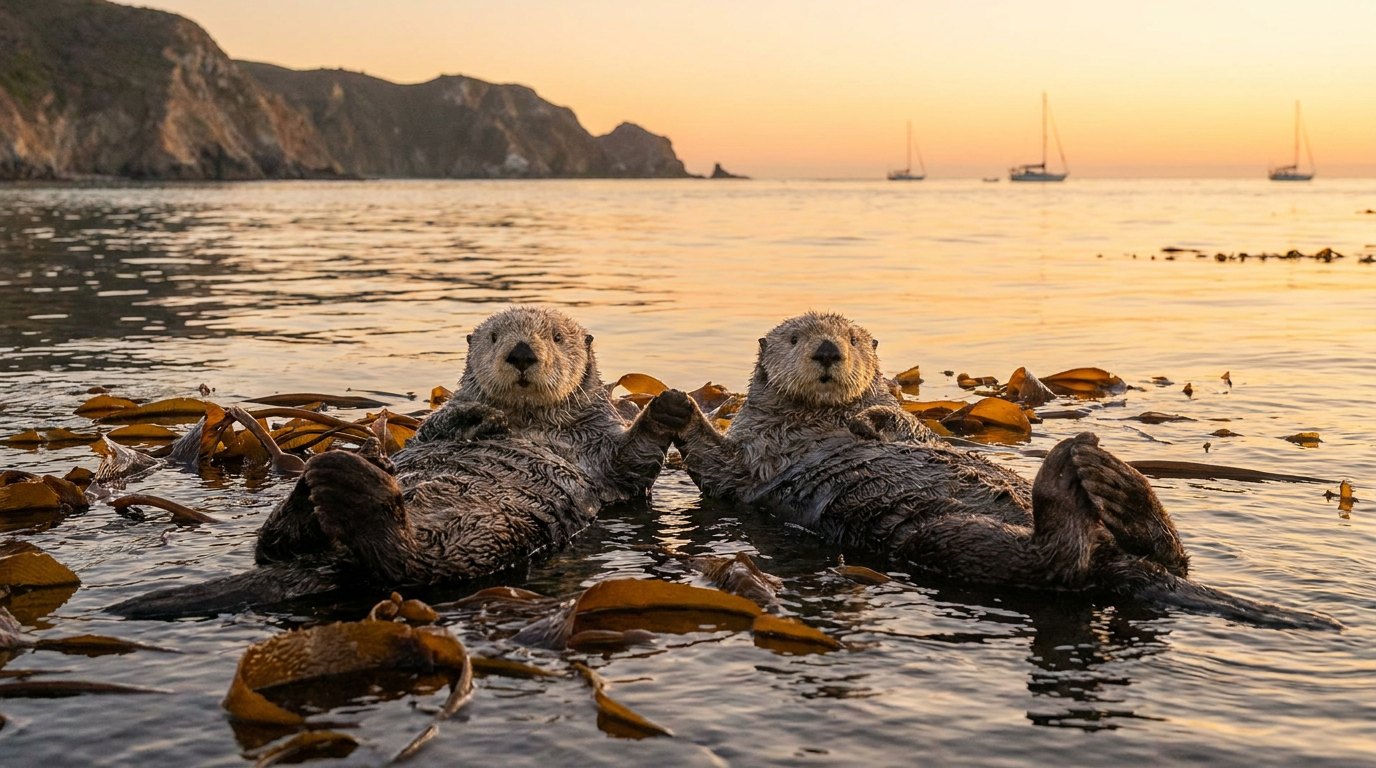
No. Sea otters are polygynous: a territorial male mates with as many females as he can, and each pair stays together only for the female’s receptive period of about three days. The female then raises her single pup alone for about six months. The viral photos of otters “holding hands” show resting otters keeping from drifting apart, not lifelong partners.
To avoid drifting apart while they sleep at the surface. Otters often wrap themselves in kelp for the same reason, and in rafts several may link up. Mothers also hold onto their pups. It is a practical habit, not a bond between mates. See sea otter social life.
Sea otters have a reputation as one of the most romantic animals in the sea. Photographs of two otters floating side by side, paws linked, have been shared millions of times, often with captions about lifelong love. The real story is less sentimental and more interesting. Sea otters do not form lasting pairs at all. A male and female stay together for a few days at most, the male plays no part in raising the young, and the behaviour that looks like affection has a practical explanation.
This page looks at the sea otter’s mating system: how males compete for females, what a mating pair actually does, why females carry the scars of it, how pregnancy and birth work, and what single motherhood costs. For the otter’s overall biology, see the sea otter profile; for life expectancy, see how long sea otters live.
Do sea otters have one partner?
No. Sea otters are polygynous: a successful male mates with several females, and a female may mate with different males in different years.
Biologists describe a mating system by asking how many partners each sex has and how long they stay together. In monogamous species, such as many seabirds, one male and one female breed together for a season or for life and usually share the work of raising young. In polygynous species, some males mate with many females while other males do not breed at all, and the female raises the young alone. Sea otters fit the second pattern closely.
The key to a male’s success is space. Adult males that can claim and hold a stretch of coast used by females get most of the matings. Females move freely between the territories of different males, and in breeding areas they outnumber adult males by an average of about five to one. Males that cannot hold a territory live elsewhere, in all-male groups, and swim through female areas looking for a receptive female when they can.
| Feature | Sea otter | Truly pair-bonded animals |
|---|---|---|
| Partners per season | Several (territorial males) | One |
| Length of pair bond | About 1–4 days | A season or a lifetime |
| Male help with young | None | Often shared |
| Everyday social life | Single-sex rafts | Pairs or family groups |
| Examples | Sea otters, most seals | Many seabirds, giant otter breeding pairs |
The comparison with other otters is revealing. The giant otter of South American rivers is unusual among the weasel family in living in cohesive family groups of about three to eight animals, built around a dominant breeding pair that stays together and is helped by older offspring. The sea otter, despite being the most social-looking of the otters when it rests in large rafts, is at the other extreme. Its social life is organised by sex, not by family.
How do male sea otters compete for females?
By holding breeding territories in places that females favour. Fighting is rare; patrolling and persistence matter more.
A long-term study in Prince William Sound, Alaska, by David Garshelis and colleagues, marked 267 sea otters between 1975 and 1984 and mapped how the population was organised. Males and females lived largely apart. Areas at the expanding front of the population were about 97% male, while breeding areas held at most about a third males. Territorial males spent the breeding period in female areas and then returned to male areas, where food was more plentiful. In the male areas, otters often rested together in groups of more than 50.
The same study found that a male’s mating success was linked to his age, his weight, the quality of his territory and how long he had held it. Males are the larger sex: they usually weigh 22–45 kg (49–99 lb), against 14–33 kg (31–73 lb) for females. Males become sexually mature at around five or six years, judging by the growth of their testes, but in Alaska males younger than about six generally could not hold territories or breed. Like many polygynous mammals, a male sea otter may have only a few good breeding years.
Territorial males patrol their boundaries to keep out rivals, but serious fights are uncommon. The prize is not the territory itself but access to the females that use it. Copulation rates in a territory track how much shelter and food it offers, which is why the best territories are in sheltered bays and kelp beds where females like to rest and forage.
How do sea otters mate?
A male courts a receptive female, they stay together for a day to a few days, mate repeatedly in the water, and then part.
When a male finds a female in oestrus, he follows her, sniffs and nuzzles her, paws at her and rolls with her at the surface. If she accepts him, the pair stay close for about one to four days and mate several times. Copulation usually takes place in the water. The male mounts the female from behind and grips her head or nose in his jaws to hold on while the pair roll and spin at the surface. The bond ends when the female leaves the male’s territory. Most males then go back to patrolling, ready for the next female.
Mating happens in every month. In Alaska it peaks in September and October, and reproduction there is more seasonal than in California. In Monterey Bay, a female whose pup has been weaned can mate again within a day or two of separating from it, so a healthy female can produce a pup roughly every year.
Why do female sea otters have scarred noses?
Because males bite the female’s nose to hold on during mating, often hard enough to draw blood and leave permanent scars.
Nose wounds are so typical of breeding females that researchers use them as field evidence. A fresh, bloody or pink nose shows that a female has mated recently. Healed scars and missing patches of skin build up over the years, and nose scarring is one of the features scientists use, alongside tooth wear and body length, to estimate the age of a wild sea otter.
The injuries are not always minor. Some females lose part of their nose, and wounds can become infected. A 1993 paper by Michelle Staedler and Marianne Riedman described fatal mating injuries in female sea otters, and later necropsies in California have confirmed that rough mating can kill females. Females are most vulnerable when they are already in poor condition, for instance late in nursing a pup.
Male sexual aggression is not always directed at otters. Between 2000 and 2002, researchers in Monterey Bay recorded 19 incidents in which at least three male southern sea otters harassed, dragged and forcibly mated with juvenile Pacific harbor seals. Carcasses of 15 juvenile seals were recovered. Some of the males guarded and mated with a seal for up to seven days after it had died. The injuries matched those found on two female sea otters that had died after similar treatment by males. The authors discussed possible explanations linked to sea otter biology and population structure, such as competition for females among males that cannot hold territories. The behaviour is rare and has been documented in only a few places, but it underlines that sea otter mating is about male competition, not romance.
How long are sea otters pregnant?
Anywhere from about 4 to 12 months, averaging around six, because the embryo can pause before it implants. Active pregnancy after implantation lasts about four months.
Sea otters, like many members of the weasel family and many seals, have delayed implantation. After fertilisation the embryo develops into a tiny ball of cells called a blastocyst and then stops growing. It floats free in the uterus for weeks or months before attaching to the uterine wall and resuming development. The total time from mating to birth therefore varies widely, while the active part of pregnancy is relatively fixed. A 2020 growth analysis of 761 southern sea otters estimated it at about 115 days, which fits the commonly cited figure of about four months.
Delayed implantation lets a female separate the timing of mating from the timing of birth. She can mate when a male is available, then hold the embryo until her own condition or the season is more favourable. Field studies of tagged females in California in the early 1980s estimated apparent gestation periods of about four to six months.
Births can happen in any month. In a 1994 study of 53 tagged females in Monterey Bay, Marianne Riedman, James Estes and colleagues found that births were most common in March and September and least common in June, but the pattern was not statistically different from uniform. Reproduction is more seasonal in Alaska. Births usually take place in the water, and the pup weighs about 1.4–2.3 kg. Twins occur in about 2% of births, but a mother cannot raise two pups and usually abandons one.
Who raises the baby sea otter?
The mother alone. Males provide nothing beyond sperm, and raising one pup is one of the most energy-hungry jobs in the animal world.
A newborn sea otter has open eyes, a few teeth and a thick, woolly coat that traps so much air the pup floats like a cork and cannot dive. The mother carries it on her chest, grooms its fur for hours to keep it waterproof, and nurses it on rich, fatty milk. When she dives to feed, she leaves the pup floating at the surface, sometimes wrapped in kelp, and it cries loudly until she returns. Pups nurse exclusively for about a month, then take more and more solid food. Most can swim, dive and groom themselves by about 14 weeks, and they begin using rocks to crack shells at about 20–24 weeks.
| Measure (Monterey Bay, 1985–1991) | Result |
|---|---|
| Tagged females followed | 53, producing 136 pups |
| Birth rate, all adult females | 0.90 pups per female per year |
| Average interval between births | 407 days (342 days for females pupping every year) |
| Average dependency of weaned pups | 166 days (range 120–280) |
| Maximum pre-weaning survival | About 60–65% |
| Weaning success by mother’s age | 40% at 3–6 years, 75% at 7–10, 100% at 11–14 |
The Monterey Bay study gives the clearest picture of how this plays out. Pups that survived to weaning depended on their mothers for an average of 166 days, but anywhere from 120 to 280 days. At best, about 60–65% of pups survived to weaning. Experience mattered: only 40% of pups born to mothers aged 3–6 years were weaned, compared with 75% for mothers aged 7–10 and all of the pups of mothers aged 11–14 in the sample.
The energetic cost is extreme. Sea otters have the highest metabolic rate for their size of any marine mammal and must eat roughly 25–38% of their body weight a day. In 2014 Nicole Thometz and colleagues measured the energy demands of young otters at different stages of development. They calculated that a mother’s daily energy needs rise 17% above her pre-pregnancy level by three weeks after birth, and keep climbing to 96% above that level by the average age of weaning. A female must nearly double her food intake while also catching food for a pup and teaching it to forage.
That burden helps explain a pattern seen in California, where some females are found dead or in very poor condition near the end of nursing, a problem biologists call end-lactation syndrome. A mother who cannot find enough food may abandon her pup, which is one reason pup survival is lower in food-poor areas. A male that helped would make a difference, but the sea otter’s mating system gives males no reason to stay.
Why do sea otters hold hands?
To keep from drifting apart while they rest or sleep at the surface. It is a practical habit, not a sign of a mated pair.
Sea otters spend much of the day resting on their backs at the surface. Currents and wind can carry a sleeping otter a long way, so otters anchor themselves. In the wild they often wrap a strand of kelp around their bodies. Resting otters also gather in single-sex groups called rafts, which typically hold 10 to 100 animals; the largest recorded raft held more than 2,000. Within a raft, otters may touch or hold on to a neighbour, and a mother keeps a firm grip on her pup.
The most famous hand-holding otters were filmed in an aquarium, where there is no kelp to wrap up in and pool currents can still push resting animals apart. Otters resting together in a raft may also hold on to one another. It is a way to stay together while sleeping, not evidence of a lifelong bond, and it says nothing about who mates with whom.
Common misconceptions about sea otter romance
“Sea otters mate for life.” They do not. Pairs last about one to four days, and successful males mate with several females.
“Hand-holding otters are couples.” Resting otters link paws to avoid drifting apart, and mothers hold their pups the same way. Since otters rest in single-sex rafts, the otter holding on to a neighbour is usually not a mate.
“Sea otter fathers help raise the pup.” The father leaves after mating. The mother does all the feeding, grooming, carrying and teaching for about four to nine months.
“Otters are all alike.” The 13 or so otter species vary. Giant otters live in families built around a stable breeding pair, while marine otters of South America have been described as either monogamous or polygamous. The sea otter’s polygyny is one end of a range. Outside the breeding season, males and females rest apart in separate rafts; see what a group of otters is called and whether sea otters hold hands while they sleep. What happens after mating, from delayed implantation to weaning, is covered in the life cycle of a sea otter.
Do sea otters mate for life?
No. Males hold territories and mate with several females. A pair stays together for only about one to four days.
Do sea otters have one partner?
No. Their mating system is polygynous: successful males mate with several females, and females raise the pups alone.
Why do sea otters hold hands?
To keep from drifting apart while they rest or sleep at the surface. In the wild they also wrap themselves in kelp for the same reason.
How long is a sea otter pregnant?
About 4 to 12 months in total, averaging around six, because of delayed implantation. Active pregnancy lasts about four months.
Do male sea otters help raise pups?
No. The mother raises the pup alone for about four to nine months; in Monterey Bay the average was 166 days.
Why do female sea otters have scarred noses?
The male bites and holds the female’s nose during mating, often drawing blood and leaving scars.
How many babies do sea otters have?
Usually one pup. Twins occur in about 2% of births, but the mother can raise only one.
When do sea otters breed?
In every month. Mating peaks in autumn in Alaska, while births in California show little or no clear season.
- Riedman, M.L., Estes, J.A., Staedler, M.M., Giles, A.A. & Carlson, D.R. (1994). Breeding patterns and reproductive success of California sea otters. Journal of Wildlife Management 58: 391–399.
- Garshelis, D.L., Johnson, A.M. & Garshelis, J.A. (1984). Social organization of sea otters in Prince William Sound, Alaska. Canadian Journal of Zoology 62: 2648–2658.
- Thometz, N.M. et al. (2014). Energetic demands of immature sea otters from birth to weaning: implications for maternal costs, reproductive behavior and population-level trends. Journal of Experimental Biology 217.
- Harris, H.S. et al. (2010). Lesions and behavior associated with forced copulation of juvenile Pacific harbor seals by southern sea otters. Aquatic Mammals 36: 331–341.
- Staedler, M. & Riedman, M. (1993). Fatal mating injuries in female sea otters. Mammalia 57.
- Nicholson, T.E. et al. (2020). Robust age estimation of southern sea otters from multiple morphometrics. Ecology and Evolution 10.
- Loughlin, T.R., Ames, J.A. & Vandevere, J.E. (1981). Annual reproduction, dependency period, and apparent gestation period in two Californian sea otters. Fishery Bulletin 79.
- Veterinary Information Network. Reproduction in the sea otter (review of breeding, gestation, pup care and maturity).
- IUCN SSC Otter Specialist Group (2020). Enhydra lutris Red List assessment: Endangered.
Blane Perun has been exploring Earth’s oceans and marine life for over 25 years. Founder of TheSea.Org in 1999, underwater photographer, coral aquaculture pioneer, and explorer of 80+ countries.
About Blane Perun → More on Sea Otter →